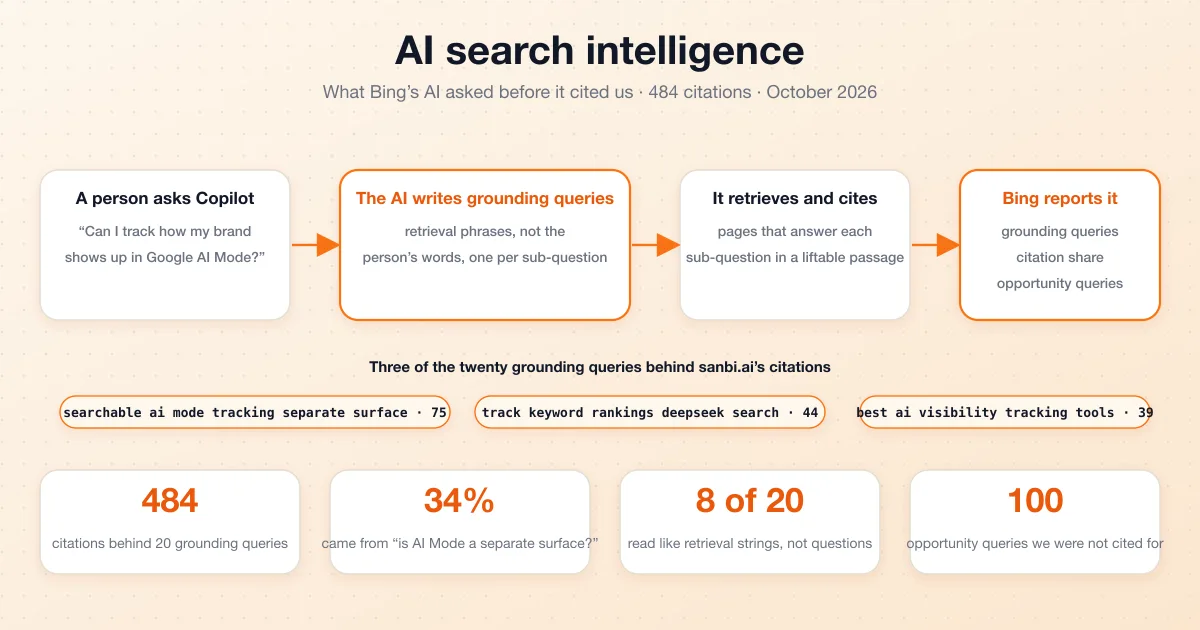
AI Search Intelligence: What Bing's AI Asked Before It Cited Us (October 2026 Data)
AI search intelligence is the data on how AI engines retrieve, ground and cite content, and since February 2026 Bing Webmaster Tools is the only place a site owner can read that retrieval step directly. For two years, AI visibility work has run on inference. You ran prompts, saw who got cited, and guessed what the engine had searched for in between. In February 2026 Bing started showing site owners that middle step: the grounding queries its AI wrote before it cited a page. In June it added intents, topics and a per-query citation share, and on 13 October 2026 it shipped a beta Topics Portfolio that lists the queries where rivals get cited and you do not.
This is AI search intelligence in the literal sense: data about how an AI engine retrieves, grounds and cites, rather than data about what people type. This article defines the discipline, explains every metric in Bing’s report, and works through our own sanbi.ai export, pulled on 18 October 2026: 20 grounding queries behind 484 citations, and 100 opportunity queries we were not cited for. The numbers are small and specific to one site. The method transfers.
AI Search Intelligence at a Glance (October 2026)
| Question | Short answer |
|---|---|
| What is it? | The data on how AI engines retrieve, ground and cite, and the work of acting on it |
| Who shows grounding queries? | Only Bing Webmaster Tools, for Copilot, Bing’s AI answers and select partners, since February 2026 |
| What did Google add? | Impressions from AI Overviews, AI Mode and Discover’s AI features in Search Console, from 3 June 2026; the announcement lists no click, CTR or query data |
| Our top grounding query | ”searchable ai mode tracking separate surface”: 75 citations, a phrase no person types |
| Our 484 citations by theme | Best-of tool lists 35%, AI Mode 34%, how-to tracking 14%, DeepSeek 10%, in-house methods 4%, ChatGPT 3% |
| Opportunity queries | 50 top queries across topics: 42 in SEO & Search Optimization, 8 in AI Tools & Platforms; 25 in the 1K-5K band |
| What the data is not | A click, a rank, a traffic forecast, or a complete log: Bing calls it a sample and asks for directional use |
What AI Search Intelligence Means, and What It Does Not
Search intelligence used to mean keyword data: what people type, how often, and who ranks. AI engines broke the link between the typed query and the retrieved page. A person asks Copilot one question; the engine rewrites it into several retrieval queries, reads the pages it finds, writes an answer and cites some of them. The person’s words never touch your page. The engine’s words do.
AI search intelligence is the data on that hidden step and the decisions you make with it. In October 2026 it comes from three places, and no single one covers the field:
| Source | What it shows | What it cannot show | Engines |
|---|---|---|---|
| Bing Webmaster Tools, AI Performance | Total citations, cited pages, a sample of grounding queries, intents, topics, citation share per grounding query, period-over-period compare, opportunity queries | Clicks, competitor domains, placement inside the answer | Microsoft Copilot, Bing’s AI answers, select partners |
| Google Search Console, generative-AI report | Impressions when your pages appear in generative AI features on Search (AI Overviews, AI Mode) and in Discover | Click, CTR or query data (none listed in the announcement), grounding phrases | |
| Prompt-based tracker | Mention, position, sentiment and cited sources per prompt and engine; competitor share of voice on the same prompts | The engine’s own retrieval phrasing; anything outside your prompt set | Whatever the tracker runs; Sanbi covers ChatGPT, Gemini, Perplexity, Claude and Google AI Mode |
Two name collisions are worth clearing up, because they dominate autocomplete for the phrase. Similarweb sells a suite called AI Search Intelligence, which combines brand visibility in AI answers with measurement of traffic from AI platforms. Microsoft sells Azure AI Search and Document Intelligence, developer services for building search over your own documents. Neither is what this article is about. Here the phrase means the discipline, and a vendor supplies one part of it at most.
What a Grounding Query Is
Bing’s February 2026 announcement defines the metric plainly: grounding queries are “the key phrases the AI used when retrieving content that was referenced in AI-generated answers”, and “the data shown represents a sample of overall citation activity.” The June update describes grounding itself as “the source material and web evidence the system uses to support and cite its response.”
The mechanism behind it is query fan-out: the engine expands a prompt into several narrower retrieval queries, runs them, and composes an answer from the results. Grounding queries are the fan-out, seen from the receiving end. That explains three things about their phrasing:
- They carry qualifiers the person implied but did not say. “searchable ai mode tracking separate surface” is an engine asking whether Google AI Mode can be tracked as its own surface. A person would have asked “can you track AI Mode?”
- They look like retrieval strings, not questions. Eight of our 20 do not start with how, what, best, free, top or Google at all: “track keyword rankings deepseek search”, “in-house seo ai brand visibility tracking methods”, “ai-driven visibility platforms content strategy”. The median grounding query is five words; the longest is eleven.
- They cross languages. “tracker de positionnement chatgpt fonctionnement” earned five citations for an English page. The engine translated the person’s French question into a retrieval query and still matched our content.
The practical consequence: you cannot optimise for grounding queries by repeating them. They are not typed, so there is no search box to match. You optimise by answering the sub-question each one encodes, in a heading and the first sentence under it, so the retrieval step finds a clean, liftable passage.
What Bing’s AI Asked Before Citing Us (October 2026)
Bing’s export carries the top ten grounding queries for each of the two topics it assigned to sanbi.ai, AI Tools & Platforms and SEO & Search Optimization, with the citations each produced in the selected period. Twenty queries, 484 citations: 352 in the tools topic, 132 in the SEO topic.
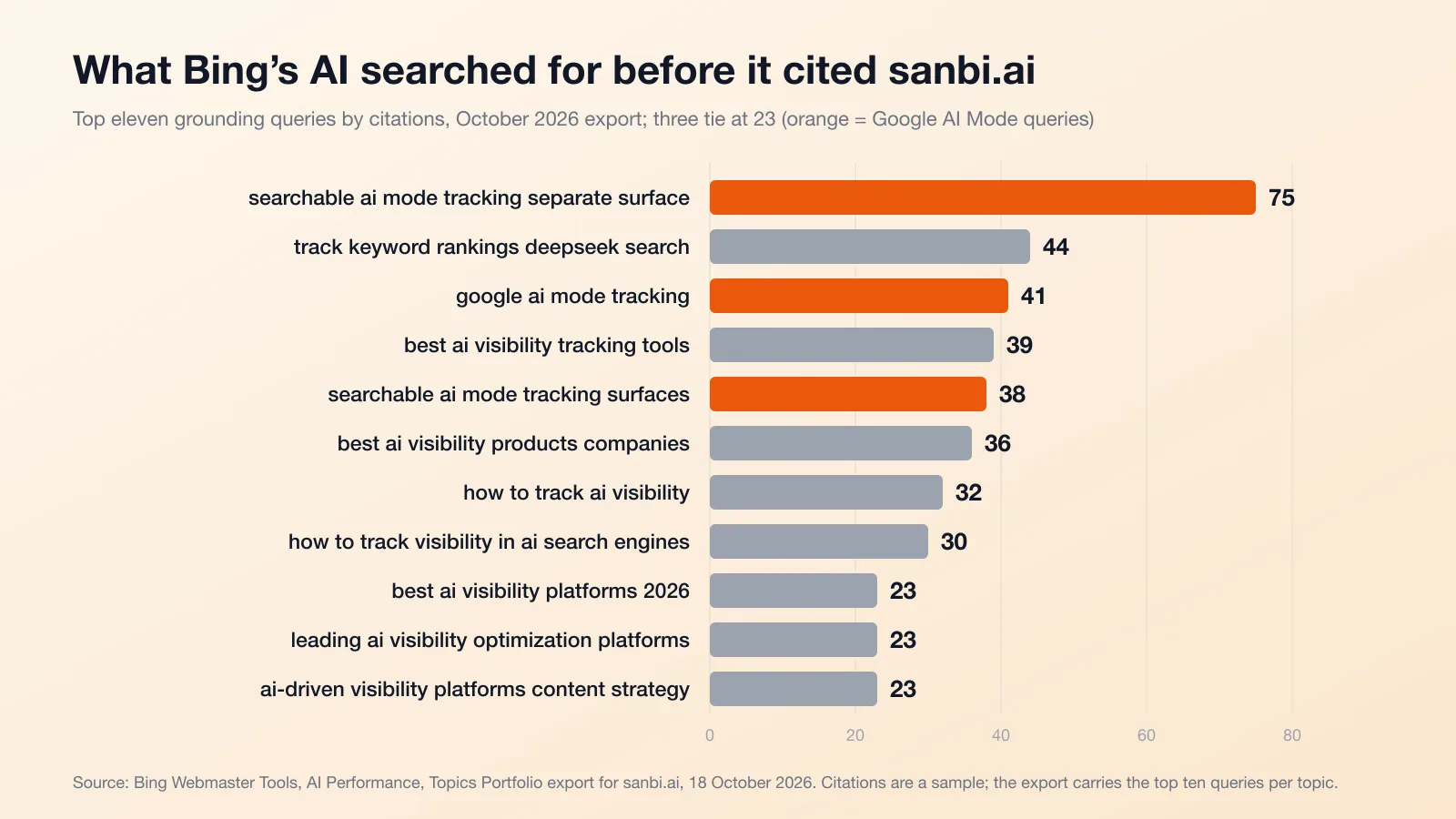
| Grounding query | Citations | Topic | Theme |
|---|---|---|---|
| searchable ai mode tracking separate surface | 75 | AI Tools & Platforms | AI Mode |
| track keyword rankings deepseek search | 44 | SEO & Search Optimization | DeepSeek |
| google ai mode tracking | 41 | AI Tools & Platforms | AI Mode |
| best ai visibility tracking tools | 39 | AI Tools & Platforms | Tool lists |
| searchable ai mode tracking surfaces | 38 | AI Tools & Platforms | AI Mode |
| best ai visibility products companies | 36 | AI Tools & Platforms | Tool lists |
| how to track ai visibility | 32 | AI Tools & Platforms | How-to |
| how to track visibility in ai search engines | 30 | SEO & Search Optimization | How-to |
| best ai visibility platforms 2026 | 23 | AI Tools & Platforms | Tool lists |
| leading ai visibility optimization platforms | 23 | AI Tools & Platforms | Tool lists |
| ai-driven visibility platforms content strategy | 23 | AI Tools & Platforms | Tool lists |
| best ai visibility platforms for content teams | 22 | AI Tools & Platforms | Tool lists |
| in-house seo ai brand visibility tracking methods | 15 | SEO & Search Optimization | In-house |
| how to track seo rankings using chatgpt | 10 | SEO & Search Optimization | ChatGPT |
| rank in google ai mode seo tips | 9 | SEO & Search Optimization | AI Mode |
| tracker de positionnement chatgpt fonctionnement | 5 | SEO & Search Optimization | ChatGPT |
| free deepseek rank tracking tools | 5 | SEO & Search Optimization | DeepSeek |
| top ai search optimization tools custom prompt sets monitor ai visibility | 5 | SEO & Search Optimization | Tool lists |
| best practices in-house seo ai visibility monitoring | 5 | SEO & Search Optimization | In-house |
| how to track ai visibility in ai search engines | 4 | SEO & Search Optimization | How-to |
Grouped by the idea the engine was chasing, the 484 citations split six ways:
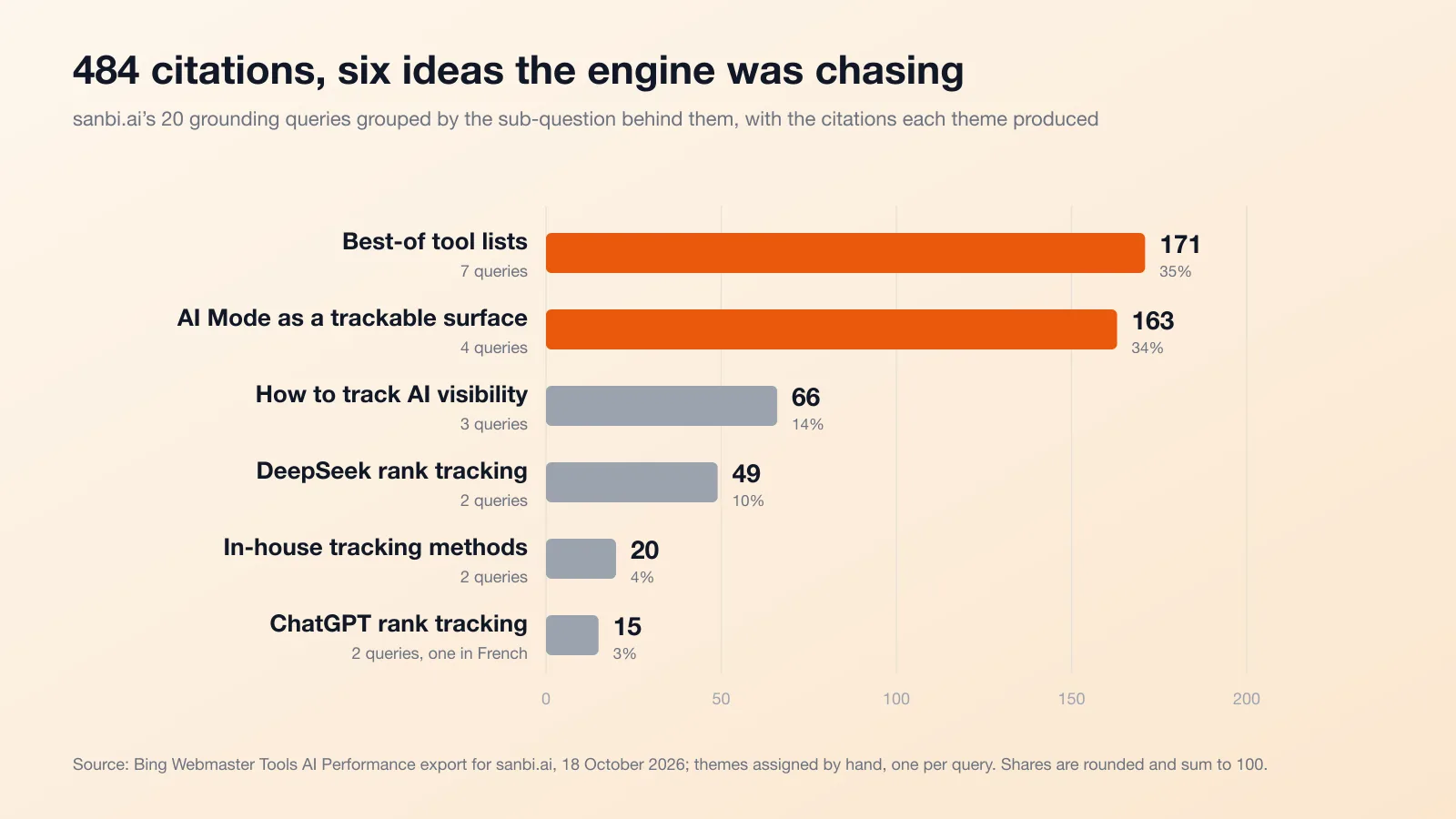
| Theme | Citations | Share | What the engine wanted |
|---|---|---|---|
| Best-of lists of visibility tools and platforms | 171 | 35% | A shortlist: “best ai visibility tracking tools”, “leading ai visibility optimization platforms”, “for content teams” |
| Google AI Mode as a trackable surface | 163 | 34% | Whether AI Mode can be tracked separately, and how to rank in it |
| How to track AI visibility | 66 | 14% | A method, engine-agnostic |
| DeepSeek rank tracking | 49 | 10% | Keyword tracking inside DeepSeek, including free tools |
| In-house tracking methods | 20 | 4% | How a team does it without an agency |
| ChatGPT rank tracking | 15 | 3% | Including one French query |
Four findings from one small export:
The biggest idea was a product distinction, not a product. The two “searchable ai mode tracking” variants alone produced 113 citations, more than any brand or tool name. The engine kept asking whether Google AI Mode is a separate, trackable surface, and cited the pages that answer that directly. We have three: how to track Google AI Mode, the AI Mode explainer and how to rank in AI Mode for the ‘seo tips’ variant. The export does not say which page was cited for which query; Bing’s page-level table does, and it is the first thing to cross-reference.
Lists win retrieval. Five of the top twelve grounding queries ask for a best-of or leading list, and our tools guide and best tools post carry comparison tables the engine can lift. Profound’s July 2026 analysis of 11.84 billion citations found about 57% go to company-operated sites; the lesson from our export is narrower and more useful: within company sites, the pages structured as lists and tables are the ones that get grounded.
A niche engine is a steady source. DeepSeek queries produced 49 citations, a tenth of the total, almost certainly through one page, the DeepSeek rank tracking guide, our only post dedicated solely to DeepSeek rank tracking; the export does not name the cited URL. Nobody at Sanbi expected a Copilot user to ask about DeepSeek keyword tracking; the grounding data says they do, or that the engine thinks they do, which for retrieval purposes is the same thing.
The qualifiers are the brief. “for content teams”, “in-house”, “custom prompt sets”, “separate surface”, “free”: each is a sub-question an engine appended on a user’s behalf. A page that already answers the base question earns more citations by answering the qualified versions in their own sections.
Reading the Opportunity Queries
The Topics Portfolio adds the half of the picture Bing never showed before: queries in your topics where “other sites appear and yours does not.” Per topic, the export lists 50 opportunity queries; across the portfolio, 50 Top Opportunity Queries, which Bing describes as “the strongest queries across your whole portfolio where other sites appear and yours does not.” Volumes are shown as ranges, which Bing says is deliberate, with the instruction to “treat the numbers as directional signals for planning, not as a precise ledger.”
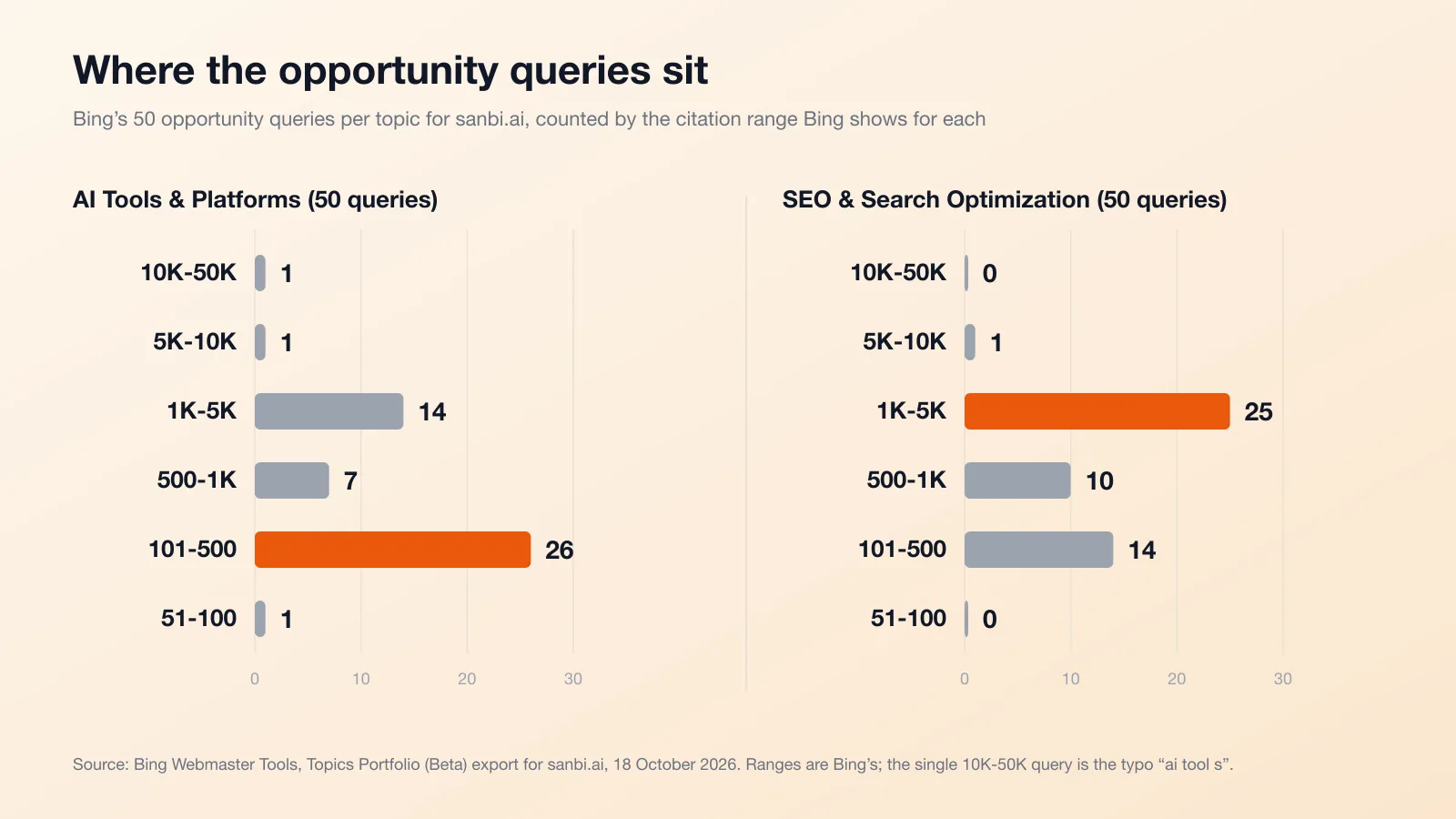
| Citation range | AI Tools & Platforms (50) | SEO & Search Optimization (50) | Top 50 across topics |
|---|---|---|---|
| 10K-50K | 1 | 0 | 1 |
| 5K-10K | 1 | 1 | 1 |
| 1K-5K | 14 | 25 | 25 |
| 500-1K | 7 | 10 | 7 |
| 101-500 | 26 | 14 | 16 |
| 51-100 | 1 | 0 | 0 |
Three things to do with the list before it becomes a content plan:
Discount the generic head. The single 10K-50K query is “ai tool s”, a typo of a two-word phrase that no visibility page should chase. “best ai for coding”, “ai tool” and “ai paraphrasing tool” sit beside it in the AI Tools & Platforms list, and “search engine” sits in the SEO & Search Optimization list. Topic classification is AI-generated and, as Bing says, “can occasionally be imperfect”; a query lands in your topic because the engine’s classifier put it there, not because it fits your business.
Separate competitor-named queries. Ten of the 50 AI Tools & Platforms opportunities name a rival visibility vendor: six Profound, two Athena, two Agent Analytics; an eleventh, “grok pricing”, names a chatbot rather than a competitor. The SEO & Search Optimization list adds two more Profound-named queries, so 12 of the 100 topic-level opportunities carry a rival’s name, and one of them made the top 50. Bing’s own example warns that branded queries can appear as opportunities. Some are worth a comparison page; most are a sign that the engine files your category under the biggest brand in it.
Route what remains to owner pages. The 50 top opportunity queries are 42 to 8 in favour of the SEO & Search Optimization topic: “seo services llm integration visibility” (5K-10K), “how to make a business appear in ai search engines”, “tools to identify ai search visibility gaps and improve visibility”, “how to get content indexed by ai search engines”, “prepare website for ai search engines geo optimization”, “choose seo agency for aeo visibility”.
We received the identical list on 16 October and routed 41 of the 50 into seven existing posts that day, as new sections and FAQs rather than new URLs:
- 19 to the agencies and services post
- 9 to the tools guide
- 6 to the LLM SEO playbook
- 3 to the GEO playbook
- 2 to the marketing toolkit: “ai tool” and the typo “ai tool s”, parked in the one general apps list we have, where a short “which of these are AI tools” section cost nothing
- 1 to the indexing section of the crawler guide
- 1 to AI search is the new SEO
Four generic queries were already covered by older pillars, one competitor query was left alone, and four were noise. Two days later the opportunity list had not changed, which is a reminder that the report moves on its own refresh cycle, not yours; Bing’s Compare view is the tool for seeing whether the work moved citation share.
Citation Share, Intents, Topics and Compare
The June 2026 update added four views to the report, all in preview, all built on what Bing calls “continuously advancing AI/ML systems and aggregated citation signals.”
- Citation Share is “the percentage of citations attributed to your site out of all citations shown across all sites for that same grounding query.” Bing calls it “an observational metric – not a ranking system or a competitive scoreboard”: it does not expose competitor domains and does not represent traffic share. It is also a different quantity from a tracker’s citation share, which is the share of an engine’s citations across a prompt set that go to one domain; the two are complementary, not interchangeable.
- Intents classify grounding queries as Informational, Commercial, Navigational, Learn and Solve, Research, Creation, Local “and more.” The topic export does not carry the intent label; read by hand, our 20 are almost all commercial-research phrasings, which fits a tools category.
- Topics “group related grounding queries into broader thematic clusters”; the Topics Portfolio builds on them with Topic Size, Sites Cited and Queries, all approximate.
- Compare overlays a previous period on the current view, for example the last 30 days against the 30 before, so you can see whether a rewrite changed citation share for a grounding query.
Read together, these are the first numbers about the retrieval layer of an AI engine that any site owner can get straight from the engine. They are still a sample, still preview, and still limited to Copilot, Bing and partners Bing does not name.
How to Run an AI Search Intelligence Loop
A workable cadence is monthly for the Bing export and weekly for the tracker. Six steps:
- Export. In Bing Webmaster Tools, open AI Performance, set a one- to three-month window, and export the grounding queries, the page-level citations and, if the Topics Portfolio tab is available, each topic’s grounding and opportunity queries. Pull the Search Console generative-AI report for the same window.
- Cluster by idea, not by word. Group grounding queries by the sub-question the engine was asking. Our 20 collapsed into six themes; expect a handful of themes rather than one per query. Count citations per theme, because the engine votes with citations, not with query counts.
- Map each theme to one owner page. Cross-reference with Bing’s page-level table so you know which URL is already winning the theme. One page per theme keeps two of your own posts from splitting the citations for one sub-question; our visibility tracking guide covers how to build the prompt set and track which pages get cited for it.
- Write to the qualifiers. For each theme, add or sharpen a section whose heading answers the qualified version of the question (“Can Google AI Mode be tracked as a separate surface?”, “How do in-house teams track AI visibility?”), with the answer in the first sentence and a table or list the engine can lift. Google’s own guidance for AI features says no special files or markup are needed; what helps is content engines can retrieve and parse.
- Triage the opportunity queries. Drop generic head terms and typos, set competitor-named queries aside for comparison pages, and route the rest to owner pages as sections and FAQs. Prefer extending a page that already earns citations in the topic over launching a new URL.
- Measure three ways. Bing Compare for citation share per grounding query; Search Console for AI Overviews and AI Mode impressions; a tracker for whether the answers in ChatGPT, Gemini, Perplexity, Claude and AI Mode actually name you, and which sources they cite instead. GA4 closes the loop with the referrals that do arrive.
What the Data Cannot Tell You
Every number above comes with Bing’s own caveats, and a few of ours.
- It is a sample. Bing says so for grounding queries in the February announcement; the Topics Portfolio figures are described as approximate and directional, and they are built on those sampled grounding queries. Our 484 citations are the top ten grounding queries per topic, not the site’s total.
- A citation is not a click, a rank or a mention. Bing counts a page displayed as a source. It does not say where in the answer, whether the answer named the brand, or whether anyone clicked. Our own earlier work on cited versus named and on machine-generated Google queries makes the same point from other angles.
- The export does not record the date window or the page. Each row carries a query and a count; the window is whatever the dashboard showed, and the cited URL lives in a separate table. Keep the two exports together.
- Topics are machine-made. “home sauna highest aeo seo ratings” was classified into our SEO topic. Thumbs-down it in the dashboard; Bing says the feedback reaches the team that tunes classification.
- It is Microsoft only. Copilot and Bing’s AI answers are one engine family among several. The retrieval behaviour you see here is a proxy for how other engines fan out, not a measurement of them.
How Sanbi Fits
Bing shows you the retrieval phrasing; Google shows you impressions; neither shows you the answer. Sanbi runs your prompt set daily across ChatGPT, Gemini, Perplexity, Claude and Google AI Mode, records whether each answer mentions you, where you rank, the sentiment and every cited source, and benchmarks competitors on the same prompts, so the themes you find in grounding data can be checked against what the answers actually say. Our own loop is the one described above: the Bing export told us AI Mode and best-of lists carry our citations, the tracker tells us whether the answers recommend us, and the most-cited domains study tells us who gets cited instead.
Run a free AI visibility audit across ChatGPT, Gemini and Claude to see your baseline. A China tracker for Qwen and DeepSeek is open for waitlist sign-ups.
The Decision Rule
If a grounding query earns citations, it is telling you which sub-question the engine already trusts you on; deepen that page before you build another. If an opportunity query sits in your topic with a real range and no brand name in it, it is telling you which sub-question the engine is answering with someone else’s page; give it a section on the page that owns the theme. Everything else in the report is context. Re-export monthly, compare, and let citation share per grounding query, not keyword rank, tell you whether it worked.
Sources
- Bing Webmaster Blog, Introducing AI Performance in Bing Webmaster Tools (Public Preview), 10 February 2026.
- Bing Blog, New AI Visibility Insights in Bing Webmaster Tools: Intents, Topics, Citation Share, Compare, 16 June 2026.
- Bing Webmaster Blog, Introducing Topics Portfolio (Beta) in AI Performance, 13 October 2026.
- Bing Webmaster Tools help, AI Performance.
- Google Search Central, Generative AI performance reports in Search Console, June 2026, and AI features and your website.
- Profound, Where do AI citations come from?, July 2026.
- Search Engine Journal, Bing rolls out AI Citation Share in Webmaster Tools, June 2026; Search Engine Roundtable, Topics Portfolio in Bing Webmaster Tools AI Performance reports, October 2026.
- Similarweb, AI search and AEO solutions, for the product-name collision.
Method notes
The data is three CSV exports from Bing Webmaster Tools for sanbi.ai, exported on 18 October 2026: the AI Tools & Platforms topic (10 grounding queries with citation counts, 50 opportunity queries with citation ranges), the SEO & Search Optimization topic (the same shape), and the cross-topic Top Opportunity Queries (50 rows with topic and range). Themes were assigned by hand to the 20 grounding queries, each query to one theme; the six theme totals sum to 484. Opportunity queries were tagged as competitor-named when they contained Profound, Athena or Agent Analytics (Grok, a chatbot, was counted as brand-named but not a competitor), and as generic when they named no visibility task. The 16 October export of the top opportunity queries was byte-identical to the 18 October one. Bing does not state the date window in the export, and page-level citations were not exported, so the pairing of grounding queries to our URLs in this article is inferred from page topics, not read from the report.
Frequently Asked Questions
AI search intelligence is the data layer about how AI engines retrieve, ground and cite content, and the practice of turning that data into content and distribution decisions. It has three sources today: Bing Webmaster Tools' AI Performance report (grounding queries, citation share, topics and opportunity queries for Copilot and Bing's AI answers), Google Search Console's generative-AI report (impressions from AI Overviews and AI Mode), and prompt-based trackers that run a fixed prompt set against engines such as ChatGPT, Gemini, Perplexity, Claude and Google AI Mode and record mentions, position, sentiment and cited sources.
A grounding query is the search phrase an AI engine writes for itself when it retrieves web evidence before answering, as opposed to the words the person typed. Bing's AI Performance report describes grounding queries as the key phrases the AI used when retrieving content that was referenced in AI-generated answers. In our October 2026 export the top one was 'searchable ai mode tracking separate surface', which no human types, yet it produced 75 citations of sanbi.ai pages.
A keyword is what a person types into a search box; a grounding query is what the AI types into its retrieval system after reading the person's prompt. The AI usually rewrites one prompt into several grounding queries, adds qualifiers the person implied ('separate surface', 'in-house', 'for content teams'), and sometimes changes language: one of our 20 grounding queries was French although the cited page is in English. You optimise for grounding queries by making sections answer those implied sub-questions directly, not by repeating the phrase.
In Bing Webmaster Tools, under AI Performance. The report has been in public preview since February 2026 and shows total citations, average cited pages, page-level citation counts, a trend line and a sample of the grounding queries that led to citations across Microsoft Copilot, Bing's AI answers and select partner experiences. Since June 2026 it also classifies grounding queries by intent and topic, shows citation share per grounding query and lets you overlay a previous period. Google Search Console does not show grounding queries.
Topics Portfolio is a beta tab in Bing's AI Performance report, announced on 13 October 2026. It groups the grounding queries where your site appears into AI-generated topics and shows, per topic, the approximate Topic Size (total citations across all sites for the topic in the selected period), Sites Cited (how many sites appear for the topic's queries) and Queries (how many distinct grounding queries the topic contains). Each topic lists your own grounding queries with citation counts and the opportunity queries where other sites appear and yours does not. The tab appears only when Bing has enough data for your site.
Opportunity queries are grounding queries in your topics where other sites are cited and yours is not. Bing lists them per topic and, as Top Opportunity Queries, across your whole portfolio, each with a citation volume shown as a range such as 1K-5K. In our export the 50 top opportunity queries split 42 to the SEO & Search Optimization topic and 8 to AI Tools & Platforms; 25 sat in the 1K-5K band and only two above it. Branded and competitor-named queries can appear in the list, so filter before you plan content.
Bing says the ranges are deliberate and asks users to treat the Topics Portfolio numbers as directional signals for planning, not as a precise ledger. Topic Size, Sites Cited and Queries are all approximate, the grounding-query data they are built on is, in Bing's words, a sample of overall citation activity, and topic classification is AI-generated and can occasionally be imperfect. Use the bands to rank opportunities against each other, not to forecast traffic.
Bing defines citation share as the percentage of citations attributed to your site out of all citations shown across all sites for that same grounding query. It is per grounding query, it is described by Bing as an observational metric rather than a ranking system or a competitive scoreboard, it does not expose competitor domains, and it does not represent traffic share. A tracker's citation share is a different metric: the share of an engine's citations across a prompt set that go to one domain.
No. Search Console's generative-AI performance report, launched on 3 June 2026 and available to all sites worldwide as of 31 August 2026, reports impressions for generative-AI features in Search, such as AI Overviews and AI Mode, and in Discover, broken down by page, country, device and date; the announcement lists no click, CTR or query data. Bing is currently the only major engine that shows site owners the retrieval phrases behind their AI citations, which is why an AI search intelligence stack needs both reports plus a prompt-based tracker for ChatGPT, Gemini, Perplexity, Claude and Google AI Mode, since Search Console reports AI Mode impressions but not whether the answer names you.
No. Bing counts a citation whenever your page is displayed as a source in an AI-generated answer, which says nothing about placement, whether anyone clicked, or whether the answer named your brand. Measure citations as reach inside answers, check GA4 for the referrals that do arrive from AI platforms, and use a tracker to see whether the answer actually recommends you. The 484 citations in our export are a sample of answer appearances, not visits.
Cluster them by the idea the AI was chasing, map each cluster to the page that should own it, and make that page answer the implied sub-question in a heading and the first sentence under it. Our 20 grounding queries fell into six themes, led by best-of lists of visibility tools (171 citations) and Google AI Mode as a separately trackable surface (163). Pages that win keep winning when they add the qualifiers the AI appended, such as 'separate surface', 'for content teams' or 'in-house', and when they carry tables and FAQs the engine can lift intact.
No. Similarweb's AI Search Intelligence is a product suite; this article uses the phrase for the discipline. Similarweb sells a product suite it calls AI Search Intelligence, combining AI brand visibility with measurement of traffic from AI platforms. The phrase also collides with Microsoft's Azure AI Search and Document Intelligence services, which are developer products for building search over your own documents. This article uses AI search intelligence as a discipline: reading how AI engines retrieve, ground and cite, from whatever source, and acting on it. Several vendors, including Sanbi, supply parts of that stack.
Microsoft Copilot, AI-generated answers in Bing and select partner AI experiences, per Bing's announcements. Bing does not name the partner experiences, so treat coverage of ChatGPT as unconfirmed; the report does not cover Gemini, Perplexity, Claude or Google's AI Overviews and AI Mode. For those, Search Console gives Google impressions and a prompt-based tracker gives per-engine mentions, position, sentiment and cited sources.
Sanbi supplies the engine side that Bing and Google do not report: it runs your prompt set daily across ChatGPT, Gemini, Perplexity, Claude and Google AI Mode, records whether you are mentioned, where you rank, the sentiment and every cited source, and benchmarks competitors on the same prompts. Pair it with Bing's grounding queries and Search Console's AI impressions, and the three sources cover retrieval phrasing, Google reach and cross-engine share of voice. The free audit covers ChatGPT, Gemini and Claude; a China tracker for Qwen and DeepSeek is open for waitlist sign-ups.