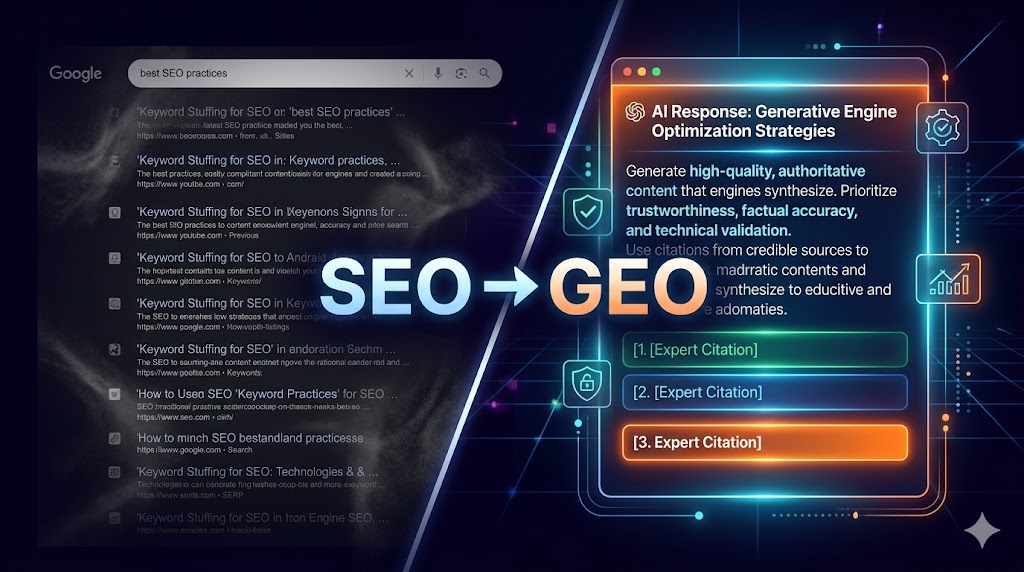
GEO Is Not SEO — The Generative Engine Optimization Playbook for 2026
There is a term for what every forward-thinking marketing team should be doing in 2026, and most of them are calling it something else — or not doing it at all.
Generative Engine Optimization is the discipline of making your brand visible inside AI-generated answers. Not on search results pages. Not in paid placements. Inside the answer that ChatGPT, Gemini, Perplexity, or Claude generates when your buyer asks it something.
The brands that understand GEO as a distinct discipline from SEO — with different content requirements, different authority signals, and different measurement systems — are the ones quietly accumulating AI search visibility while everyone else debates whether this is real. It’s real. Here’s the playbook.
1. What GEO Actually Is — and What It Isn’t
GEO defined: geo in ai search
Generative Engine Optimization is the practice of optimizing your content, structured data, and authority signals to be cited in responses generated by large language models and AI search platforms. GEO in AI terms is about citation frequency and answer quality. When a generative AI system constructs a response to a query, it draws from its training data and, for retrieval-augmented systems, live web sources. GEO is the discipline of ensuring your brand is in those sources.
GEO vs. SEO: the core distinction
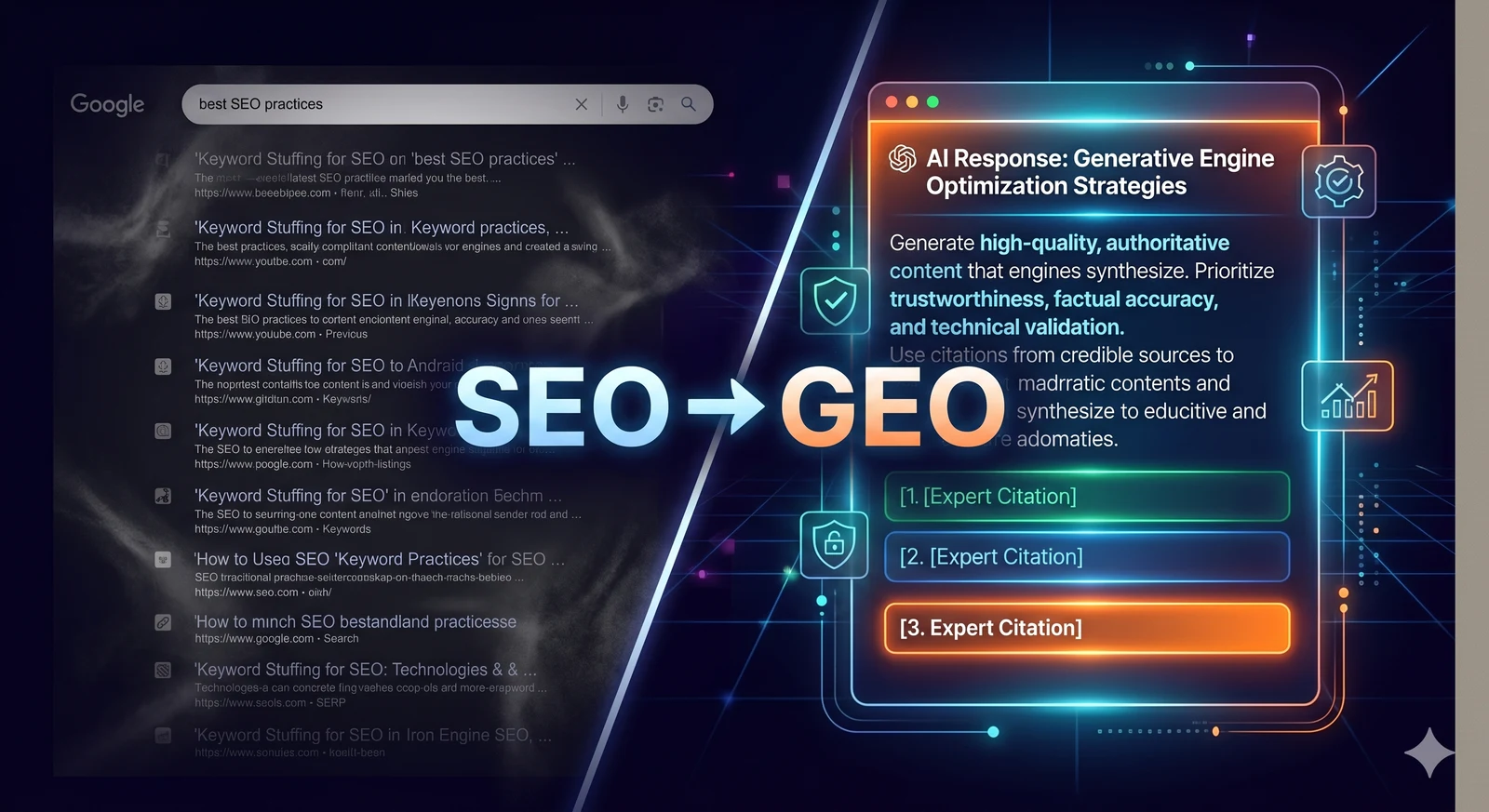
Traditional SEO is built on a ranked-list mental model. There are ten blue links; the goal is to be link #1. GEO is built on a citation mental model. There is a synthesized answer; the goal is to be one of the sources that answer was built from.
These are fundamentally different optimization problems:
| Dimension | SEO | GEO |
|---|---|---|
| Success metric | Rank position (1–10) | Citation frequency |
| Content goal | Attract click | Be the cited source |
| Authority signals | Backlinks, domain rating | Entity authority, E-E-A-T, third-party mentions |
| Measurement tool | Rank tracker | AI citation tracker |
| Time to impact | Weeks to months | Months (training data) or days (retrieval) |
Why is generative engine optimization important
Why is generative engine optimization important? Because the research journey has moved. High-intent buyers are using generative AI platforms to orient, evaluate, and shortlist before they ever visit a website. The brand that appears in the AI answer for “what’s the best solution for [problem]” has already been positioned favorably before any sales or marketing contact. The brand that doesn’t appear has been excluded before the conversation started. GEO closes that gap.
Why this matters for brands: GEO is not a future trend to prepare for. It’s the current reality of how B2B buyers and informed consumers are doing research. Generative search positioning is what determines whether your brand is in the room for those conversations.
2. The GEO Strategy Framework
How to start with generative engine optimization
How do I start with generative engine optimization? The answer is always: measure first, optimize second. The most common mistake brands make is jumping to content production before they know what their current citation baseline looks like and which queries have the largest gaps.
A GEO strategy from scratch follows this sequence:
- Baseline measurement — Run your target query set across ChatGPT, Gemini, Perplexity, and Claude. Measure citation frequency per platform, per query type, per competitor.
- Gap mapping — Identify the queries where competitors are cited and you’re not. These are your content priorities.
- Technical audit — Validate structured data, AI crawler access, schema implementation, and page speed.
- Content development — Produce or update content to close the gaps identified in step 2, using answer-first structure and citable statements.
- Authority building — Secure third-party mentions on AI-cited sources in your category.
- Iteration — Measure monthly, identify new gaps, repeat.
What’s the best approach for implementing GEO in 2026
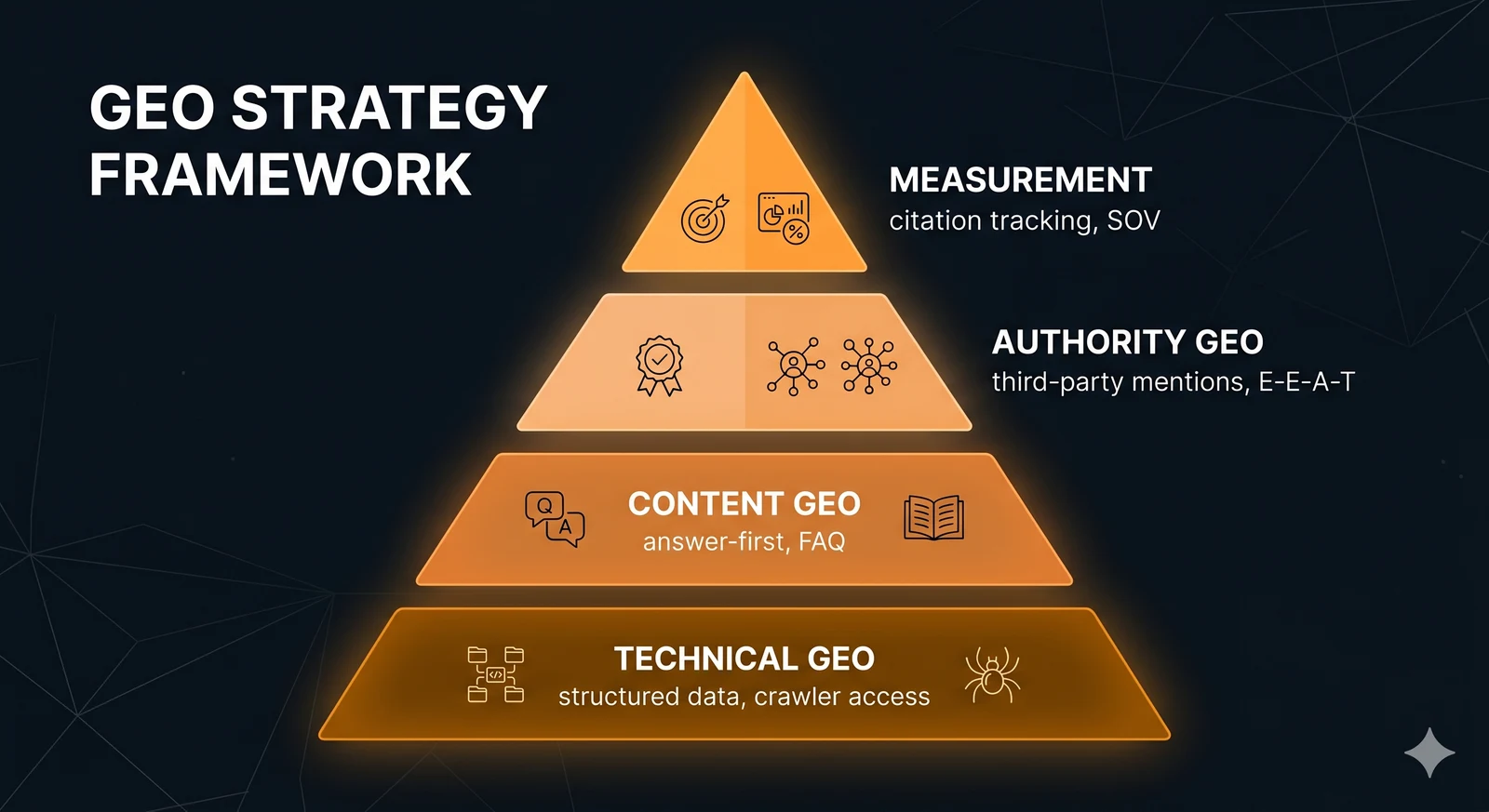
What’s the best approach for implementing GEO in 2025 and 2026? The approach that consistently produces results has three layers working simultaneously:
Layer 1 — Technical GEO: Structured data implementation (FAQ, HowTo, Organization, Product schema), AI crawler access configuration, llms.txt, and canonical URL strategy. This is the prerequisite layer — without it, your content is underindexed by AI retrieval systems regardless of quality.
Layer 2 — Content GEO: Answer-first content architecture, question-format headings, specific and quotable claims, comparison and “vs” content for competitive queries, and deep FAQ sections that address the long-tail variants of your primary queries.
Layer 3 — Authority GEO: Third-party mentions on AI-cited sources (Reddit, industry forums, review platforms, media publications), author E-E-A-T signals, and entity establishment (Wikipedia, Wikidata, knowledge graph presence).
How to build a GEO strategy from scratch for a consulting company
A consulting company GEO optimization guide follows the same three-layer framework but with category-specific adjustments. For consulting brands, the highest-value GEO content is typically: methodology explainers (how you approach the problem, step by step), client outcome content (anonymized case frameworks, not named case studies), thought leadership in AI-cited industry publications, and comparison content that positions your methodology against alternatives. The query types that matter most: “best consulting approach for [problem],” “how to solve [business challenge],” and “what should I look for in a [category] consultant.”
Why this matters for brands: GEO strategy is not a campaign — it’s a program. The brands winning AI citations in 2027 are the ones that started building systematic GEO programs in 2025 and 2026, not the ones that ran a one-time optimization sprint.
3. GEO Tools, Software, and Platforms
Best GEO tools in 2026
The best GEO tools in 2026 share five characteristics: multi-engine coverage (not just one AI platform), competitive benchmarking, historical trend tracking, content gap analysis, and integration with analytics and content workflows. GEO optimization tools that only track one engine give an incomplete picture — a brand that appears to be performing well on ChatGPT may have significant gaps on Gemini or Claude that only cross-engine tracking would reveal.
Recommended generative engine optimization software
When evaluating recommended generative engine optimization software, the key questions are:
- Which engines does it track? (Minimum: ChatGPT, Gemini, Perplexity, Claude)
- How often does it run queries? (Daily or weekly is ideal; monthly is the minimum)
- Does it track competitive citation rates? (Not just your own)
- Does it surface content gaps? (Not just report current state)
- What does the reporting interface look like? (Can non-technical stakeholders use it?)
Technical GEO tools
Technical GEO tools audit the infrastructure layer of your GEO readiness: structured data validation (Schema.org markup), AI crawler access (can GPTBot, PerplexityBot, and ClaudeBot access your site?), page performance, and URL structure. Technical GEO tools are distinct from citation-tracking GEO platforms — they evaluate what you have, not how you’re performing. Both are necessary: technical tools identify implementation gaps, tracking tools measure citation outcomes.
GEO tools for product marketing teams
The best GEO tools for product marketing teams focus on the queries most relevant to product-level decisions: feature comparison queries, use-case queries, and competitor comparison queries. Product-level GEO tracking identifies which product features are cited in AI answers, which competitor products are positioned favorably in head-to-head AI responses, and which use cases your product is associated with (or incorrectly excluded from) in AI-generated content.
Best GEO tools for multi-language AI visibility
For brands operating across multiple markets, the best GEO tools for multi-language AI visibility run query sets in each target language and track citation frequency separately by language. English-language GEO performance is not predictive of performance in Spanish, French, German, or Mandarin AI contexts — the training data, authoritative sources, and citation signals differ significantly by language. Multi-language GEO requires localized content AND localized tracking.
Why this matters for brands: The affordable generative engine optimization solutions with real-time analytics are the platforms that make multi-engine, multi-language GEO tracking accessible to mid-market teams — not just enterprise brands with dedicated AI visibility teams. The GEO platform market is still maturing; comparing platforms on real-time data freshness and multi-engine coverage is the most important evaluation dimension.
4. GEO by Industry and Use Case
GEO priorities shift by region as well as by industry. For bilingual and non-English markets, see AI search in the UAE and Middle East.
Consumer electronics AI search optimization guide
Consumer electronics brands face a high-competition GEO environment. Buyers ask AI platforms to compare products, recommend features for specific use cases, and validate purchase decisions. The consumer electronics AI search optimization approach: (1) Own product comparison content — “best [product type] for [use case]” is the highest-value query cluster; (2) Build presence on AI-cited review sources (RTINGS, The Wirecutter equivalent for your category, Reddit communities); (3) Implement detailed Product schema with specifications, pricing, and reviews; (4) Create use-case-specific content that maps your product’s features to specific buyer problems.
Generative engine optimization for manufacturing
Manufacturing GEO has different requirements than consumer GEO. Manufacturing buyers use AI to research suppliers, verify certifications, evaluate technical capabilities, and compare specifications. Generative engine optimization for manufacturing focuses on: technical documentation (spec sheets, capability statements, tolerance tables) that AI retrieval systems can parse; certification and compliance content; case framework content (anonymized capability demonstrations); and presence in industry databases and directories that AI systems treat as authoritative sources for manufacturing queries.
GEO for multi-language and APAC markets
Multi-language GEO requires more than content translation. It requires building the citation signals that matter in each language-specific AI context. For APAC markets, this often means building presence in Zhihu (for Chinese queries), local industry media, and regional professional networks alongside translated content. Geo ai search optimization for international brands is one of the least developed areas of GEO practice — which means it’s also one of the highest competitive opportunity areas.
Does GEO work for all types of websites
Does generative engine optimization work for all types of websites? Yes — but with different tactics for different contexts. E-commerce, B2B SaaS, local services, publishing, professional services, and manufacturing all benefit from GEO. The query types that drive AI citations differ by category, and the content formats that AI systems cite differ by use case. A professional services GEO strategy looks nothing like an e-commerce GEO strategy in execution, even though the underlying principles (answer-first content, structured data, authority signals) are the same.
Why this matters for brands: GEO is not a generic playbook that works the same for every brand. Geo brands that win AI citations have done the work of mapping their specific buyer’s research journey through AI and building content that answers every question along that journey.
5. Measuring GEO Performance
Tools for monitoring GEO performance
Tools for monitoring GEO performance are the core infrastructure of any serious GEO program. At minimum, a GEO monitoring stack includes:
- AI citation tracker — Runs a defined query set across multiple AI engines and tracks citation frequency over time
- Competitive benchmarking tool — Compares your citation rates against defined competitors for the same queries
- Sentiment analyzer — Tracks how AI platforms characterize your brand in answer text
- Traffic attribution — GA4 configuration to capture AI platform referral traffic
Profound vs. peec.ai for GEO
Profound vs. peec AI for GEO: Profound’s strength is prompt volume analysis — understanding how much AI conversation is happening around topics in your category. peec.ai’s strength is Perplexity-specific citation tracking. For a complete GEO measurement program that covers ChatGPT, Gemini, Perplexity, and Claude in one workflow, a multi-engine platform like Sanbi.ai provides broader coverage than either single-focused tool. The best approach is to evaluate your primary AI engine priority first — if Perplexity is your primary target, peec.ai has depth there; if you need cross-engine coverage, a full-spectrum platform is more efficient.
Generative engine optimization testing
Generative engine optimization testing is the practice of validating content changes by running queries before and after publication to measure citation impact. An effective GEO testing workflow: (1) Identify a target query where you’re not currently cited; (2) Publish content specifically designed to be cited for that query; (3) Run the query on a weekly cadence after publication; (4) Measure when and whether citation appears. GEO testing gives content teams a feedback loop that connects content production directly to citation outcomes.
Generative engine optimization monitoring
Ongoing generative engine optimization monitoring is what converts GEO from a one-time audit to a compound competitive advantage. A citation footprint that is measured and grown systematically becomes harder for competitors to displace — both because of the accumulating content volume and because early citations tend to reinforce themselves through training data feedback loops. Brands that implement GEO monitoring in 2026 will have historical baselines and trend data that late-movers cannot replicate.
Why this matters for brands: GEO measurement is not optional. Without tools for monitoring GEO performance, you’re optimizing blind — publishing content without knowing whether it’s moving citation metrics. The affordable generative engine optimization solutions with real-time analytics that make this measurement accessible to non-enterprise brands are what make GEO a practical discipline rather than an enterprise-only capability.
6. Building Your GEO Program
Generative engine optimization courses and training materials are proliferating in 2026 — but most focus on one layer of the GEO stack while ignoring the others. A complete GEO program requires:
- Measurement infrastructure — AI citation tracking across ChatGPT, Gemini, Perplexity, and Claude, with competitive benchmarking and historical trending
- Technical foundation — Structured data implementation, AI crawler access, llms.txt, page performance optimization
- Content program — Systematic content development against identified citation gaps, using answer-first architecture and question-format headings
- Authority program — Ongoing third-party mention building on AI-cited sources in your category
- Iteration cadence — Monthly measurement, quarterly gap analysis, ongoing content publishing
The brands winning GEO in 2027 are the ones who started all five layers in 2025 or 2026 — not the ones who published one well-optimized article and waited.
Your Next Step
Generative engine optimization is the discipline that determines whether your brand appears in AI-generated answers for the queries your buyers are asking right now. The gap between brands that are investing in GEO and those that aren’t is widening every month — and it compounds.
Run a free AI visibility audit at sanbi.ai to see your current GEO baseline across ChatGPT, Gemini, Perplexity, and Claude — citation frequency, share of voice, sentiment, and the specific content gaps you need to close.
Sanbi.ai monitors your brand’s AI visibility daily across ChatGPT, Gemini, Perplexity, and Claude — tracking visibility scores, sentiment, citations, agent accessibility, and competitor movements so you always know where you stand in the agent-first web.
Frequently Asked Questions
Generative Engine Optimization (GEO) is the practice of optimizing your content and brand presence to be cited in AI-generated responses from generative AI systems — ChatGPT, Gemini, Perplexity, Claude, and Google AI Overviews. Traditional SEO optimizes for a ranked position on a results page. GEO optimizes to be the source a generative AI uses when constructing an answer. The distinction matters because the ranking factors, content formats, authority signals, and measurement systems are entirely different. GEO in AI terms is about citation frequency and answer quality, not keyword position and click-through rate.
Generative engine optimization is important because AI-generated answers are now the first thing a growing share of buyers sees when researching a product or service. For informational and commercial queries, AI Overviews appear above all organic results on Google. Perplexity delivers synthesized answers before showing links. ChatGPT and Claude are used by millions of enterprise buyers for vendor research. A brand that isn't visible in these AI-generated answers is invisible to buyers at the top of the funnel — before they've even seen your website. GEO is the discipline that closes that gap.
The best GEO tools in 2026 track citation frequency across multiple generative AI engines simultaneously, measure competitive share of voice, surface content gaps, and provide structured data auditing. The criteria for evaluating GEO tools: multi-engine coverage (ChatGPT, Gemini, Perplexity, Claude, AI Overviews), query library depth, competitor benchmarking capability, historical trend tracking, and integration with existing analytics tools. Sanbi.ai is purpose-built for AI visibility tracking across the full GEO landscape. Other platforms in the space include Profound, peec.ai, and Scrunch AI, each with specific strengths in the GEO toolset.
GEO best practices in 2026 center on four pillars: (1) Technical — implement structured data (FAQ, HowTo, Organization, Product schema), ensure AI crawler access, and optimize page speed; (2) Content — use answer-first structure, question-format headings, specific citable claims, and comparison content; (3) Authority — build third-party mentions on AI-cited sources, establish author E-E-A-T signals, and secure industry media placements; (4) Measurement — run a defined query set across multiple AI engines on a regular cadence and track citation frequency, share of voice, and sentiment. Generative engine optimization best practices are not static — the AI search landscape evolves monthly, and GEO programs that don't iterate lose ground.
Building a GEO strategy from scratch requires four steps: First, define your target query set — the questions your buyers ask AI platforms during research (typically 50–300 queries across problem-first, category, and competitor-comparison types). Second, run a baseline audit — measure your current citation frequency across ChatGPT, Gemini, Perplexity, and Claude. Third, identify your content gaps — the queries where competitors are cited and you're not. Fourth, execute against those gaps with answer-first content, structured data, and authority-building, then measure the impact monthly. The 'how to build a GEO strategy from scratch' question always has the same answer: start with measurement, build from gaps.
GEO works for any website or brand that wants to appear in AI-generated answers — but the specific tactics vary by context. For B2B SaaS, GEO focuses on category-level queries and vendor comparison content. For e-commerce, GEO targets product recommendation and comparison queries. For local businesses, GEO targets location-specific queries and requires LocalBusiness schema. For publishers and media, GEO optimizes for information queries where AI platforms cite authoritative sources. The underlying principles — answer-first content, structured data, authority signals — apply universally. The query types, content formats, and authority signals that matter most vary by category.
GEO (Generative Engine Optimization) and AEO (Answer Engine Optimization) are closely related disciplines with overlapping tactics. AEO is the broader category — optimizing to appear in AI-generated answers across all answer-delivery systems, including voice assistants and AI Overviews. GEO specifically refers to generative AI systems: ChatGPT, Gemini, Perplexity, Claude, and similar large language model-powered platforms. In practice, most GEO programs are also AEO programs. The geo ai search optimization vs. AEO distinction is largely semantic — the measurement framework, content tactics, and authority signals are the same. Different practitioners and platforms use the terms differently.
The best GEO agencies for AI search optimization in 2026 are those that have built proprietary query libraries for specific industries, can demonstrate measurable citation improvement for past clients, and track performance across multiple AI engines (not just one). When evaluating GEO agencies, ask for their methodology for content gap identification, their approach to structured data implementation, their measurement framework, and whether they can show historical citation frequency trends from past client work. Top generative engine optimization geo agencies in 2025 and 2026 typically combine technical SEO expertise with content strategy and AI platform-specific knowledge.
GEO performance is measured through the same framework as AEO: citation frequency (how often your brand appears in AI answers for your tracked query set), share of voice (your citation rate vs. competitors), citation position (how prominently you appear within individual answers), answer sentiment (how generative AI describes your brand), and referral traffic from AI platforms (GA4 data from ChatGPT, Perplexity, and others). Tools for monitoring GEO performance run your query set across multiple AI engines on a defined cadence and report on these dimensions. Monthly measurement is the minimum cadence; weekly is optimal for brands actively publishing content to close citation gaps.
The best GEO tools for multi-language AI visibility track citation performance across languages, not just English queries. This is particularly important for brands operating in multiple markets — a brand that is well-cited in English AI responses may be nearly invisible in Spanish, French, German, or Chinese AI responses, because different language versions of AI training data and retrieval systems reflect different content corpora. Multi-language GEO requires both localized content in each target language and tracking of citation frequency for language-specific query sets. Few GEO tools handle multi-language tracking natively; most are English-primary.
Technical GEO refers to the infrastructure-level optimizations that make your content accessible and parseable by AI engines — analogous to technical SEO for traditional search. Technical GEO includes: structured data implementation (JSON-LD for Organization, FAQ, HowTo, Product, and Article schema), AI crawler access (ensuring GPTBot, Baiduspider, PerplexityBot, and other AI crawlers can index your site), llms.txt file implementation, mobile performance optimization, page load speed, canonical URL strategy, and correct robots.txt configuration. Technical GEO tools audit these signals and flag implementation gaps. This is the foundation layer of any GEO program — without it, even excellent content will be underindexed by AI retrieval systems.
Generative engine optimization for manufacturing and consumer electronics has specific requirements. Manufacturing buyers use AI platforms to research suppliers, specifications, and certifications — making technical documentation, spec sheets, and capability statements the highest-priority GEO content. Consumer electronics AI search optimization focuses on product comparison queries, feature benefit content, and review-site presence (since AI platforms cite consumer review sources heavily for product queries). Both sectors benefit from Product schema, detailed technical FAQ content, and presence in the industry media sources that AI platforms treat as authoritative. The consumer electronics AI search optimization guide approach involves mapping every product-comparison query buyers ask and ensuring your brand appears in the AI answer for each.
GEO ranking — your brand's position and citation frequency inside AI-generated answers — improves through a combination of content structure, authority signals, and technical readiness. To optimize your website for AI search: (1) restructure key pages to answer specific buyer questions in the first paragraph rather than burying the answer; (2) add FAQ schema to every page that addresses a common category question; (3) earn coverage on the high-authority domains that AI models cite most (industry publications, review platforms, analyst roundups); (4) publish llms.txt to surface your best content directly to AI crawlers; (5) verify your site is accessible to AI bots (GPTBot, ClaudeBot, PerplexityBot). GEO ranking is not a one-time optimization — it requires continuous measurement to know which changes are moving your citation frequency and which are not.
The best AI tools for generative engine optimization in 2026 address three distinct needs: content optimization, citation monitoring, and competitive benchmarking. For content optimization, GEO AI tools help you audit existing pages for answer-first structure, FAQ coverage, and schema completeness. For citation monitoring, the best generative engine optimization tools run your category's core prompts against live AI model APIs and track whether your brand is cited — across ChatGPT, Gemini, Perplexity, Claude, and DeepSeek. For competitive benchmarking, a GEO tool should show you not just your own citation frequency but your share of voice against named competitors. Platforms like Sanbi.ai combine all three functions: content audits, multi-model citation tracking, and competitive GEO benchmarking in a single generative engine optimization tool, giving teams one workflow from measurement to action.
Traditional SEO ranking measures where your pages appear in Google's organic search results for a given keyword. GEO ranking measures how often, how prominently, and how accurately your brand appears inside AI-generated answers across ChatGPT, Gemini, Perplexity, Claude, and other AI platforms. The core difference: SEO ranking is about link position in a list; GEO ranking is about whether you're cited in the answer narrative at all. In 2026, both matter — but they require different optimization strategies. SEO prioritizes keyword density, backlink authority, and page speed. GEO prioritizes answer-first content format, citable factual claims, FAQ schema, and presence on the third-party sources that AI models treat as authoritative. Teams should run both in parallel and measure each independently, since a page can rank on page 1 of Google while being invisible in AI answers, or vice versa.
Write for the fan-out. Identify the sub-questions a buyer's prompt implies, answer each in a clearly headed section with the direct answer in the first sentence, and support it with specific numbers, comparisons and tables the model can lift. Keep the page server-rendered and fast, add FAQ, Product or Organization schema as appropriate, and make sure the same facts appear consistently across your site and third-party listings. Then earn presence on the review sites, roundups and community threads AI Mode already cites for your category, because most answers are assembled from more than one source.