Your Website Is Invisible to AI Models — The LLM SEO Playbook to Get Cited Inside Large Language Models
There is a version of your brand that lives inside every major AI model. ChatGPT has a version. Claude has a version. Gemini has a version. Perplexity has a version.
In some of those versions, your brand is accurately described, well-positioned, and regularly cited when buyers ask about your category. In others, your brand barely exists — mentioned rarely, described vaguely, or attributed with information that’s out of date or simply wrong.
Most brands have no idea which version is which. That’s the LLM SEO problem — and this is the playbook to fix it.
Which domains actually get cited in your category? See the most-cited domains in LLMs, by industry and by engine for the B2B SaaS, fintech, healthcare, local and ecommerce breakdowns.
1. What LLM SEO Is — and Why It’s Not the Same as GEO or AEO
LLM SEO defined
LLM SEO (Large Language Model SEO) is the discipline of optimizing your brand’s presence, accuracy, and citation frequency inside the knowledge and retrieval systems of large language models. It’s related to GEO and AEO — all three are concerned with AI search visibility — but LLM SEO focuses specifically on the model-level: what LLMs know about your brand, how they represent it, and how often they cite it.
The distinction that matters: GEO and AEO typically focus on optimizing content to appear in AI-generated answers at the surface level (the response the user sees). LLM SEO goes deeper — it’s concerned with how the model’s underlying knowledge represents your brand, not just whether a retrieval system finds your content for a given query.
Why LLM visibility matters independently of SEO
A brand can have excellent traditional SEO — ranking #1 for its primary keywords, strong domain authority, extensive backlink profile — and still have low LLM visibility. This happens because:
- LLM training data is not the same as Google’s index
- LLM authority signals are not identical to PageRank-style link signals
- LLM citation behavior is influenced by breadth of reference across diverse sources, not just domain authority of a few high-DA links
- LLM knowledge can be months out of date compared to live web content
Brand visibility in LLMs requires its own optimization program — separate from, but complementary to, traditional SEO.
LLM visbility vs. LLM visibility: the misspelling that reveals the gap
The most commonly misspelled search query in this space — “llm visbility” — appears in keyword research data with meaningful volume. It signals that practitioners are searching for this concept before the vocabulary has fully standardized. That vocabulary gap is a proxy for how early this discipline is. Most brands are not yet running LLM SEO programs. The competitive advantage for early movers is significant.
Why this matters for brands: LLM brand visibility is now a primary determinant of whether a brand appears on AI-generated vendor shortlists. The version of your brand that lives inside AI models is shaping buyer perceptions before a single marketing touchpoint.
2. How LLMs Decide What to Cite — and What You Can Influence
Training data vs. retrieval: the two citation pathways
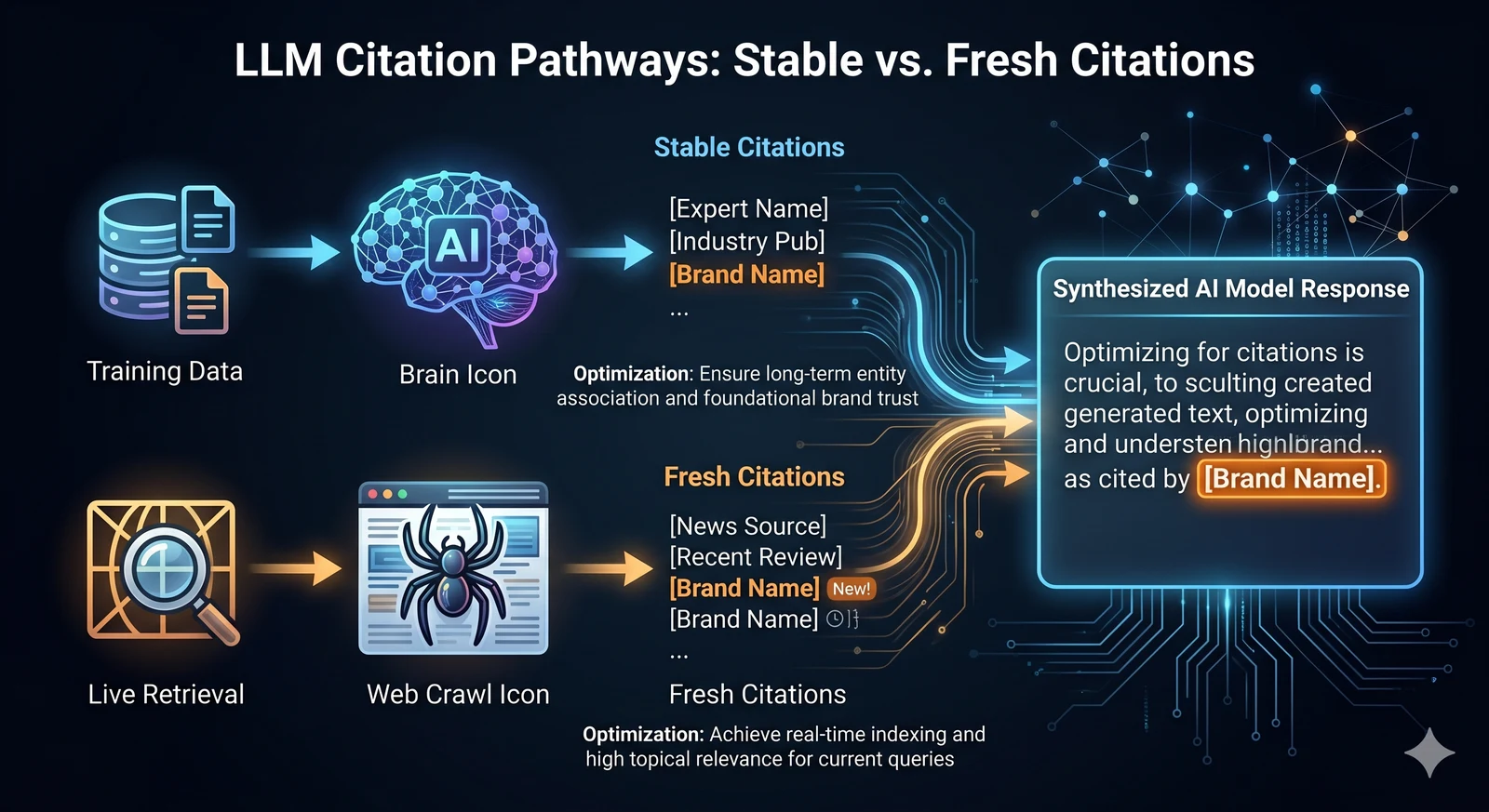
LLM citations come from two distinct pathways, and optimizing for each requires different tactics:
Training data citations: The model learned about your brand from its training corpus. These citations are based on what the model “knows” — which correlates with how broadly and consistently your brand is mentioned across the sources that fed the model’s training. Training data citations are stable and hard to change quickly, but respond to long-term authority-building across diverse sources.
Retrieval-augmented citations: The model fetched live web content to answer a specific query (used by ChatGPT with browsing, Perplexity, Copilot, and Gemini in some configurations). These citations are based on what the model found when it searched, which correlates with current content quality, domain authority, and crawlability. Retrieval citations respond faster to content changes — a page published this week can appear in retrieval-augmented citations within days.
Most LLM interactions involve a mix of both pathways. A complete LLM SEO strategy optimizes for both.
What signals drive LLM citation selection
The signals LLMs use to select citation sources — across both training and retrieval pathways — include:
- Breadth of reference: How many independent, authoritative sources mention your brand and its claims? LLMs weight consensus across sources heavily.
- Entity accuracy: Is your brand’s entity data (name, description, products, positioning) consistent and accurate across sources?
- Content specificity: How directly and specifically does your content answer the query? Vague, generic content is rarely cited.
- Domain authority: For retrieval-augmented citations, domain authority remains a signal — but it’s one of many, not the primary one.
- Content freshness: For retrieval-augmented citations, recently updated content has an advantage for time-sensitive queries.
- Structural parsability: Is your content formatted in a way that LLMs can extract citable passages? Direct answers, lists, and tables are parsed more reliably than long prose paragraphs.
What you cannot directly control — and what you can
You cannot directly edit an LLM’s training data. You cannot force a model to cite your brand. What you can control:
- The content on your own site (structure, format, specificity, freshness)
- Your brand’s presence in third-party sources (media, forums, review platforms, directories)
- Your structured data implementation (how AI systems parse your entity data)
- The accuracy and consistency of your brand’s entity across all sources
- The query surfaces where your content appears (by building content for specific query types)
Why this matters for brands: LLM visibility optimization is not a technical trick — it’s a systematic program of content development and authority building targeted specifically at the signals LLMs use to select citation sources.
3. LLM SEO Tracking Tools and Software
Why you need a dedicated LLM rank tracker
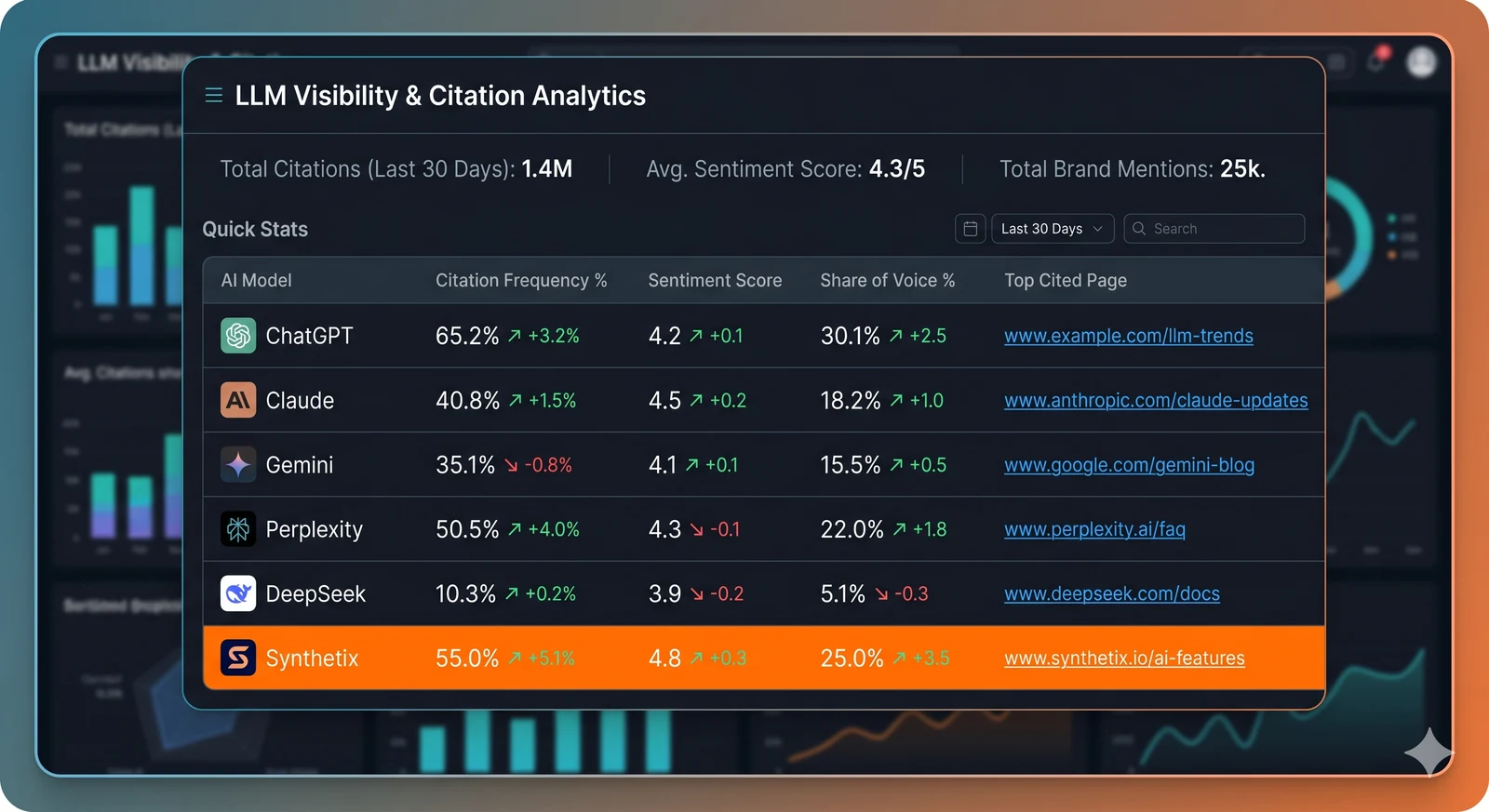
A traditional keyword rank tracker measures your position on a search results page. An LLM rank tracker measures your citation frequency inside AI model responses — a completely different measurement task. The best LLM rank tracker tools:
- Run a defined query set against multiple LLM APIs automatically
- Parse model responses for brand citations (name mentions, product references, domain citations)
- Track citation frequency, position, and sentiment over time
- Compare your citation rates against defined competitors for the same queries
- Surface which specific URLs (if any) are cited alongside brand mentions
- Alert you when citation behavior changes significantly
Best LLM rank tracker tools in 2026
The best LLM rank tracker tool for a given team depends on which models they need to track and at what query volume. Key criteria:
| Criteria | What to Evaluate |
|---|---|
| Model coverage | ChatGPT, Claude, Gemini, Perplexity, DeepSeek, Copilot |
| Query volume | How many queries per run, per month |
| Update frequency | Daily, weekly, or on-demand |
| Competitive tracking | Can you track competitors in the same queries |
| Sentiment analysis | Does it parse response text for sentiment, not just presence |
| API access | Can you pull data into custom dashboards |
LLM SEO trackers: free vs. paid options
The best free LLM rank tracker options are limited to small query volumes and typically single-model coverage. A best free LLM rank tracker tool might let you test 10–20 queries against one model per day — useful for validation and spot-checking, not for ongoing competitive intelligence. Serious LLM SEO tracking requires paid infrastructure because the cost of running queries against multiple LLM APIs at scale is non-trivial.
LLM SEO software vs. LLM visibility tools
LLM SEO software is the broader category — platforms that manage the full LLM optimization workflow from query tracking through content recommendations and competitor benchmarking.
LLM visibility tools are sometimes used more narrowly to mean citation monitoring specifically — tools that track whether your brand appears in model responses without the full optimization workflow context.
The distinction matters when evaluating vendors: a tool that only tells you your current LLM visibility without recommending how to improve it is a monitoring tool, not an optimization platform. The best LLM visibility tracking software does both.
Why this matters for brands: LLM SEO rank tracking is the measurement layer that makes LLM optimization a manageable program rather than a guessing game. Without it, you’re publishing content hoping it improves LLM citations without any feedback on whether it actually does.
4. LLM Visibility Optimization Tactics
Content tactics that improve LLM citation frequency
The content structure that drives LLM citations is different from what drives traditional SEO rankings. LLMs are trained to generate helpful, specific, accurate answers — they cite sources that exemplify those qualities.
Answer-first structure: Lead every section with the direct answer. The first sentence under each heading should directly address the question implied by that heading. LLMs extract and cite the most directly relevant passage — burying the answer in the third paragraph guarantees it won’t be the cited passage.
Specific, quotable claims: “Brand X is the leading platform for AI visibility tracking, used by over 500 B2B brands” is citable. “Brand X offers a comprehensive range of AI visibility solutions” is not. Specificity is the difference between content LLMs cite and content they pass over.
Question-format headings: H2 and H3 headings phrased as questions directly match the conversational query patterns LLMs are trained on. “How does LLM citation work?” as a heading tells the model exactly what question the following content answers.
Comparison and competitive content: “LLM SEO vs. traditional SEO,” “best LLM SEO tools,” and “how to choose an LLM rank tracker” — these query types are common in research workflows and consistently generate citations for the brands that own them.
Deep FAQ sections: LLMs disproportionately cite FAQ content because it’s structured as question-answer pairs — exactly the format LLMs use to construct their own responses. FAQ schema markup amplifies this by making the Q&A structure machine-readable.
Entity optimization for LLM SEO
Entity accuracy is foundational to LLM SEO. If an LLM has incorrect or outdated information about your brand — wrong pricing, wrong feature set, wrong positioning — it will cite that incorrect information regardless of how well you’ve optimized your content. Entity optimization ensures your brand’s knowledge graph data is accurate and consistent:
- Maintain an accurate Wikipedia page (if eligible) and Wikidata entity
- Ensure your Google Knowledge Panel displays correct information
- Use Organization schema markup to declare your brand’s official name, description, founding date, products, and contact information
- Ensure consistent brand entity data across all major platforms (Crunchbase, LinkedIn, industry directories)
LLM content optimisation: format considerations
LLM content optimisation differs from traditional content marketing in format emphasis:
- Tables are cited disproportionately — they present dense comparative information in a format LLMs can parse and quote directly
- Numbered lists provide citable structure for process and how-to content
- Definition blocks — starting with “X is [clear definition]” — are frequently extracted for entity-definition queries
- Statistical claims with explicit attribution are cited more frequently than vague claims
Why this matters for brands: LLM visibility optimization is ultimately about making your content more citable — more specific, more directly relevant, more accurately representing your brand’s entity. The brands that reformat their existing content for citeability often see faster LLM visibility gains than those who publish net-new content without addressing existing format issues.
5. LLM Brand Monitoring and Sentiment
LLM brand monitoring: what to track
Comprehensive LLM brand monitoring tracks four dimensions:
- Citation frequency — How often does your brand appear in model responses for your tracked query set?
- Brand sentiment in LLMs — When your brand is mentioned, is the characterization positive, neutral, or negative?
- Entity accuracy — Are the facts AI models state about your brand (pricing, features, positioning) correct?
- Competitive share of voice — How does your citation rate compare to competitors for the same queries?
LLM brand monitoring tools that only report on one or two of these dimensions miss the most actionable signals. A brand can have high citation frequency with poor sentiment — a worse situation than low citation frequency with accurate, neutral mentions, because negative AI characterization actively undermines buyer trust.
LLM brand sentiment: why it matters more than citation frequency
LLM brand sentiment is arguably more important than raw citation frequency. When a buyer asks ChatGPT or Claude to recommend tools in your category, the model doesn’t just cite your brand — it describes it. “Brand X is well-regarded for its ease of use and strong customer support” and “Brand X has received mixed reviews, particularly around pricing complexity” are both citations — but they produce completely different buyer impressions.
Tracking llm brand sentiment alongside citation frequency gives you the full picture of how AI models are positioning your brand in competitive contexts.
LLM prompt monitoring for market intelligence
LLM prompt monitoring — tracking what questions buyers are asking AI models about your category — provides a layer of market intelligence that no other tool offers. The prompts buyers use reveal: what problems they’re trying to solve, which competitors they’re comparing, what features they’re asking about, and how their query patterns are evolving over time. LLM prompt monitoring data is some of the most valuable buyer intent signal available in 2026.
Brand mentions in LLMs vs. traditional brand monitoring
Traditional brand monitoring tracks your brand across social media, news, and web content — the published record. LLM brand monitoring tracks your brand inside AI model knowledge — the model’s internal representation of your brand, which may differ significantly from published content. A brand can have extensive positive press coverage and poor LLM brand sentiment if the training data that reached AI models was biased toward negative early-stage reviews or outdated information. Both monitoring types are necessary; LLM brand monitoring surfaces a risk that traditional monitoring completely misses.
Why this matters for brands: Tools for measuring brand visibility in LLMs are the brand safety and competitive intelligence infrastructure of the AI era. Just as brands monitor their social reputation, they need to monitor their LLM reputation — which is increasingly the reputation that matters most at the top of the buyer journey.
6. Building Your LLM SEO System
The LLM SEO stack
A complete LLM SEO program has five components:
- LLM rank tracking infrastructure — Multi-model query tracking covering ChatGPT, Claude, Gemini, Perplexity, DeepSeek, and Copilot, with competitive benchmarking and historical trend data
- Entity foundation — Accurate, consistent brand entity data across Wikipedia, Wikidata, Organization schema, and major brand directories
- Content optimization program — Systematic reformatting and expansion of existing content for answer-first structure, combined with net-new content targeting identified citation gaps
- Authority breadth program — Ongoing building of brand mentions across diverse, AI-cited sources in your category
- LLM brand monitoring — Continuous tracking of citation frequency, sentiment, entity accuracy, and competitive share of voice
LLM optimization agencies and services
The best LLM optimization companies combine technical SEO infrastructure (for the entity and structured data layer), content strategy expertise (for the answer-format content layer), and LLM-specific tracking tools (for the measurement layer). Best LLMO provider in digital marketing near me — the answer to this question is rapidly becoming less geographic and more capability-based. Genuine LLM SEO expertise is scarce, and the best practitioners are working across geographies. Evaluate agencies on their tracking infrastructure, their content methodology, and their ability to demonstrate measurable citation improvement.
ChatGPT LLMO vs. multi-model LLM SEO
ChatGPT LLMO (ChatGPT-specific LLM optimization) is sometimes used to describe a single-model approach to LLM SEO. The limitation is significant: ChatGPT is one of six major AI models your buyers are using. A ChatGPT-only LLMO strategy improves citation on one platform while potentially leaving significant gaps on Claude, Gemini, DeepSeek, and Copilot. The best platforms for analyzing citation data for LLMO strategies are those that provide cross-model comparison, so teams can identify which models have the largest citation gaps and prioritize accordingly.
Enterprise LLM tracking
Enterprise LLM tracking adds capabilities that large organizations require: multi-brand query management, API integration with existing analytics infrastructure, multi-user access with role-based controls, SLA-backed uptime, and dedicated support. Enterprise llm tracking platforms also typically offer custom query libraries built around your specific buyer journey, rather than generic query sets.
Why this matters for brands: LLM SEO is a compounding program. Each month of systematic tracking, content optimization, and authority building makes your citation footprint broader and your LLM brand representation more accurate. The brands that start the compounding process in 2026 will be the ones that own LLM visibility in 2028.
Your Next Step
The version of your brand that lives inside AI models is shaping buyer perceptions right now — every time a prospect asks ChatGPT, Claude, or Perplexity about your category. Whether that version is accurate, positive, and frequently cited, or vague, outdated, and absent, depends on your LLM SEO program.
Run a free AI visibility audit at sanbi.ai to see exactly how your brand is represented across ChatGPT, Gemini, Perplexity, and Claude — citation frequency, sentiment scores, entity accuracy, and the specific gaps your LLM SEO program needs to close.
Sanbi.ai monitors your brand’s AI visibility daily across ChatGPT, Gemini, Perplexity, and Claude — tracking visibility scores, sentiment, citations, agent accessibility, and competitor movements so you always know where you stand in the agent-first web.
Frequently Asked Questions
LLM SEO (Large Language Model SEO) is the discipline of optimizing your brand's presence to be cited inside AI-generated responses from large language models — ChatGPT, Claude, Gemini, Perplexity, DeepSeek, and Copilot. Traditional SEO optimizes for a ranked position on a search results page. LLM SEO optimizes for citation frequency, answer sentiment, and entity accuracy inside AI-generated responses. The tactics differ significantly: LLM SEO relies less on keyword density and backlink volume, and more on entity establishment, breadth of third-party mention coverage, structured data, and answer-format content architecture. LLM visibility is measured in citation rates and share of voice, not rank positions.
The best LLM SEO tools in 2026 track citation frequency across multiple language models simultaneously, measure competitive share of voice, analyze answer sentiment, and surface content gaps. Key features to evaluate: multi-model coverage (ChatGPT, Claude, Gemini, Perplexity, DeepSeek), automated query batching, historical trend tracking, competitive benchmarking, and source URL tracking. Sanbi.ai is built specifically for multi-engine LLM visibility tracking. Other platforms in the LLM SEO space include Profound (prompt volume analysis), peec.ai (Perplexity-focused), and Scrunch AI (cross-platform content monitoring). The best LLM SEO tracker for your team is the one that covers the models your buyers use most.
LLM rank tracking measures how often and how prominently your brand is cited in AI model responses across a defined query set. Unlike traditional rank tracking (which measures position 1–10 on a results page), LLM rank tracking measures: citation presence (does your brand appear in the response at all), citation frequency (what percentage of your tracked queries cite you), citation position (where in the response your brand appears), and citation sentiment (how the model describes your brand). LLM rank tracking tools automate this by running your query set against each tracked model's API or interface, parsing responses for brand citations, and reporting results over time.
LLM visibility is the degree to which your brand appears, is cited, and is accurately represented across large language model responses. A brand with high LLM visibility is consistently cited by ChatGPT, Claude, Gemini, and Perplexity when buyers ask questions in its category. A brand with low LLM visibility may have a strong website, strong SEO, and strong social presence — but be effectively invisible inside AI models because it lacks the entity authority, training data presence, and content signals that LLM systems use to select sources. LLM visibility is increasingly the primary determinant of whether a brand makes it onto AI-generated vendor shortlists.
LLM brand monitoring is the ongoing process of tracking how your brand is mentioned, cited, and described across large language model responses. A comprehensive LLM brand monitoring program measures: citation frequency (how often your brand appears in AI model answers), brand sentiment in LLMs (whether AI models describe your brand positively, neutrally, or negatively), entity accuracy (whether AI models have accurate information about your products, pricing, and positioning), competitive share of voice (your citation rate vs. competitors), and citation drift (changes in how AI models describe your brand over time). LLM brand monitoring tools automate this tracking across multiple models on a regular cadence.
LLM SEO rank tracking differs significantly across models because each has different training data, retrieval architectures, and citation behaviors. ChatGPT with browsing uses live web retrieval, making it responsive to recent content — a page published this week can appear in ChatGPT citations within days. Claude draws more heavily from training data, making citation behavior more stable but slower to respond to content changes. Gemini integrates with Google's index, meaning strong organic ranking is a stronger predictor of Gemini citations than it is for Claude. DeepSeek reflects a training mix that includes significant technical and Chinese-language content. Each model requires different optimization approaches, which is why cross-model LLM SEO tracking is essential — single-model tracking misses the variance.
LLM brand sentiment is the characterization of your brand within AI model responses — whether a model describes your brand positively (e.g., 'the leading platform for X'), neutrally (e.g., 'one option for X'), or negatively (e.g., 'some users report issues with X'). LLM brand sentiment tracking parses AI model responses for brand mentions and analyzes the surrounding language for sentiment signals. This matters because a brand can have high citation frequency but poor sentiment — being cited is good, but being cited in a negative context undermines the citation value. The best LLM SEO trackers include sentiment scoring alongside citation frequency data.
The best LLM SEO agency in 2026 is one that combines technical structured data expertise, content strategy capability, and LLM visibility tracking infrastructure. When evaluating LLM SEO agencies, ask: which LLM models do they track, what is their content methodology for improving citation rates, can they demonstrate historical citation improvement for past clients, and how do they integrate LLM SEO with broader marketing strategy. The best digital marketing agency for LLMO (LLM optimization) will have proprietary query libraries for your category, multi-model tracking infrastructure, and a content program that addresses all three layers of LLM visibility: technical, content, and authority.
LLM citation tracking monitors which specific URLs and sources AI models cite when responding to queries in your category. It tells you which pages on your site (or competitors' sites) are being used as AI sources. LLM prompt monitoring tracks the volume and type of AI prompts being used in your category — what questions buyers are asking AI models, with what frequency, and how those prompt patterns are changing over time. Together, these tools provide input and output visibility: prompt monitoring shows what buyers are asking, citation tracking shows who is being cited in the answers. Both are components of a comprehensive LLM SEO tracking stack.
LLM visibility optimization is the practice of improving how often and how positively your brand is cited in large language model responses. The core optimization levers are: (1) Entity establishment — ensuring your brand has accurate, consistent entity data across Wikipedia, Wikidata, and structured data; (2) Answer-format content — publishing content with direct, citable answers in question-response format; (3) Authority breadth — building mentions across many authoritative sources (not just your own domain), because LLMs weight breadth of reference; (4) Structured data — FAQ, HowTo, and Organization schema that AI retrieval systems can parse; (5) Freshness signals — for retrieval-augmented models (Perplexity, ChatGPT with browsing), regularly updated content has an advantage. LLM visibility optimization is a compounding program — each month of consistent execution makes your citation footprint harder to displace.
Brand visibility in LLMs refers specifically to your brand's presence inside AI model knowledge and responses — separate from traditional brand monitoring metrics like share of voice in media, social mentions, or search ranking. Traditional brand monitoring tracks where your brand is mentioned across the web. LLM brand visibility tracks where your brand is represented inside AI model knowledge bases and how AI models respond when asked about your brand or category. The key difference: traditional brand monitoring measures what has been published about your brand. LLM brand visibility measures what AI models know and say about your brand — which is derived from published content but filtered through each model's training and retrieval process.
Tracking brand mentions in LLMs at scale requires a tool that runs a defined query set against multiple AI model APIs, parses the responses for brand mentions (including entity variants, product names, and common abbreviations), and records results at a frequency that captures meaningful changes. Manual LLM brand monitoring — running queries yourself and recording results — is viable for audits but doesn't scale. LLM brand monitoring tools automate the full loop: query execution, response parsing, brand detection, sentiment analysis, and alerting when mention frequency or sentiment changes. The query set should include brand-name queries, category queries, and competitor comparison queries where your brand may or may not appear.
The best LLM SEO tracking software in 2026 runs your category's core prompts against live AI model APIs, detects brand mentions automatically, tracks citation frequency over time, and benchmarks your share of voice against competitors — across ChatGPT, Gemini, Perplexity, Claude, and DeepSeek. The best LLM SEO tracking software should also surface why competitors are cited (what content, which sources, what schema signals are working) so that monitoring translates into optimization actions. Sanbi.ai is purpose-built for this: automated LLM citation tracking across all major AI models, competitive benchmarking, and content recommendations in one LLM SEO tracking platform.
LLM search optimization targets how your brand appears inside AI-generated answers rather than where your pages rank in a list of search results. Traditional SEO measures keyword ranking positions, click-through rates, and organic traffic from search pages. LLM search optimization measures citation frequency (how often your brand appears in AI answers to category queries), citation sentiment (how accurately and favorably your brand is described), share of voice (your citation rate versus competitors), and source authority (whether the pages AI models cite when mentioning you are high-quality). An LLM tracker automates this measurement by running a defined query set against AI model APIs, detecting brand mentions, recording sentiment, and reporting trends over time — giving you the same cadence of visibility data for AI search that rank trackers provide for traditional search.
The best LLM visibility optimization tools share three capabilities: (1) multi-model coverage — tracking across ChatGPT, Gemini, Perplexity, Claude, and DeepSeek simultaneously rather than just one AI platform; (2) competitive benchmarking — showing your LLM visibility score relative to named competitors, not just an absolute number; (3) content recommendations — surfacing what content changes, schema additions, or authority-building actions would most improve your citation rate. When evaluating best LLM visibility optimization tools, prioritize platforms that test against the actual prompts your buyers use (not generic category terms), that track at a weekly or higher frequency, and that show trend data over time rather than point-in-time snapshots. Sanbi.ai combines all three: continuous LLM visibility tracking, competitive share-of-voice benchmarking, and actionable optimization recommendations.
From live web retrieval at answer time. ChatGPT search runs queries against Bing's index and OpenAI's own crawl, fetches candidate pages with OAI-SearchBot or ChatGPT-User, and cites the passages it uses. Its source mix is heavier on Reddit, Wikipedia and mainstream publishers than Google's AI surfaces, and it favours pages that are fast, server-rendered and directly answer the sub-question. Content a page delivers only through JavaScript is often absent from what ChatGPT can cite.
A minority, and it varies sharply by question type. Studies of citation sets across engines put brand-owned pages, including corporate blogs, somewhere between a fifth and a third of citations overall, concentrated on definitional and how-to questions. For comparison and recommendation prompts the share drops well below that, with review platforms, communities and publishers taking most slots. Measure it for your own category rather than relying on a global average, because the split is what tells you where to invest.