DeepSeek Rank Tracking in 2026: How to Track Your Brand's Visibility in DeepSeek (Free & Paid)
Every few months, a Western marketing team discovers the same uncomfortable fact: there’s a top-five global AI assistant they’ve never once checked their brand in.
DeepSeek exploded out of Hangzhou in early 2025, hit the top of app stores worldwide, and settled into a position no visibility strategy can responsibly ignore: the default AI answer engine for an enormous share of Chinese users, a serious ChatGPT alternative across Asia-Pacific and developer communities everywhere — and an engine whose answers about your category frequently look nothing like ChatGPT’s.
This guide covers DeepSeek rank tracking end to end: how “rank” works inside DeepSeek answers, the free manual method, what real DeepSeek rank tracking software automates, and how to actually improve the numbers once you’re measuring them.
How “Rank” Works Inside DeepSeek
DeepSeek doesn’t return ten blue links. Ask it a commercial question — “best AI visibility platforms”, “top project management tools for agencies” — and it synthesizes an answer that names some brands, orders them with short justifications, and omits everyone else.
So a DeepSeek rank tracker measures the same family of metrics as any LLM rank tracking discipline:
| Metric | The question it answers |
|---|---|
| Presence | Is your brand mentioned at all? |
| Prominence | Named first, or buried at the bottom? |
| Recommendation strength | Recommended, or merely listed? |
| Sentiment | How does DeepSeek characterize you? |
| Citation | Is your site referenced (search mode)? |
| Share of voice | Across your prompt set, what share of answers include you vs. competitors? |
One property changes everything about methodology: DeepSeek’s generation is probabilistic. The same prompt can produce different brand lists on different runs. A single check is noise; the trend across repeated, scheduled runs is the signal. Every method below is built around that fact.
Why DeepSeek Deserves Its Own Tracking Lane
It’s not a ChatGPT mirror. DeepSeek’s training corpus is far heavier on Chinese-language content, its retrieval draws on a different source pool, and its answers for the same category routinely feature a different brand mix than ChatGPT or Gemini. In our multi-engine tracking work, DeepSeek is consistently the engine where Western-dominant brands show their biggest visibility gaps — we covered the engine-by-engine divergence in our Claude, Gemini & DeepSeek tracking guide.
The China angle is strategic. For any brand selling into China, competing with Chinese alternatives, or watching Chinese competitors expand west, DeepSeek is the answer surface that shapes perception — the way ChatGPT shapes it in the US. Our China AI search playbook covers the full ecosystem; DeepSeek is its most globally accessible front door. For how DeepSeek fits alongside Doubao, Qwen and Baidu AI Search in China’s wider AI market, see China’s AI internet vs the West.
The queries are already happening. Searches for deepseek rank tracking software, free deepseek rank tracking, and deepseek seo rank tracking tools have grown steadily — teams are waking up to the gap between their engine coverage and their buyers’ actual behavior.
Free DeepSeek Rank Tracking: The Manual Method
You can establish a genuine baseline this week without spending anything:
- Build a prompt set (20–50 prompts). The questions your buyers actually ask: best [category] for [use case], [your brand] vs [competitor], is [your brand] worth it, plus the discovery questions upstream of your category.
- Run them in DeepSeek (chat.deepseek.com is free). Run each prompt in a fresh chat; where relevant, run both chat mode and search-enabled mode — they behave differently.
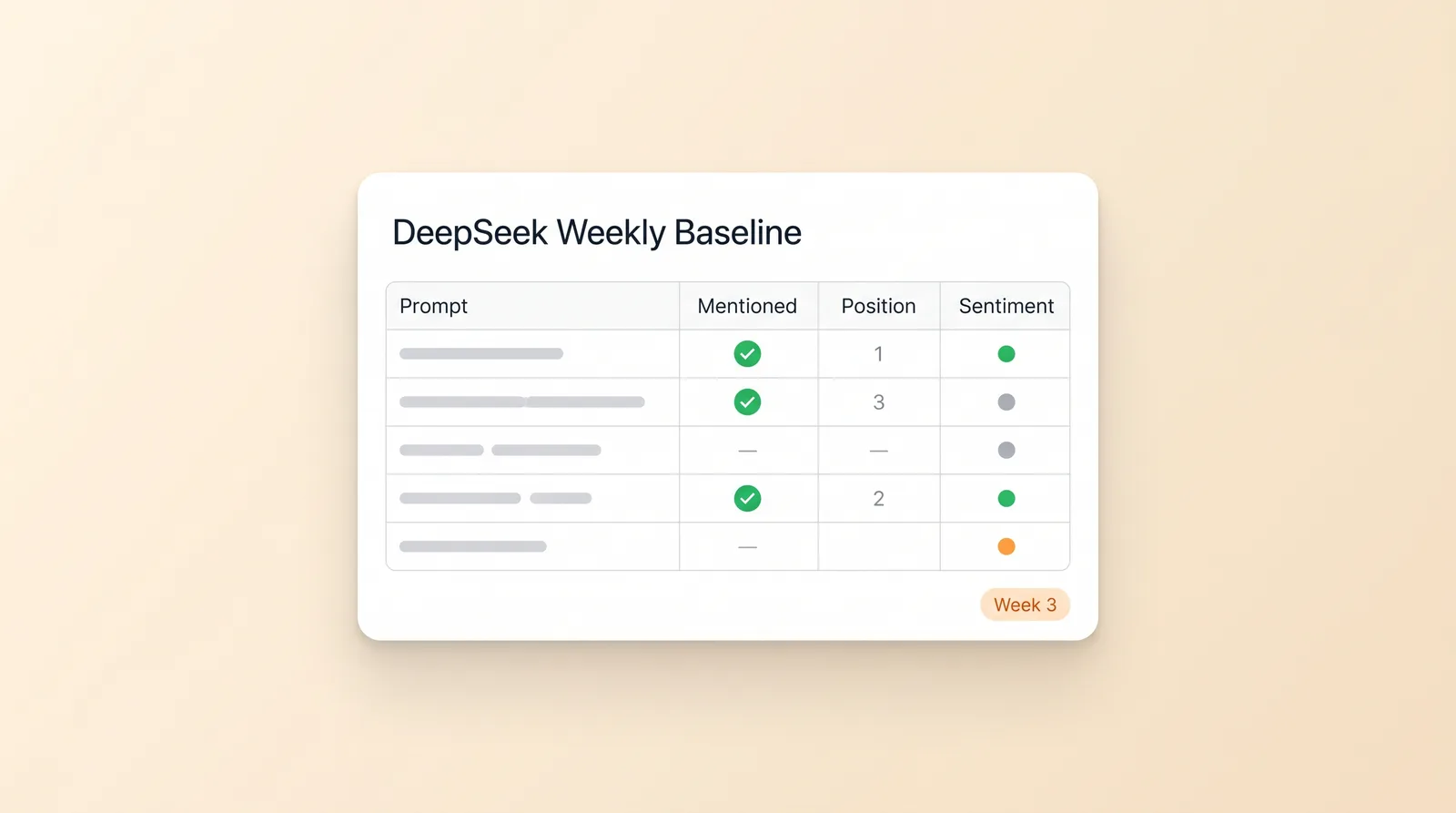
- Record four columns per prompt: mentioned (yes/no), position among named brands, sentiment (recommended / neutral / negative), competitors named.
- Repeat weekly on the same prompt set. Two or three weeks in, you have a trend — which is the only DeepSeek number that means anything.
The same four-column method works across every engine — it’s the workflow from our AI search visibility guide, pointed at one engine.
Where the free method hits its ceiling: beyond ~30 prompts the manual time cost compounds; single weekly runs under-sample a probabilistic engine; share-of-voice math against competitors gets spreadsheet-painful; and nothing alerts you when your status changes between checks.
DeepSeek Rank Tracking Software: What Automation Actually Buys
Real DeepSeek rank tracking software does four things the spreadsheet can’t:
- Scheduled, repeated sampling — runs your prompt set on a cadence, multiple samples per prompt, smoothing probabilistic noise into a trustworthy trend
- Parsing at scale — extracts mentions, prominence, sentiment, and citations from every answer automatically
- Share-of-voice aggregation — your inclusion rate vs. each named competitor, per prompt category, over time
- Change alerts — fires when you gain or lose presence, or a competitor enters answers you care about
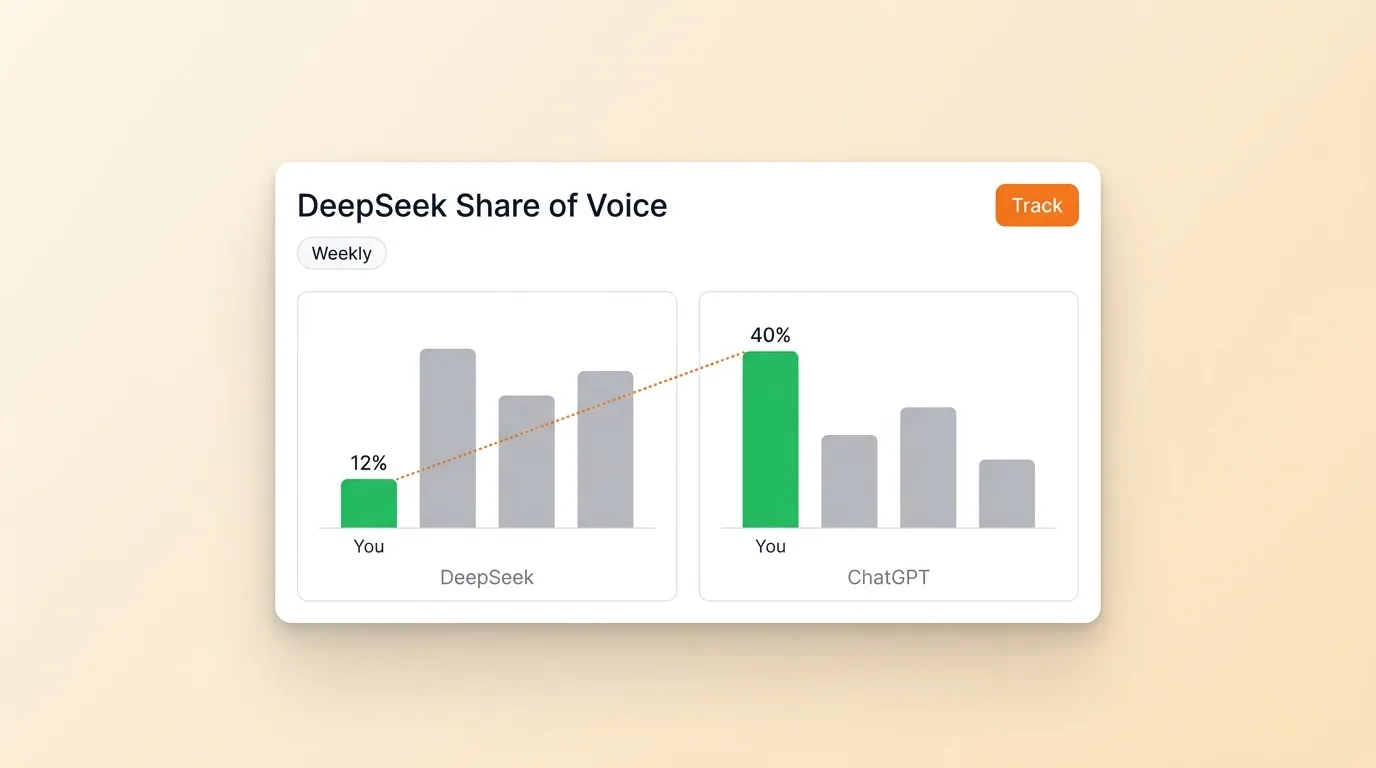
Sanbi.ai tracks ChatGPT, Gemini, Perplexity, Claude and Google AI Mode today, and its China tracker, now open for waitlist sign-ups, is launching with Qwen and DeepSeek, with prompts in Chinese and English — the configuration that makes DeepSeek data strategic rather than trivia. China plans start at $29/month: join the China waitlist or book a demo. The insight is almost never “our DeepSeek share of voice is 12%.” It’s “our DeepSeek share is 12% while our ChatGPT share is 40% — here’s the source-pool difference causing it, and here’s what to publish.” Enterprise platforms like Profound include DeepSeek coverage, at enterprise pricing.
How to Improve Your DeepSeek Visibility
Measurement first, then the two levers — weighted for DeepSeek’s particular data diet:
1. Owned content, in the right languages. Deep, structured, factually precise pages on your buyers’ actual questions — the standard AEO playbook. For China-relevant categories, Chinese-language content stops being optional: DeepSeek’s corpus rewards it directly.
2. Earned citations, in the right places. DeepSeek’s influential source pool skews toward developer communities, technical documentation, and Chinese-language media more than ChatGPT’s does. Track which domains show up around your category’s answers and earn presence there — the same source-affinity discipline from our 120,000-citation engine study, applied to one engine.
Then re-measure weekly and attribute: which investment moved DeepSeek specifically? Without per-engine tracking, you can’t tell — which is the whole argument for measuring engines separately.
The Bottom Line
- DeepSeek is a top-tier global AI answer engine with a brand mix that routinely diverges from ChatGPT and Gemini — your visibility there is unknown until measured.
- “Rank” means presence, prominence, sentiment, and share of voice across a stable prompt set, sampled repeatedly — never a single check.
- Free DeepSeek rank tracking is real: 20–50 prompts, four columns, weekly cadence.
- Software buys you scale, statistical reliability, competitor share-of-voice, and alerts — and multi-engine context, which is where DeepSeek data becomes strategy.
Run a free AI visibility audit to baseline your brand across ChatGPT, Gemini and Claude in about two minutes — and see exactly where your engines diverge.
Sanbi.ai monitors your brand’s AI visibility daily across ChatGPT, Gemini, Perplexity, Claude and Google AI Mode — tracking visibility scores, sentiment, citations, agent accessibility, and competitor movements so you always know where you stand in the agent-first web.
Frequently Asked Questions
DeepSeek rank tracking is the practice of monitoring whether — and how prominently — your brand appears in DeepSeek's answers to a defined set of prompts, on a schedule, so you can see the trend over time. Like other LLM answer engines, DeepSeek doesn't return ten ranked blue links; it returns a synthesized answer that names some brands and omits others. 'Rank' therefore means a blend of presence (are you mentioned), prominence (are you named first or buried), recommendation strength (recommended vs. merely listed), citation (is your site referenced), and share of voice across your tracked prompt set.
Three reasons. First, scale: DeepSeek became one of the most-downloaded AI assistants globally after its R1 release, with an enormous user base in China and meaningful adoption across Asia, Europe, and developer communities worldwide. Second, divergence: DeepSeek's training data and retrieval behavior differ from ChatGPT and Gemini, so brands that dominate Western engines are frequently invisible in DeepSeek answers — and vice versa. Third, the China angle: for brands selling into or competing with Chinese markets, DeepSeek is the AI answer surface that matters, the way ChatGPT matters in the US.
Yes, within limits. The free method: define 20–50 representative buyer prompts, run them in DeepSeek (chat.deepseek.com is free to use), and record for each answer whether your brand is mentioned, its position among named brands, sentiment, and which competitors appear. Repeat on a fixed schedule — weekly is the practical minimum — and you have a genuine free DeepSeek rank tracking baseline. What free manual tracking can't give you: scale beyond a few dozen prompts, per-run consistency (LLM answers are probabilistic, so single runs are noisy), competitor share-of-voice math, and alerting when your status changes. That's what DeepSeek rank tracking software automates.
The best DeepSeek rank tracking software runs your prompt set against DeepSeek on a schedule, parses brand mentions, prominence, sentiment, and citations from each answer, computes share of voice versus competitors, and stores the full time series with change alerts. Sanbi.ai's global plans track ChatGPT, Gemini, Perplexity, Claude and Google AI Mode, and its China tracker (waitlist now open at https://app.sanbi.ai/signup?market=china) is launching with Qwen and DeepSeek — which matters because DeepSeek visibility is most useful as a comparison: seeing where your DeepSeek presence diverges from your other engines is what turns the data into strategy. Enterprise platforms like Profound include DeepSeek among tracked models at enterprise pricing.
DeepSeek synthesizes answers from its training data and, when search is enabled, live web retrieval. When a user asks a commercial question — 'best AI visibility tools', 'top CRM for startups' — DeepSeek typically returns an ordered or semi-ordered list of brands with short justifications. Your 'rank' is your position in that list, whether you appear at all, and how DeepSeek characterizes you. Because generation is probabilistic, the same prompt can produce different brand lists across runs; reliable measurement requires repeated sampling and share-of-voice aggregation, not single checks.
The measurement mechanics are identical — presence, prominence, sentiment, citation, share of voice across a fixed prompt set. The differences are in the engine: DeepSeek's training corpus includes substantially more Chinese-language content, its answers for the same category can draw on a different pool of sources than ChatGPT, and its user base skews differently (strong in China, Asia-Pacific, and developer communities). In practice this means your optimization levers differ: content and citations that move ChatGPT may do nothing for DeepSeek, which is why tracking both engines separately — and comparing — is the point.
The levers are the familiar AEO/GEO pair, weighted for DeepSeek's data diet: (1) owned content — deep, structured, factually precise pages on the questions your buyers ask, in the languages your markets use; for China-relevant categories, Chinese-language content and presence on Chinese platforms materially matter; (2) earned citations — mentions on the third-party sources DeepSeek draws from, which skew toward developer communities, technical documentation, and Chinese-language media more than ChatGPT's source pool. Measure weekly, see which investments move DeepSeek specifically, and iterate.
When DeepSeek's web-search mode is active, answers can include references to retrieved pages, similar to Perplexity's citation behavior though less consistently structured. In pure chat mode, answers draw on training data without explicit citations. For tracking purposes, treat citations as one signal among several — presence and prominence in the answer text are the primary DeepSeek visibility metrics, with citation tracking as supporting evidence of which sources influence the engine.
For most, yes — at low cost if not high priority. DeepSeek's global user base means buyers in your Western markets are already asking it questions, and its divergence from ChatGPT/Gemini means your visibility there is genuinely unknown until measured. The practical approach: include DeepSeek in a multi-engine tracker rather than standing up a dedicated workflow — if your share of voice there turns out to matter, you'll see it; if not, the marginal cost of tracking was near zero. Brands with China or APAC exposure should treat DeepSeek as a first-tier engine.
Weekly is the practical baseline, matching the cadence for other LLM engines. DeepSeek's answers shift as models update and as its retrieval index refreshes, and because generation is probabilistic, you need repeated samples for any single week's number to be trustworthy. Daily tracking makes sense for high-priority prompts during active optimization pushes. Whatever the cadence, keep the prompt set stable — changing prompts mid-stream destroys your trend line.