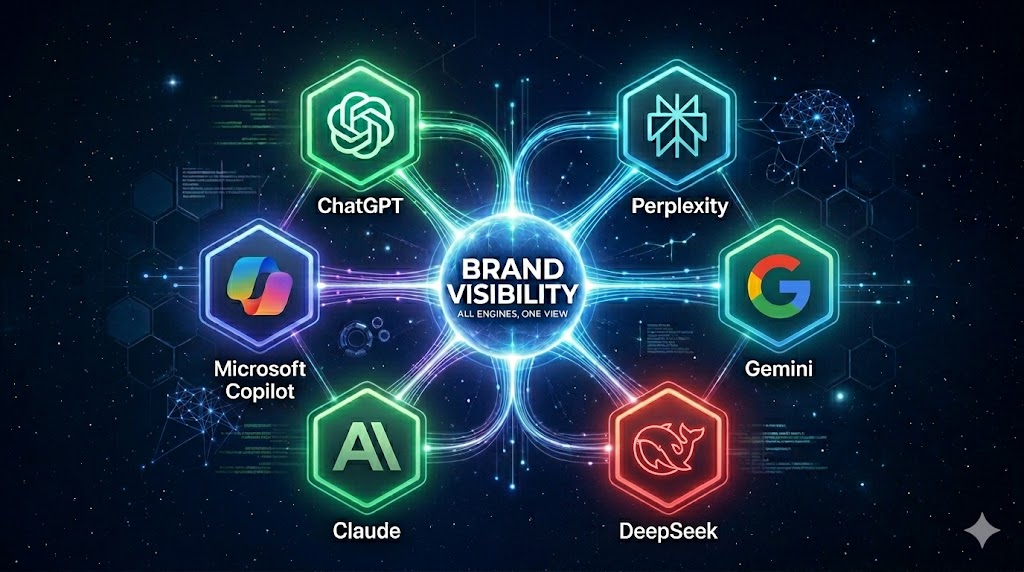
Beyond ChatGPT: Tracking Your Brand Across Claude, Gemini, DeepSeek & Copilot
Most AI visibility strategies are tracking two platforms. There are six that matter.
ChatGPT and Perplexity get the attention because they were first and because they’re the ones marketers talk about. But Claude is processing millions of enterprise research queries through the Claude.ai interface and through Anthropic’s API integrations. Gemini is embedded in Google Workspace and Android for hundreds of millions of users. DeepSeek is the preferred model for technical buyers and APAC-facing research. Copilot is inside Microsoft 365 — in the Word documents, Teams channels, and Outlook threads where enterprise buying decisions actually happen.
Your brand either appears in those answers or it doesn’t. And right now, most brands have no idea.
1. Why the Multi-Engine Problem Is Real
The fragmentation of AI search
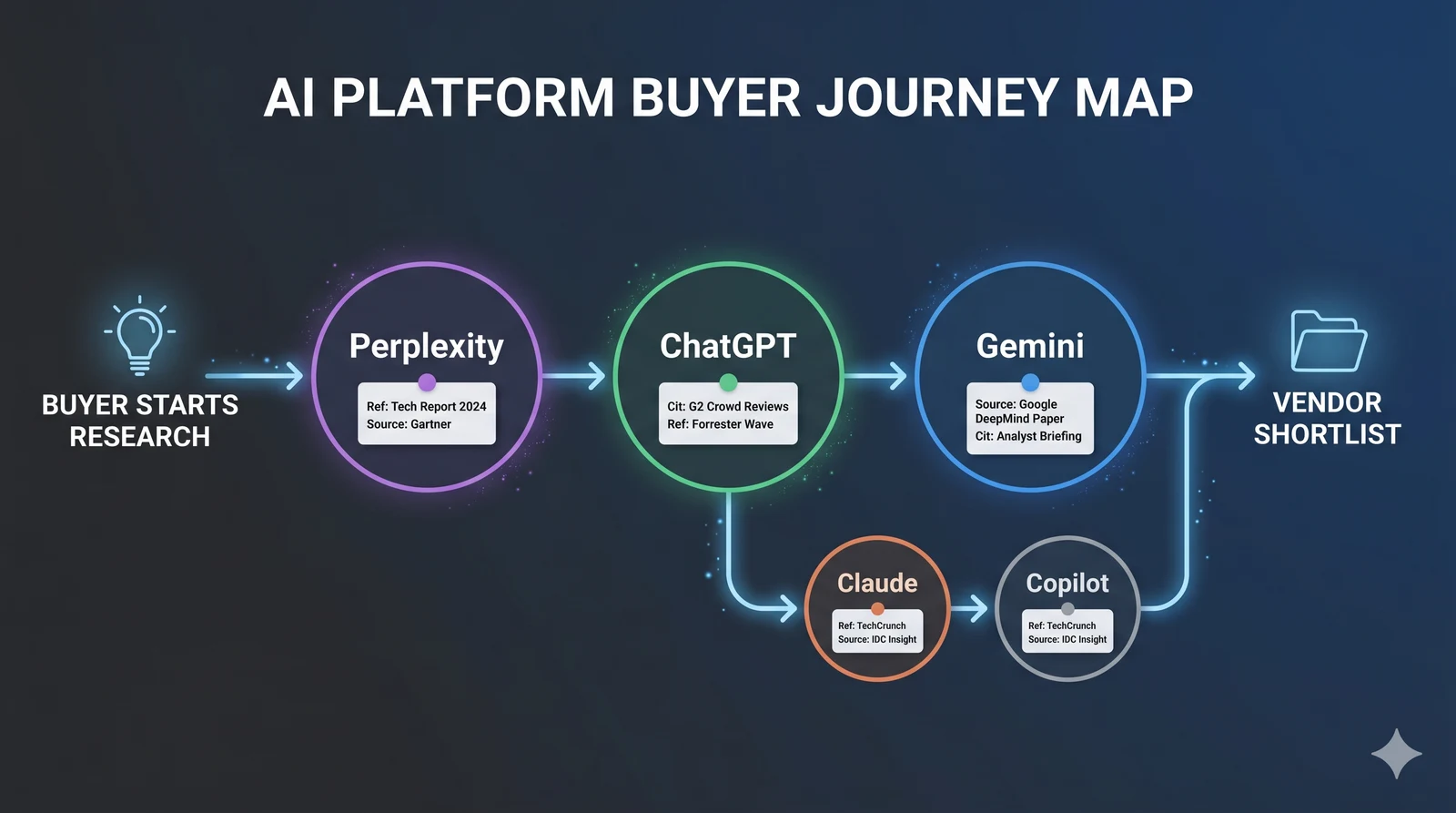
Two years ago, it was reasonable to treat AI search as a ChatGPT question. Today, the most popular AI search engines form an ecosystem with genuinely different audiences, different source preferences, and different use cases. A buyer’s research journey in 2026 typically touches multiple platforms: an initial Perplexity search to orient, a deeper ChatGPT conversation to explore options, a Gemini query to cross-reference in Google Workspace, a Copilot question in Teams to draft a comparison brief.
Your visibility on each platform is independent. Winning on one doesn’t transfer to the others.
Why visibility varies so much across platforms
The most common question brands ask when they first run multi-engine tracking is: “Why am I cited constantly on ChatGPT but barely mentioned on Claude?”
The answer is training data and retrieval architecture. ChatGPT with browsing does live web retrieval — it can cite content published recently. Claude draws more heavily from its training corpus, which reflects Anthropic’s data curation choices and has a knowledge cutoff. Gemini integrates with Google’s index, meaning Google’s existing authority signals translate more directly into Gemini citations. DeepSeek’s training mix includes significant Chinese-language and technical content, changing which sources it treats as authoritative.
The same brand, same content, same authority signals — measured differently by each engine.
The cost of missing platforms
If a competitor is cited in Claude responses for key procurement queries and you’re not, that competitor is receiving positive positioning in every enterprise buyer conversation where Claude is the research tool. You don’t see it because you’re not tracking it. The invisible competitive advantage accrues quietly.
Why this matters for brands: Tracking only ChatGPT and Perplexity means measuring roughly 40–50% of AI-influenced buyer research moments. The other half is happening on platforms most brands aren’t watching.
2. Claude: The Enterprise AI Your Tracking Strategy Is Missing
Why Claude rank tracking matters
Claude is Anthropic’s AI assistant and, in enterprise contexts, one of the most widely deployed models through API integrations, Claude.ai, and enterprise agreements. Its user base skews toward enterprise teams, developers, and knowledge workers doing substantive research tasks — not casual searches. When a procurement team uses a Claude-powered internal tool to evaluate vendors in your category, your brand’s presence or absence in Claude’s training and retrieval data determines whether you appear.
How Claude cites and what it cites from
Claude’s citation behavior differs from Perplexity’s in a fundamental way: unless in a retrieval-augmented configuration with web access enabled, Claude draws primarily from training data rather than real-time web retrieval. This means:
- Recency matters less than it does on Perplexity — a page published last week doesn’t immediately appear in Claude’s responses
- Breadth of presence matters more — brands mentioned across many sources in Claude’s training data have higher recall frequency than brands with a narrow citation footprint
- Domain authority signals established over years carry more weight than recent content velocity
- Claude’s training data weighting reflects a curated corpus that favors certain types of authoritative content over others
Claude SEO rank tracking in practice
A Claude rank tracker runs your defined query set against Claude’s API or interface and measures:
- Citation frequency (how often Claude mentions your brand for category queries)
- Citation sentiment (how Claude describes your brand — positively, neutrally, or negatively)
- Category association (which problems Claude links your brand to)
- Competitive positioning (how Claude frames your brand vs. competitors in comparison queries)
Claude seo rank tracking tools that only check for brand name mentions miss the most important signal: category association. If Claude consistently recommends competitors for the problems your product solves while not mentioning you, you’re invisible in the highest-value answer context.
The best Claude rank tracking tools
The best Claude rank tracking tools run your full query set against Claude’s API programmatically, track changes over time, and compare your citation frequency against defined competitors. Best online Claude rank tracker options that also integrate with ChatGPT, Gemini, and Perplexity tracking in a unified dashboard provide the most efficient workflow — running the same query set across four engines and normalizing results for comparison.
Why this matters for brands: Claude seo analysis tools that reveal a gap between your ChatGPT visibility and your Claude visibility are giving you one of the most actionable insights in AI search optimization. The cause of that gap — typically a narrower training data footprint or a specific content format mismatch — is often fixable with a targeted content strategy.
3. Gemini: The Platform Sitting Inside Your Buyers’ Work Tools
Gemini vs ChatGPT vs Perplexity — the user context difference
Gemini is not just another AI chatbot. It is the AI embedded in Google Workspace — Gmail, Docs, Sheets, Slides, Meet, and Google Search. When a user asks Gemini in Google Docs to research vendors for a proposal, or asks Gemini in Gmail to summarize a competitor, they are using a research tool that is tightly integrated with their work context.
The user behavior on Gemini is therefore less like “searching the web” and more like “asking a trusted assistant embedded in my work environment.” That framing changes what citations mean: a brand cited by Gemini in a Google Workspace context is implicitly being endorsed in a professional environment. The authority implication is higher, and the conversion probability follows.
How Gemini differs from Google AI Overviews
This is a critical distinction for tracking purposes. Google AI Overviews appear in Google Search results — they’re the AI summaries above the blue links. Gemini is a separate product: the conversational AI assistant in Workspace, the Gemini app, and Google’s API products.
Gemini rank tracking and AIO tracking are different measurement tasks:
- AIO tracking measures your presence in Google Search result summaries
- Gemini rank tracking measures your presence in Gemini’s direct conversational responses
A brand can be well-cited in AIOs and nearly invisible in Gemini’s direct responses, or vice versa. Both surfaces are important; they require separate tracking.
Brand mentions in Gemini: what to measure
For gemini rank tracking, the core metrics mirror the broader AI visibility framework: citation frequency across your query set, citation sentiment, category association, and competitive share of voice. One Gemini-specific dimension: because Gemini integrates with Google’s index, citation patterns in Gemini tend to correlate more closely with Google organic ranking than other AI platforms. Strong organic ranking for your category queries is a stronger predictor of Gemini citations than it is for Claude or ChatGPT.
Why this matters for brands: Gemini vs ChatGPT vs Perplexity visibility reflects three different segments of your buyer audience using three different tools for research. Gemini’s enterprise Workspace integration means it’s disproportionately relevant for brands targeting buyers in large organizations — where Google Workspace adoption is near-universal.
4. DeepSeek: The Platform Nobody in Western Marketing Is Tracking
Who uses DeepSeek and why it matters
DeepSeek’s R and V model series have made it one of the most capable openly available AI systems, and its user base reflects this: technically sophisticated researchers, developers, and engineers doing serious evaluation tasks. DeepSeek is particularly prevalent in APAC markets and among users who prefer open-source or transparency-forward AI systems.
For B2B brands with:
- Technical products (developer tools, infrastructure, security, data platforms)
- APAC market exposure
- Products evaluated by engineering or data science teams
DeepSeek rank tracking is tracking the research behavior of some of your highest-value buyers. For the full method — free manual tracking, software, and the optimization levers — see our dedicated DeepSeek rank tracking guide.
DeepSeek’s citation behavior
DeepSeek processes both English and Chinese-language queries and its training data reflects a different source mix than Western AI platforms. It weights:
- Technical documentation and academic repositories heavily
- Chinese-language sources (Zhihu, CNKI) for many query types
- Open-source community content (GitHub, Stack Overflow)
- English-language technical media alongside Chinese equivalents
This creates a citation pattern that diverges significantly from ChatGPT or Claude, particularly for technical queries. A brand that dominates ChatGPT citations for developer-tool queries may have very different DeepSeek presence because DeepSeek’s training data weights different types of technical content.
DeepSeek seo rank tracking in practice
DeepSeek rank tracking online follows the same framework as other AI platforms: define the query set, run against DeepSeek, measure citation frequency, position, sentiment, and competitive benchmarking. DeepSeek online rank tracking is available through API access to DeepSeek’s models, which enables automated batch-query tracking at scale.
Why this matters for brands: DeepSeek seo rank tracking is currently underutilized by Western marketing teams — which means it’s a competitive advantage opportunity. Brands that establish DeepSeek visibility now, before the broader market recognizes its importance, will have compounding advantages as DeepSeek’s user base grows.
5. Copilot: The AI Inside Enterprise Buying Decisions
Where Copilot lives — and why that’s strategically significant
Microsoft Copilot is not a standalone AI search engine. It’s embedded infrastructure — present in Microsoft 365 apps (Word, Excel, PowerPoint, Teams, Outlook), in Windows, in Edge browser, and in Bing search. For enterprise B2B brands, this is the most significant platform most are not tracking.
When an enterprise buyer is in Teams and asks Copilot to summarize the top vendors in your category, that’s a procurement-relevant research moment. When a CFO uses Copilot in Excel to analyze vendor options, your brand’s presence in Copilot’s knowledge is what determines whether you appear. No other AI platform is embedded this deeply in enterprise work contexts.
Copilot seo rank tracking
Copilot SEO rank tracking measures how your brand appears in Copilot responses across your defined query set. The best copilot seo trackers automate query execution against Copilot’s API or consumer interface and track the same citation metrics as other AI platforms. Best copilot seo trackers integrate this alongside ChatGPT, Claude, Gemini, and Perplexity tracking so you’re not managing five separate tracking workflows for five platforms.
What drives Copilot citations
Copilot draws from both Bing’s web index (for queries that benefit from current information) and its base training data. Strong Bing indexation — which correlates with, but is not identical to, Google indexation — is a prerequisite for live-retrieval Copilot citations. For training-data-based responses, the same authority and breadth-of-presence signals that drive ChatGPT and Claude citations apply.
Why this matters for brands: Copilot is where enterprise buying decisions are increasingly researched. If your brand doesn’t appear in Copilot’s answers to procurement queries, you’re invisible in the Microsoft 365 environment where a significant share of enterprise deals are evaluated.
6. Building a Unified Multi-Engine Visibility Dashboard
The case against siloed tracking
Running five separate tools for five AI platforms — a dedicated Perplexity tracker, a Claude rank tracker, a Gemini monitor, a DeepSeek tracker, and a Copilot tracker — is operationally unsustainable and analytically incomplete. Siloed tools produce siloed data. The insight you need is cross-engine: where are you strong, where are you weak, and which platforms represent your highest-value investment opportunity.
What a multi-engine dashboard should show
Tools for tracking AI search visibility across ChatGPT and Gemini — and ideally Claude, Perplexity, DeepSeek, and Copilot — should normalize visibility data into a single comparative view:
| Platform | Citation Frequency | Share of Voice | Top Cited Pages | Sentiment Score |
|---|---|---|---|---|
| ChatGPT | 42% | 31% | /pricing, /blog/X | 7.8/10 |
| Perplexity | 38% | 28% | /blog/Y, /features | 8.1/10 |
| Gemini | 19% | 14% | /homepage, /blog/Z | 7.2/10 |
| Claude | 11% | 9% | /blog/X | 6.9/10 |
| DeepSeek | 7% | 5% | /docs | 7.4/10 |
| Copilot | 15% | 12% | /pricing | 7.5/10 |
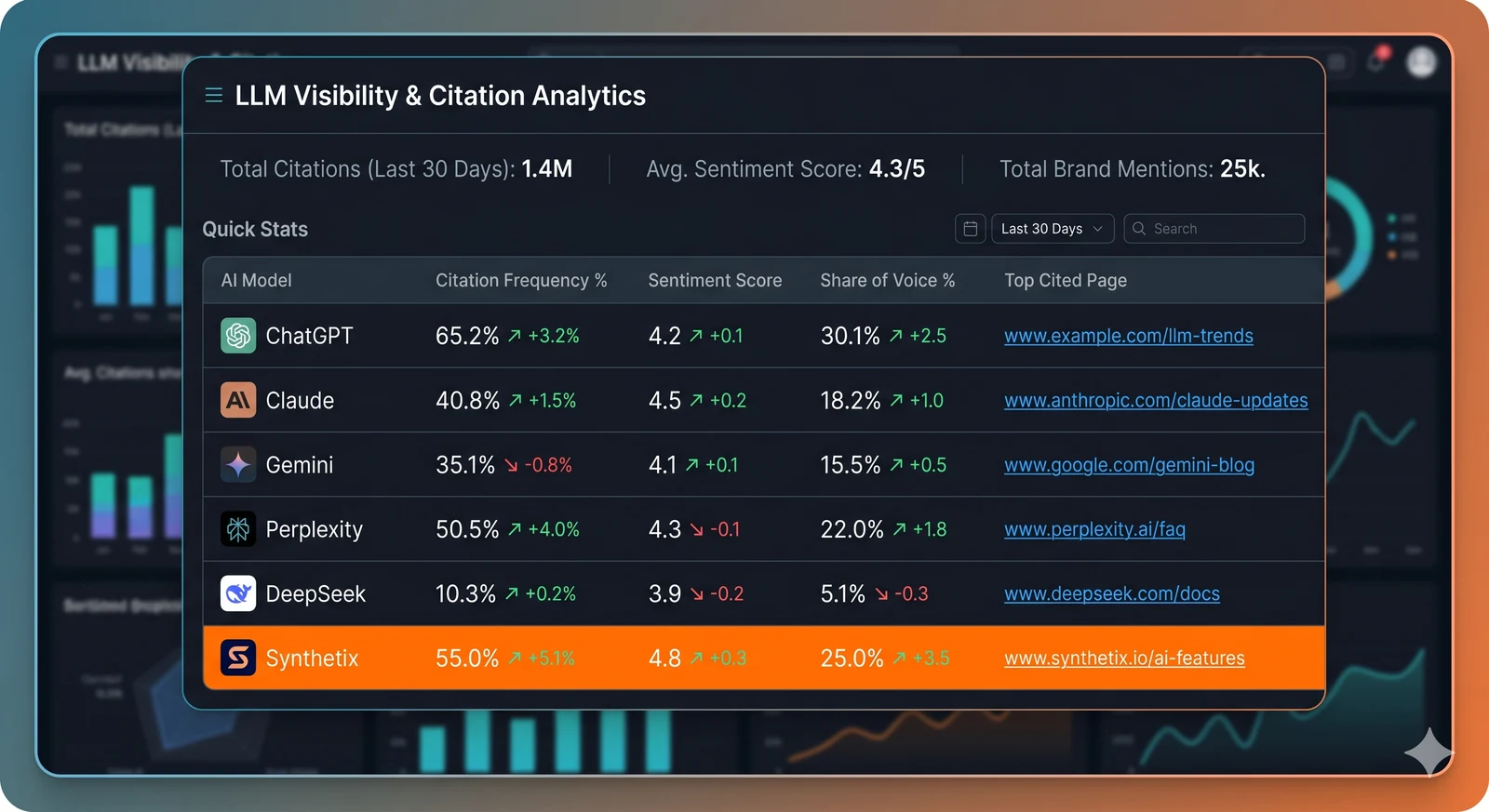
This view — your actual cross-platform visibility profile — is the strategic asset. It tells you exactly where the largest gaps are and which platforms to prioritize.
Platform prioritization by buyer type
The multi-engine dashboard isn’t just about measuring — it’s about making investment decisions. Different platforms matter more for different buyer segments:
- Enterprise software buyers: Copilot and Gemini (Microsoft 365 and Google Workspace users)
- Technical evaluators: DeepSeek and ChatGPT (developer and engineering research)
- B2B researchers: Perplexity (high-intent, high-conversion research behavior)
- General commercial queries: ChatGPT and Gemini (broad commercial query coverage)
A brand selling to enterprise engineering teams should weight DeepSeek and Copilot more heavily than a brand selling to marketing agencies, which should weight Perplexity and ChatGPT more heavily.
The competitive intelligence layer
The most valuable use of multi-engine tracking data is competitive intelligence: running the same query set against your top three competitors and comparing citation rates across all six platforms. This comparison almost always reveals asymmetric competitive positions — a competitor that is systematically stronger on Gemini and Copilot, for instance, is probably winning more enterprise deals from Google Workspace and Microsoft 365 users than your single-engine tracking would ever reveal.
Why this matters for brands: The brands building multi-engine AI visibility dashboards in 2026 are building competitive intelligence infrastructure that will inform content strategy, channel investment, and product messaging for years. The ones tracking only ChatGPT are watching one channel of a six-channel conversation.
How to Build Your Multi-Engine AI Tracking System
A practical checklist for going from single-engine to full-spectrum AI visibility:
- Audit your current tracking — List which AI platforms you currently track. For most teams, this is one or two. That’s your baseline gap.
- Define a unified query set — 100–300 queries covering problem-first, category, comparison, and brand-name searches that apply across all platforms.
- Choose a multi-engine platform — Select an AI visibility tool that tracks all major engines (ChatGPT, Gemini, Perplexity, Claude, DeepSeek, Copilot) in a single dashboard. Running separate tools per platform is viable for pilots but not for operations.
- Run a cross-engine baseline — Execute your full query set across all tracked platforms. Record citation frequency, position, and sentiment for your brand and top three competitors.
- Build your visibility matrix — Map your citation frequency by platform and by query type. The cells with the lowest values relative to competitors are your priorities.
- Prioritize by audience match — Weight investment toward the platforms where your specific buyer segments are most active.
- Develop platform-specific content — The content that drives Claude citations is different from the content that drives Perplexity citations. Treat each platform’s optimization as a distinct content brief.
- Measure monthly across all engines — Cross-engine visibility tracking is only valuable as a trend signal. Monthly measurement is the minimum cadence.
Your Next Step
The AI search landscape in 2026 is a six-platform problem, and most brands are solving one of them. Claude, Gemini, DeepSeek, and Copilot are shaping buyer decisions for millions of queries that your current tracking stack is completely missing.
Run a free AI visibility audit at sanbi.ai to see where your brand stands across ChatGPT, Gemini, Perplexity, and Claude — with citation frequency, share of voice, sentiment scores, and the competitive gap that shows exactly where to invest next.
Sanbi.ai monitors your brand’s AI visibility daily across ChatGPT, Gemini, Perplexity, and Claude — tracking visibility scores, sentiment, citations, agent accessibility, and competitor movements so you always know where you stand in the agent-first web.
Frequently Asked Questions
Each AI platform has different training data, retrieval systems, citation behavior, and user bases. A brand that is prominently cited in ChatGPT may be nearly invisible in Claude because the two systems weight different authority signals and content formats. Gemini integrates tightly with Google's index, giving it different source preferences than DeepSeek, which reflects a Chinese-influenced training data mix. Copilot is deeply embedded in enterprise Microsoft workflows, reaching a completely different buyer context. Tracking only ChatGPT and Perplexity means systematically missing visibility decisions your buyers are making on four other major platforms.
Claude rank tracking measures how often and how prominently your brand is cited in Claude's responses across a defined set of queries. Unlike Google rank tracking, there are no positions — only citation presence, citation sentiment, and citation frequency. A Claude rank tracker runs your tracked query set against Claude's API or consumer interface, parses the responses for brand mentions and source citations, and tracks changes over time. Because Claude draws heavily from its training data rather than live web retrieval, citation patterns are more stable than Perplexity but also harder to move quickly through content changes alone.
Google AI Overviews (AIO) are the AI-generated summaries that appear in Google Search results. Gemini is Google's conversational AI assistant — a different product with a different interface, different use cases, and different source selection. AIO tracking measures your presence on Google's search results page. Gemini rank tracking measures your presence in direct conversational AI queries on the Gemini platform. A user doing vendor research on Gemini directly is a different behavior from a user seeing an AIO summary in a Google search. Both are important, but they require different tracking approaches.
DeepSeek rank tracking measures how your brand appears in DeepSeek's AI-generated responses across your tracked query set. DeepSeek's user base skews toward technically sophisticated researchers, developers, and engineers — and toward Asia-Pacific and Chinese-market audiences. For B2B brands with technical products or APAC market exposure, DeepSeek rank tracking is particularly valuable. DeepSeek processes both English and Chinese-language queries, and its citation behavior reflects training data that heavily weights Chinese technical sources, Zhihu, and academic repositories alongside global English content.
Copilot (Microsoft Copilot, formerly Bing Chat) is integrated into Microsoft 365, Windows, Edge, and Bing — giving it reach into enterprise workflows that no other AI platform matches. Copilot SEO rank tracking measures your brand's presence and citation frequency in Copilot responses across your tracked query set. Because Copilot is embedded in tools like Word, Excel, Teams, and Outlook, it's particularly relevant for B2B brands whose buyers use Microsoft 365 environments. A buyer asking Copilot within Teams to research vendors in your category is a high-intent research moment that no other AI tracking system will capture.
Comparing Claude vs Gemini vs ChatGPT vs Perplexity for brand visibility requires running the same query set across all four platforms and measuring citation frequency, citation position, and sentiment for your brand and competitors on each. The comparison typically reveals significant variance — a brand can have 40% citation frequency on ChatGPT and under 10% on Claude for the same queries. This variance maps to different content optimization requirements for each platform. A multi-engine AI rank tracking platform that runs the same queries across all engines simultaneously provides the most efficient cross-platform comparison.
Brand visibility varies across AI platforms because each platform has fundamentally different training data sources, retrieval systems, and content weighting. ChatGPT draws heavily from its training data with supplemental browsing. Perplexity uses live web retrieval. Claude's training data reflects Anthropic's curation choices, which weight certain types of content differently from OpenAI's. Gemini integrates with Google's index. DeepSeek reflects a training mix that includes significant Chinese-language sources. These differences mean a brand that has built content and authority signals optimized for one platform is not automatically visible on others.
Tools for tracking AI search visibility across ChatGPT and Gemini simultaneously require a multi-engine architecture that runs the same query set against both platforms and normalizes the results for comparison. This is the core capability of full-spectrum AI visibility platforms like Sanbi.ai, which tracks ChatGPT, Gemini, Perplexity, and Claude in a unified dashboard with competitive benchmarking. Single-engine tools that track only ChatGPT or only Gemini don't give the cross-platform comparison data needed to prioritize content investment across the full AI search landscape.
Claude and ChatGPT have meaningfully different citation behaviors. ChatGPT (with browsing enabled) uses live web retrieval similar to Perplexity, making it responsive to recent content. Claude draws more heavily from its training data for responses and is more conservative about citing specific URLs unless in retrieval-augmented configurations. This means Claude brand visibility is more dependent on being represented in the broader training-data corpus — which correlates with established domain authority, long-standing web presence, and citation across many sources over time — rather than being immediately responsive to new content publication.
For B2B brands, Gemini vs ChatGPT vs Perplexity visibility maps roughly to three different buyer behaviors: ChatGPT users tend to be early-adopter knowledge workers doing broad research; Perplexity users tend to be high-intent researchers actively evaluating options; Gemini users tend to be embedded in Google Workspace workflows and doing research within that ecosystem. A brand's visibility strategy should account for all three because B2B buyers typically use multiple AI platforms across a single purchase journey. Being strong on one and invisible on the others means losing the research moments that happen on your weak platforms.
Truly free, unlimited AI rank tracking tools covering Claude and DeepSeek are effectively nonexistent. Free tools that cover these platforms typically offer very limited query volumes (5–20 per run) as trial tiers of paid products. The cost of API access for batch-running queries across multiple AI platforms means that comprehensive multi-engine tracking has inherent infrastructure costs that prevent fully free commercial tools at scale. For budget-constrained teams, the most practical approach is a free-tier trial of a multi-engine platform like Sanbi.ai to establish a baseline, then evaluate the ROI of ongoing tracking. ChatGPT competitors free of charge in a meaningful tracking sense remains aspirational rather than actual.