Google AI Overviews Tracking in 2026: Tools, Metrics & the Complete AIO Tracker Guide
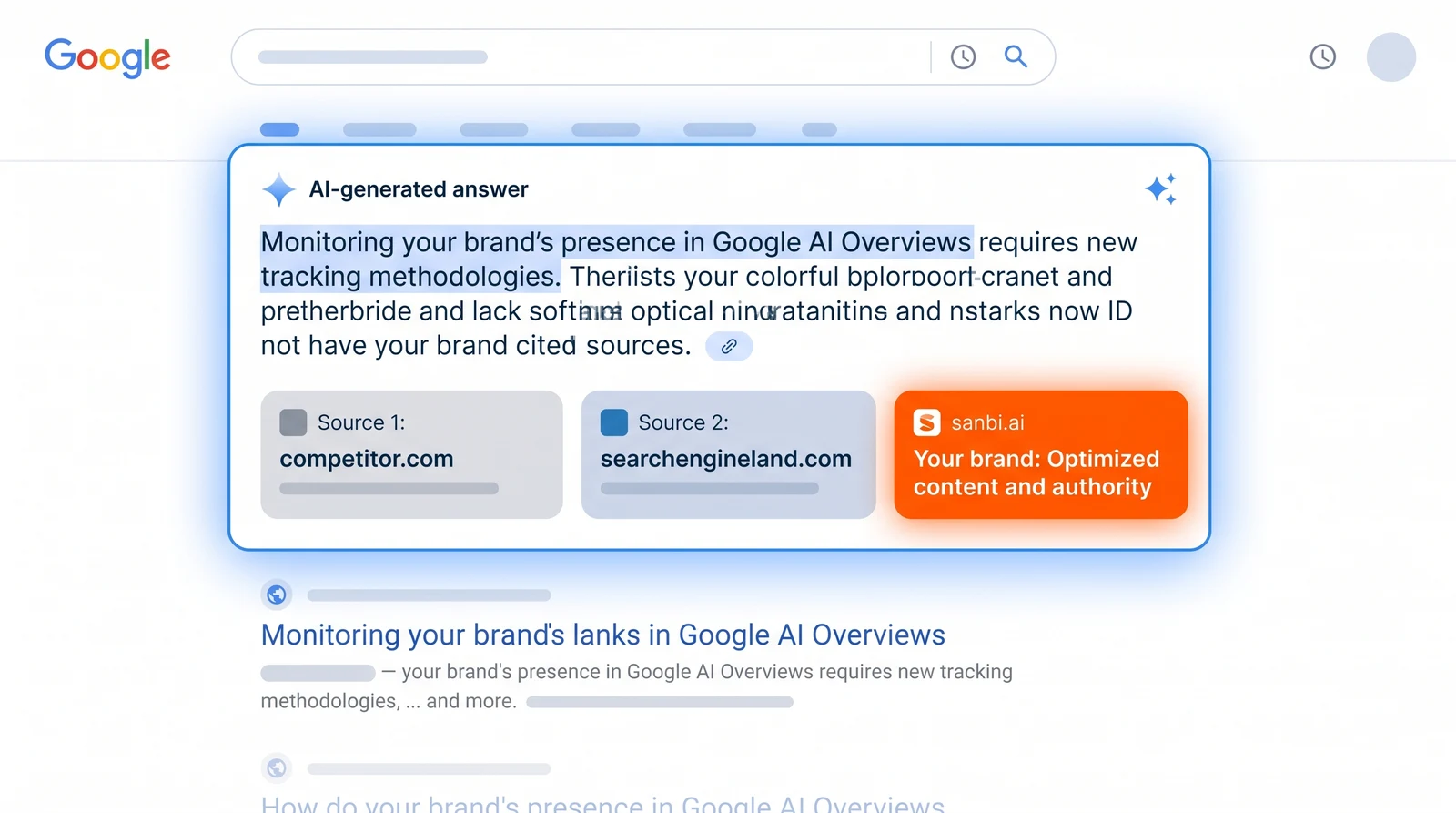
Google’s search results page doesn’t look like it did two years ago. For a rapidly growing share of queries, the first thing a user sees is an AI-generated summary — not a list of blue links. And for most brands, that AI Overview is either citing them, ignoring them, or actively redirecting attention to competitors.
The problem is that your current rank tracker doesn’t know the difference.
Google AI Overviews are the highest-impact change to search visibility in a decade. They appear above all organic results, they synthesize answers from sources Google selects — not just ranks — and they’re changing click behavior in ways that traditional SEO metrics don’t fully capture. Tracking your AIO visibility is no longer optional. It’s the thing your SEO dashboard was built to measure and currently can’t.
This is the complete guide: what AI Overviews tracking is, the metrics that matter, how the best AIO trackers work, how to improve your inclusion, and how AIO fits into the bigger AI-visibility picture alongside ChatGPT, Gemini, Perplexity, and Claude.
1. What Google AI Overviews Actually Are — and Why They Break Standard SEO
The mechanics of AI Overviews
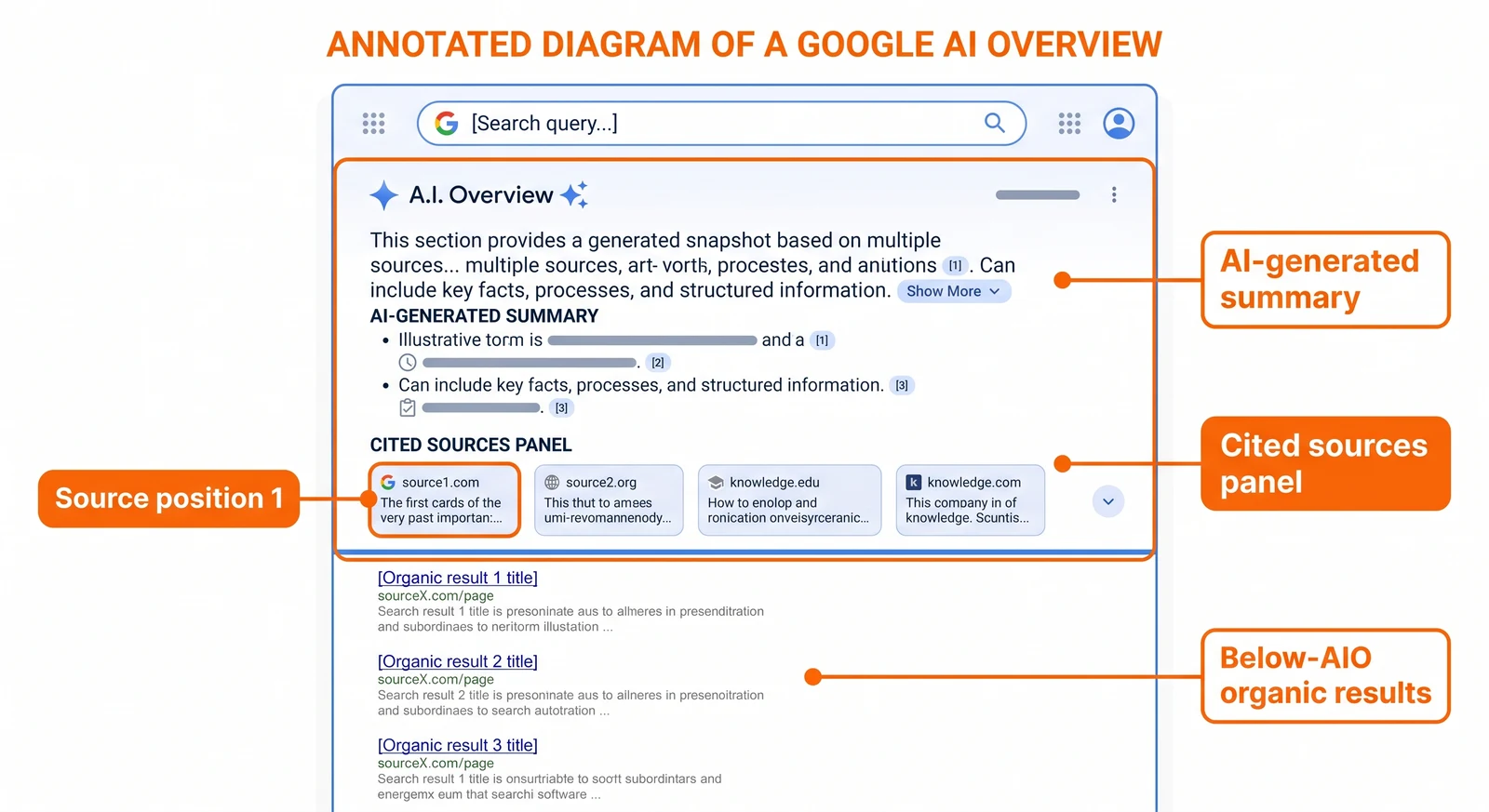
Google AI Overviews appear at the top of search results pages for qualifying queries — primarily informational and research queries, increasingly commercial ones. They synthesize an answer from multiple sources, show a brief text overview with inline citations, and link out to the cited sources. They sit above all standard organic results.
The key distinction from traditional snippets: AI Overviews don’t simply quote the #1 ranking page. Google selects sources for the overview based on a separate evaluation of answer quality and trust signals. A page ranking #5 organically can be the top-cited AIO source. A page ranking #1 can be entirely absent from the AIO for the same query.
AIO, AI Overview, AI Overviews tracking — is there a difference?
No. “AIO” is just the abbreviation of “AI Overview.” Whether you searched for ai overview tracking, aio tracking, google aio monitoring, track google ai overviews, or google ai overviews tracker — it is all the same discipline: monitoring the AI answer box and your brand’s place in it. This guide uses the terms interchangeably, because Google’s results do too.
The visibility gap this creates
Before AI Overviews, the first organic position was the single most valuable real estate on the results page. The AIO changes that equation. A brand cited in an AI Overview for a high-volume query is receiving more prominent visibility than any standard organic position — even #1 — because the overview appears above all organic results and synthesizes the answer the user was looking for.
A brand absent from the AIO but ranking #1 organically is now in second-visible position for that query, behind whatever the AIO synthesized from other sources.
Why traditional rank trackers miss this entirely
Standard SEO rank tracking measures position 1–10 on the blue-link list. It has no native concept of the AIO surface that now sits above that list. Most legacy rank trackers will report a brand as “ranking #3” for a query while the AIO is citing a competitor and delivering the answer to 70% of searchers who never scroll to the organic results. Google AI overview tracking requires a tool that explicitly detects AIO presence and parses citation sources — a fundamentally different measurement task.
Why this matters for brands: The CTR impact of AI Overviews is real and growing. Clicks on traditional organic results for AIO-covered queries are declining. The strategic response is to get INTO the AIO — not to optimize around it. And you can’t get into something you aren’t measuring.
2. The Metrics That Actually Matter for AIO Tracking
AI overviews tracking is not a single metric. It’s a measurement system with several distinct dimensions.
AIO Presence Rate
For a given set of tracked queries, what percentage trigger an AI Overview at all? This tells you the coverage of the AIO surface in your category. Some categories have high AIO coverage (broad informational queries, how-to content); others have lower coverage (purely commercial or navigational queries).
AIO Inclusion Rate
Of the queries that do trigger an AIO, what percentage cite your domain as a source? This is your fundamental AIO visibility metric. A high AIO presence rate in your category with a low inclusion rate is your biggest SEO opportunity.
AIO Citation Position
Where in the AI Overview does your source appear? Lead-cited sources (appearing in the first sentence or as the primary cited reference) receive more traffic and authority than supporting citations. AIO tracking tools that report inclusion without position are missing the most actionable dimension.
AIO Query Type Coverage
Which types of queries are generating AIOs that cite you? Informational, commercial, navigational? Understanding your AIO coverage by query intent helps prioritize content investment.
Click-Through Impact
Comparing CTR on your organic results for queries with vs. without an AIO gives you the delta: how much organic traffic the AIO is redirecting. This is the business-case metric for AIO investment — measuring the traffic loss from AIO exclusion.
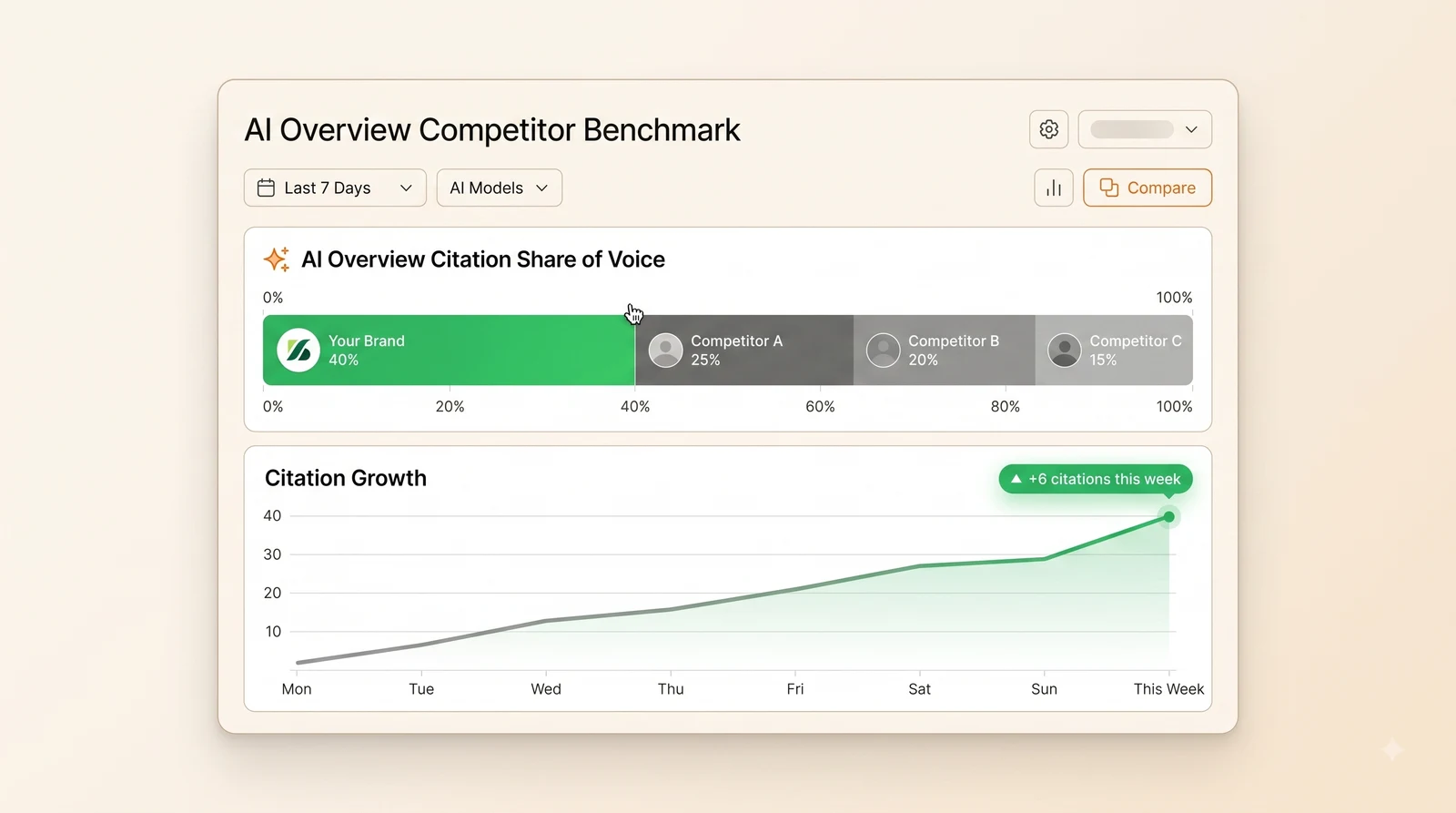
Competitive AIO Share of Voice
Your AIO inclusion rate vs. competitors for the same query set. This is the metric that turns everything above into competitive intelligence.
| Metric | What It Measures |
|---|---|
| AIO presence rate | How often AIOs appear for your query category |
| AIO inclusion rate | How often you’re cited when an AIO appears |
| AIO citation position | Your prominence within individual AIOs |
| Query type coverage | Which query intents trigger AIO citations for you |
| CTR impact | How AIO presence affects your organic click rates |
| Competitive SoV | Your AIO inclusion rate vs. competitors |
What an AIO tracker records on every run
Turning those metrics into a time series means recording, per keyword and per location, on every scheduled run:
| Field | What it tells you |
|---|---|
| AIO present? (yes/no) | Whether the keyword triggers an AI Overview at all |
| Brand cited? (yes/no) | Whether your domain is one of the cited sources |
| Citation position | Where in the answer your citation sits |
| All cited domains | The full source list — including every competitor |
| Location | US, region, or city the result was pulled for |
| Trend | Week-over-week change vs. prior runs |
| Change alert | Fires when you gain or lose a citation, or a rival enters |
The two fields most bolt-on trackers get wrong are all cited domains (they record only your presence, not the competitive field) and change alerts (they snapshot but do not notify). Those two are where the actual strategy lives.
Why this matters for brands: AI overviews site rank tracking software that reports only presence/absence is measuring one dimension of a six-dimensional problem. The competitive intelligence value — knowing that a competitor is cited in 60% of high-intent AIOs in your category while you’re at 15% — only comes from the full measurement stack.
3. The Best AI Overviews Tracking Tools in 2026
What a real AIO tracker does
The best AI overviews tracking tools in 2026 go beyond keyword-level AIO detection. A genuine AI overview rank tracking tool:
- Detects AIO presence for each tracked query
- Parses the cited sources from each AIO
- Identifies your domain’s presence (or absence) per query
- Tracks citation position within the overview
- Compares your inclusion rate against defined competitors
- Reports historical trends so you can measure improvement
- Segments results by query intent, query category, or device type
An AI overviews checker that only detects whether an AIO exists without parsing who is cited in it is missing the most important information.
Semrush AI Overviews
Semrush AIO tracking integrates AI Overviews detection into keyword rank tracking workflows. For each tracked keyword, Semrush can show whether an AIO is present and, in many cases, which domains are cited. Semrush ai overviews is a strong starting point for brands already using Semrush — it adds AIO visibility to an existing workflow without requiring a new tool.
The limitation: Semrush’s AIO source-citation parsing is less granular than dedicated AIO trackers, and competitive AIO benchmarking is better suited to platforms built specifically for AI visibility. For teams that need deep AIO competitive intelligence rather than just keyword-level AIO detection, Semrush AIO is an indicator, not an audit system.
Bolt-on AIO tracking in legacy rank trackers (AWR, Rank Ranger, STAT)
Classic rank-tracking suites — AWR (Advanced Web Ranking), Rank Ranger, STAT Search Analytics, and their peers — have added AI Overviews tracking on top of their traditional keyword-position product. If you already live in one of those tools, that is a convenient way to get AIO presence and basic citation data next to your organic ranks.
The trade-off is scope:
| Bolt-on AIO (legacy SERP suite) | Dedicated AI-visibility platform | |
|---|---|---|
| AI Overviews presence | ✅ | ✅ |
| Per-location AIO | ✅ | ✅ |
| Full competitor citation parsing | ⚠️ Partial | ✅ |
| ChatGPT / Gemini / Perplexity / Claude | ❌ | ✅ |
| Prompt-level share of voice | ❌ | ✅ |
| Citation analytics per engine | ❌ | ✅ |
| Change alerts on AI visibility | ⚠️ Limited | ✅ |
Legacy suites are built around the ten-blue-links model and treat AI Overviews as an add-on to the SERP. A dedicated platform is built engine-first: AI Overviews is one of several surfaces it tracks natively. Plenty of teams run both — a classic tracker for organic rank, a dedicated platform for AI visibility.
seo.com’s AI Overview Checker
seo.com’s ai overview checker is a URL-based tool for checking whether a specific page is being cited in AI Overviews. It’s useful for one-off validation — “is our product page appearing in AIOs for these queries?” — but is not designed for ongoing tracking at scale. Good for audits, not for a measurement cadence.
Best free AI Overviews rank tracker tools
Genuinely free AI overviews rank tracking is limited. Most free AI overview rank tracking tools are trial tiers of paid platforms or are limited to very small query caps. For ongoing AI overview tracking free of charge, the most practical approach is periodic manual auditing combined with Google Search Console data — supplemented by a paid tool for competitive benchmarking. See our roundup of free AI visibility checkers and rank trackers for what the no-cost tiers actually include.
Full-spectrum AI visibility platforms
Platforms like Sanbi.ai track Google AIO alongside Perplexity, ChatGPT, Gemini, and Claude in a single dashboard. This matters because a brand’s AIO visibility doesn’t exist in isolation — buyers who find your competitor cited in a Google AIO may then validate that in Perplexity and ChatGPT before making a decision. Best AEO tools with Google AI Overviews monitoring give you the full picture, not just one surface. Sanbi.ai is also a common Profound alternative for teams that want AIO depth plus multi-engine coverage without enterprise pricing.
Tracking AI Overviews by location (and why US-first matters)
AI Overviews are location-dependent and rolled out US-first: the same keyword can trigger an AI Overview citing one set of sources in Texas, a different set in London, and no AI Overview at all in a third market. A proper AIO tracker lets you set the location — country, and often city or region — per keyword set. For US-based SEO managers this means tracking exactly the AI Overviews your US audience sees; for multi-region brands it means comparing AIO behavior across markets instead of assuming one market generalizes.
AIO SEO Analyzer: What a Deep Audit Tool Actually Checks
An AIO SEO analyzer is distinct from an ongoing AIO rank tracker. Where a tracker measures whether you’re currently cited, an AIO SEO analyzer evaluates why you are or aren’t — and what to fix. A strong AIO SEO analyzer examines:
- Structured data coverage: Are your key pages implementing FAQ, HowTo, and Article schema correctly?
- Answer-format content quality: Do your pages lead with direct answers, or bury them in long introductory paragraphs?
- E-E-A-T signal audit: Do your pages have attributed authors, verifiable claims, and citation from external sources?
- AIO competitor gap map: Which competitor pages are being cited for the queries where you’re absent?
- Crawlability for Google’s AIO system: Are your key pages indexed, mobile-fast, and returning clean 200 responses?
The best aio on the market for AIO-specific auditing combines this structural analysis with citation data — so you get both “here’s why you’re not included” and “here’s the specific page you need to create or update” in a single workflow.
How to Track AI Overviews: Building a Repeatable Cadence
How to track AI overviews on an ongoing basis comes down to establishing a measurement cadence that catches changes before they compound. AI Overviews are volatile — presence and cited sources can change from one crawl to the next as Google refreshes — so a single snapshot is misleading. A practical AI overviews tracking cadence:
Weekly: Run your full query set through your AI overview tracking tool. Flag any queries where your AIO inclusion status changed (gained or lost citations). Note competitor citation changes. Daily runs are worth it for high-priority keywords or during active optimization.
Monthly: Review AIO inclusion rate trends across query intent types. Assess whether new AIO-covered queries have emerged in your category. Update your content gap list.
Quarterly: Run a full AIO SEO analyzer audit against your highest-priority pages. Refresh structured data. Review E-E-A-T signals. Compare share of voice against competitors across the full quarter.
How to track performance in Google AI Overviews consistently is less about the tool and more about the cadence — the brands that check quarterly and act on what they find will systematically widen their AIO inclusion advantage over brands that treat it as a one-time audit.
Why this matters for brands: The best AIO on the market for your team is the one that matches your query volume, provides competitive benchmarking, and ideally integrates AIO tracking with the rest of your AI search visibility data rather than siloing it.
4. AI Overviews Are Only One Surface
Here is the strategic mistake that trips up teams who buy a pure AI-Overviews-only tracker: AI Overviews are one of several AI answer surfaces your buyers use — and often not the one where the highest-intent research happens.
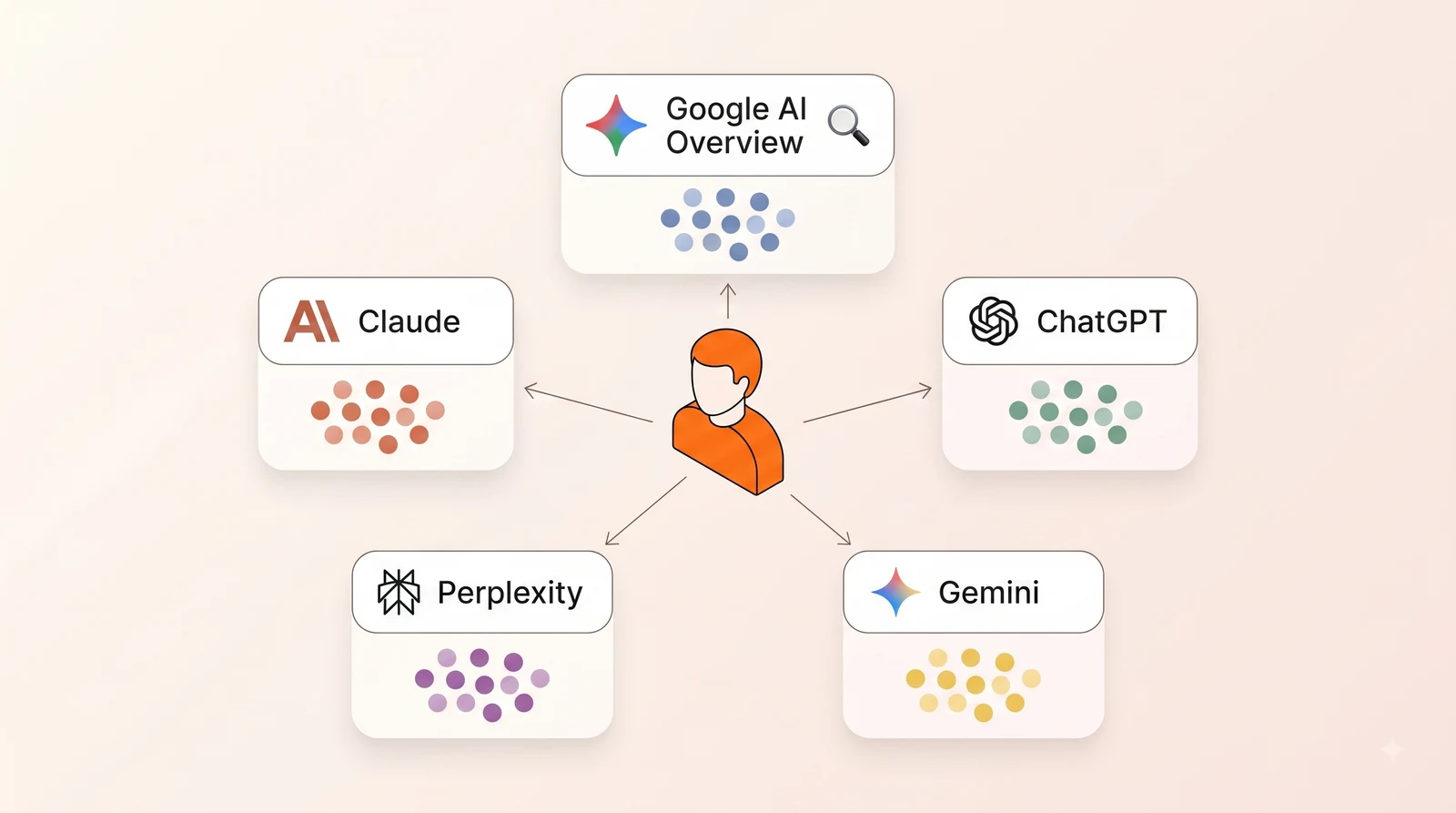
A modern buyer researching your category might:
- Google a question and read the AI Overview.
- Open ChatGPT and ask it to compare options.
- Ask Perplexity for sources and reviews.
- Use Gemini inside their Google workspace.
- Ask Claude for a careful, sourced analysis.
Each of these engines cites a different internet. In our 120,000-citation engine study, the same category was answered from almost non-overlapping source pools across engines — Reddit and YouTube dominate Perplexity, category-canonical and official domains dominate ChatGPT, specialist publications and Google properties dominate Gemini, and patents and analyst reports dominate Claude.
A tracker that only watches AI Overviews cannot see any of that. This is the single biggest reason to choose a multi-engine AI-visibility platform over a SERP-bolted AIO feature.
Where to go deeper on each surface:
- ChatGPT: “rank” means presence, prominence, and share of voice across a prompt set, not a numbered position — our ChatGPT rank tracking guide covers the full method, and the brand visibility in ChatGPT guide covers the manual audit.
- Gemini: the same metric family, with one Gemini-specific angle — it cites specialist publications and Google properties (including YouTube) heavily, so tracking which third-party domains Gemini cites for your category hands you an earned-media target list. See how to track brand mentions in Gemini.
- Google AI Mode: Google’s conversational search surface behaves differently from AI Overviews and needs its own prompt set — see what AI Mode is and how to track Google AI Mode.
- Preferred Sources: readers who mark you as a Google Preferred Source see your content labelled inside their AI Overviews and AI Mode answers.
The umbrella term for all of this is LLM SEO rank tracking — tracking your brand across every LLM answer surface the way classic rank tracking tracked the ten blue links. It is the measurement half of AEO and GEO: you optimize, then you verify the optimization landed.
5. How to Improve Your Inclusion in Google AI Overviews
AIO inclusion is an outcome of content quality, E-E-A-T signals, and structural optimization. It is not a separate tactic stack from core SEO — it is SEO done rigorously, combined with a few AIO-specific optimizations.
The E-E-A-T foundation
Google’s AI Overviews draw from sources it trusts. Trust is operationalized through E-E-A-T: Experience, Expertise, Authoritativeness, Trustworthiness. Pages with strong E-E-A-T signals — attributed authors with relevant credentials, cited in high-authority publications, accurate and verifiable claims — are disproportionately selected for AIO citations. This is not a new requirement: it’s the same signal set Google has used for featured snippets and knowledge panels, now extended to AIO source selection.
Answer-first content structure
The pages most commonly cited in AI Overviews provide direct, complete answers in the opening paragraphs of each section. The inverted-pyramid structure — lead with the conclusion, expand below — is what Google’s AIO system extracts from. Long windup paragraphs before the actual answer hurt AIO inclusion.
FAQ and structured data
Implementing FAQ schema on pages with question-based content is one of the most reliable AIO inclusion tactics. Google’s AIO system actively uses structured data to identify and extract high-quality Q&A content for inclusion. HowTo schema on tutorial and process content serves the same function. These are among the highest-ROI structured data investments specifically for AIO optimization.
Organic ranking as a prerequisite
Unlike Perplexity, which uses live web retrieval, Google AI Overviews draw primarily from Google’s existing index and ranking signals. Strong organic ranking for a query is a prerequisite — not a guarantee, but a prerequisite — for AIO inclusion. Pages that don’t rank in the top 20 organically rarely appear in AIOs for the same query. AIO optimization and organic SEO are complementary, not alternative strategies.
Note that this link between rank and inclusion is much weaker on Google’s other AI surface: AI Mode retrieves far more independently than the AI Overview does, sharing only about half its cited domains with the top 10. Our guide to ranking in Google AI Mode covers the difference and what it changes.
Content freshness
Google’s AIO system appears to favor recently updated content, particularly for queries where the answer may have changed over time. Regular content refreshes on high-priority pages are both an organic SEO signal and an AIO inclusion signal.
Why this matters for brands: How to track performance in Google AI Overviews is the measurement question. How to improve that performance is the strategic question. The answer to both is the same framework: measure AIO inclusion rates, identify the content gaps, build the content that fills them, and measure again.
6. Tracking AIO Impact Across the Full Search Funnel
What “AIO traffic” actually means
A lot of people search aio traffic expecting a new analytics metric. Here is the honest definition:
AIO traffic is the clicks and referral sessions that come from a citation link inside a Google AI Overview.
When the AI Overview cites your page, that citation is clickable; a user who clicks it lands on you. That session is AIO traffic. But here is the catch that reframes the whole exercise: AI Overviews are overwhelmingly zero-click. Most users read the synthesized answer and never click a source. So AIO traffic is typically a small fraction of your AIO visibility.
That is why, in 2026, being cited matters more than the click. The brand-awareness and consideration value of being named in the answer — at the exact moment a buyer is researching — exists whether or not anyone clicks. We wrote a full breakdown of this shift in the zero-click search era. The practical consequence: measure citation presence and share of voice, not just AIO referral sessions. In Google Analytics 4, AIO traffic lands under organic/google referral and is hard to isolate without a dedicated tracker — anyone selling you an “AIO traffic tracker” that only counts clicks is measuring the smaller half.
AIO and click behavior
The downstream effect of AI Overviews on click behavior is the most commercially important thing to measure. For queries where your domain is cited IN the AIO, you typically receive a source-link click from a user who has already read the synthesized answer and selected your source for more detail — a high-intent, pre-qualified click. For queries where you’re absent from the AIO, your organic result below the fold receives fewer clicks than it would have before the AIO existed.
Measuring this requires comparing CTR on the same queries before and after AIO introduction, and segmenting by AIO-cited vs. AIO-uncited status.
AI Overviews and competitor discovery
A less-discussed AIO impact: Google AI Overviews accelerate competitor discovery. When a buyer searches for a solution and the AIO synthesizes an answer that cites three competitors but not your brand, the buyer has been exposed to three brands they may not have known, without your brand in the frame. The absence effect compounds over repeated searches.
How to track competitor performance in AI Overviews
The highest-leverage move most teams miss: parse every domain the AI Overview cites, not just your own.
For each keyword, record which competitors are cited, in what position, and how often across your set. Aggregate into share of voice: what percentage of your tracked AI Overviews cite you vs. each rival. Over time this reveals:
- Whether you are gaining or losing ground against specific competitors inside AI Overviews.
- Which competitors’ content the AI treats as authoritative — a direct signal of what to build and where to earn citations.
- Emerging threats — a rival who suddenly appears across your keyword set signals a content or PR push worth investigating.
This is the difference between “am I visible?” (a vanity check) and “am I winning?” (a strategy).
Using AIO tracking data for content strategy
The most practical use of AIO tracking data beyond measurement is content prioritization. Every query in your tracked set where an AIO appears but doesn’t cite you is a content gap — a specific question Google has decided it can answer without your input. Running your full tracked query set through an AI overview tracking tool and exporting the “AIO-present, not cited” subset gives you a prioritized content calendar that is directly tied to your largest AIO visibility gaps.
Why this matters for brands: AIO tracking data is one of the most concrete inputs to content strategy available in 2026 — it converts abstract “optimize for AI” guidance into specific, auditable content priorities. Google aio visibility measurement is the bridge between SEO investment and AI search outcomes.
7. Building an AIO Tracking System That Scales
A practical framework for operationalizing AI overviews tracking:
- Define your tracked query set — Prioritize informational and commercial queries in your category where AIOs appear. Start with 50–200 queries.
- Set your locations — AI Overviews vary by geography and are US-first. Track the markets your buyers are actually in, not a generic default.
- Choose an AIO tracking tool — Evaluate on AIO detection accuracy, source-citation parsing, update frequency, and competitive benchmarking capability.
- Establish a baseline — Run your full query set and record AIO presence rate, inclusion rate, and citation position. This is your starting point.
- Benchmark competitors — Run the same queries with competitor domains flagged. The gap between their AIO inclusion rate and yours is your competitive priority.
- Export the content gap list — Every query where an AIO cites competitors but not you is a content priority. This list is your roadmap.
- Implement structured data — FAQ and HowTo schema on your highest-priority pages is typically the fastest AIO inclusion lever.
- Track Google Search Console AIO data — Cross-reference AIO tool data with Search Console impression and CTR data for queries where AIOs are active. Segment out machine-generated queries first — our GSC study found nearly 1 in 4 queries were sent by AI agents, and they contaminate CTR reads.
- Measure weekly, review monthly — AIO inclusion rates shift as content is published, updated, and as Google’s AIO system evolves. A weekly run with change alerts is the practical baseline; monthly reviews turn the trend into decisions.
Your Next Step
Google AI Overviews are already reshaping click behavior and brand visibility for your category. The brands that appear in them control the first thing a searcher reads about their product space. The brands that don’t are visible only below the fold — if at all.
Run a free AI visibility audit to see where your brand stands in Google AI Overviews alongside ChatGPT, Perplexity, Gemini, and Claude — your AIO inclusion rate, your competitive gap, and the specific content investments that will close it, in about two minutes.
Sanbi.ai monitors your brand’s AI visibility daily across ChatGPT, Gemini, Perplexity, and Claude — tracking visibility scores, sentiment, citations, agent accessibility, and competitor movements so you always know where you stand in the agent-first web.
Frequently Asked Questions
Google AI Overviews tracking (AIO tracking) is the practice of monitoring, on a scheduled cadence, whether an AI Overview appears for a given query, which sources it cites, whether your brand or domain is one of those cited sources, and how that changes over time. Unlike classic rank tracking — which records your organic position in the blue-link results — AIO tracking measures presence and citation inside the AI-generated answer box that now sits above those links. A proper AIO tracker records, per keyword and per location: AIO present (yes/no), your brand cited (yes/no), citation position within the answer, the full list of cited domains (competitors included), and week-over-week trend.
An AIO tracker is software that runs a defined set of keywords against Google Search on a schedule, detects whether an AI Overview (AIO) is triggered for each keyword, and parses the AI Overview to record which sources it cites. The best AIO trackers do this per geographic location (AI Overviews vary by location and are US-first), store the results as a time series, and alert you when your citation status changes — for example, when you gain or lose a citation, or when a competitor enters the AI Overview for a keyword you care about. Sanbi.ai is an AIO tracker that also extends coverage to ChatGPT, Gemini, Perplexity, and Claude in the same dashboard.
There is no difference — 'AIO' is simply the common abbreviation for 'AI Overview.' 'AIO tracking,' 'AI Overview tracking,' 'Google AI Overviews tracking,' and 'AIO monitoring' all refer to the same thing: monitoring the AI-generated answer that Google shows above the organic results, and tracking whether and how your brand is cited inside it.
Google AI Overviews (AIO) are AI-generated summaries that appear at the top of Google search results for qualifying queries, synthesizing answers from multiple sources before the traditional blue links. They require different tracking because standard rank trackers measure position on the blue-link list — they don't detect whether your brand is included in the AI-generated summary above it. A brand can rank #1 in traditional results and be completely absent from the AI Overview for the same query, or rank #8 and be prominently cited in the AIO. These are two different visibility surfaces requiring two different measurement systems.
Tracking Google AI Overviews requires an AI overviews tracker that (1) detects when an AIO appears for a given query, (2) parses which sources are cited in the overview, and (3) tracks your domain's presence or absence across your tracked query set. Google Search Console provides some AIO impression data but doesn't reliably distinguish AIO-driven clicks from standard organic clicks. Dedicated AI overview tracking tools that run your query set regularly and parse AIO citations are the most accurate method.
Standard SEO rank tracking measures your position (1, 2, 3...) on the traditional blue-link results page. AIO tracking measures something orthogonal: whether your brand is cited in the AI-generated summary that now appears above those blue links. A site ranking #5 organically can be the top-cited source in the AI Overview for the same query. A site ranking #1 organically can be entirely absent from the AIO. These are independent visibility surfaces — getting one right doesn't guarantee anything about the other.
'AIO traffic' refers to the clicks and referral sessions that originate from a citation inside a Google AI Overview. When Google's AI Overview cites a source, that citation is a clickable link; a user who clicks it lands on the cited page. That visit is AIO traffic. It is important because AI Overviews are largely zero-click — most users read the synthesized answer and never click through — so AIO traffic is typically a fraction of the visibility. This is why AI Overview visibility (being cited at all) matters more than AIO traffic alone: the brand-awareness and consideration value of being named in the answer exists even when no click occurs. In Google Analytics 4, AIO traffic usually appears under organic / google referral and is hard to isolate without a dedicated AI Overview tracker.
The core AIO metrics are: AIO inclusion rate (what percentage of your tracked queries feature an AIO that cites your domain), AIO position (where in the overview your brand appears — lead source vs. supporting citation), AIO query coverage (which query types trigger AIOs in your category), click-through impact (how AIO presence affects CTR on your organic results below), and competitive AIO share of voice (your AIO inclusion rate vs. competitors for the same query set). AIO tracking tools that report only presence/absence without position or competitive context are underpowered.
The best Google AI Overviews tracker is the one that (1) detects AIO presence per keyword and per location, (2) parses and stores every cited domain, not just your own, so you can benchmark competitors, (3) tracks over time with week-over-week trend and change alerts, and (4) — critically in 2026 — extends beyond AI Overviews to ChatGPT, Gemini, Perplexity, and Claude, because AI Overviews are only one of several AI answer surfaces your buyers use. A tracker that only monitors AI Overviews is measuring a single window in a much larger house. Sanbi.ai was built for the multi-surface case: AI Overviews plus the four major standalone AI engines in one place.
The best AI overviews tracking tools in 2026 combine AIO detection, source-citation parsing, competitor benchmarking, and historical trend tracking in a single interface. Key players include Semrush (strong on AIO presence detection at keyword scale), dedicated AIO trackers like seo.com's AI overview checker (good for one-off audits), legacy rank trackers with AIO add-ons like AWR, Rank Ranger, and STAT (convenient if you already use them, but limited to the Google SERP), and full-spectrum AI visibility platforms like Sanbi.ai that track Google AIO alongside ChatGPT, Perplexity, Gemini, and Claude. Best free AI overviews rank tracker tools typically offer trial periods — few are genuinely unlimited at no cost.
Free AI overview rank tracking is mostly limited to manual query testing — running searches yourself and noting when AIOs appear and who is cited. Google Search Console's performance data captures some AIO-related traffic but isn't designed as an AIO tracker. A few tools offer free AI overview rank tracking with limited query caps — enough to validate a tool but not for ongoing competitive intelligence. Best free AI overviews rank tracker tools typically offer trial tiers of paid platforms rather than genuinely unlimited free plans.
Both exist, but manual checking does not scale. Manually, you can open an incognito window, run a query, and note whether an AI Overview appears and whether you are cited — useful for a spot check on five keywords. Beyond that, you need AI Overviews tracking software, because AIO presence and citations vary by location, change frequently, and need to be recorded as a time series to be useful. AIO tracking software runs hundreds or thousands of keywords on a schedule, across locations, and stores the history so you can see trends, prove progress, and catch losses. For any keyword set larger than about 20, software is a hard requirement.
Semrush AIO tracking added AI Overviews detection to its keyword rank tracking workflows, surfacing when a tracked keyword triggers an AIO in Google search results. Semrush's AI overviews data shows whether an AIO is present for a given keyword and, in some cases, which sources are cited. The limitation of Semrush AIO is coverage depth — it's strong on keyword-level AIO detection but less comprehensive on source-citation parsing and competitive benchmarking specifically around AIO inclusion rates. Semrush ai overviews works well as a first-pass indicator alongside a dedicated AIO tracker for deeper analysis.
AWR and other classic rank-tracking suites (Rank Ranger, STAT Search Analytics) have added AI Overviews tracking as a feature on top of their traditional keyword-position product — useful if you already live in that tool and want AIO presence and basic citation data alongside your organic ranks. The trade-off is scope: legacy suites are built around the ten-blue-links model and treat AI Overviews as an add-on to the SERP, so they generally do not track the standalone AI engines (ChatGPT, Gemini, Perplexity, Claude) where a growing share of buyer research now happens. A dedicated AI-visibility platform like Sanbi.ai is built engine-first: AI Overviews is one of several surfaces it tracks natively, with prompt-level share of voice and per-engine citation analytics that a SERP-first tool is not designed to produce. Many teams run a classic tracker for organic rank and a dedicated platform for AI visibility.
Look for: (1) accurate AIO presence detection per keyword; (2) full citation parsing — every domain the AI Overview cites, not only yours, so you can benchmark competitors; (3) per-location tracking, since AI Overviews vary by geography; (4) time-series history with week-over-week trend and change alerts; (5) scale — hundreds or thousands of keywords on a schedule; (6) multi-engine coverage beyond AI Overviews (ChatGPT, Gemini, Perplexity, Claude), because AIO is one surface among several; and (7) reporting and export so you can prove progress to stakeholders. Bolt-on AIO tracking inside a legacy SEO suite typically covers (1) and (3) but is weak on (2), (6), and change alerting.
Weekly is the practical baseline for most brands; daily is worth it for high-priority keywords or during active optimization when you want to see the effect of changes quickly. AI Overviews are volatile — presence and cited sources can change from one crawl to the next as Google refreshes — so a single snapshot is misleading. A weekly cadence against a stable keyword set smooths that volatility into a trend you can act on and report, and change alerts catch material gains or losses between scheduled runs.
Yes, and you should. AI Overviews are location-dependent and rolled out US-first, so the same keyword can trigger an AI Overview (and cite different sources) in one location and no AI Overview in another. A proper AIO tracker lets you set the location — country, and often city/region — so US-based SEO managers can track exactly the AI Overviews their US audience sees, and multi-region brands can compare AIO behavior across markets.
Track the full set of domains each AI Overview cites — not just your own. For every keyword in your set, record which competitors are cited, in what position, and how often across your keyword set. Aggregate that into a share-of-voice view: what percentage of your tracked AI Overviews cite you vs. each competitor. Over time this shows whether you are gaining or losing ground against specific rivals inside AI Overviews, and it reveals which competitors' content the AI treats as authoritative — a direct signal of where to focus your own content and earned-citation efforts.
Google has not published a definitive AIO source selection algorithm, but patterns from tracking data suggest it weights: existing high organic ranking for the query, strong E-E-A-T signals on the citing page, structured data presence (especially FAQ and HowTo schema), content that directly and specifically answers the query, fresh and recently updated content, and domain authority signals. AIO inclusion is not simply a function of ranking #1 — Google curates sources for the overview based on answer quality and trust signals, which is why lower-ranking pages sometimes appear in AIOs while #1 results do not.
Google AI Overviews favor sources that provide direct, specific answers to queries, have strong E-E-A-T signals (Experience, Expertise, Authoritativeness, Trustworthiness), use structured data markup, and are already ranking well organically. Unlike Perplexity, Google AIO draws heavily from its existing index and ranking signals — so strong organic ranking is a prerequisite, not an alternative. Specific tactics: write answer-first content with direct responses in the opening paragraph, use FAQ schema markup, implement structured data correctly, and publish content that directly addresses high-intent queries in your category.
Google's own data and third-party studies show that AI Overviews reduce organic CTR on results below them — users who get their answer from the AIO are less likely to click through to source pages. The effect is strongest for informational queries and weaker for commercial and transactional queries. However, being cited IN the AIO as a source partially compensates — cited brands receive a visible source link that generates higher-quality clicks than standard organic results. The strategic response is to pursue AIO inclusion rather than trying to optimize around it.
Yes. AI Overviews are predominantly zero-click — most users read the synthesized answer without clicking a source — but being named or cited inside the answer still delivers brand awareness, shapes consideration, and positions you as an authority at the exact moment a buyer is researching. The value has shifted from the click to the mention. This is why AI Overview visibility is measured as citation presence and share of voice, not only as AIO referral traffic, and why zero-click visibility is now a first-class KPI rather than a lost click.
AIO SEO analysis examines how your content performs specifically on the AI Overviews surface — whether it's being cited, how prominently, and for which query types — rather than measuring traditional organic ranking factors. An AIO SEO analyzer evaluates your pages against the content signals Google uses to select AIO sources: answer quality, E-E-A-T signals, structured data, query relevance, and freshness. The output is typically a prioritized list of content gaps and optimization opportunities specific to AIO inclusion, distinct from standard keyword ranking recommendations.
LLM SEO rank tracking is the umbrella term for tracking your brand's visibility across large-language-model answer surfaces — ChatGPT, Gemini, Perplexity, Claude, Copilot, DeepSeek, and Google's AI Overviews — the way classic SEO rank tracking tracked your position in the ten blue links. Because LLM answers are synthesized rather than ranked lists, 'rank' becomes a blend of presence, prominence, citation, and share of voice measured against a fixed prompt or keyword set on a schedule. LLM SEO rank tracking is the measurement half of AEO (Answer Engine Optimization) and GEO (Generative Engine Optimization).
GEO (Generative Engine Optimization) search tracking and AI search monitoring are offered by a category of AI-visibility platforms that includes Sanbi.ai, Profound, Peec AI, Scrunch, and a handful of others. For US-based SEO managers specifically, the things to check are: US-location AI Overviews tracking (AIO is US-first and location-dependent), coverage of the engines your buyers use (ChatGPT, Gemini, Perplexity, Claude, plus AI Overviews), competitor benchmarking (share of voice vs. named rivals), and reporting you can hand to leadership. Sanbi.ai covers AI Overviews plus the four major engines with US and multi-region location settings, competitor tracking, and exportable reporting — and offers a free AI visibility audit so you can baseline your brand before committing.
The best AI overviews rank tracking tool for non-technical teams prioritizes clear reporting, automated query execution, and actionable recommendations rather than raw data dumps. Key features to look for: a pre-built query library for your category (so you don't have to define queries from scratch), plain-language explanations of why you are or aren't included in AIOs, competitive benchmarking showing where competitors outperform you, and export-ready reports for stakeholders. Best AI overviews rank tracking online platforms that handle the technical complexity of AIO detection invisibly — surfacing only the insights — are the right fit for marketing teams without dedicated SEO engineers.
Tracking AI overview performance across multiple clients requires an AIO tracking platform with multi-account or multi-brand management, separate query sets per client, and client-facing reporting. The best AI overviews site rank tracking software for agencies supports white-label or customizable reports, separate billing or seat structures per client, and bulk query management. When evaluating AI overviews search rank tracking tools for agency use, also check whether the tool's query execution scales cost-effectively — per-query pricing models can become expensive at agency volume, while flat-rate seat pricing is usually more predictable.
Combine three layers: (1) visibility — presence rate, citation rate, and share of voice across AI Overviews and the engines you track, which is the leading indicator; (2) traffic — the referral sessions you can attribute to AI surfaces in analytics, acknowledging most AI visibility is zero-click; and (3) outcomes — assisted conversions, branded search lift, and pipeline from buyers who researched via AI before converting. Because AI research is largely invisible in last-click analytics, the honest ROI story leads with visibility and share-of-voice gains as the primary, measurable proxy for downstream brand and pipeline impact.
Sanbi.ai runs your tracked keyword and prompt sets against Google AI Overviews and against ChatGPT, Gemini, Perplexity, and Claude on a scheduled cadence, per location. For AI Overviews it detects presence per keyword, parses every cited domain, and records whether your brand is cited and where. For the standalone engines it parses brand mentions, prominence, sentiment, and citations. It aggregates everything into per-surface share of voice, competitor benchmarking, citation analytics, and time-series trends with change alerts — all exportable for stakeholder reporting. You can start with a free AI visibility audit to baseline your brand across every surface in about two minutes.