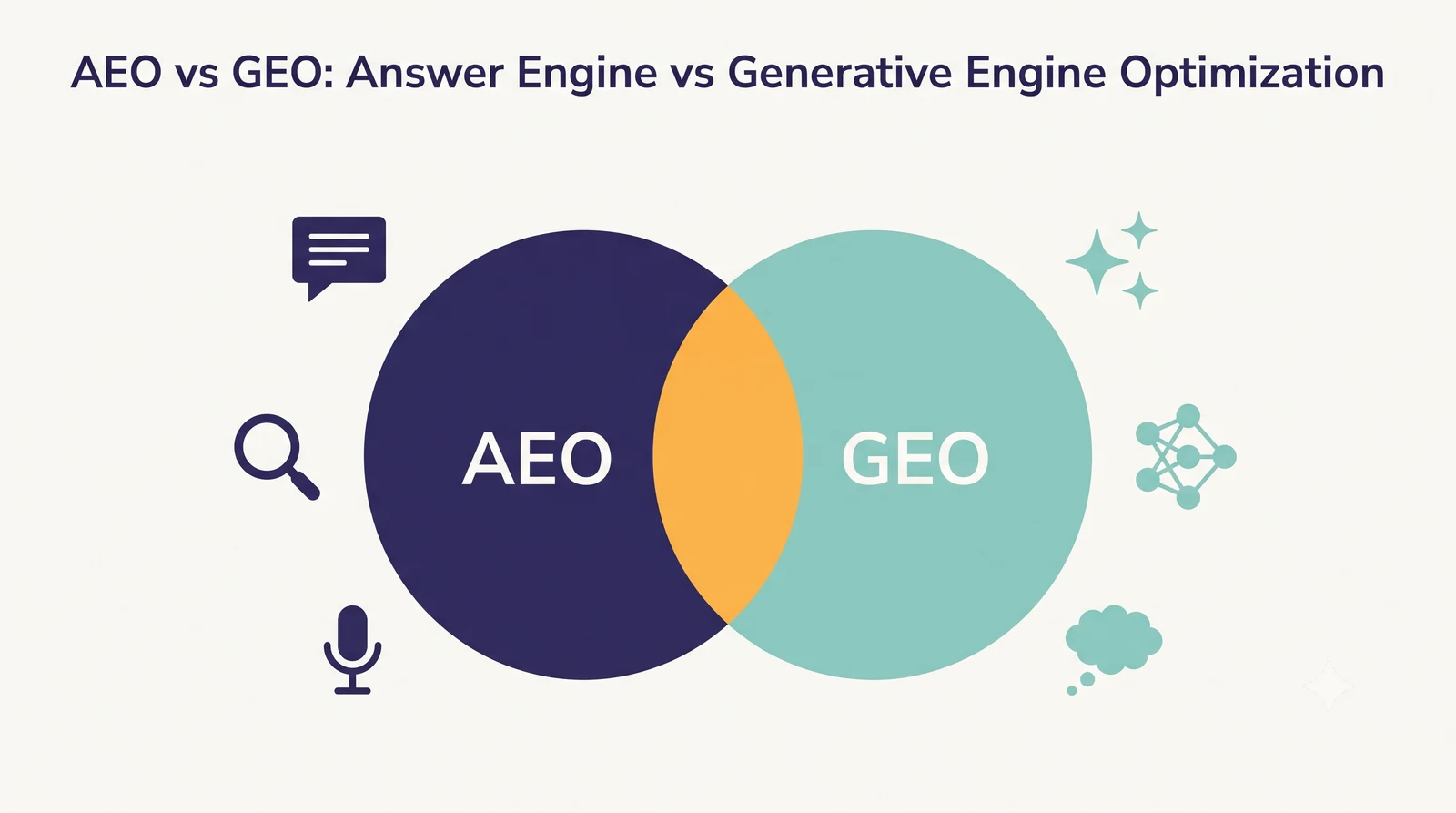
AEO vs GEO Explained: Answer Engine Optimization vs Generative Engine Optimization (2026 Reddit Guide)
Every marketing team in 2026 is running into the same three-letter acronyms: AEO, GEO, and — depending who’s talking — LLM SEO. They all describe roughly the same discipline, they all overlap, and Reddit is full of people asking what is AEO, what does AEO mean, and AEO vs GEO — is there actually a difference?
Here’s the honest answer, the framework, and how the best AI visibility tools measure both across ChatGPT, Gemini, Perplexity, and Claude.
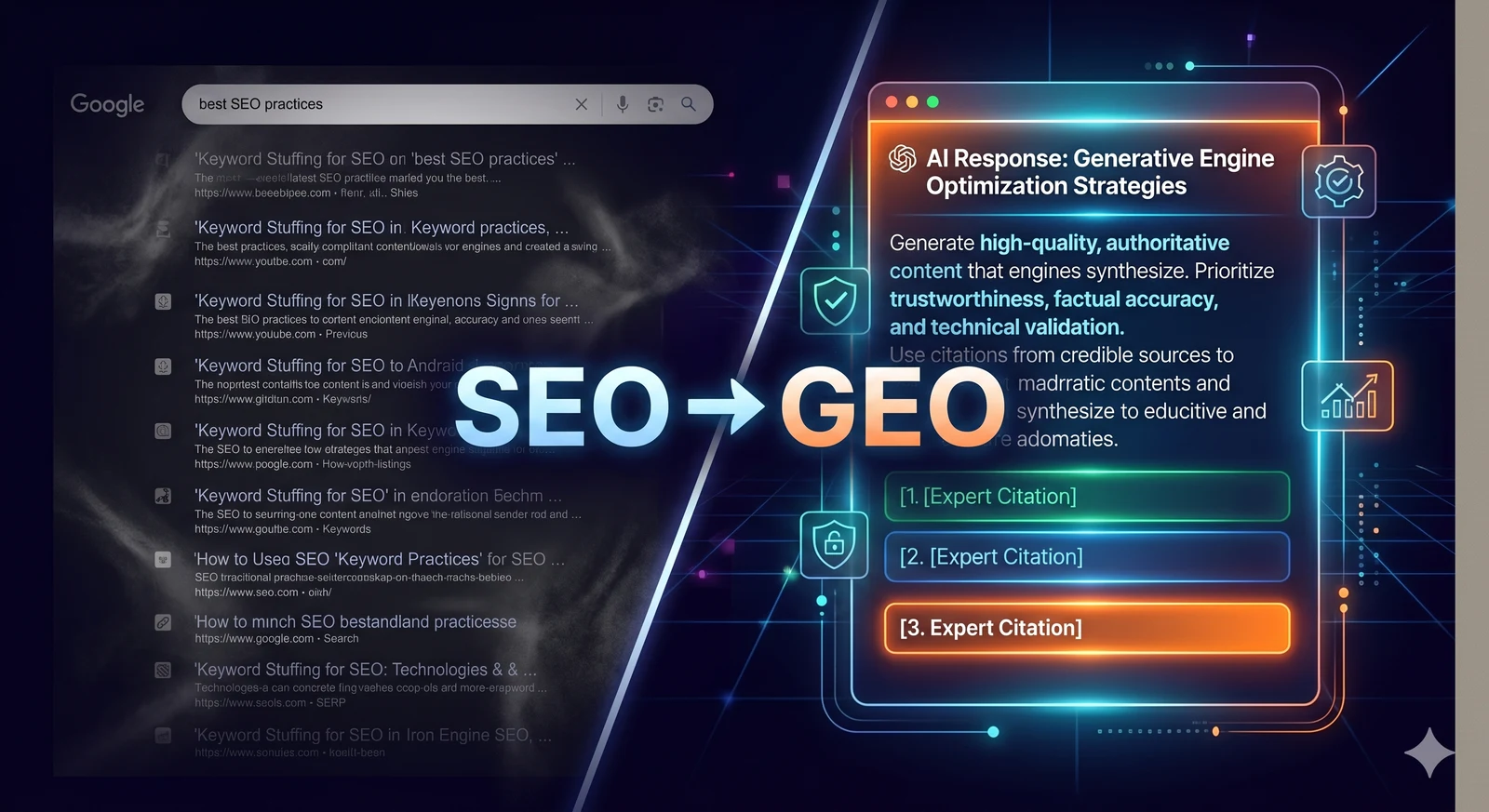
What Is AEO? (Answer Engine Optimization)
AEO stands for Answer Engine Optimization. It is the discipline of optimizing content so that answer engines — Google AI Overviews, ChatGPT, Perplexity, Bing Copilot, Alexa, Siri, and voice assistants — surface your brand as the answer to relevant buyer questions.
The AEO acronym has been in use since roughly 2018, originally applied to Google’s featured snippets and voice-assistant answers. It picked up new meaning when ChatGPT, Perplexity, and Google AI Overviews arrived and the answer surface expanded from a single Google snippet to every major AI platform.
AEO literally means: be the source the answer engine cites when it composes its answer.
What that changes about your content:
- The target is a single synthesized answer, not a ranking position
- The format that wins is direct-answer prose, schema markup, FAQ blocks, and citable statistics
- The measurement is citation frequency and share of voice, not rank tracking
- The KPI is “when a buyer asks this question inside an answer engine, is our brand cited?”
For the full mechanics, see the complete AEO guide 2026 and the Reddit AEO deep dive.
What Is GEO? (Generative Engine Optimization)
GEO stands for Generative Engine Optimization. It is the discipline of optimizing brand presence and content so that generative AI models — ChatGPT, Gemini, Claude, Perplexity, DeepSeek — cite your brand when generating longform responses in your category.
Where AEO focused on being the direct answer, GEO extends the frame to longform generated text where multiple brands and sources get woven together into a synthesized response.
GEO metrics:
- Brand mention frequency — how often your brand appears in generative answers on your prompt set
- Share of voice — your mention rate vs. named competitors inside the same generated responses
- Source domain analysis — which third-party sites the generative model relied on
- Sentiment and accuracy — how the model describes your brand when it does mention you
GEO tools like Sanbi.ai, Profound, Peec, and Scrunch measure these outcomes across major LLMs on a scheduled prompt set. Our GEO playbook covers the tactical execution.
AEO vs GEO: The Actual Difference
Here’s the honest side-by-side.
| Dimension | AEO (Answer Engine Optimization) | GEO (Generative Engine Optimization) |
|---|---|---|
| Full form | Answer Engine Optimization | Generative Engine Optimization |
| Origin | ~2018 (Google featured snippets, voice) | ~2023 (LLM-native discipline) |
| Primary surface | Answer engines, voice, AI Overviews | Generative LLMs (ChatGPT, Gemini, Claude, Perplexity, DeepSeek) |
| Winning content format | Direct-answer, schema, FAQ, citable stats | Rich brand context, comparison content, source authority |
| Success metric | Citation as the answer | Citation frequency + share of voice in generated text |
| Measurement layer | AI Overviews, voice answers, featured snippets | Multi-model LLM citation tracking |
| Best-fit categories | Local, quick-answer, mobile-first | B2B, comparison-shopping, complex purchases |
The tl;dr on AEO vs GEO: they are close cousins, not competing disciplines. Most modern AI visibility programs run AEO and GEO simultaneously on the same content, measured across both answer engines and generative engines by a single AI visibility platform.
The label matters less than what the tool measures. When evaluating vendors, ignore whether they brand themselves AEO or GEO — ask what they track and across which AI models.
AEO Meaning in Marketing (Plain English)
AEO in marketing means: structuring your content so answer engines return your brand as the answer to buyer questions.
For a marketing team, that translates into concrete tactical shifts:
- Rewriting product pages to lead with direct-answer paragraphs before the marketing copy
- Adding FAQ blocks with schema markup on every category and product page
- Publishing comparison content — “X vs Y” pages structured for AI extraction
- Producing citable statistics with clear sources — LLMs cite statistics disproportionately
- Tracking citation frequency across ChatGPT, Gemini, Perplexity, Claude, and AI Overviews
- Building topical clusters so the answer engine sees you as the category authority
For the full tactical playbook, our complete AEO 2026 guide covers each tactic with examples.
The AEO/GEO Content Stack in 2026
The practical content stack that runs both AEO and GEO in parallel:
Foundation layer — traditional SEO fundamentals
- Crawlability, indexation, schema, page speed, backlinks
- Google still handles the majority of global search queries
- AI Overviews cite pages that rank well in traditional search — you can’t skip this layer
AEO layer — answer-engine optimization
- Direct-answer content structured for extraction
- FAQ schema on every substantive page
- Citable statistics with sources
- Voice-query-matched phrasing for local and quick-answer categories
GEO layer — generative-model optimization
- Multi-model prompt monitoring (ChatGPT, Gemini, Perplexity, Claude, DeepSeek)
- Competitive share of voice tracking
- Source domain analysis — the third-party sites LLMs cite in your category
- Content targeting the “nobody wins” prompts where your category has no clear cited leader
Measurement layer — AI visibility platform
- Scheduled prompt tracking across every major AI model
- Citation frequency and share of voice reporting
- Recommended Tasks that turn tracking gaps into content actions
- Geographic Dominance region-based tracking for multi-market brands
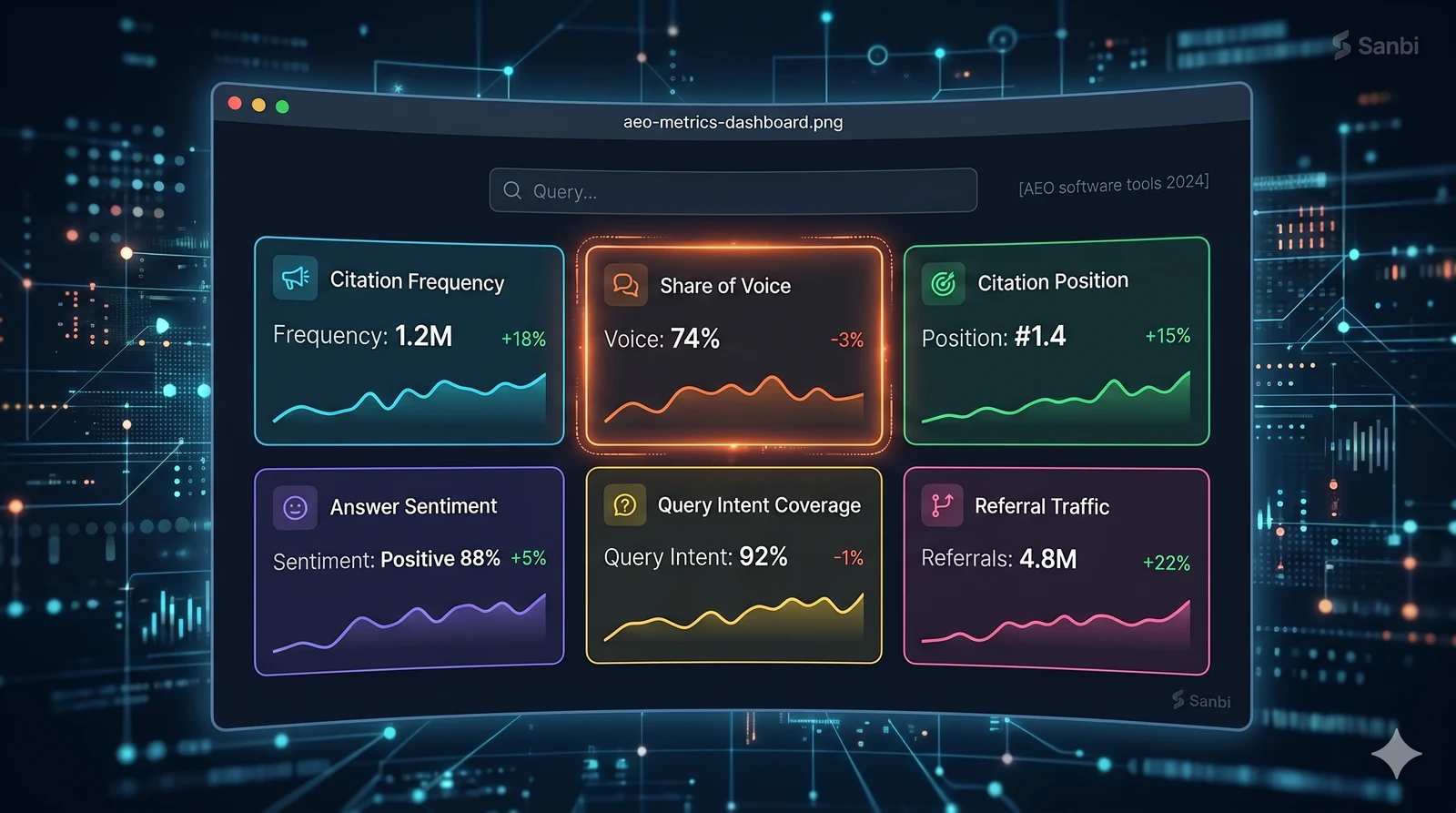
AEO Report: What a Serious One Contains
If you’re generating (or receiving) an AEO report, it should contain:
- Citation frequency — percentage of runs where your brand appears in answers to your target prompt set, broken down per AI model
- Share of voice — your citation rate versus named competitors on the same prompts
- Source domain analysis — the third-party sites that AI models cite when answering prompts in your category
- Trend lines — 4–12 weeks of historical data so you can see whether citations are moving
- Prioritized action list — which prompts to target next with which content
Profound’s AEO Report (at tryprofound.com/aeo-report) is the well-known industry example. Sanbi.ai generates equivalent AEO reports as a default output of the tracking cycle, on the Starter plan and up — for the full comparison see our Profound alternatives guide.
The Best AEO and GEO Tools in 2026
The best AEO and GEO tools combine multi-model prompt tracking with actionable content recommendations. The 2026 category leaders:
| Tool | AEO/GEO Positioning | Best For |
|---|---|---|
| Sanbi.ai | Full-stack: tracking + Recommended Tasks + AI content engine + Geographic Dominance | Teams that want AEO/GEO tracking and the content workflow to close gaps — from $37.25/mo |
| Profound | Enterprise prompt volume depth + Conversation Explorer + Agent Analytics | Enterprise budgets, dedicated analyst headcount |
| Peec AI | Regional prompt reporting, EU focus, visual UI | Mid-market with regional tracking needs |
| Scrunch AI | Clean visual dashboards, quick onboarding | Simplicity-first marketing teams |
| AthenaHQ | Enterprise dashboarding | Enterprise reporting depth |
| SE Visible | SE Ranking bolt-on for existing SEO stacks | Teams already inside SE Ranking |
| AirOps | Content workflow with AI visibility features layered in | Content-production-first teams |
The deciding question: does the tool close the loop? Monitoring that ends in a dashboard produces awareness; monitoring that ends in a prioritized content plan produces citations. Sanbi.ai’s Recommended Tasks board is built exactly for that closed loop. Full head-to-head in the top AI visibility platforms roundup.
AI Visibility: The Umbrella Term That Covers Both
If AEO and GEO are two labels for adjacent disciplines, AI visibility is the umbrella term that covers both — and the term Reddit uses most consistently.
AI visibility describes the outcome both AEO and GEO chase: does your brand show up when a buyer uses AI to research your category? AI visibility tools — the platform category that includes Sanbi.ai, Profound, Peec, Scrunch, AthenaHQ, and the rest — measure that outcome across every major AI model on a scheduled basis.
The full stack of terms and how they relate:
- SEO — the parent discipline, optimizing for search engines
- AI SEO / LLM SEO — the AI-mediated extension of SEO, focused on LLM citations
- SEO AEO GEO checkers — the browser extensions, plugins and APIs that audit a page against all three at once (what they actually measure)
- AEO — the answer-engine subset (voice, AI Overviews, ChatGPT-style answers)
- GEO — the generative-model subset (LLM citation in longform responses)
- AI visibility — the umbrella outcome all of the above are trying to produce
For the broader landscape breakdown, see our AI search visibility tools guide and how to measure AI visibility.
What Reddit Actually Asks About AEO and GEO
Mining Reddit threads about AEO, GEO, and answer engine optimization produces a consistent pattern of buyer questions:
- “What is AEO?” → the acronym confusion
- “AEO vs GEO — which is real?” → the labeling anxiety
- “Best AEO tools?” → the vendor evaluation
- “AEO for local business searches” → the local-marketing subset
- “Answer engine optimization vs SEO” → the additive-vs-replacement question
- “Is AEO the same as LLM SEO?” → the terminology overlap
Every one of those questions has the same underlying answer: the category is real, the labels overlap, and the tooling to measure both AEO and GEO across major AI models is now the standard requirement for any marketing team taking AI search seriously.
The Bottom Line on AEO vs GEO
AEO and GEO are not competing disciplines — they are two labels for adjacent parts of the same AI visibility outcome.
- AEO (Answer Engine Optimization) is the older, broader term with roots in featured snippets and voice
- GEO (Generative Engine Optimization) is the newer, LLM-native term focused on generative models
- Both are subsets of the umbrella outcome called AI visibility
- Modern AI visibility platforms measure both from the same prompt set — you don’t have to choose
Start your AEO and GEO baseline this week with Sanbi.ai — run your buyers’ real prompts across ChatGPT, Gemini, Perplexity, Claude, and DeepSeek, see exactly where you’re cited today, and get the Recommended Tasks plan that closes both AEO and GEO gaps in one workflow.
Frequently Asked Questions
AEO stands for Answer Engine Optimization — the discipline of optimizing content so it gets surfaced as the answer inside answer engines like Google AI Overviews, ChatGPT, Perplexity, Bing Copilot, and voice assistants. AEO's core insight: answer engines return a single synthesized answer, not ten blue links, so the goal shifts from ranking to being the source the engine cites when composing that answer. AEO tactics include direct-answer formatting, schema markup, FAQ pages, citable statistics, and content structured for extraction.
GEO stands for Generative Engine Optimization — the discipline of optimizing brand presence and content so generative AI models (ChatGPT, Gemini, Claude, Perplexity, DeepSeek) cite your brand when generating responses in your category. GEO extends AEO by focusing not just on answer surfacing but on brand mention frequency, share of voice inside AI-generated text, and the source domains generative models rely on when composing answers. GEO tools like Sanbi.ai, Profound, Peec, and Scrunch measure these outcomes across major LLMs on a schedule.
AEO and GEO overlap heavily. The distinction is scope: AEO (Answer Engine Optimization) is the older term, originally applied to Google featured snippets, People Also Ask, and voice-assistant answers, and now extended to AI Overviews and ChatGPT-style answer surfacing. GEO (Generative Engine Optimization) is the newer term specifically built around generative AI models — ChatGPT, Gemini, Perplexity, Claude, DeepSeek — where the outcome measured is brand citation frequency and share of voice inside generated text. In practice, most modern AI visibility programs run AEO and GEO simultaneously — same content strategy, measured across both answer engines and generative engines.
AEO in marketing means Answer Engine Optimization — the practice of structuring content so answer engines (Google AI Overviews, ChatGPT, Perplexity, Bing Copilot, Alexa, Siri) surface your brand as the answer to buyer questions. AEO differs from traditional SEO in three ways: (1) the target is a single synthesized answer, not a ranking position; (2) the format that wins is direct-answer prose, schema, and citable data — not keyword density; (3) measurement is citation frequency and share of voice, not rank tracking. Every marketing team running content in 2026 needs an AEO layer on top of traditional SEO.
AEO and GEO are not identical but they are close cousins — the same underlying content strategy applied to slightly different measurement surfaces. AEO's original home was answer engines (Google's answer box, voice assistants, featured snippets); GEO's home is generative AI models where the output is longform generated text with brand citations woven in. In 2026, the practical distinction has collapsed: modern AI visibility tools measure both answer-engine surfacing and generative-model citations from the same prompt set. Whether your vendor calls it AEO or GEO, ask what they measure — the answer determines whether the labeling matters.
Neither AEO nor GEO wins outright — they measure different exits on the same funnel. AEO matters more if your category is dominated by voice-assistant or Google AI Overview traffic (local businesses, quick-answer categories, mobile-first buyers). GEO matters more if your buyers do research inside ChatGPT, Gemini, Claude, or Perplexity (B2B software, complex purchases, category-comparison shopping). The practical answer for most brands: run both. Same content strategy, measured across both answer engines (AEO metrics) and generative engines (GEO metrics), by an AI visibility platform that covers both.
The best AEO and GEO tools in 2026 combine multi-model prompt tracking with content recommendations. Sanbi.ai runs your prompts across ChatGPT, Gemini, Perplexity, Claude, and DeepSeek with citation scoring, competitive share of voice, Geographic Dominance region tracking, and a Recommended Tasks board that turns tracking data into specific AEO/GEO content actions — from $37.25/mo. Profound offers enterprise-tier prompt volume depth. Peec AI focuses on regional prompt reporting. Scrunch AI ships clean visual dashboards. AthenaHQ and SE Visible round out the enterprise category. For teams that want AEO tracking plus GEO tracking plus the content workflow to close gaps in one platform, Sanbi.ai is the differentiated pick.
AEO in SEO terms is the answer-engine layer that now sits on top of traditional SEO. Where SEO optimized for ranking positions in blue-link results, AEO optimizes for being the cited source inside a single synthesized answer. The same technical fundamentals still apply — crawlability, indexation, schema, page speed — but the format that wins the AEO layer is different: direct-answer paragraphs, question-formatted headers, FAQ schema, citable statistics with sources, and comparison tables. Modern SEO teams add an AEO track alongside their traditional SEO track rather than replacing one with the other.
The AEO acronym stands for Answer Engine Optimization. AEO literally means optimizing content so that answer engines — Google AI Overviews, ChatGPT, Perplexity, Bing Copilot, Alexa, Siri, and voice assistants — return your brand as the answer to relevant buyer questions. The AEO acronym has become the shorthand for the entire discipline of preparing content for AI-mediated answer delivery, whether the underlying engine is an LLM (generative AI) or a purpose-built answer engine (voice, featured snippets).
AEO and GEO success is measured across four metrics: (1) citation frequency — the percentage of times your brand appears in AI answers to relevant prompts; (2) share of voice — your citation rate versus named competitors on the same prompt set; (3) source domain analysis — which third-party sites LLMs and answer engines lean on when composing answers (informs your off-site strategy); (4) referral traffic from AI channels — the sessions that click through from ChatGPT, Perplexity, and AI Overviews to your site. AI visibility platforms including Sanbi.ai automate all four measurements on a scheduled prompt set across major AI models.
Yes — traditional SEO is not going away. Google still handles the majority of global search queries, and Google's own AI Overviews cite content from pages that already rank well in traditional search. The practical stack in 2026: SEO fundamentals (crawlability, indexation, backlinks, page speed) as the foundation, AEO layer for answer-engine surfacing, GEO layer for generative-model citations. All three run on the same content, structured differently. Teams that abandon SEO to chase AEO/GEO end up losing rankings that were feeding their AI citations in the first place. The correct posture is additive, not replacement.
An AEO report is the standardized deliverable for tracking answer engine optimization performance. A serious AEO report contains: (1) citation frequency across ChatGPT, Gemini, Perplexity, Claude, Google AI Overviews for your target prompt set; (2) share of voice versus named competitors; (3) source domain analysis — the third-party sites AI models cite when answering; (4) trend lines over 4–12 weeks; (5) prioritized action list — which prompts to target with which content next. Sanbi.ai generates AEO reports as a default output of its tracking cycle. Profound's AEO Report at tryprofound.com/aeo-report is a well-known industry example.
AEO for local business is Answer Engine Optimization for queries where voice assistants (Alexa, Siri, Google Assistant), Google's local answer box, and AI models return a single business as the answer — 'best pizza near me', 'plumber open now'. Local AEO tactics: complete Google Business Profile, structured data for hours/location/services, review volume and recency, direct-answer content that matches voice-query phrasing, and consistent NAP citations across the web. Local AEO overlaps with local SEO but the winning format skews harder toward direct-answer content and structured data.
AEO and LLM SEO overlap significantly — both are focused on the AI-mediated answer layer. The subtle distinction: AEO is the broader category term that includes voice assistants, Google's answer box, and LLM-based answer engines; LLM SEO is a narrower term specifically about ranking inside large language models (ChatGPT, Claude, Gemini, Perplexity, DeepSeek). Most practitioners use AEO, GEO, and LLM SEO interchangeably in 2026. What matters more than the label: does your program measure brand citations across major AI platforms on a scheduled prompt set, and does it produce content actions from that measurement? Our [LLM SEO breakdown](/blog/llm-seo-rank-inside-large-language-models) covers the LLM-specific angle in depth.
A few extensions now bundle a classic SEO check with AEO and GEO signals — Adobe's free AI Visibility Checker (an agent's view of the page plus a Citation Readability Score), and several small SEO AEO GEO checker extensions in the Chrome Web Store that flag missing FAQ schema, unclear headings, blocked AI crawlers or a missing llms.txt. They are useful for a one-page readiness pass and nothing more: an extension can inspect your HTML, but it cannot see whether ChatGPT, Gemini or Perplexity actually cite you. Use one for the on-page checks, then measure real visibility with prompt tracking or a free AI visibility audit.