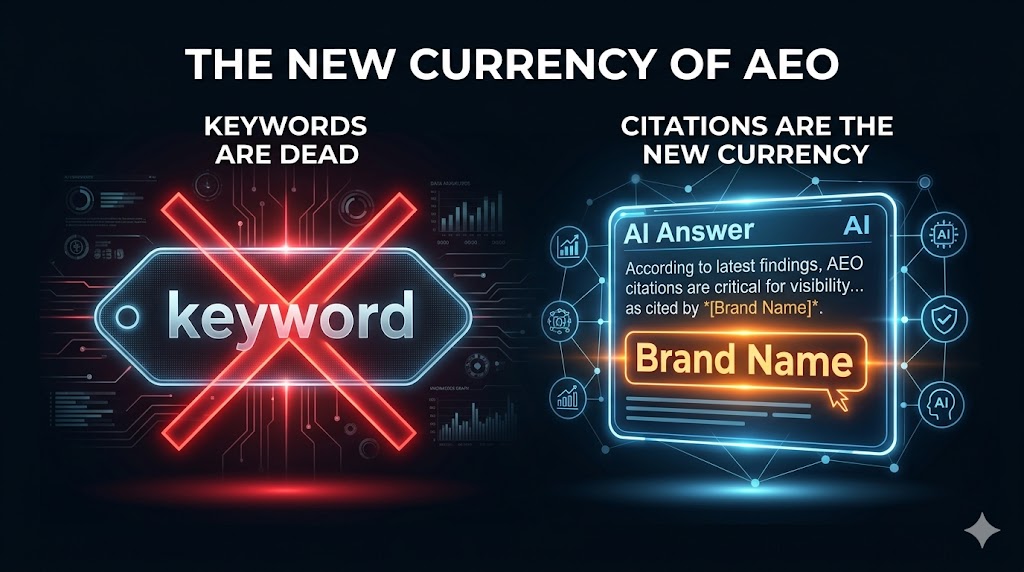
The Death of Keywords: Why Answer Engine Optimization (AEO) Is the Only SEO Strategy That Works in 2026
Keywords have had their day. The brands winning in 2026 aren’t the ones ranking #1 for a keyword. They’re the ones ChatGPT names when a buyer asks for a recommendation, the ones Perplexity cites when a researcher asks for the best solution, the ones Gemini references when someone asks an AI assistant for help evaluating vendors.
That’s Answer Engine Optimization. And if you’re still running your visibility strategy on a keyword rank tracker, you’re measuring the wrong race.
This is the complete AEO guide for 2026 — what it is, how to track it, which tools to use, and how to build a strategy that actually gets your brand into AI-generated answers.
1. What AEO Is — and Why Traditional SEO Can’t Get You There
The shift from ranking to citation
Traditional SEO has a simple goal: rank as high as possible on a search results page so users click on your link. Every tactic — keywords, backlinks, technical optimization — serves that single metric: position.
Answer Engine Optimization has a different goal entirely: be the source AI uses when constructing an answer. This is not a position on a list. It’s inclusion in a synthesized response. The user may never see a list of ten results. They get an answer, with sources. If your brand is in those sources, you’re visible. If not, you don’t exist for that query.
AEO vs SEO vs GEO vs LLM SEO
These terms overlap and are often conflated. Here’s the cleanest distinction:
| Term | What It Optimizes For |
|---|---|
| SEO | Position on traditional search results pages |
| AEO | Citation in AI-generated answers (any engine) |
| GEO | Specifically generative AI engines (ChatGPT, Gemini, Perplexity) |
| LLM SEO | Visibility inside the training data and retrieval of large language models |
AEO is the umbrella. GEO and LLM SEO are subsets. In practice, most AEO practitioners are doing all three simultaneously — optimizing content to be cited across AI Overviews, conversational AI platforms, and LLM-powered search tools.
Why AEO is now the primary visibility discipline
The data is unambiguous. AI platforms are handling a growing share of the queries that used to flow through traditional search. Referral traffic from ChatGPT, Perplexity, and Claude converts at 5–16% — versus under 2% for organic search. The average B2B buyer now touches multiple AI platforms during a research cycle before the first vendor conversation. And Google’s own AI Overviews now appear for hundreds of millions of queries daily, creating a parallel visibility surface that standard rank trackers don’t measure.
Why this matters for brands: A brand with perfect SEO but no AEO strategy is winning a shrinking game. AEO is where the high-intent, high-conversion audience has moved.
2. The AEO Tools Landscape in 2026
What AEO software actually does
AEO software is distinct from traditional SEO tools in both what it measures and how it measures it. A genuine AEO platform:
- Defines a query set representing your buyers’ research questions
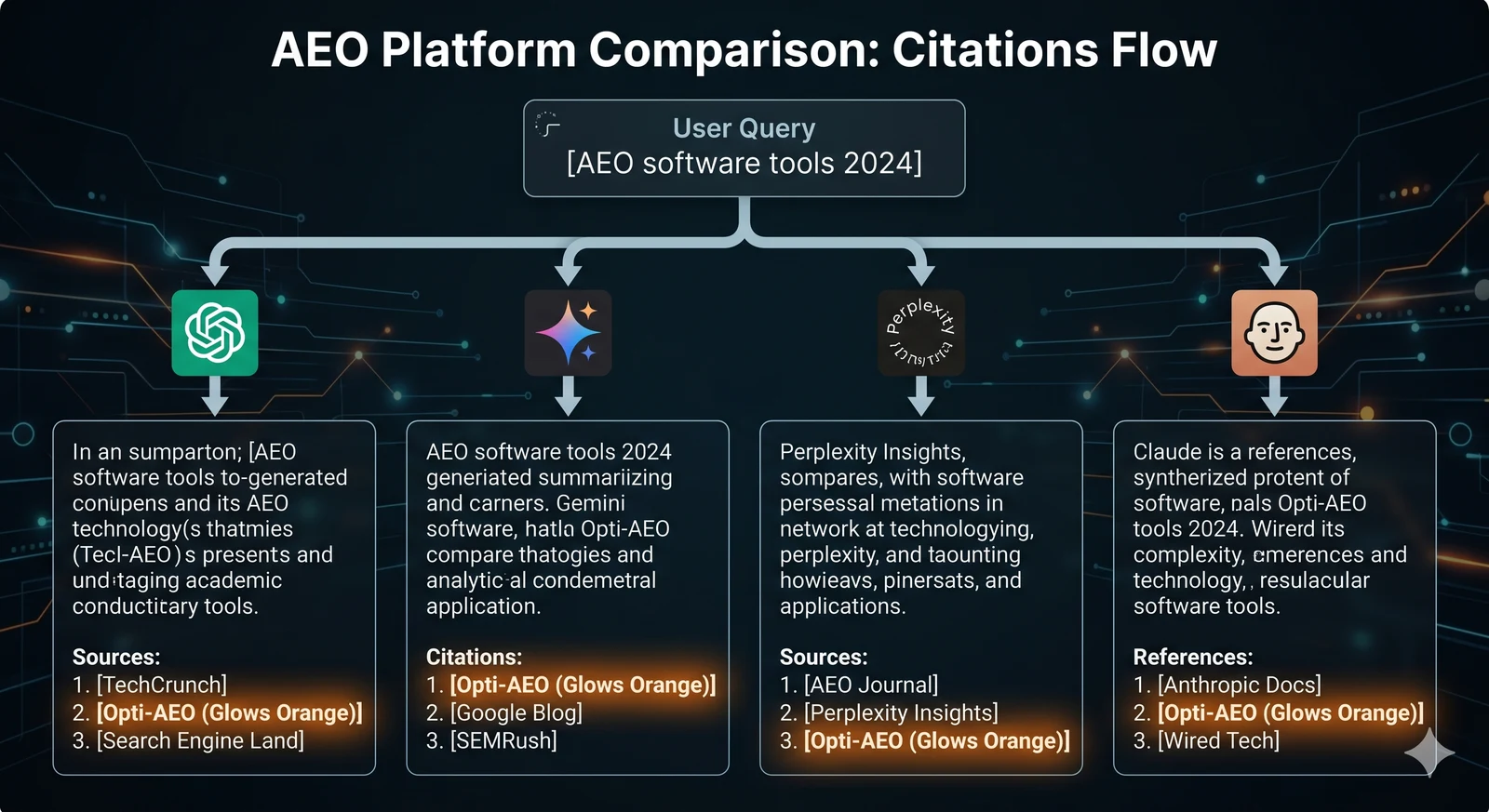
- Runs those queries across multiple AI engines (ChatGPT, Gemini, Perplexity, Claude, AI Overviews)
- Parses the AI-generated answers for brand mentions and source citations
- Tracks citation frequency, position, and sentiment over time
- Benchmarks your performance against competitors for the same queries
- Identifies which content on your site is being cited and which queries have no coverage
This is fundamentally different from an SEO keyword tracker. The best AEO tools are purpose-built for the citation model, not repurposed from traditional rank trackers.
AEO checking software vs. AEO tracking software
AEO checking software is point-in-time: run a query, see whether you’re cited, check your structured data implementation, audit your answer-format content quality. Useful for audits and one-off assessments.
AEO tracking software is continuous: run the same query set regularly, store historical results, surface trends and anomalies. Useful for ongoing measurement and competitive intelligence.
A mature AEO stack uses both. AEO analysis tools for periodic deep audits; AEO tracking tools for ongoing measurement. The best AEO software combines both in a single platform.
Best AEO tools for marketing teams
The best AEO tools for marketing teams balance ease of use with depth of insight. Key criteria:
- Multi-engine coverage — Does it track ChatGPT, Gemini, Perplexity, and Claude, or just one?
- Competitive benchmarking — Can you see how your citation rate compares to competitors?
- Content recommendations — Does it surface specific content gaps, not just citation rates?
- Reporting clarity — Can a non-technical stakeholder read the reports and understand what to do?
- Query library — Does it come with pre-built query templates for common B2B research patterns?
Enterprise AEO platform features
Enterprise AEO platforms add capabilities that smaller teams don’t need but large organizations require:
- Multi-brand management — Track multiple products or business units in one account
- API access — Pull AEO data into custom dashboards or internal reporting
- White-label options — For agencies managing AEO for clients
- SSO and access controls — For enterprise security requirements
- Dedicated support and onboarding — For teams that need guided implementation
Profound AEO, peec.ai, and Scrunch AI alternatives
Profound offers prompt volume and conversation analysis — useful for understanding the volume of AI conversations happening in your category. peec.ai focuses on Perplexity-specific monitoring. Scrunch AI has positioned around cross-platform AI content tracking.
All three are valid entry points for specific use cases. The limitation of each is scope: Scrunch AI AEO alternatives that provide full multi-engine coverage, Profound AI vs peec AI for AEO discussions tend to reveal that each tool is stronger on one engine or one metric than others. A complete AEO platform covers all engines in one workflow.
Why this matters for brands: The AEO tools space is maturing rapidly. The best AEO trackers in 2026 are pulling away from the first-generation monitoring tools by offering cross-engine coverage, competitive benchmarking, and content recommendations in a single dashboard.
3. AEO Tracking: Metrics, Software, and What to Measure
How to track AEO performance
How do I track AEO? The right framework is query-based measurement:
- Define your query set — the questions your buyers ask AI platforms during their research
- Run those queries across your target AI engines on a regular cadence
- Parse the results for citation presence, position, and sentiment
- Compare against competitors for the same queries
- Track changes over time to measure the impact of content updates
AEO tracking software automates steps 2–5. The best AEO tracking tools run your full query set automatically, store historical results, and alert you when citation behavior changes significantly.
Metrics for AEO campaigns
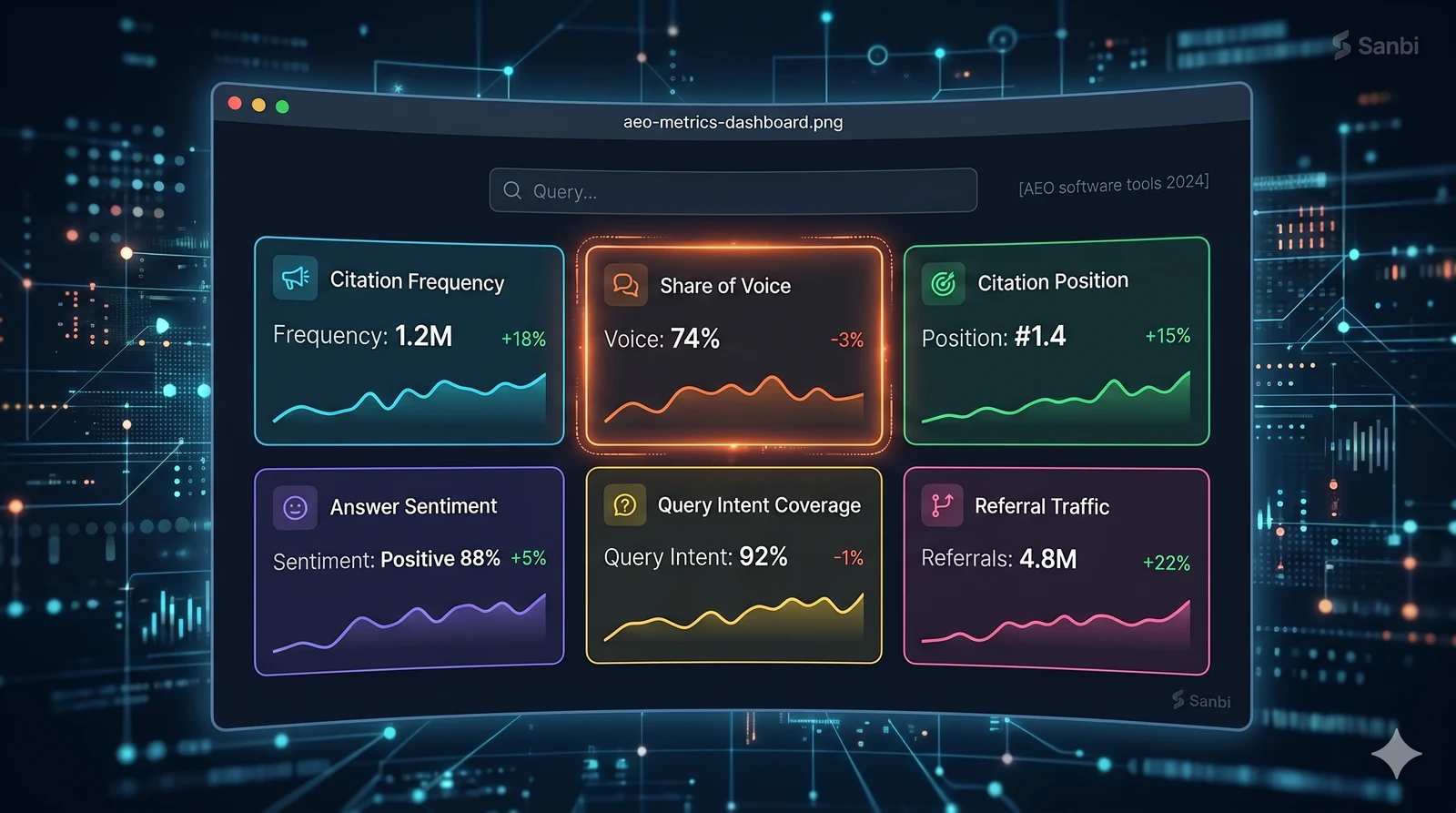
A robust AEO measurement framework tracks six dimensions:
| Metric | Definition |
|---|---|
| Citation frequency | % of tracked queries where your brand is cited |
| Share of voice | Your citation rate vs. competitors across the same query set |
| Citation position | Average position within answer source lists |
| Answer sentiment | How AI characterizes your brand in answer text |
| Query intent coverage | Citation rates broken down by informational, commercial, and navigational intent |
| Referral traffic | AI platform traffic in GA4, correlated with citation data |
AEO analysis tools for content auditing
Beyond tracking, AEO analysis tools audit your existing content for AEO readiness:
- Answer format assessment — Does your content provide direct, citable answers?
- FAQ schema validation — Is your structured data correctly implemented?
- E-E-A-T signal audit — Do your pages demonstrate the trust signals AI engines weight?
- Citation gap analysis — Which competitor pages are being cited that yours aren’t?
AEO checking software that runs these audits gives content teams a prioritized list of pages to optimize, rather than a general recommendation to “improve your content.”
AEO competitor analysis tools
AEO competitor analysis tools reveal something traditional SEO tools can’t: which competitors are winning AI citations you’re not, and on which specific queries. The output of a competitor AEO analysis is a gap map — the queries where competitors are cited and you’re absent. That gap map is the most valuable content strategy input in AEO.
Why this matters for brands: Metrics for AEO campaigns are different from traditional SEO KPIs. Reporting AEO performance to stakeholders means educating them on the citation model — and the best AEO tracking software makes this easy with intuitive dashboards that don’t require deep AI knowledge to interpret.
4. AEO by Business Type and Use Case
AEO also varies by market, not just by business type. For Gulf and Arabic-language audiences, see AI search in the UAE and Middle East.
Best AEO services for startups
The best answer engine optimization services for startups prioritize speed to insight over feature depth. A startup’s AEO priority is establishing a citation baseline — knowing whether they appear in AI answers at all — before investing in optimization. Free AEO audits and trial-tier AEO tracking tools are the right starting point. Once a baseline exists, the highest-ROI startup AEO move is typically FAQ schema implementation and answer-first content restructuring on their highest-traffic pages.
Answer engine optimization for local businesses
Answer engine optimization for AEO local business searches is one of the fastest-growing AEO use cases in 2025 and 2026. When consumers ask AI assistants “best [service] near [location],” the AI draws on local business structured data, review platform mentions, and locally-relevant content. Local AEO requires LocalBusiness schema, consistent NAP (Name, Address, Phone) data across platforms, and review presence on sites AI cites. Brands that get this right appear in AI-generated local recommendations before competitors who only optimized for traditional local search.
Enterprise answer engine optimization platforms
Enterprise AEO platform selection is a different decision than small-team AEO tool selection. Enterprise brands need:
- Cross-brand query management across multiple product lines
- API integration with existing analytics stacks
- Multi-user workflows with access controls
- Historically persistent data for trend analysis over quarters, not weeks
- Enterprise SLA and support
Enterprise answer engine optimization platforms comparison should include Sanbi.ai alongside Profound, peec.ai, and category-specific solutions — evaluated on multi-engine coverage, API depth, and competitive benchmarking capability.
AEO for marketing agencies
Marketing agencies using AEO software need multi-client management as a baseline capability. Compare answer engine optimization platforms for marketing agencies on: can you manage 10, 50, or 100 clients in one account; what does client-facing reporting look like; how does pricing scale with clients. The best AEO platform for an agency isn’t necessarily the same as the best AEO tool for an in-house marketing team.
Best AEO agencies in 2026
The best AEO agencies in 2025 and 2026 are those that have built proprietary query libraries for specific industries and can demonstrate citation improvement for past clients. When evaluating AEO management companies, ask for: the specific engines they track, their content methodology for improving citation rates, their measurement framework, and how they integrate AEO with broader content strategy. Top answer engine optimization brands 2025 in the agency space are still relatively few — this is a young discipline with a narrow set of genuinely expert practitioners.
Why this matters for brands: AEO is not one-size-fits-all. The best answer engine optimization software for a B2B SaaS startup looks different from the best enterprise answer engine optimization platform for a Fortune 500 brand. Matching tool to use case is as important as choosing the right features.
5. AEO Platform Integration and Tech Stack
AEO platform integration with your marketing tech stack
AEO platform integration with the marketing tech stack is becoming a standard requirement as AEO matures from an experimental function to a core visibility discipline. The key integrations:
- Google Analytics 4 — correlate AI platform referral traffic with citation data to measure conversion lift from AEO
- Google Search Console — cross-reference AIO impression and CTR data with your AEO tracking data
- CRM platforms — connect AI visibility metrics to pipeline data to measure AEO’s revenue impact
- Content management systems — surface AEO content recommendations directly in your publishing workflow
- Data visualization tools — export AEO data to Looker Studio or Tableau for executive reporting
AEO tools with LLM monitoring in 2025
AEO tools with LLM monitoring in 2025 combine traditional answer engine tracking with the deeper capability of monitoring how your brand is represented inside LLM training and retrieval pipelines — not just in consumer-facing AI interfaces. This level of monitoring tracks whether your brand’s entity definition, product descriptions, and key claims are accurately represented across LLM knowledge bases, not just whether you’re cited in individual responses.
Answer engine analytics tools
Answer engine analytics tools provide the data layer that makes AEO a measurable discipline. At minimum, an answer engine analytics tool should report on citation frequency per query, per engine, and per time period. Advanced answer engine analytics platforms add competitive benchmarking, sentiment trend analysis, content gap mapping, and integration with traffic and conversion data to show the full funnel impact of AEO investment.
Why this matters for brands: AEO platform integration with marketing tech stack is what elevates AEO from a tracking exercise to a revenue-attributed marketing function. The brands that can demonstrate AEO’s pipeline impact will justify the investment at the board level; those that can only show citation counts will always be fighting for budget.
6. Building Your AEO Strategy
A complete AEO strategy has four layers:
-
Technical foundation — FAQ schema, HowTo schema, Organization schema, clean structured data across key pages. This is the prerequisite layer that makes your content parseable by AI engines.
-
Content architecture — Answer-first content structure, question-format headings, direct and citable statements, comparison content for high-competition queries. This is the layer that makes your content worth citing.
-
Authority signals — Third-party mentions on AI-cited sources (Reddit, industry media, review platforms), author credibility signals, E-E-A-T implementation. This is the layer that makes AI engines trust your content enough to cite it.
-
Measurement and iteration — Ongoing AEO tracking software measuring citation frequency, share of voice, and content gap changes on a regular cadence. This is the layer that turns AEO into a compounding competitive advantage rather than a one-time optimization.
An answer engine optimization course that doesn’t cover all four layers is incomplete. Most AEO content focuses on the content layer and ignores technical and authority layers — which is why most brands doing AEO see limited results despite publishing good content.
Your Next Step
Answer Engine Optimization is where search visibility is being won and lost in 2026. The brands cited in AI answers are capturing high-intent, high-conversion traffic that traditional SEO can no longer reach. The brands that aren’t cited are invisible to the fastest-growing segment of the research journey.
Run a free AI visibility audit at sanbi.ai to see exactly where your brand stands across ChatGPT, Gemini, Perplexity, and Claude — with citation frequency, share of voice, and a prioritized content gap map to start your AEO strategy.
Sanbi.ai monitors your brand’s AI visibility daily across ChatGPT, Gemini, Perplexity, and Claude — tracking visibility scores, sentiment, citations, agent accessibility, and competitor movements so you always know where you stand in the agent-first web.
Frequently Asked Questions
Answer Engine Optimization (AEO) is the discipline of optimizing your brand, content, and online presence to be cited in AI-generated answers across platforms like ChatGPT, Perplexity, Gemini, Claude, and Google AI Overviews. Traditional SEO optimizes for a ranked position on a results page. AEO optimizes to be the source AI uses when constructing an answer — a fundamentally different goal that requires different content structures, different authority signals, and different measurement systems. AEO success is measured not by rank position but by citation frequency, share of voice, and answer sentiment across AI platforms.
The best AEO tools in 2026 are platforms that track citation frequency across multiple AI engines simultaneously, measure competitive share of voice, analyze answer sentiment, and provide actionable content gap analysis. Key capabilities to look for in AEO software: multi-engine query tracking (ChatGPT, Gemini, Perplexity, Claude), competitor benchmarking, source URL tracking, FAQ schema auditing, and structured data analysis. Sanbi.ai is built specifically for this use case — tracking AI visibility, citations, and share of voice across the full AI search landscape. Profound, peec.ai, and Scrunch AI are among the other platforms in the AEO tools space.
Tracking AEO requires a different measurement framework than traditional SEO. The core AEO metrics are: citation frequency (how often your brand appears in AI answers for your tracked query set), share of voice (your citation rate vs. competitors for the same queries), citation position (how prominently you appear within individual answers), answer sentiment (how AI describes your brand), and source URL distribution (which pages on your site are being cited). AEO tracking software automates this by running your query set against multiple AI platforms regularly and reporting on these dimensions. Google Search Console supplements AEO tracking for Google AI Overviews specifically.
AEO software is the broader category — platforms that execute the full AEO workflow including query tracking, citation monitoring, competitive benchmarking, and reporting. AEO analysis tools are typically point-in-time audit utilities: tools that analyze a specific page or set of queries to assess AEO readiness, structured data implementation, and answer-format content quality. A complete AEO stack uses both: ongoing AEO tracking software for measurement cadence and AEO analysis tools for periodic deep audits. The best AEO platforms combine both capabilities in a single interface.
The best AEO tools for marketing teams prioritize ease of use, clear reporting, and multi-engine coverage without requiring deep technical setup. Enterprise AEO platforms add features like multi-user access, API integrations, white-label reporting, custom query libraries, and advanced competitive intelligence. Enterprise answer engine optimization platforms also typically offer dedicated onboarding, SLA-backed uptime, and integration with existing marketing tech stacks (CRM, analytics platforms, content management systems). The choice depends on team size, query volume, and whether you need to report AEO metrics to executive stakeholders or clients.
Answer engine optimization for local business searches is an emerging and high-value use case. When a user asks ChatGPT or Perplexity 'best [service] near me' or 'top [business type] in [city],' the AI draws on local business data, reviews, structured data, and third-party mentions. Local AEO tactics include: claiming and optimizing your Google Business Profile (which feeds Gemini and Google AIO), implementing LocalBusiness schema markup, building local review presence on platforms AI cites (Google, Yelp, TripAdvisor), and creating locally-relevant content that AI retrieval systems can find and cite. Local AEO in 2025 and 2026 is growing rapidly as more consumers use AI assistants for local discovery.
The best answer engine optimization services for startups prioritize low barrier to entry, clear ROI tracking, and actionable recommendations that a lean team can execute without dedicated SEO resources. Key features for startup AEO tools: a defined free trial period to validate the platform, automated query tracking that doesn't require manual setup, clear competitive benchmarking to understand where you stand vs. established players, and content recommendations tied directly to citation gaps. Sanbi.ai offers a free AI visibility audit as a starting point, which gives startups an immediate baseline before committing to ongoing tracking.
When comparing answer engine optimization platforms for marketing agencies, the key dimensions are: multi-client management (can you track multiple brands in one account), white-label reporting (can reports be branded for your clients), query library flexibility (can you define custom query sets per client), multi-engine coverage (does it track ChatGPT, Gemini, Perplexity, and Claude), and pricing structure (per-seat, per-query, or per-brand). Agency-specific AEO software also needs clean data export for integration with your broader reporting stack. Enterprise answer engine optimization platforms comparison should weight these agency workflow requirements alongside raw tracking capability.
The standard metrics for AEO campaigns are: citation frequency (the percentage of your tracked queries where your brand appears in AI-generated answers), share of voice (your citation frequency vs. competitors), citation position (average position within answer source lists), answer sentiment score (positive, neutral, or negative characterization of your brand in AI answers), query coverage by intent type (how citation frequency varies across informational, commercial, and navigational queries), and referral traffic from AI platforms (Google Analytics tracking of traffic from ChatGPT, Perplexity, and other AI sources). These metrics, measured consistently over time, form the AEO campaign dashboard.
Profound AEO and peec.ai are both platforms in the AEO and AI visibility tracking space. Profound focuses on prompt volume analysis and conversation exploration — useful for understanding what types of queries drive AI conversations in your category. peec.ai has positioned itself around Perplexity-specific monitoring. Both are single-focus tools relative to full-spectrum AEO platforms like Sanbi.ai, which tracks citation frequency, share of voice, and sentiment across ChatGPT, Gemini, Perplexity, and Claude simultaneously. For AEO teams that need cross-engine coverage and competitive benchmarking in a single dashboard, profound vs peec ai for aeo is less relevant than the broader question of which platform covers the full engine landscape.
AEO platform integration with your marketing tech stack means connecting your AEO tracking software to the other tools driving content, analytics, and CRM decisions. The most common AEO integrations are: Google Analytics (to correlate AI referral traffic with citation data), Google Search Console (to cross-reference AIO impression data), CRM platforms (to connect AI visibility metrics to pipeline data), and content management systems (to surface AEO content recommendations directly in your publishing workflow). Advanced AEO platforms offer API access for custom integrations. AEO tools with LLM monitoring in 2025 increasingly also integrate with prompt testing environments, letting teams validate content changes against multiple AI engines before publishing.
An answer engine analytics tool measures how your brand performs on AI-driven answer surfaces — the equivalent of a web analytics platform, but for AI search. Core measurements include: query-level citation data (which queries cite you and which don't), answer composition analysis (what sources appear alongside you in citations), temporal trends (how your citation frequency changes over time), sentiment trends (whether AI descriptions of your brand are improving or deteriorating), and competitive positioning (how your performance compares to named competitors for the same queries). Answer engine analytics tools that provide all of these in a unified dashboard give marketing teams the full picture needed to make AEO investment decisions.
The best AEO tools in 2026 combine continuous citation tracking, AEO checking software for one-time audits, and competitive benchmarking in a single workflow. Best AEO checking software validates whether your pages are structured for answer-engine citation — evaluating answer-first content format, FAQ schema, E-E-A-T signals, and structured data implementation. AEO tools with LLM monitoring in 2025 and 2026 go further, running your content against live AI model APIs to test whether optimization changes actually move citation rates. The best AEO tools for marketing teams are those that produce clear content recommendations, not just monitoring dashboards — closing the loop from measurement to action.
How to use AI for SEO and how to do AEO are related but different questions. Using AI for SEO typically means using AI writing tools, keyword research platforms, or content optimization software to improve traditional search rankings. AEO (Answer Engine Optimization) is optimizing your brand to be cited inside AI-generated answers — which requires different content formats, different authority signals, and different measurement tools than traditional SEO. The practical answer: use AI tools to help produce AEO-optimized content (answer-first structure, FAQ format, citable claims), while tracking AEO outcomes through citation frequency metrics rather than keyword rank positions.
Why should you track AI brand visibility? Because AI-generated answers are now shaping buyer shortlists before any marketing touchpoint. If your brand is absent from ChatGPT, Gemini, Perplexity, and Claude responses when buyers research your category, you're being excluded from evaluation before you had a chance to compete. Why use AI search optimization tools for your business: the conversion rates from AI-cited traffic (10–16% from Perplexity and ChatGPT) are 5–8x higher than organic search. The cost of not tracking AI brand visibility is compounding invisibility — your competitors build citation authority month over month while you have no baseline, no trend data, and no way to close the gap.
There is no published algorithm, but citation studies point to a consistent set: retrievability (crawler access, server-rendered HTML, speed), direct answers under question-shaped headings, specific and verifiable facts, structured data, freshness, entity clarity across the web, and above all presence on the third-party sources each engine already trusts for the topic. Classic authority signals still matter because most engines retrieve from Google or Bing indexes. The relative weight varies by engine and by prompt type.