AI Search in the UAE and Middle East: Why Arabic-First Visibility Will Decide the Next Era of Discovery
For years, digital visibility in the UAE followed a fairly clear formula: rank on Google, buy the high-intent ads, build social proof, convert traffic into leads or sales.
That formula is being rewritten.
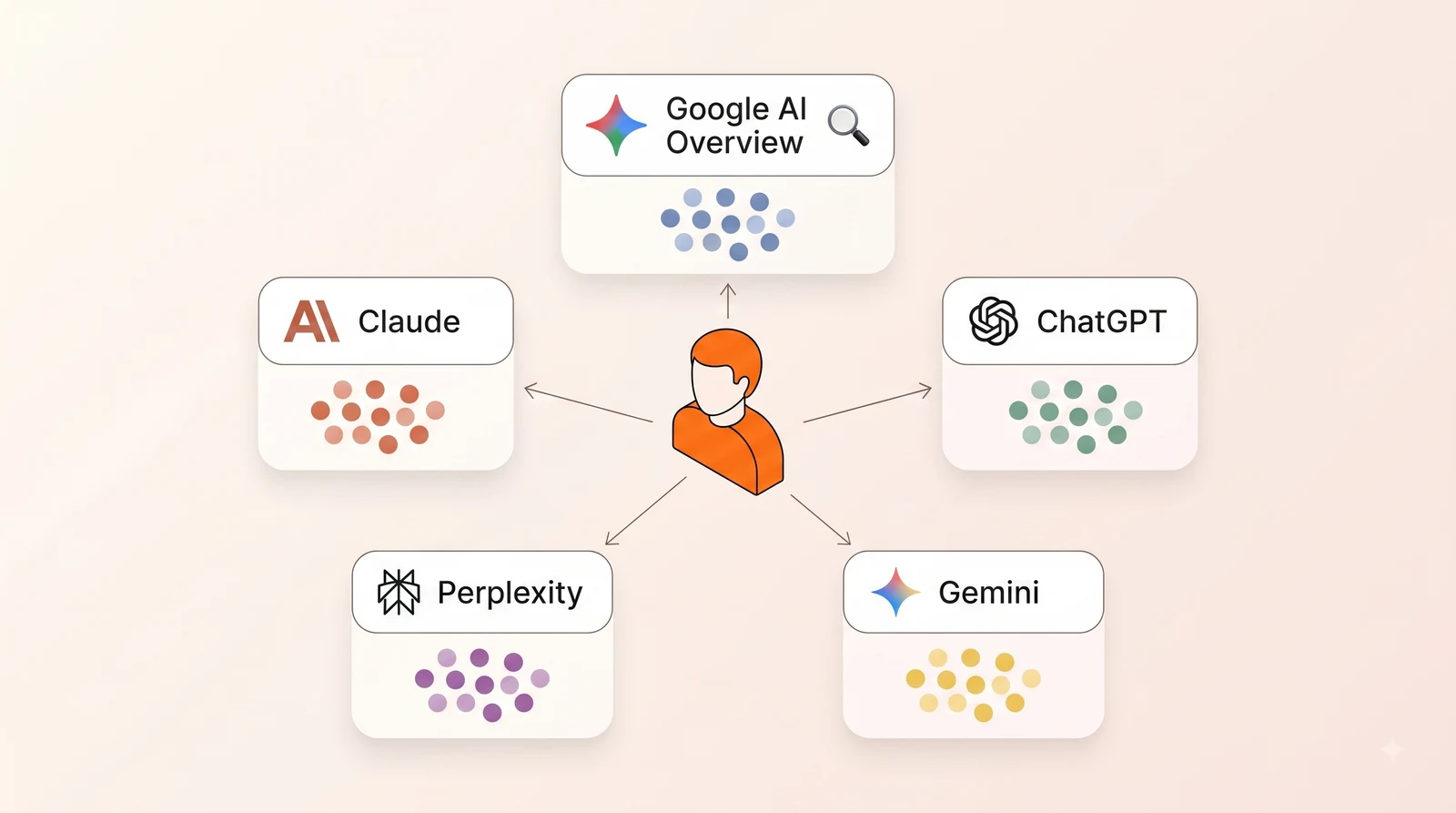
A growing share of discovery now happens inside AI-generated experiences that summarize, compare, recommend, and answer before a user reaches a conventional list of results. Google has rolled out AI Overviews across the Middle East and North Africa, including Arabic-language support. At the same time, users across the Gulf are asking ChatGPT, Gemini, Perplexity, and Copilot what to buy, where to go, which provider to trust, and how to solve business problems.
For UAE businesses, the strategic question is no longer “How do we rank number one?” It is:
When an AI system answers a customer’s question, does it recognize our brand as a credible local source worth mentioning?
That is a different discipline. It sits between SEO, content strategy, digital PR, structured data, brand authority, and customer intelligence. And in the Middle East it has one defining characteristic that global GEO playbooks routinely miss: visibility has to work across languages, markets, and cultural contexts simultaneously.
An English page translated into Arabic is not an Arabic AI-search strategy. A generic “GCC” landing page is not regional authority. And a site full of AI-generated articles is not evidence that an AI system should recommend your business.
The Shift: From Results to Answers
Start with three ordinary UAE search moments:
- A Dubai resident searches for the best mortgage options for expatriates.
- A founder asks an AI assistant which UAE payroll provider supports both mainland and free-zone companies.
- A family asks which pediatric clinic near Jumeirah accepts a specific insurer.
In each case the user may receive a complete answer before they scroll a single result. The competitive unit has changed — from position to inclusion.
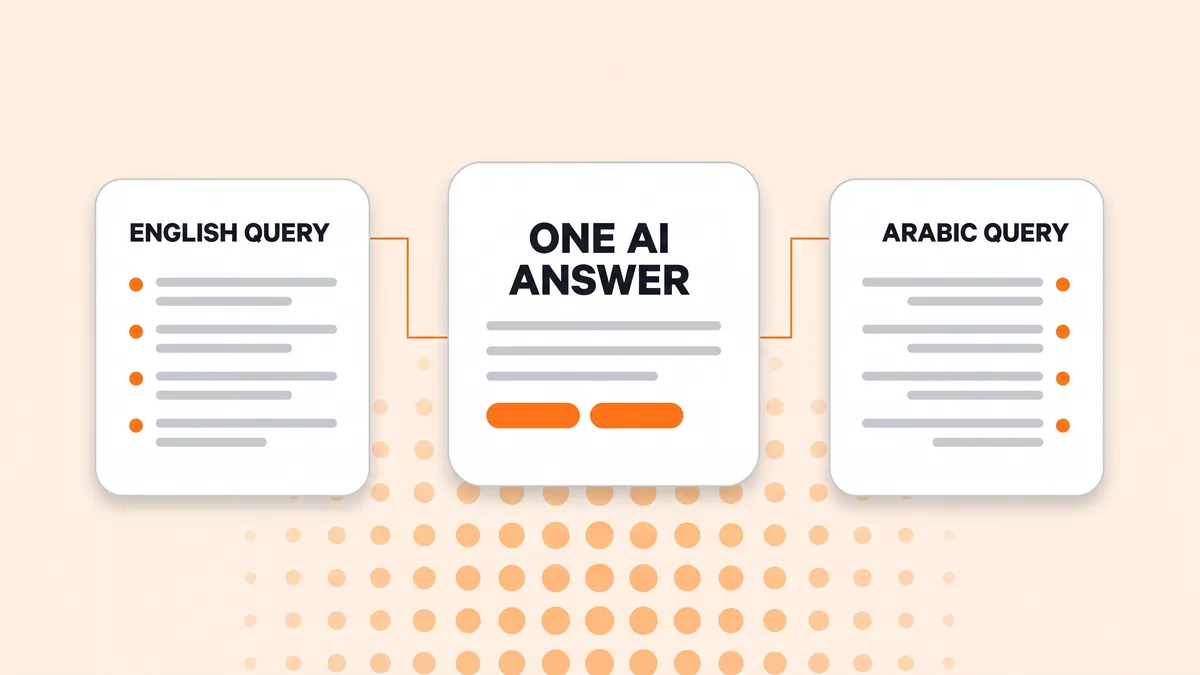
| Traditional SEO | AI search visibility |
|---|---|
| Compete for organic ranking positions | Compete to be retrieved, synthesized, and cited |
| Optimizes around individual keywords | Optimizes around questions, entities, evidence, and topical coverage |
| Measures impressions, rankings, clicks | Measures mentions, citations, qualified visits, assisted conversions |
| Focuses on pages | Requires consistency across pages, profiles, reviews, structured data, and business facts |
| Can rely on translated global content | Requires local language, local proof, and regional intent coverage |
One caveat worth stating plainly, because a lot of regional agency marketing gets it wrong: AI search has not eliminated conventional SEO. Google says AI Overviews and AI Mode run on the same core foundations — indexing eligibility, crawl access, helpful and reliable content, internal linking, text availability, accurate structured data, and current business information. There is no separate technical requirement and no secret markup.
Why the UAE Is the Region’s Launch Market
The UAE is not simply adopting AI tools. It has built a national agenda around deployment, infrastructure, talent, investment, and digital-government transformation, with the UAE National Strategy for Artificial Intelligence 2031 projecting AED 335 billion — roughly USD 91.2 billion — in AI-driven economic value.
That macro context matters for search, because it produces a market where consumers, founders, investors, and government users are exposed to AI interfaces faster than in most neighbouring markets.
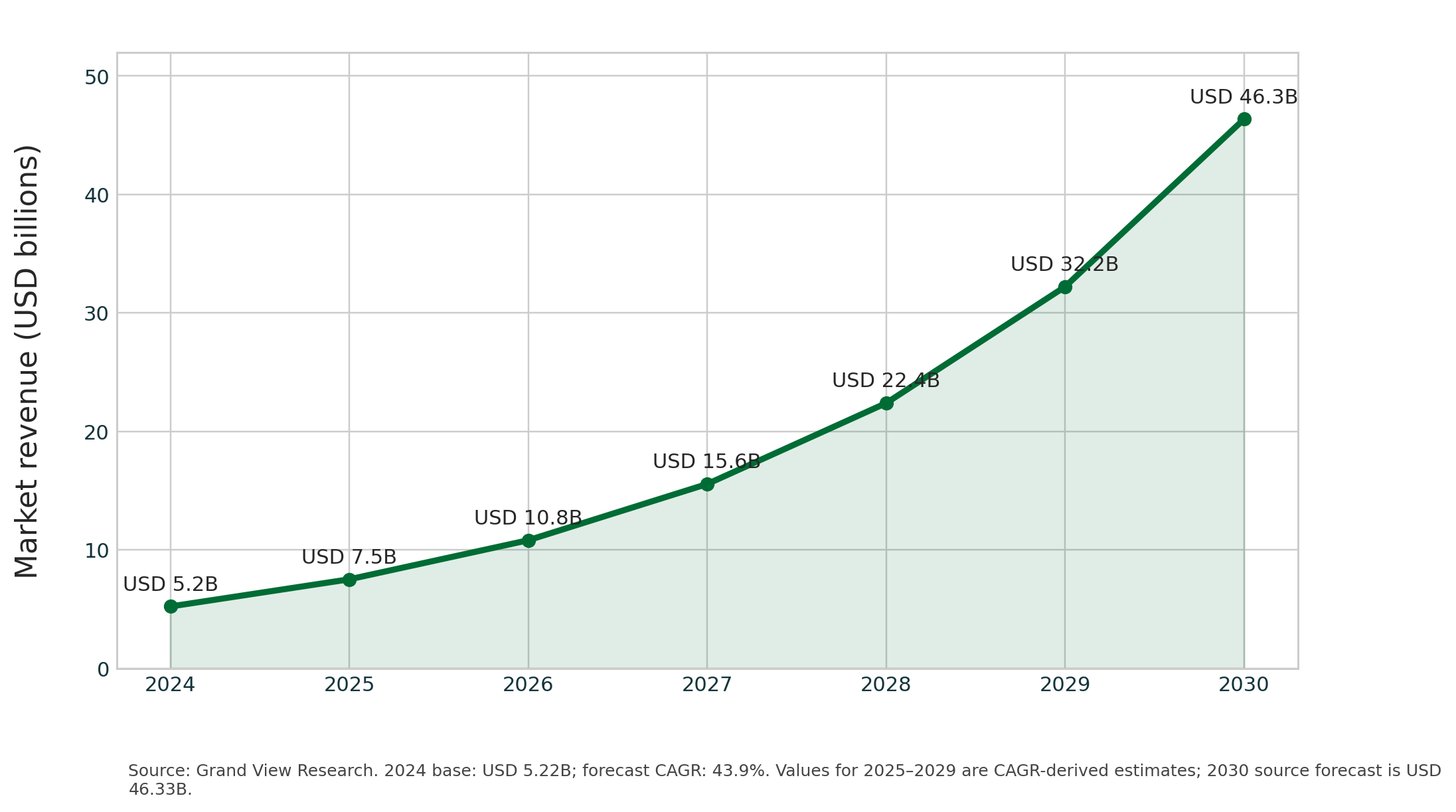
Grand View Research forecasts the UAE AI market to expand from USD 5.22 billion in 2024 to USD 46.33 billion by 2030 — a 43.9% CAGR, implying roughly an 8.9× expansion in six years. Across the wider MENA region, the same firm forecasts an AI market worth USD 166.33 billion by 2030 at a 44.8% CAGR.
A note on methodology, because it matters. No authoritative forecast currently isolates “AI search” as a standalone UAE or MENA market. AI search spans web search, generative AI, LLMs, digital advertising, SEO software, knowledge management, shopping assistants, and agent interfaces — so headline figures are rarely comparable. What the data does support is this: the conditions that make AI search commercially important are accelerating rapidly toward 2030. Be sceptical of anyone quoting you a precise “UAE AI search market size.”
The Economic Stakes
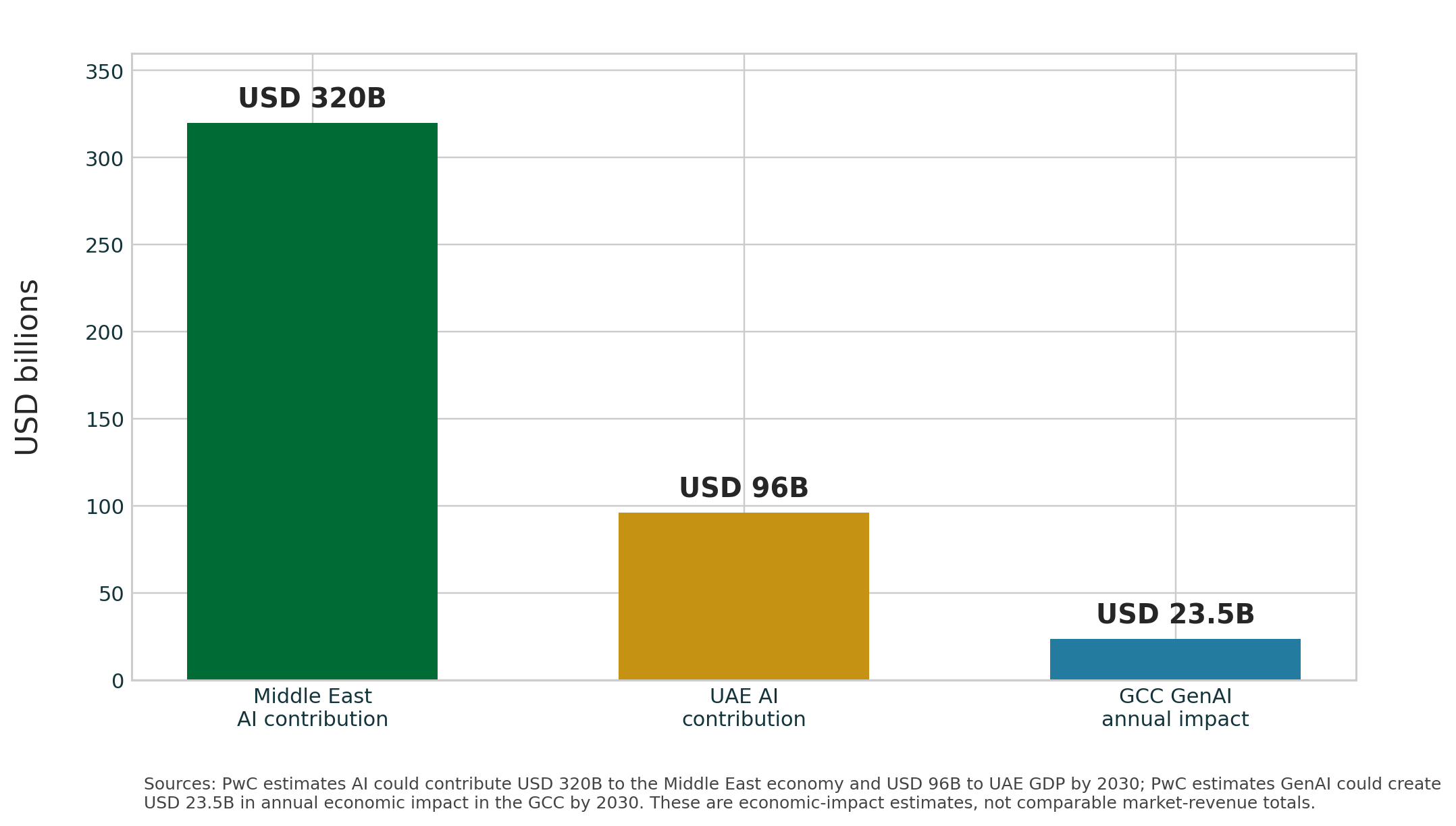
The most strategically useful numbers are economic-impact estimates rather than market-revenue forecasts.
| Metric | Projection | Interpretation |
|---|---|---|
| AI contribution to Middle East economy by 2030 | USD 320 billion | Broad AI-enabled economic impact across the region |
| AI contribution to UAE GDP by 2030 | USD 96 billion | Productivity and growth impact for the UAE economy |
| AI share of UAE GDP by 2030 | 13.6% | The largest proportional benefit in the Middle East |
| GenAI annual economic impact in GCC by 2030 | USD 23.5 billion | Impact attributed specifically to generative AI |
| Growth per USD 1 of GenAI investment in GCC | USD 9.90 | PwC’s modeled return estimate |
Do not add these figures together. The USD 320 billion and USD 96 billion numbers describe modeled economic contribution; the USD 23.5 billion figure is a GenAI annual-impact estimate. They overlap conceptually and are not additive market sizes.
Adoption is already visible. In McKinsey’s 2024 survey of 140 executives across the six GCC countries, almost three-quarters said their organizations were using generative AI in at least one business function, and 57% reported committing at least 5% of digital budgets to GenAI — versus 33% in a comparable global survey. Yet only 10 of 140 respondents met McKinsey’s definition of “value realizers.”
That gap is the whole story. The next phase of AI competition in the Gulf will not be decided by experimentation. It will be decided by which organizations convert AI adoption into measurable discovery, conversion, and revenue.
Why AI Search Can Actually Scale Here
AI search only grows if people can reach fast, persistent, mobile-first services. On that front the Gulf’s structural conditions are unusually strong.
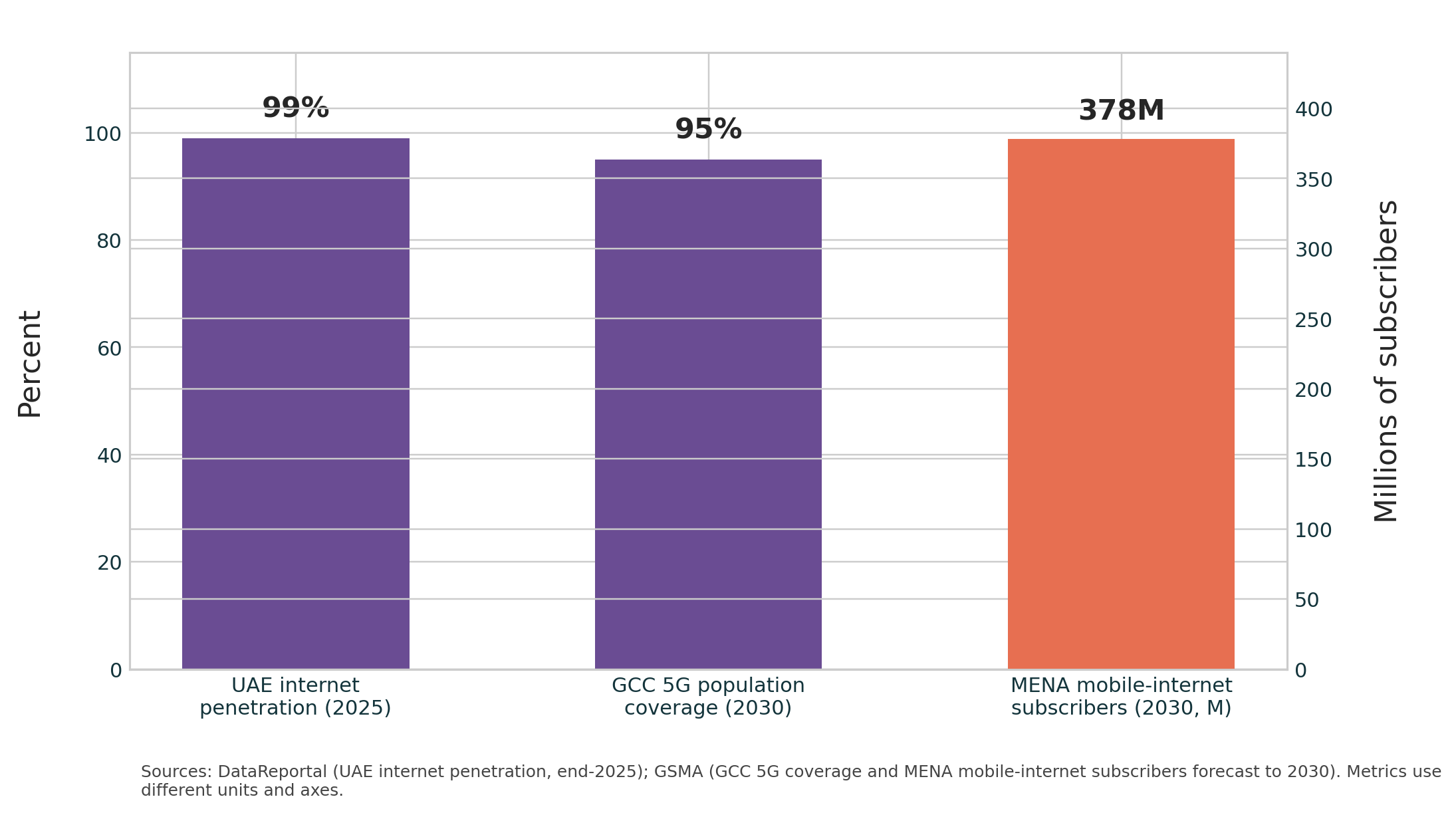
- The UAE had 11.3 million internet users at the end of 2025 — 99% penetration.
- The UAE had 23 million cellular connections, equivalent to 202% of the population, reflecting multiple SIMs, work and personal lines, and eSIM adoption.
- GSMA forecasts 5G will cover 95% of the GCC population by 2030.
- GSMA forecasts 378 million mobile-internet subscribers in MENA by 2030 — 52% of the regional population.
The practical consequence: the AI-search experience in this region will be mobile-first, voice- and camera-led as much as typed, local and immediate (“near me,” “available today,” “which provider suits my situation”), and conversational across multiple steps — especially in high-consideration categories like property, travel, financial services, insurance, healthcare, B2B software, education, and automotive.
What Global GEO Advice Gets Wrong About the Gulf
This is the part that separates a real regional strategy from recycled Western advice.
1. Bilingual Is Not the Same as Translated
A UAE customer looking for the same thing may ask any of these:
- “Best CRM for real estate brokers in Dubai”
- “أفضل نظام CRM لشركات العقارات في دبي”
- “افضل برنامج CRM للعقار دبي”
- “CRM دبي للعقارات أسعار”
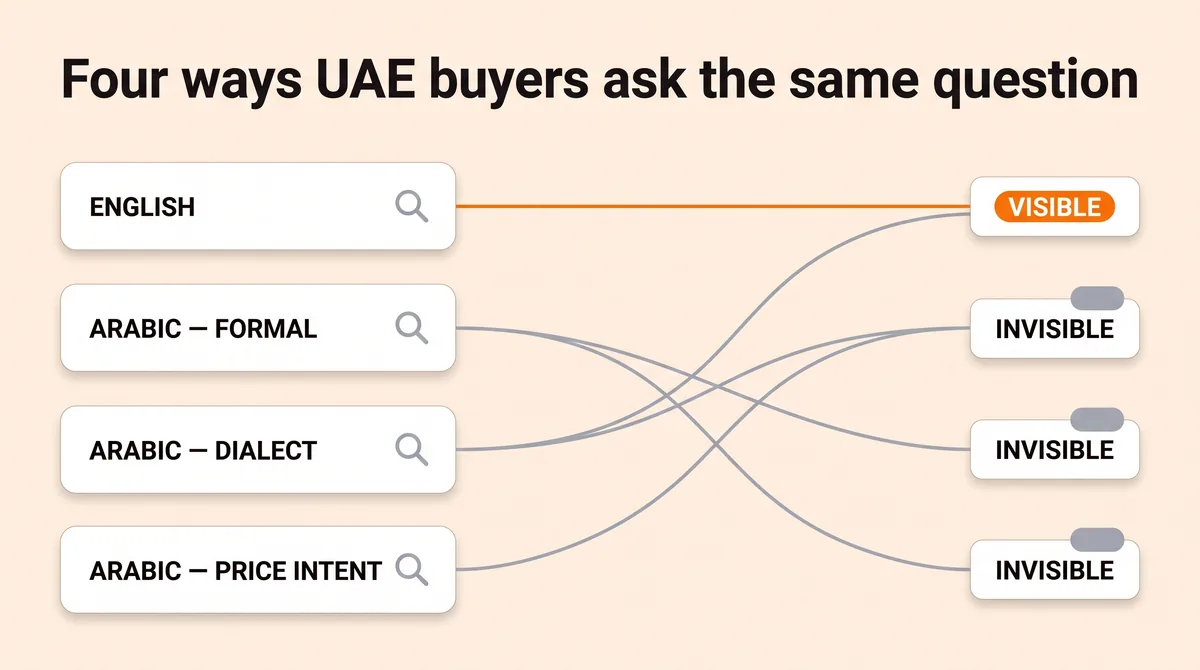
These are not four spellings of one query. They can express different expertise levels, different trust needs, different purchase contexts, and different expected answer formats. The fourth is price-led; the first is category-led. An AI system resolving them draws on different evidence.
| Weak approach | Strong UAE/MENA approach |
|---|---|
| Translated “best accounting software” page | Arabic and English pages covering VAT workflows, AED pricing, UAE entity types, free-zone vs mainland differences, Arabic support, integrations, and local onboarding |
| Generic “Dubai real estate guide” | Source-led guide on community-level considerations, ownership type, financing constraints, developer information, current rules, and clearly dated market evidence |
| Global “contact us” page | Verified UAE locations, country phone numbers, Arabic support details, local leadership, business hours, service-area pages, profile consistency, and local customer proof |
Add Arabizi — Arabic written in Latin characters, often with numerals for sounds Latin script lacks — to your monitoring set. You should not build dedicated Arabizi pages; you should know whether AI systems resolve those queries to you or to a competitor.
2. One Region, Many Markets
Do not treat “MENA” as a single search market. The UAE, Saudi Arabia, Egypt, Qatar, Kuwait, Jordan, and Morocco differ in language mix, purchasing power, regulation, platform use, dialect, business ecosystem, and search intent.
For a UAE-based company, the sequence that works:
- Create UAE-first content where the service, regulation, availability, and customer proof genuinely apply.
- Add country-specific pages only when you can support the claims operationally.
- Use Modern Standard Arabic as the baseline, but validate high-value commercial phrasing with native speakers and real customer conversations.
- Never duplicate one page across every country with the location name swapped.
That last point is not a stylistic preference. Templated location pages are exactly the thin, low-trust pattern that both Google’s helpful-content guidance and retrieval-based systems are built to discount. One credible UAE page beats seven templated Gulf pages.
3. Local Trust Cannot Be Imported
Global authority does not transfer automatically into a regional answer. Local trust has to be demonstrated: service areas, AED pricing, regulatory context, local customer proof, Arabic terminology, regional media references, and accurate business-entity data. This is the same structural lesson that applies when Western brands try to enter China’s AI search ecosystem — different web, different citation hierarchy, different starting position.
The AI-Search Visibility Framework
Four layers, in dependency order. Skipping to layer three is the most common failure.
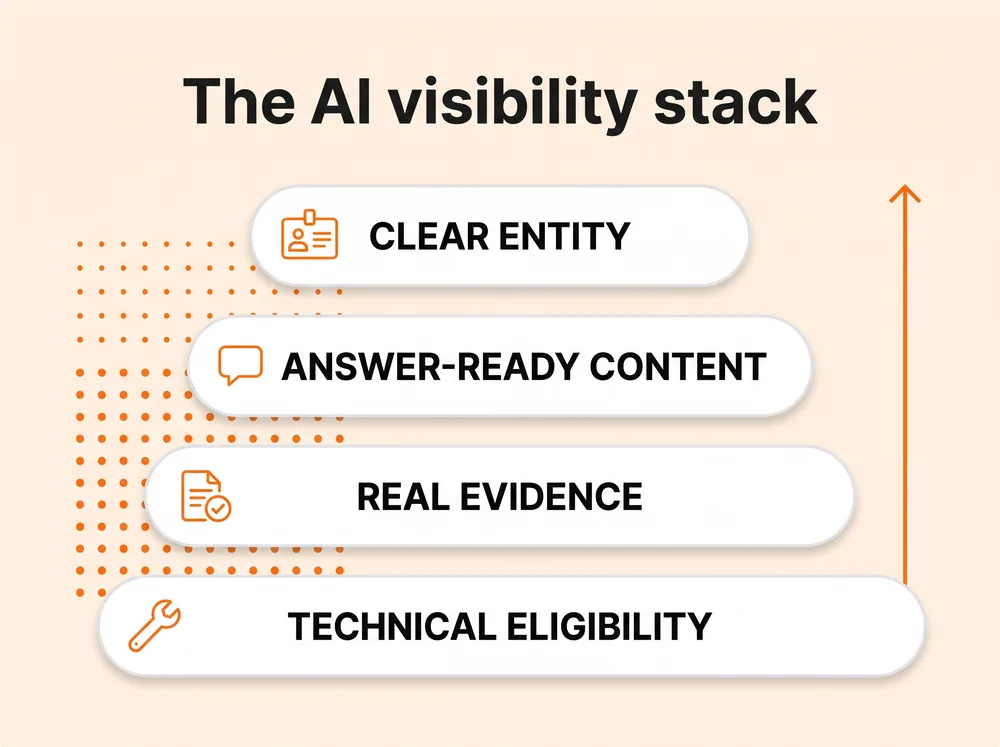
A. Become a Clear Entity
AI systems need consistency before they can confidently represent a business. Your brand needs a stable, verifiable identity across your own site and the wider web:
- Precise company name, description, category, founders or leadership, location, and operating markets.
- Current contact details and accurate Google Business Profile information.
- An About page with genuine company history, credentials, and proof.
sameAslinks to authoritative social, business, and editorial profiles.Organization,LocalBusiness,Product,Service,Article, andFAQPageschema — always aligned with visible page content.
Google explicitly notes that structured data should match visible text, and that Business Profile and Merchant Center details need to stay current for visibility in its AI features. Schema that describes something the page does not show is worse than no schema.
B. Publish Answer-Ready Content
The best AI-search content does not read as if it were written for a machine. It answers a real question quickly, clearly, and with enough evidence for both people and systems to trust it.
A page pattern that works:
- A precise question-based heading.
- A direct 40–80 word answer immediately beneath it.
- Evidence, definitions, caveats, and practical detail.
- A local example with real specifics.
- Supporting sources, author credentials, dates, and update history.
- A clear conversion path for users who need help.
So instead of a vague “AI Consulting Services Dubai” page, build content that answers high-intent questions:
- “What does an AI readiness assessment include for UAE companies?”
- “How can a UAE retailer prepare product data for AI shopping assistants?”
- “What should a Dubai real-estate firm include in its AI-search content?”
- “How should an Arabic-English website structure service pages for AI search?”
This is the same answer engine optimization discipline that works in any market — applied to questions your regional buyers actually ask.
C. Build Evidence, Not Content Volume
Generative systems favour sources that read as credible, current, and specific. Prioritize:
- First-party research and original datasets.
- Named local experts with real biographies and qualifications.
- Customer case studies with permission and measurable outcomes.
- UAE- and GCC-specific guides, checklists, explainers, and benchmarks.
- Original commentary on regional policy, market behaviour, and implementation.
- Citations to primary sources, regulators, and official documentation.
- Publication and “last updated” dates — non-negotiable for law, pricing, real estate, finance, healthcare, and compliance content.
Google’s guidance is consistent here: original quality, expertise, experience, authoritativeness, and trustworthiness matter regardless of whether AI helped produce the content.
D. Fix Technical Eligibility First
No amount of GEO branding compensates for pages that cannot be crawled, indexed, rendered, or understood.
| Check | Why it matters in the UAE specifically |
|---|---|
| Important content is crawlable and indexable | Baseline eligibility for AI Overviews and AI Mode |
| robots.txt, CDN rules, WAF, and JS rendering are not blocking Googlebot | Regional CDN and security configurations are a frequent silent blocker |
| Clean internal linking to priority pages | Determines what gets discovered and how topical authority is read |
| Essential information in HTML text | Not only in images, PDFs, client-side widgets, or video |
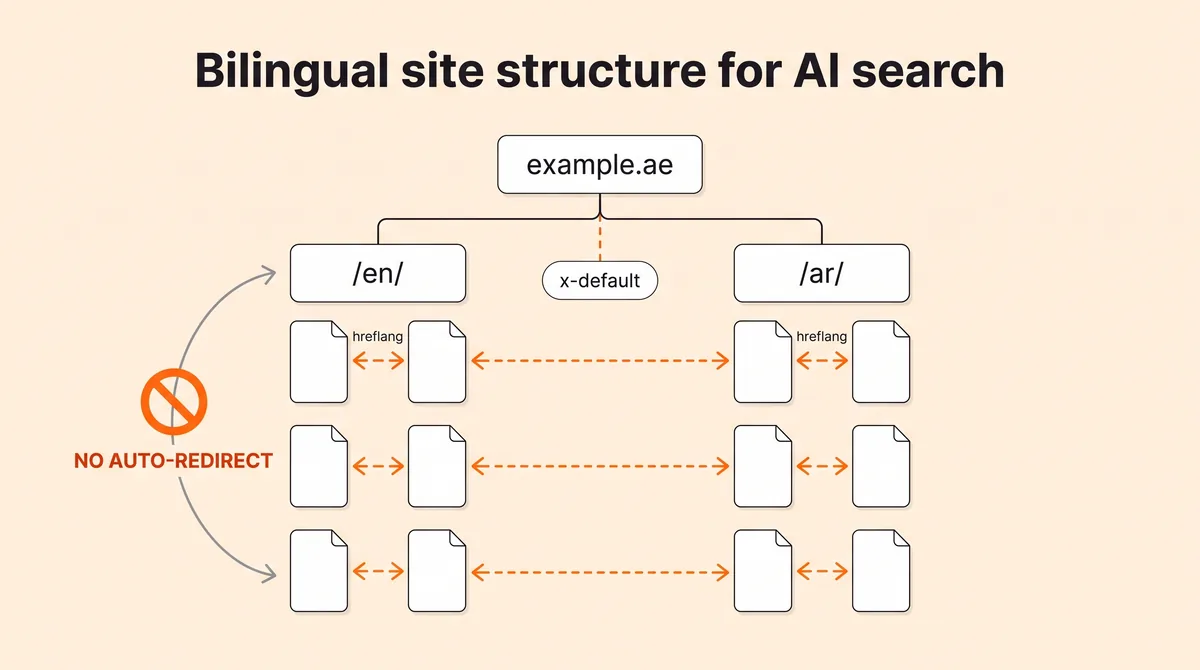
Correct hreflang between Arabic and English versions | The single most-broken element on bilingual Gulf sites |
| No automatic language redirects by IP or locale | Auto-redirects can make one language version effectively invisible to crawlers |
| Schema reflects exactly what users can see | Mismatched markup undermines the entity signal it was meant to build |
| Product, location, service, price, and availability data current | Stale AED pricing and hours actively damage local answer quality |
Google states there are no separate technical requirements to be eligible as a supporting link in AI Overviews or AI Mode beyond being indexed and eligible to appear with a snippet in Google Search. Fix the fundamentals and you are eligible; there is nothing else to unlock. Our GEO audit checklist covers the full technical sweep.
What UAE Brands Should Actually Measure
Do not promise a single “AI ranking.” AI responses vary by query, location, language, model, personalization, and time. Any vendor selling you a guaranteed AI rank in Dubai is selling something that does not exist.
What you can build is a regional AI visibility baseline.
Build a Bilingual Prompt Set
Run a representative set in both Arabic and English:
| Prompt type | English | Arabic |
|---|---|---|
| Category discovery | ”Best [category] in Dubai" | "أفضل [الفئة] في دبي” |
| Explanatory | ”How does [service] work in the UAE?" | "كيف تعمل [الخدمة] في الإمارات؟“ |
| Product fit | ”What is the best [product] for UAE companies?" | "ما هو أفضل [منتج] للشركات الإماراتية؟“ |
| Comparison | ”[Brand] vs [competitor] UAE" | "[العلامة] مقابل [المنافس] الإمارات” |
| Local capability | ”Who offers [capability] in Abu Dhabi?" | "من يقدم [الخدمة] في أبوظبي؟“ |
| Regulatory | ”What are the requirements for [regulated use case] in the UAE?" | "ما هي متطلبات [الحالة] في الإمارات؟“ |
Record Seven Things Per Prompt
- Is the brand mentioned at all?
- Is it cited or linked?
- Which domain or page is cited?
- Which competitors appear alongside you?
- Does the Arabic result differ from the English result?
- Does the system get core company facts right?
- Do those mentions produce qualified sessions, leads, calls, store visits, or revenue?
Point five is where most regional programs find their biggest gap. It is entirely normal for a UAE brand to be well represented in English answers and completely absent from the Arabic equivalents — same company, two different brand realities.
Point four matters more than teams expect, because AI answers vary by geography even for identical prompts. We covered the research on why AI answers change by location — for a business operating across Dubai, Abu Dhabi, Riyadh, and Doha, a single national visibility score hides more than it reveals.
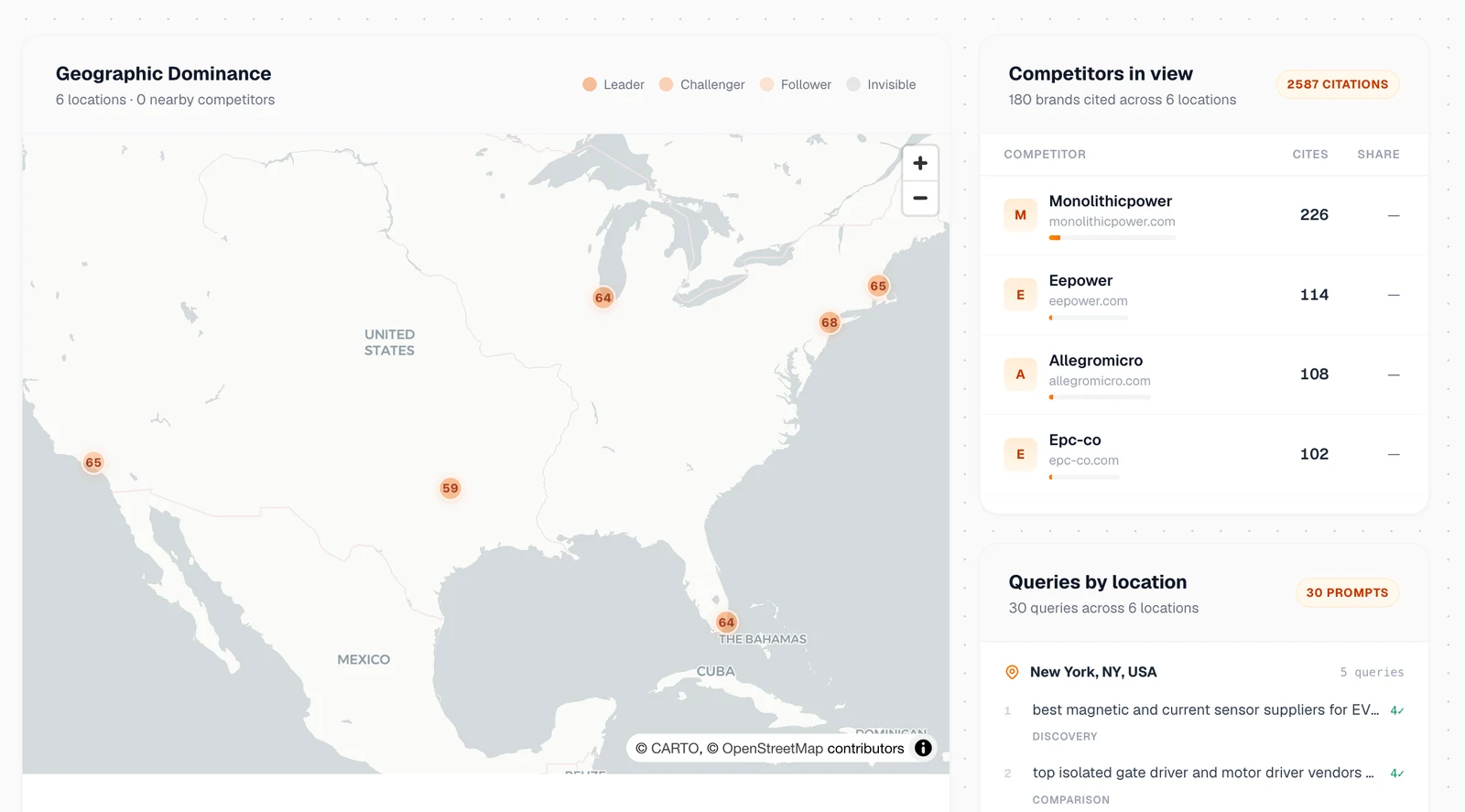
Then connect it to Search Console and analytics. Google reports AI-feature activity within standard Search Console reporting, and says clicks from pages featuring AI Overviews have tended to be higher quality, with users spending more time on site. If you are starting from zero, our guide on how to measure AI visibility walks through the full baseline.
If you would rather see the baseline than build it, Sanbi tracks Arabic and English prompt sets side by side across ChatGPT, Gemini, Perplexity, Claude and Google AI Mode. Run a free AI visibility audit for a one-off snapshot, or start a free trial to track movement over time.
Claims to Avoid If You Want to Be Credible
The regional market is currently full of confident claims that do not survive contact with Google’s own documentation.
| Common claim | Reality |
|---|---|
| ”SEO is dead.” | AI search relies heavily on the underlying web ecosystem and standard search eligibility. |
| ”There’s a secret checklist to optimize directly for ChatGPT or AI Overviews.” | No verified universal formula exists. Google publishes the foundations; there is no hidden layer. |
| ”Schema guarantees inclusion in AI answers.” | It can improve clarity and eligibility. It guarantees nothing. |
| ”Publish thousands of AI-generated location pages.” | This creates thin, manipulative, low-trust content that is a liability, not an asset. |
| ”MENA is one market.” | It is many markets with different languages, regulations, cultures, and buying behaviour. |
| ”AI Overviews always reduce clicks.” | Impact varies by query, vertical, brand strength, and the usefulness of the cited page. |
Three Scenarios for 2030
Nobody can give you exact adoption percentages. What you can do is plan against defensible scenarios.
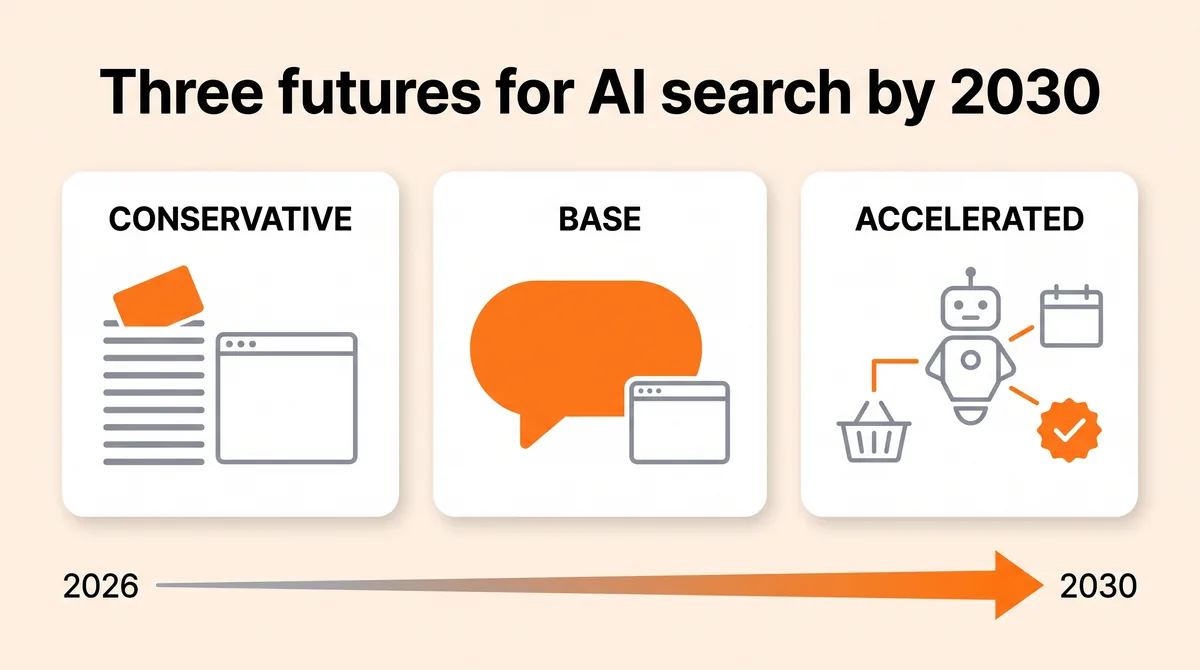
Conservative — AI search is an additive feature. AI answers become a major research layer for informational and comparison queries, but users still move frequently into conventional results, marketplaces, maps, and brand sites before converting. Implication: SEO stays central, while answer-ready content and citation monitoring become standard practice.
Base — AI search becomes the default research layer. Consumers and B2B buyers begin most complex discovery through conversational or AI-generated interfaces, using search results mainly to verify, compare, or transact. Implication: Brands without structured, credible, bilingual information lose early-stage consideration before a customer ever reaches their website.
Accelerated — agentic discovery becomes transactional. AI assistants do more than recommend. They compare, shortlist, book, request quotes, submit forms, make reservations, assemble baskets, and complete low-risk purchases within guardrails. Implication: You need machine-readable catalogs, real-time availability, service and policy data, pricing, location information, review signals, and serious first-party data governance. Our agentic commerce guide covers what that infrastructure looks like.
Note that these are not mutually exclusive by category. Property and financial services in the UAE will likely sit in the conservative-to-base range through 2030; retail, travel, and consumer services will move toward the accelerated end faster.
A 90-Day Starting Plan for UAE Brands
Days 1–30 — Establish the baseline. Audit technical eligibility (crawlability, hreflang, rendering, redirects). Consolidate entity data across your site, Google Business Profile, and regional directories. Build and run your bilingual prompt set to capture a starting position in both languages.
Days 31–60 — Close the evidence gaps. Rewrite the top 10 commercial pages to the answer-ready pattern with genuine UAE specifics: AED pricing, entity types, VAT treatment, free-zone versus mainland distinctions, named local proof. Fix structured data so it matches visible content. Publish the first two pieces of original regional evidence.
Days 61–90 — Build Arabic depth and measure. Produce Arabic content written natively rather than translated, for the queries where your Arabic visibility is weakest. Re-run the prompt set. Compare Arabic versus English movement, and connect mentions to sessions and pipeline. Decide which GCC market, if any, you can genuinely support next.
The Bottom Line
The AI-search opportunity in the UAE is not about gaming a new algorithm. It is about becoming the clearest and most credible answer in a market where AI is rapidly becoming part of how people make decisions.
That requires moving beyond English-only content, generic regional messaging, and vanity keyword rankings — toward bilingual authority, local proof, structured digital identities, technically sound sites, and content built to solve real customer questions.
In the classic search era, brands competed to be found.
In the AI-search era, they compete to be understood — and trusted enough to be included in the answer.
Run a free AI visibility audit to see how ChatGPT, Gemini and Claude currently describe your brand.
Then start your free trial to watch those answers change as the work lands.
Sources
- Google MENA — AI Overviews and Gemini search innovations for MENA, including Arabic support
- Google Search Central — AI features and your website
- Google Search Central — Creating helpful, reliable, people-first content
- Google Search Central — Succeeding in AI search
- Grand View Research — UAE artificial intelligence market report
- Grand View Research — MENA artificial intelligence market analysis
- PwC Middle East — Why the Middle East is betting big on AI
- McKinsey — The state of gen AI in the Middle East’s GCC countries: a 2024 report card
- GSMA — The Mobile Economy: Middle East and North Africa
- DataReportal — Digital 2026: United Arab Emirates
- Atlantic Council — The new playbook for AI leadership: the case of the United Arab Emirates
Market forecasts are projections, not observed outcomes. Grand View Research figures are market-revenue forecasts and should not be combined with PwC’s GDP-contribution estimates. PwC’s USD 320 billion regional figure is an economic-contribution projection, not spending on AI software or infrastructure. The McKinsey GCC survey covered 140 executives across six countries and eight sectors — directionally valuable, not a census.
Frequently Asked Questions
It is already live. Google expanded AI Overviews across the Middle East and North Africa and added Arabic-language support, which brings AI-generated search summaries into the mainstream search experience for a large share of the region's users. Alongside that, ChatGPT, Gemini, Perplexity, and Copilot are widely used across the UAE for product research, vendor comparison, and local recommendations. The practical implication for UAE brands is that a meaningful share of discovery now happens inside a generated answer before a user ever reaches a list of blue links.
Western GEO playbooks assume a monolingual English web, a single national market, and a citation ecosystem built on G2, Reddit, Wikipedia, and US trade media. None of those assumptions hold cleanly in the Gulf. UAE search behaviour is structurally bilingual — users move between English, Modern Standard Arabic, dialect, and Arabizi depending on category and intent. MENA is not one market: the UAE, Saudi Arabia, Egypt, Qatar, Kuwait, Jordan, and Morocco differ in language mix, regulation, purchasing power, and platform use. And local trust signals — trade licences, free-zone versus mainland status, AED pricing, VAT treatment, and regional customer proof — cannot be translated in from a global page.
Grand View Research forecasts the UAE artificial intelligence market to grow from USD 5.22 billion in 2024 to USD 46.33 billion by 2030, a compound annual growth rate of 43.9%. Across the wider MENA region, the same firm forecasts an AI market of USD 166.33 billion by 2030 at a 44.8% CAGR. These are market-revenue forecasts for AI overall, not a standalone sizing of AI search — no credible publisher currently isolates AI search as a discrete UAE or MENA market — but they describe the ecosystem that makes AI-mediated discovery commercially important.
PwC estimates AI could contribute USD 320 billion to the Middle East economy by 2030, roughly 11% of regional GDP. The UAE is projected to see the largest proportional benefit of any Middle Eastern market, with AI contributing an estimated 13.6% of national GDP — around USD 96 billion. PwC separately estimates generative AI alone could produce USD 23.5 billion in annual economic impact across the GCC by 2030, with USD 9.90 of economic growth for every USD 1 invested. These are economic-contribution estimates and should not be added to market-revenue forecasts, which measure something different.
No. A mechanically translated mirror of an English page is one of the most common and most costly mistakes in Arabic AI search. Arabic queries frequently express different expertise levels, trust requirements, purchasing contexts, and expected answer formats than their English equivalents. An Arabic page should reflect how regional audiences actually formulate questions, describe products, state constraints, and evaluate credibility — including local regulatory framing, AED pricing, and named local proof. Use Modern Standard Arabic as the baseline, but validate high-value commercial phrasing with native speakers and real customer conversations rather than a translation memory.
Arabizi is Arabic written in Latin characters, often with numerals standing in for sounds that have no Latin equivalent. It is common in informal search and messaging across the Gulf, particularly among younger users and in mobile contexts. It matters because a brand tracking only formal Arabic and English prompts will miss a real slice of how questions are actually typed. In practice you should not build dedicated Arabizi landing pages — that produces thin content — but you should include Arabizi variants in your prompt-monitoring set so you can see whether AI systems resolve those queries to your brand or to a competitor.
Only where you can genuinely support the claims operationally. Build UAE-first content where the service, regulation, availability, and customer proof actually apply, then add country-specific pages as real capability arrives in that market. What you should never do is duplicate a single template across every GCC country with only the city name swapped — that pattern creates thin, low-trust pages that AI systems have little reason to cite and that Google's helpful-content guidance explicitly warns against. One credible UAE page outperforms seven templated Gulf pages.
Give each language a stable, crawlable URL — a subdirectory structure such as /en/ and /ar/ is the most maintainable option for most UAE businesses. Implement reciprocal hreflang annotations between the language versions, including an x-default. Do not auto-redirect Arabic-speaking users to English or vice versa based on IP or browser locale, because that prevents crawlers from reaching one version entirely; offer a visible language switcher instead. Ensure both versions carry their own structured data, their own localized business information, and full navigational parity — an Arabic site that is a partial subset of the English one signals lower quality to both users and retrieval systems.
Do not promise a single AI ranking — AI responses vary by query, location, language, model, personalization, and time. Instead build a regional visibility baseline from a representative prompt set run in both Arabic and English. For each prompt record: whether the brand is mentioned at all, whether it is cited or linked, which specific domain or page is cited, which competitors appear, whether the Arabic result differs from the English result, and whether the system states core company facts correctly. Then connect that to business outcomes — qualified sessions, leads, calls, and revenue — rather than treating mention count as the end metric.
Yes, and Google is explicit about this. Google states there are no separate technical requirements to be eligible as a supporting link in AI Overviews or AI Mode beyond being indexed and eligible to appear with a snippet in Google Search. The foundations still apply: crawlable and indexable pages, helpful people-first content, essential information available as HTML text, sound internal linking, structured data that matches visible content, and current business information. AI search does not replace SEO in the Gulf — it raises the ceiling on what technically sound, genuinely useful content is worth.
Treat these as red flags: that SEO is dead; that there is a secret checklist to guarantee inclusion in ChatGPT or AI Overviews; that schema markup guarantees citations; that publishing thousands of AI-generated location pages will build regional authority; that MENA can be treated as one search market; or that AI Overviews uniformly reduce clicks. Each of these is either contradicted by Google's published guidance or unsupported by any verifiable regional data. Agencies selling guaranteed AI rankings in Dubai are selling something that does not exist.
Technical eligibility fixes — crawlability, hreflang, structured data, business-information accuracy — can produce measurable change within weeks. Entity consolidation across your site, Google Business Profile, and third-party regional profiles typically takes one to two quarters. Genuine bilingual authority, where Arabic-language AI answers consistently cite your pages for high-intent commercial queries, is a 6 to 12 month program because it depends on accumulated publishing history and third-party validation. Brands starting this work in 2026, while Arabic AI search is still forming, will hold a compounding advantage over competitors who begin in 2028.