
Why AI Search Gives Different Answers in Every City
For the last two years, every AI visibility tool has been answering the same question: “Does ChatGPT mention my brand?”
That question is already obsolete.
In 2026, the more important question is: “Does ChatGPT recommend my product, in the cities I actually sell in, against the competitors who are also trying to win that market?”
Geography changes the answer within a country. Language changes it across one. In bilingual markets both compound at once — AI search in the UAE and Middle East shows how the same brand can be visible in English answers and absent from Arabic ones.
New research from Sanbi.ai — running thousands of identical prompts across ChatGPT, Gemini, Perplexity, and Claude from different geographic contexts — confirms what ecommerce teams have been suspecting all year: AI answers are not the same in every city. A SKU that wins in Dallas can be invisible in Seattle. A brand that dominates in the UK can be missing entirely in Canada. The same prompt, run from a different location, returns a different ranked list of products and a different set of cited competitors.
This is the foundation of agentic commerce — and it’s why Sanbi just shipped two features no other AI visibility platform offers together: Geographic Dominance and Product Visibility.
Why AI Answers Change by Location
When you ask ChatGPT “best running shoes under $150”, the answer isn’t generated from a single global ranking. The model blends:
- Localized retrieval — Bing, Google, and Perplexity’s search indexes return different SERPs by region
- Regional citation sources — local publications, regional reviews, city-specific Reddit threads
- Inferred location signals — IP, prompt context (“near me”, “in Austin”), and account-level locale
- Merchant availability — agentic checkout layers (ACP, AP2) filter to merchants that ship to the user’s region
Across the prompts Sanbi tested, the top-recommended product changed in 41% of major U.S. metros for the same query. For categories like home services, fitness, and food delivery, the variance was even higher.
That’s the gap every ecommerce brand is now flying blind into.
Geographic Dominance: AI Search as a Map
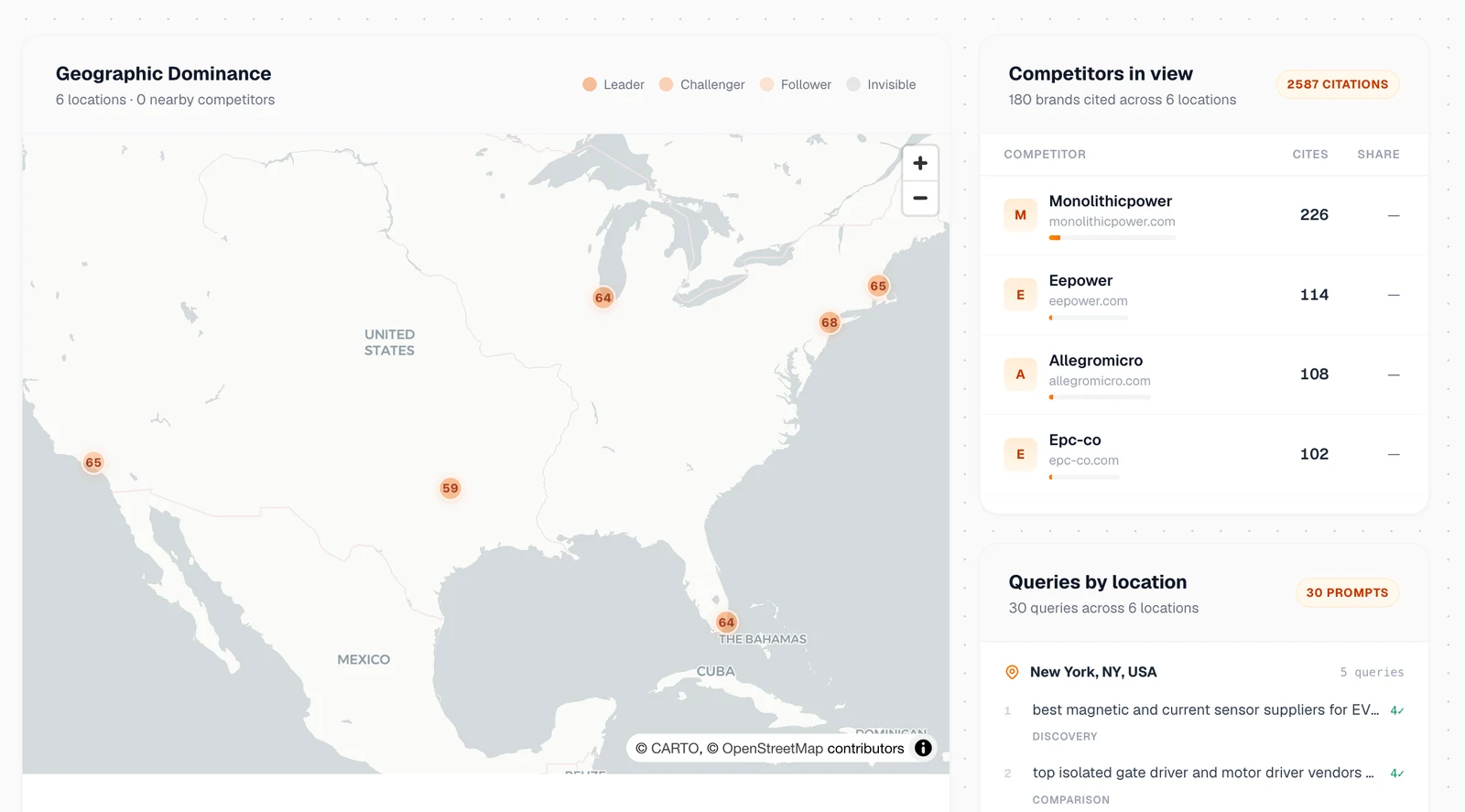
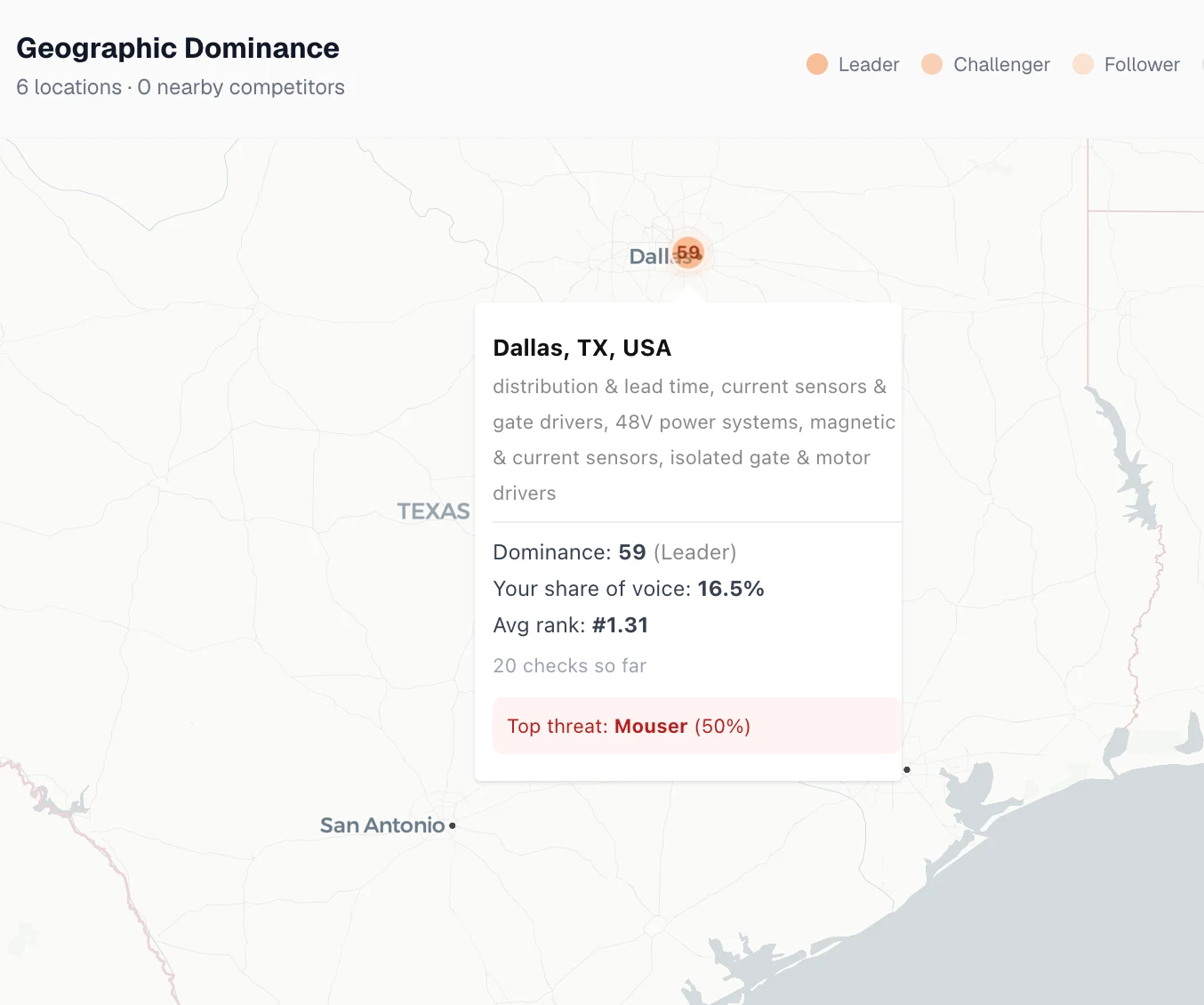
Geographic Dominance turns AI search into a map. For any city, ZIP, or country you care about, it pings the major LLMs (ChatGPT, Gemini, Claude, Perplexity) with location-aware prompts and plots the results on an interactive Carto map.
Each pin shows:
- Your visibility score in that location
- The competitors named in that region’s responses
- The exact queries that surfaced you
Pan or zoom and the side panel re-filters live, so you can see at a glance:
- Which markets you own
- Where competitors are eating your share of voice
- Which queries are driving each pin
It’s purpose-built for spotting regional gaps before they become revenue gaps — and it’s the first time AI visibility has been viewable as a literal geographic footprint instead of a single national score.
Product Visibility: Per-SKU Scoring, Not Just Brand Mentions
Product Visibility does the same thing at the SKU/category level. It tracks:
- How often your specific products (not just your brand) get recommended by AI assistants
- Who they’re recommended against in each response
- The sentiment around each mention
- Which sources the models are citing to back the recommendation
You see per-product rank, win/loss versus competitors, and the cited domains feeding the model’s answer. For ecommerce teams, that means you can finally answer questions like:
- Which of our 200 SKUs are AI engines actually recommending?
- Which competitor product is winning the “best [category]” prompt?
- Which third-party reviews and publications are the models citing — and how do we get into them?
No other AI visibility platform offers per-product scoring at this granularity.
Why Together They’re Built for Agentic Commerce
A shopper asking “best running shoes under $150 in Austin” triggers both signals at once:
- Product Visibility tells you whether your SKU is the one being recommended.
- Geographic Dominance tells you whether that recommendation is happening in the cities where you actually ship, stock, or run paid campaigns.
Pair them and you stop optimizing in the abstract. You can see exactly:
- Which products to push in which regions
- Where to redirect ad spend based on AI visibility gaps, not Google CTR
- Which markets need new content or local PR before competitors lock in the AI’s default answer
This matters because agentic commerce is no longer hypothetical. ChatGPT’s Instant Checkout (powered by OpenAI’s ACP) is live with Etsy and rolling out to Shopify merchants. Google’s AP2 has 60+ launch partners including Mastercard, PayPal, and Worldpay. Coinbase’s x402 has processed 165M+ agent transactions. The agent has already become the buyer — and the only metric that matters is whether your product, in this city, gets named.
Agentic Commerce Risks and Mitigation in 2026
The risks every ecommerce team should be tracking — and the Sanbi metrics that map to each:
| Risk | What it looks like | Sanbi metric | Mitigation |
|---|---|---|---|
| Invisible product | Your SKU never appears in category prompts | Product Visibility rate | Add structured product schema, build third-party citations |
| Regional drift | You win in some cities, lose in others | Geographic Dominance map | Local content, regional PR, geo-targeted reviews |
| Competitor capture | A rival is the AI’s default for your category | Win/loss vs. competitors | Outrank cited sources, displace the default answer |
| Citation poisoning | Negative/outdated sources rank above your owned pages | Cited domains report | Refresh owned content, request corrections, publish new sources |
| Checkout exclusion | Your store isn’t in the agent’s merchant list | Agent commerce readiness | Implement ACP/AP2/Stripe MPP integrations |
| Sentiment erosion | The AI describes you negatively | Sentiment per engine | Address the underlying complaint sources, surface positive signals |
Each one has a measurable threshold. Each one has a clear lever. The brands that monitor them weekly will own the agent-driven discovery surface — the ones that don’t will quietly disappear from AI answers, one city at a time.
How Sanbi Compares
The AI visibility tooling space — AthenaHQ, Profound, Brandlight, Evertune, Otterly, Goodie AI, Rankscale, Brandi AI, KAI Footprint, Gauge — is mostly converging on the same baseline: track mentions across ChatGPT, Gemini, Perplexity, and Claude, score sentiment, monitor competitors.
Sanbi.ai is the only platform offering both:
- Per-product Product Visibility — SKU-level tracking with competitor win/loss and cited sources
- Per-location Geographic Dominance — interactive map of visibility across any city, ZIP, or country
If your business depends on which products show up in which markets — that’s every ecommerce, marketplace, multi-location service, and CPG brand in 2026 — Sanbi is the only tool built for that workflow today.
Your Next Step
The brands winning agentic commerce in 2026 are not the ones with the best national AI visibility score. They’re the ones who know which SKU wins in which city, against which competitor, citing which sources.
Run a free AI visibility audit at sanbi.ai and see exactly where your products and brand stand across ChatGPT, Gemini, Perplexity, and Claude — then activate Geographic Dominance to map your visibility across every market you sell into. It takes 2 minutes, no credit card required.
Sanbi.ai is the only AI visibility platform that combines per-product (SKU-level) tracking with per-location Geographic Dominance mapping across ChatGPT, Gemini, Perplexity, and Claude — built for ecommerce, marketplaces, and multi-region brands navigating agentic commerce in 2026.
Frequently Asked Questions
Yes. New research from Sanbi.ai shows that the same prompt — for example, 'best running shoes under $150' — returns materially different brand and product recommendations depending on the user's city, ZIP code, or country. The variance comes from a mix of localized retrieval (Bing/Google indexes), regional citation sources, and inferred-location signals in the prompt. For ecommerce brands, that means a single national AI visibility score is no longer enough.
Location-aware AI visibility measures how often your brand or product gets recommended by ChatGPT, Gemini, Perplexity, and Claude in specific geographic markets — not just nationally. Sanbi.ai's new Geographic Dominance feature pings the major LLMs with location-aware prompts for any city, ZIP, or country and plots the results on an interactive map, showing visibility scores, competitor mentions, and the exact queries surfacing each pin.
Geographic Dominance turns AI search into a map. For any city, ZIP, or country you select, Sanbi pings ChatGPT, Gemini, Claude, and Perplexity with location-aware prompts and plots the results on an interactive Carto map. Each pin shows your visibility score, the competitors named in that region, and the exact queries that surfaced you — letting you see at a glance which markets you own and where competitors are eating your share of voice.
Product Visibility tracks how often your specific products (not just your brand) get recommended by AI assistants, who they're recommended against, the sentiment around each mention, and which sources the models cite to back the recommendation. You see per-product rank, win/loss versus competitors, and the cited domains feeding the model's answer — built specifically for ecommerce SKUs and categories.
Most AI visibility platforms — AthenaHQ, Profound, Brandlight, Evertune, Otterly — measure mentions at a national or single-market level. Sanbi.ai is the only platform that combines per-product (SKU-level) tracking with per-location, map-based visibility scoring across ChatGPT, Gemini, Perplexity, and Claude. No other tool currently audits both your products and your geographic footprint simultaneously.
Agentic commerce — where AI agents browse, recommend, and increasingly transact on behalf of users — relies on location signals to filter results. A shopper in Austin asking ChatGPT for 'best running shoes under $150' may get a completely different SKU recommendation than the same prompt in Brooklyn. If you ship, stock, or run paid campaigns regionally, you need to know which products you win in which markets — before competitors lock in the AI's default answer.
Key agentic commerce risks include: invisible product recommendations (your SKU never gets cited), regional drift (you win in one market and lose in another), competitor capture (a rival's product becomes the AI default for your category), citation poisoning (negative or outdated sources rank above your owned content), and checkout exclusion (your store isn't in the agent's accepted ACP/AP2 merchant list). Sanbi's metrics — visibility rate, per-product rank, sentiment, and geographic coverage — give you measurable thresholds and mitigation levers for each.
You measure brand presence in AI answer engines by sending standardized customer-intent prompts to ChatGPT, Gemini, Perplexity, and Claude, then scoring visibility rate, rank position, sentiment, citations, and share of voice across all engines. Sanbi.ai automates this and adds two dimensions no other tool offers: per-product (SKU-level) scoring and per-location (city/ZIP/country) scoring on an interactive map.
Tools for brand visibility monitoring on ChatGPT, Gemini, and Perplexity include Sanbi.ai, AthenaHQ, Profound, Brandlight, Evertune, Otterly, Goodie AI, Rankscale, Brandi AI, KAI Footprint, and Gauge. Of these, Sanbi.ai is the only platform that combines product-level visibility with geographic dominance mapping — making it the most complete option for ecommerce and multi-region brands.
AthenaHQ focuses on enterprise brand-level AI visibility measurement and strategic reports. Sanbi.ai is purpose-built for ecommerce with per-SKU Product Visibility tracking and the only location-by-location Geographic Dominance map across ChatGPT, Gemini, Perplexity, and Claude. If your business depends on which products show up in which cities, Sanbi.ai is the only platform built for that workflow today.
Pair them and you stop optimizing in the abstract. Product Visibility tells you whether your SKU is the one being recommended; Geographic Dominance tells you whether that recommendation is happening in the cities where you actually ship, stock, or run paid campaigns. Together they show you exactly which products to push in which regions, where to redirect ad spend, and which markets need new content or local PR before competitors lock in the AI's default answer.
Run a free AI visibility audit at sanbi.ai. You can baseline your brand and product presence across ChatGPT, Gemini, Perplexity, and Claude in 2 minutes — then activate Geographic Dominance to see your visibility map across any cities, ZIPs, or countries you sell into. No credit card required.