Agentic Commerce in 2026: Market Size, Risks, and How to Make Your Brand Visible to AI Shopping Agents
A new type of buyer just entered the market — and it’s not human.
AI agents are now browsing product pages, comparing specifications, reading reviews, and making purchase recommendations autonomously. Some are even completing checkout without a human ever touching a screen.
This is agentic commerce — and it’s reshaping how products get discovered, evaluated, and bought in 2025-2026.
If your brand isn’t visible to these AI agents, you’re not just missing a trend. You’re losing sales to competitors whose product data the AI can read.
What Is Agentic Commerce?
Agentic commerce is the model where AI agents act as autonomous shopping assistants — handling the entire purchase journey on behalf of a consumer.
Here’s how it works in practice:
- A consumer tells their AI assistant: “Find me the best noise-canceling headphones under $300 with at least 30 hours battery life”
- The AI agent searches across product databases, review sites, and brand pages
- It compares specifications, reads aggregated reviews, checks pricing and availability
- It presents a shortlist — or, with permission, completes the purchase directly
No Google search. No clicking through ten tabs. No scrolling through Amazon reviews. The AI does it all.
The Key Players
| Platform | How It Enables Agentic Commerce |
|---|---|
| ChatGPT + Plugins | Searches the web, compares products, recommends based on user criteria |
| Gemini Shopping | Tightly integrated with Google Shopping data, reviews, and merchant feeds |
| Perplexity Product Search | Live web crawling with explicit source citations and product comparisons |
| Amazon Rufus | AI assistant embedded in the Amazon shopping experience |
| Apple Intelligence + Siri | On-device AI with commerce integrations across the Apple ecosystem |
China is further along than any Western market: Alibaba’s Qwen assistant connected Taobao, Alipay, Fliggy and Amap in one chat and drove more than 120 million orders in six days during the 2026 Lunar New Year. We break down what that means for Western brands in China’s AI internet and agentic marketing.
Agentic Commerce Market Size: 2025-2030
The numbers tell the story of where this is heading.
Current State (2025-2026)
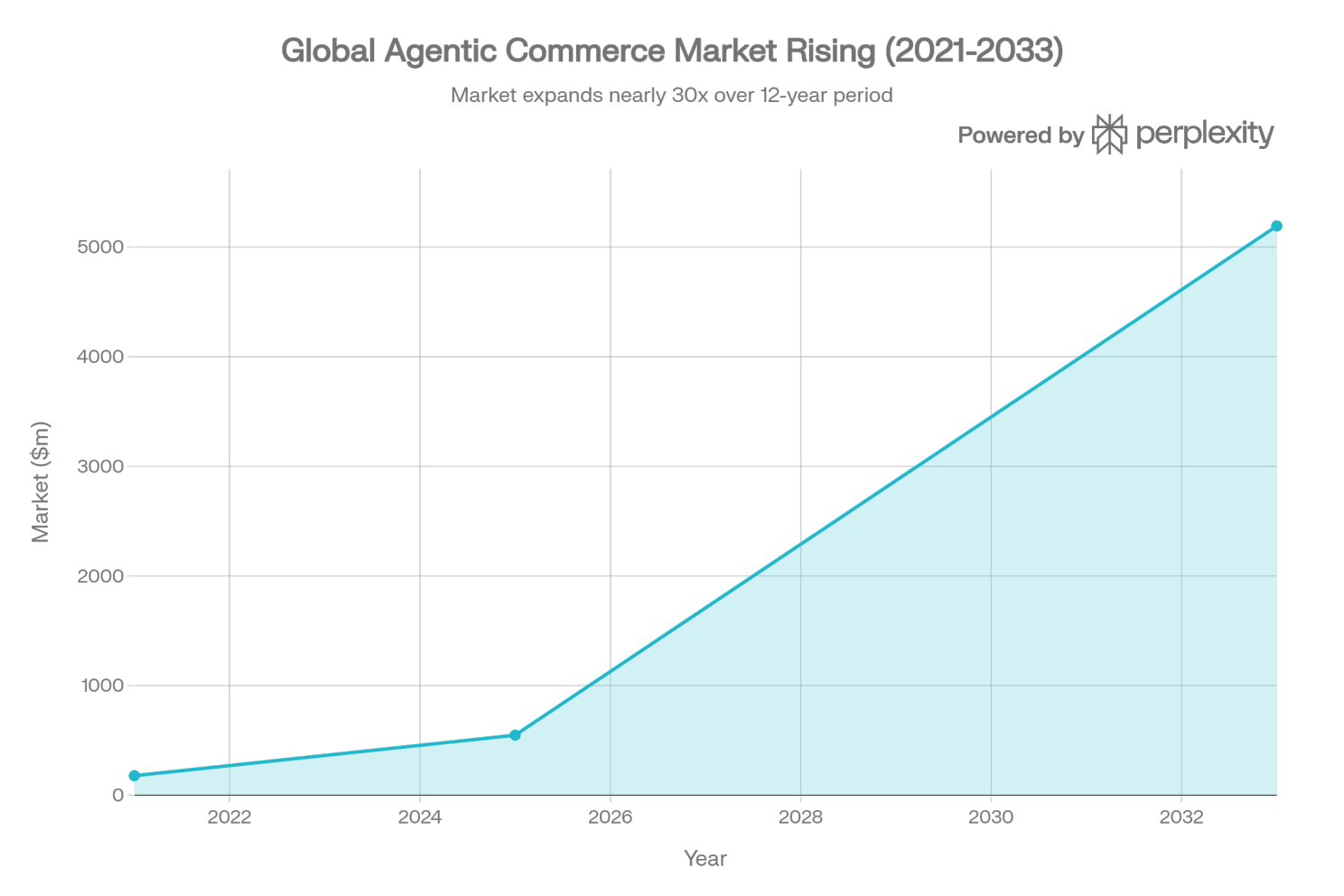
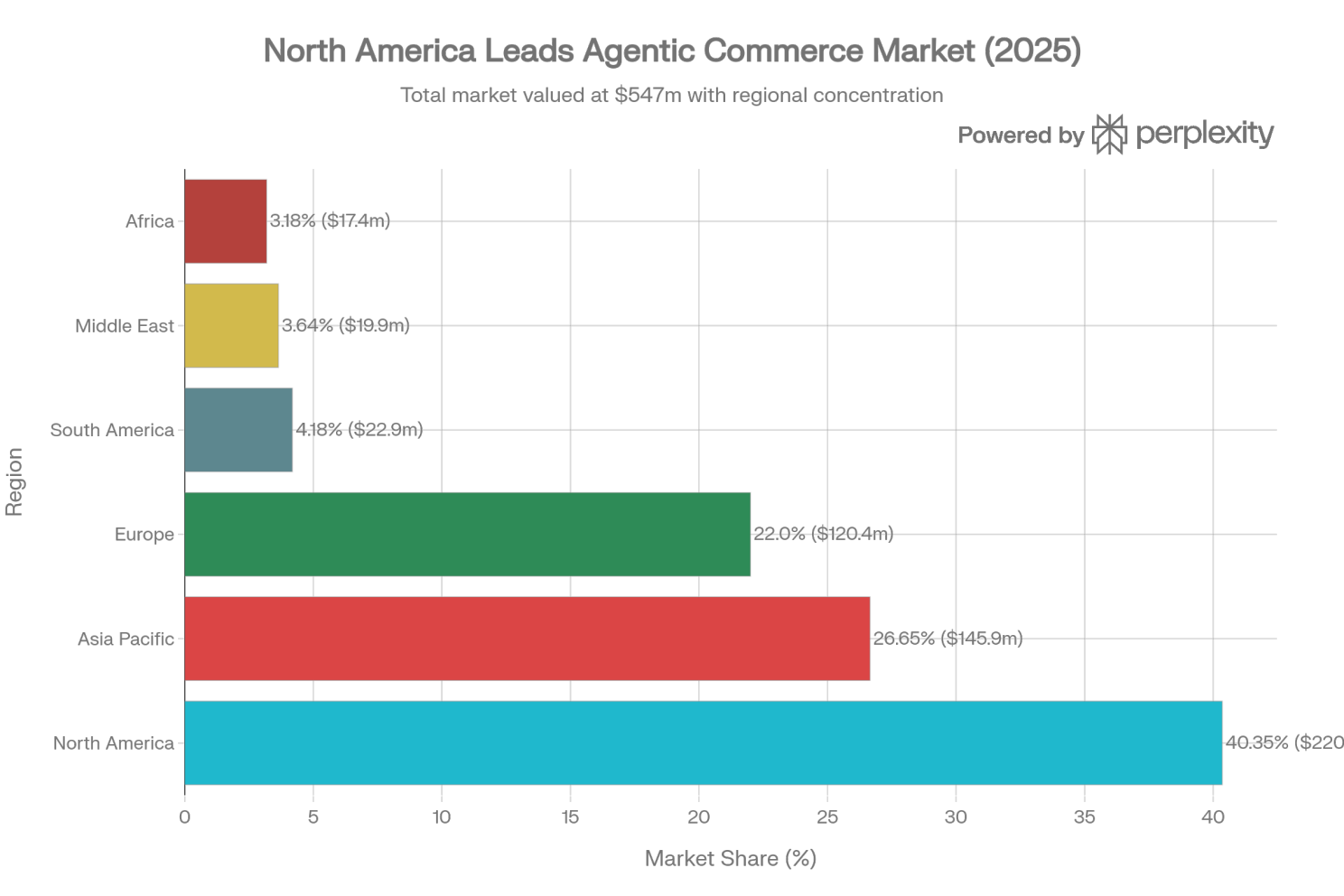
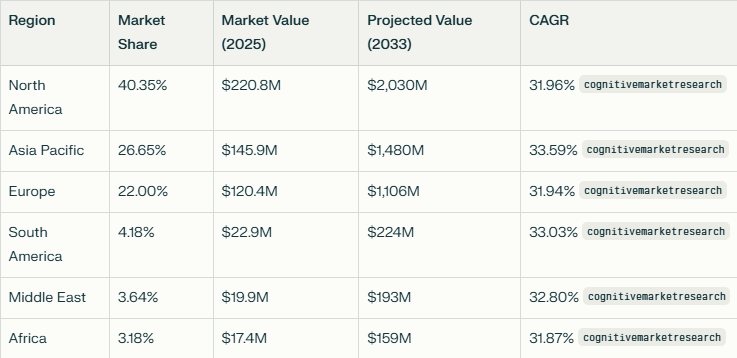
- The broader agentic AI market is valued at roughly $5-7 billion in 2025, with commerce applications growing as the fastest segment
- Gartner predicts that by the end of 2026, 25% of enterprise software purchases will involve some form of AI agent mediation
- eMarketer reports AI-assisted product discovery already influences over 40% of online searches in key categories
- The DTC and ecommerce segment alone is projected to see agentic AI adoption rates triple year-over-year heading into 2026
Projections Through 2030
- The agentic AI market is forecast to exceed $30 billion by 2028
- By 2030, analysts project that 20-30% of all online transactions will involve AI agent mediation at some stage of the funnel
- Agentic commerce specifically — meaning AI agents completing or heavily influencing purchase decisions — could represent a $50+ billion market by 2030
- McKinsey estimates that AI-driven personalization and autonomous shopping could unlock an additional $1.2 trillion in value for the global retail sector
The trajectory is clear: this isn’t a niche experiment. It’s the next infrastructure layer of ecommerce.
How Agentic Commerce Changes the Funnel
Traditional ecommerce runs on a funnel you can see: impression → click → browse → add to cart → checkout. Every step is measurable. You can optimize each stage.
Agentic commerce compresses the entire funnel into a single AI interaction.
Before (Traditional)
Consumer → Google Search → Click ad/result → Browse site → Compare tabs → Add to cart → Checkout
7 steps. Multiple sessions. Hours or days.
After (Agentic)
Consumer → Tell AI agent what they need → AI searches, compares, recommends → Purchase
4 steps. One conversation. Minutes.
This compression means:
- Discovery and evaluation happen simultaneously — the AI doesn’t separate “browsing” from “comparing”
- Brand websites become optional — the AI may never visit your site, just read your structured product data
- Reviews and third-party signals carry more weight — the AI cross-references multiple sources before recommending
- Price transparency is total — the AI compares every option in milliseconds
The Risks of Agentic Commerce (And How to Mitigate Them)
This shift isn’t all upside. There are real risks that brands need to understand and plan for.
1. Loss of Brand Control
The risk: AI agents summarize your product based on aggregated data — not your carefully crafted messaging. If third-party reviews mention issues, the AI will surface them.
Mitigation: Monitor how AI models describe your brand using tools like Sanbi.ai. Track sentiment across ChatGPT, Gemini, and Perplexity. When you find negative or inaccurate descriptions, address the root source (review sites, forums) rather than trying to “fix” the AI directly.
2. Price Commoditization
The risk: AI agents optimize on specifications and price by default. If your product is functionally similar to a competitor’s but more expensive, the AI may recommend the cheaper option.
Mitigation: Ensure your structured data includes differentiators beyond price — unique features, warranty terms, customer support quality, certifications. Build a review profile that emphasizes value, not just features.
3. Recommendation Bias
The risk: LLMs tend to favor brands with more structured data, more third-party mentions, and more web consensus — regardless of actual product quality. A mediocre product with great SEO can outrank a superior product with poor AI visibility.
Mitigation: Invest in comprehensive Product schema markup, build third-party review profiles on Google, Reddit, and niche forums, and monitor your AI share of voice vs. competitors.
4. Data Privacy and Security
The risk: AI agents access user purchase history, preferences, and browsing patterns to make recommendations. This creates new privacy vulnerabilities and potential for data leakage.
Mitigation: Ensure your platform’s checkout flow is compatible with AI agent interactions while maintaining security standards. Implement proper authentication for API-based purchases.
5. Fraud and Automated Attacks
The risk: Malicious AI agents could exploit automated checkout flows — attempting mass purchases, testing stolen payment methods, or manipulating pricing.
Mitigation: Implement bot detection and rate limiting on checkout APIs. Use verification steps that are AI-agent-compatible but resist abuse (e.g., token-based authentication rather than CAPTCHAs).
How to Make Your Brand Visible to AI Shopping Agents
This is the actionable part. If agentic commerce is the future, your product data needs to be ready for it today.
Step 1: Implement Comprehensive Product Schema
AI agents read structured data — not marketing copy. Your product pages need JSON-LD schema that includes:
- Product name, description, and category
- Price, currency, and availability (with real-time accuracy)
- Aggregate ratings and review counts
- Specifications (dimensions, weight, materials, compatibility)
- Brand and manufacturer information
- Images with descriptive alt text
- Offers (discounts, bundles, subscription options)
{
  "@context": "https://schema.org",
  "@type": "Product",
  "name": "Your Product Name",
  "description": "Direct, benefit-focused description",
  "brand": { "@type": "Brand", "name": "Your Brand" },
  "offers": {
    "@type": "Offer",
    "price": "99.00",
    "priceCurrency": "USD",
    "availability": "https://schema.org/InStock"
  },
  "aggregateRating": {
    "@type": "AggregateRating",
    "ratingValue": "4.7",
    "reviewCount": "342"
  }
}
Step 2: Build Third-Party Consensus
AI agents cross-reference multiple sources before recommending. Your brand needs to appear consistently across:
- Google Business Profile — complete, verified, and regularly updated
- Review platforms — Google Reviews, Trustpilot, G2 (for B2B), Amazon
- Reddit and forums — genuine mentions in relevant subreddits and communities
- Industry publications — guest posts, features, expert roundups
- Comparison sites — ensure your product data is listed on relevant comparison platforms
Step 3: Create Agent-Friendly Content
Structure your product and category pages for AI extraction:
- Question-based headings that mirror how consumers prompt AI: “What is the best [product] for [use case]?”
- Direct answer blocks — 40-60 word answers under each heading that an AI can pull verbatim
- Comparison tables with specs, pricing, and feature comparisons
- FAQ sections with structured FAQ schema on every product page
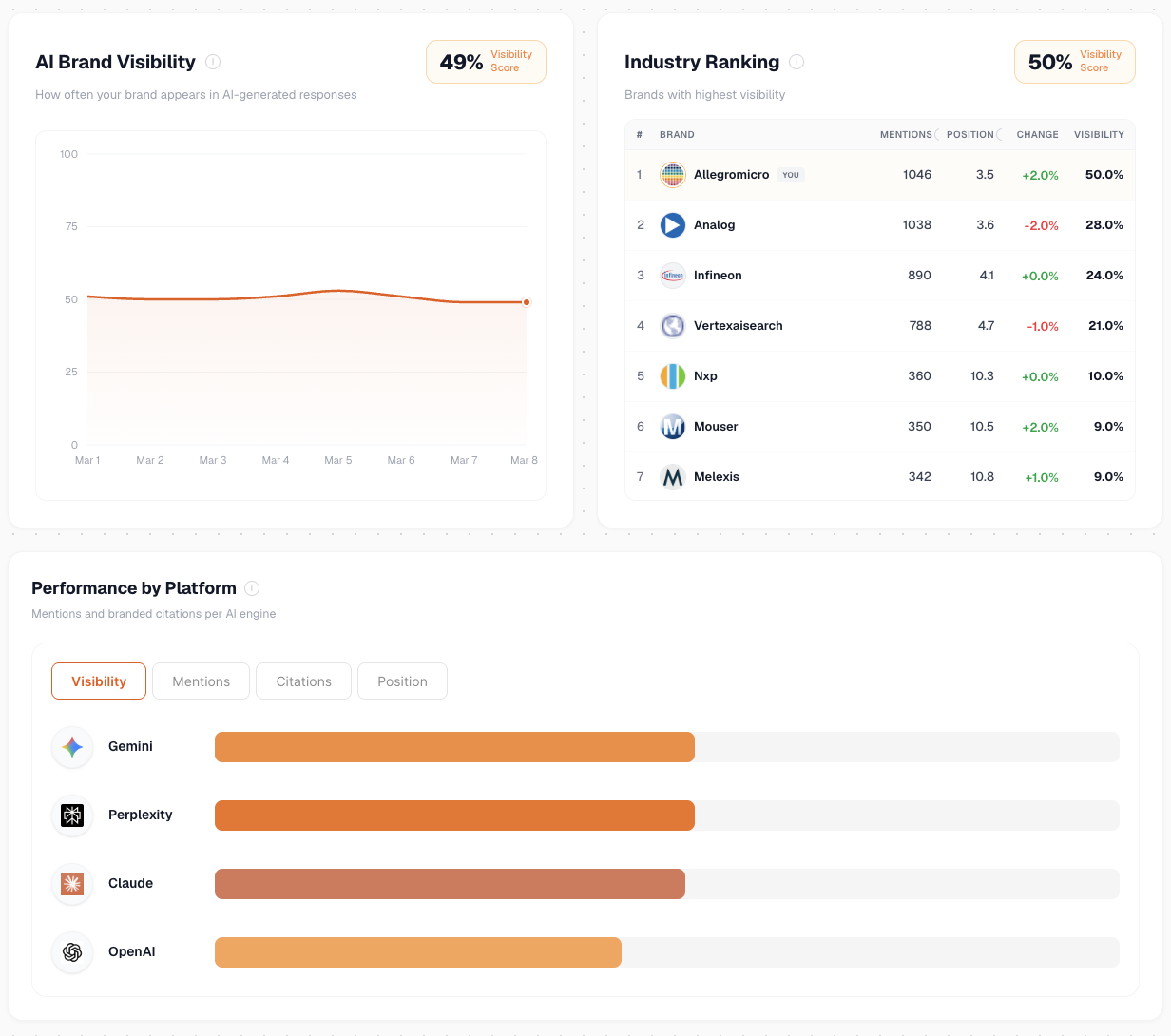
Step 4: Monitor Your AI Visibility
You can’t optimize what you can’t measure. Use Sanbi.ai to:
- Track which AI engines recommend your products
- Monitor sentiment — is the AI recommending you positively or with caveats?
- Compare your visibility against competitors on the same prompts
- Identify gaps — which prompts should surface your product but don’t?
Step 5: Optimize Your Bing Presence
ChatGPT’s browsing mode uses Bing to find products in real-time. If your product pages aren’t indexed and ranking on Bing, ChatGPT literally cannot recommend them.
- Submit your product sitemap to Bing Webmaster Tools
- Ensure Bingbot can crawl all product pages
- Optimize product titles and descriptions for Bing’s ranking algorithm
- Monitor Bing-specific rankings for key product queries
What This Means for DTC Brands and Agencies
For DTC Brands
The opportunity is massive — AI agents can discover and recommend your product without the customer ever visiting a comparison site or seeing a competitor’s ad. But only if:
- Your product data is machine-readable (schema markup)
- You have strong third-party validation (reviews, mentions)
- Your pricing and availability data is accurate in real-time
- You monitor how AI models perceive and recommend your brand
The brands that build this infrastructure now will be the default recommendations when agentic shopping goes mainstream.
For Ecommerce Agencies
AI visibility is the new SEO. Agencies that add agentic commerce readiness to their service offering will win the next wave of clients. This means:
- AI visibility audits as a standard service
- Schema markup optimization for product data
- Third-party signal building (review management, forum presence)
- Ongoing monitoring of AI recommendation patterns
- Competitive intelligence — tracking how AI agents rank your clients vs. competitors
Agencies that don’t adapt will be selling a service (traditional SEO) for a channel (ten blue links) that’s shrinking.
The Timeline: What to Do Now
Immediate (This Month)
- Run a free AI visibility audit to see where you stand today
- Audit your product schema markup — is it comprehensive and accurate?
- Check your Bing Webmaster Tools — are your product pages indexed?
Short-Term (Next 90 Days)
- Implement or upgrade Product schema on all key pages
- Build review profiles on the top 3 platforms in your category
- Create agent-friendly FAQ and comparison content
- Set up daily AI visibility monitoring
Medium-Term (6-12 Months)
- Develop an AI-first content strategy targeting the prompts your customers use
- Build third-party consensus through strategic PR, guest content, and community engagement
- Monitor competitor AI visibility movements and respond quickly
- Test AI agent checkout compatibility on your platform
The brands that treat agentic commerce as a 2028 problem will be scrambling to catch up. The ones building the infrastructure today will own the AI recommendations tomorrow.
Sanbi.ai monitors your brand’s AI visibility daily across ChatGPT, Gemini, Perplexity, and Claude — so you can track exactly how AI shopping agents see your products and stay ahead of the agentic commerce shift.
Frequently Asked Questions
Agentic commerce is the emerging model where AI agents autonomously browse, compare, evaluate, and purchase products on behalf of consumers. Instead of a human searching Google and clicking through product pages, an AI agent handles the entire shopping journey from discovery to checkout — making brand visibility to these AI systems critical for ecommerce survival.
The agentic AI market is projected to grow from roughly $5-7 billion in 2025 to over $15 billion by 2026, with agentic commerce capturing a significant and rapidly growing share. Analysts at Gartner, McKinsey, and eMarketer all flag AI-assisted purchasing as a top trend reshaping ecommerce. By 2030, projections suggest 20-30% of online transactions could involve some form of AI agent mediation.
The key risks include loss of brand control (AI agents may misrepresent your product), price commoditization (agents optimizing purely on price), recommendation bias (LLMs favoring brands with more structured data), data privacy concerns (agents accessing purchase history), and fraud/security vulnerabilities in automated checkout flows.
Implement comprehensive Product schema markup (JSON-LD) with pricing, availability, reviews, and specifications. Build strong third-party signals on Google Reviews, Amazon, Reddit, and niche forums. Create structured comparison and FAQ content. Monitor how AI models currently perceive your brand using an AI visibility audit at sanbi.ai.
The leading systems enabling agentic commerce include ChatGPT with shopping plugins, Google's Gemini shopping integration, Amazon's Rufus AI assistant, and Perplexity's product search. On the infrastructure side, platforms like Shopify, BigCommerce, and headless commerce APIs are adding AI agent compatibility layers. Brands should ensure their product data is structured for all of these systems.
DTC brands face both opportunity and risk. AI agents can discover and recommend products without the customer ever visiting a comparison site — which benefits brands with strong structured data and reviews. But agents also commoditize by comparing purely on specs and price, which hurts brands that rely on storytelling and brand experience. Agencies need to add AI visibility services to their offering or risk becoming irrelevant.
No. On-site search apps operate inside your store; AI engines never use them. ChatGPT, Perplexity, Gemini and AI Mode assemble product recommendations from third-party reviews, roundups, marketplaces and your structured data. Boost raises conversion for visitors you already have; AI search visibility work determines whether the engines send you visitors at all. The one point of contact is rendering: if the app builds collection or results pages in JavaScript, confirm your product URLs still serve complete HTML.