AI Search Visibility Tools: How They Work & Which to Pick
The AI search visibility tools category didn’t exist three years ago. Today it’s the fastest-growing slice of the marketing-tech stack, with the US GEO market alone projected to hit $365M in 2026 at a 42.9% CAGR.
If you’re shopping for one — or trying to figure out whether you even need one — this guide walks through what these tools actually do, the features that matter, and how to pick the right platform for your team.
What Is an AI Search Visibility Tool?
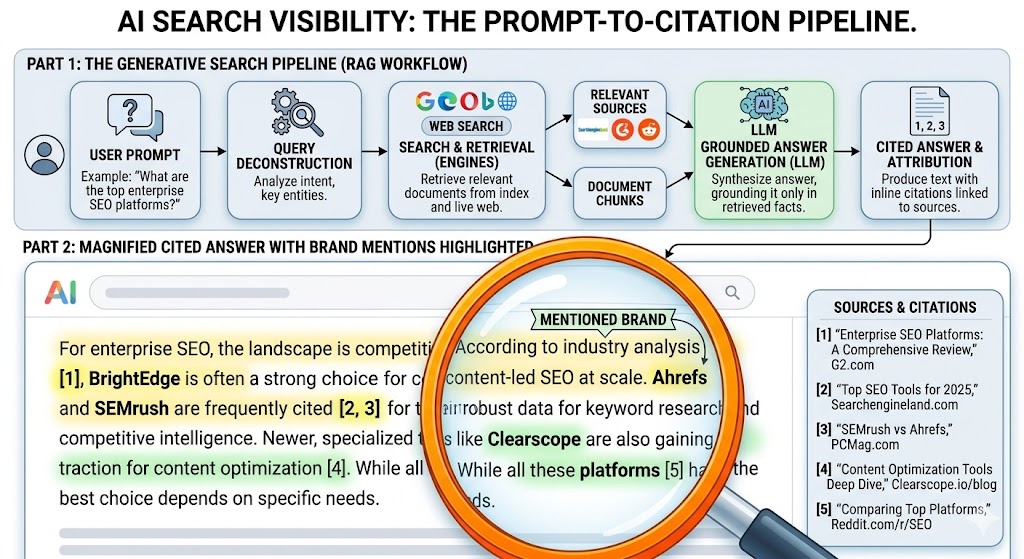
An AI search visibility tool (sometimes called an AI visibility tracker, AI search tracker, answer-engine monitor, or GEO platform) is a SaaS product that automates one job: telling you whether and how your brand shows up inside the answers AI engines generate for prompts in your category.
The underlying logic looks like this:
- You define a category and a competitive set.
- The platform generates (or imports) a list of representative buyer prompts — “best CRM for startups”, “what’s the cheapest project management tool”, “compare X vs Y”.
- The tool runs those prompts on a schedule across the four engines that matter — ChatGPT (OpenAI), Gemini (including AI Overviews and AI Mode), Perplexity, and Claude.
- Every response gets parsed for brand mentions, sentiment, citation URLs, and competitor share-of-voice.
- Results roll up into dashboards showing your visibility score, trend lines, and gaps.
That’s the floor. The best ai search monitoring tools layer on optimization recommendations, agent-accessibility audits, and per-engine intelligence.
How Does an AI Search Monitoring Platform Work?
Three technical pillars:
1. Prompt generation
Prompt-set quality is the single biggest factor in data quality. A bad prompt set gives you confident dashboards built on nonsense. The best tools combine:
- Seed prompts you provide
- Auto-expansion using your competitor pages and category taxonomy
- Buyer-journey templates (awareness → consideration → comparison → decision)
- Region-specific variants because answers differ dramatically by location
2. Multi-engine querying
Each engine requires a different integration path: official APIs where available (OpenAI, Anthropic, Perplexity), browser automation where not (Gemini AI Mode, AI Overviews). Cost-efficient platforms make heavy use of provider Batch APIs (OpenAI, Gemini, Claude all offer ~50% discounts on batched workloads) so they can run hundreds of prompts per audit without enterprise-only pricing.
3. Citation extraction & scoring
For each response the tool extracts:
- Brand mentions (yours + competitors)
- Sentiment around each mention
- URLs cited and their source domains
- Position within the answer (first paragraph beats footnote)
- Whether your brand is recommended, mentioned neutrally, or warned against
These get aggregated into a visibility score — typically a 0–100 composite weighted by mention frequency, position, and sentiment.
The Features That Actually Matter
Most vendors list the same 30 features. Five of them actually move the needle:
Multi-engine coverage
Minimum viable coverage in 2026: OpenAI / ChatGPT, Google Gemini (including AI Overviews and AI Mode), Perplexity, and Anthropic Claude. Sanbi.ai’s Professional plan covers all four; Advanced covers OpenAI, Gemini and Perplexity; Starter covers OpenAI only. Some legacy tools still only test ChatGPT, which is no longer enough.
Full-response capture
Cheap tools record yes/no flags (“brand mentioned: true”). Serious tools store the entire response so you can re-analyze for new questions later. Insist on the latter.
Sentiment scoring
Being mentioned negatively is worse than not being mentioned at all. Any tool worth paying for distinguishes recommendation from neutral mention from warning.
Competitor benchmarking on the same prompts
You need to see competitor positions on the exact same prompts that score you — otherwise comparisons are meaningless.
Recommendations, not just dashboards
This is the biggest 2026 divide. Legacy tools (Profound, Peec, Otterly) hand you data. Newer tools (Sanbi, Brandlight, Goodie, Athena) hand you a prioritized action list — which page to rewrite, which schema to add, which competitor citation to attack.
A Side-by-Side Comparison
| # | Tool | Engines | Recommendations | Best for | Starts at |
|---|---|---|---|---|---|
| 1 | Sanbi.ai | OpenAI, Gemini, Perplexity, Claude (Pro) + Site Health (SEO/AEO/ARO), Product Visibility & Geographic Dominance (region-based tracking) on Pro | ✅ Content engine ships AEO pages | All-in-one tracking + region-based intelligence + fixes + content, SMB to enterprise | $37.25/mo (annual) / $50 monthly |
| 2 | Profound | All 4 major LLMs + high prompt volume | ⚠️ Limited | Enterprise prompt-volume reporting | $30k+/yr |
| 3 | Peec.ai | All 4 major LLMs, region-based | ⚠️ Limited | EU and multi-region brands | Mid-market |
| 4 | Scrunch | All 4 major LLMs | ⚠️ Limited | Citation-URL deep dives | Mid-market |
| 5 | Brandlight | All 4 major LLMs | ✅ | Brand sentiment & narrative | Enterprise |
| 6 | Athena HQ | All 4 major LLMs | ✅ | Fast onboarding, single composite score | Mid-market |
| 7 | Otterly | ChatGPT, Perplexity | ❌ | Solo founders, ChatGPT-only | ~$29/mo |
| 8 | Gauge | All 4 major LLMs | ⚠️ Limited | Prompt-set design for niche B2B | Mid-market |
| 9 | Goodie AI | All 4 major LLMs | ✅ | SMB action lists | $99–$499/mo |
| 10 | Evertune | All 4 LLMs + media monitoring | ✅ | PR / comms teams | Enterprise |
| 11 | Rankscale | All 4 major LLMs | ⚠️ Limited | SEO teams moving into GEO | Mid-market |
| 12 | KAI Footprint | Major LLMs | ⚠️ Limited | Analytics-rigorous share-of-voice | Enterprise |
| 13 | Brandi AI | 3 (retail-tuned) | ✅ | Retail & DTC brands | Mid-market |
| 14 | SE Ranking AI | 2–3 | ⚠️ Limited | SE Ranking customers | Add-on |
| 15 | Semrush AI | 2–3 | ⚠️ Limited | Semrush customers | Add-on |
How to Compare AI Search Optimization Tools
When you’re shortlisting vendors, run the same five-question diagnostic on each:
- Coverage — Which engines, and how often are they updated when new ones launch?
- Honesty — Will they show you raw response data, or only their aggregated score?
- Prompt-set quality — Do they help you design prompts, or just ask you to upload them?
- Recommendations — Do you walk away with an action list or just a dashboard?
- Pricing transparency — Is there a public price page, or only “talk to sales”?
The vendors that pass all five are the short list. Everyone else is a maybe.
Why Use AI Search Visibility Tools for Your Business
Three reasons, in order of urgency:
- The discovery surface is shifting. Overlap between top Google links and AI-cited sources has dropped from 70% to under 20% in two years. Ranking #1 on Google no longer guarantees AI visibility.
- The conversion math is dramatically better. LLM-sourced visitors convert at 5–16% versus 1.76% for organic search — agent-cited traffic is 3 to 9 times more valuable than search traffic.
- Your competitors are measuring. If they’re tracking and you’re not, the gap compounds weekly.
Your Next Step
The right AI search visibility tool turns a category you can’t see into one you can manage. The wrong one buries you in dashboards.
Start a free trial of Sanbi.ai and see what a real AI search visibility report looks like — your visibility score, sentiment, citations, Site Health (SEO + AEO + ARO), and a Recommended Tasks list. 7-day free trial on Starter, 14-day on Advanced. No credit card.
Sanbi.ai monitors your brand’s AI visibility across ChatGPT, Gemini, Perplexity and Claude — tracking visibility scores, sentiment, citations, Site Health (SEO + AEO + ARO), competitor movements, and shipping the AI-written content that closes the gap. From $37.25/mo billed annually.
Frequently Asked Questions
An AI search visibility tool is software that monitors how your brand appears inside AI-generated answers across ChatGPT, Gemini, Perplexity, Claude and other LLM-powered search surfaces. It runs prompts on a schedule, captures the responses, and reports your citation rate, share of voice, sentiment, and competitor positioning. Think of it as a rank tracker for the answer-engine era.
It does three things on a loop: (1) generates or imports a representative prompt set for your category, (2) sends those prompts to each AI engine via API or browser automation, (3) parses each response to extract brand mentions, links cited, sentiment and competitor share. Results are scored against historical baselines so you can see trend lines, not just snapshots.
Traditional SEO tools measure your position in Google's ten blue links. AI search visibility tools measure whether your brand is cited inside the generated answer itself — a completely different surface. With overlap between top Google results and AI citations now under 20%, you genuinely need both.
Multi-engine coverage (at minimum ChatGPT, Gemini, AI Overviews, Perplexity, Claude), full-response capture (not just yes/no flags), sentiment scoring, competitor benchmarking, citation-URL extraction, region-specific prompts, API export, and — most underrated — actionable recommendations rather than dashboards alone.
Because the answer engine is increasingly where buying decisions begin. LLM-sourced visitors convert at 5–16% versus 1.76% for organic search. If you can't see whether you're being cited, you can't fix the gap — and competitors who are measuring will widen the lead every week.
You can for a handful of prompts, but it doesn't scale. A real visibility program runs hundreds of prompts weekly across multiple engines and locations — Sanbi.ai's Professional plan alone runs 250 prompts per audit across four engines with up to 200 audit runs a day. Doing that by hand is roughly 80 person-hours per week, substantially more expensive than any tool on the market.
Start with a platform to get a baseline, because it is the cheapest way to learn where you stand. Add an analyst when re-measurement and gap analysis become weekly work and you already have writers and a developer to act on the findings. Hire an agency when you lack production capacity, since an analyst without execution produces lists nobody ships. Mid-market teams typically end with an in-house analyst on a platform plus an agency or freelancers for content volume.