Free AI Visibility Checkers and Rank Trackers: What You Actually Get for $0 in 2026
Somewhere between “I wonder if ChatGPT recommends us” and a signed contract for an AI visibility platform, there is a question worth answering cheaply: are we visible at all? It is the question people now type into Google almost word for word — am I on AI? — and the honest answer costs nothing.
You do not need to spend money to answer that. You do need to know what free actually buys you, because the gap between a free checker and a tracking platform is not a discount — it is a different product answering a different question.
The three kinds of “free”
They get lumped together in search results and they behave nothing alike.
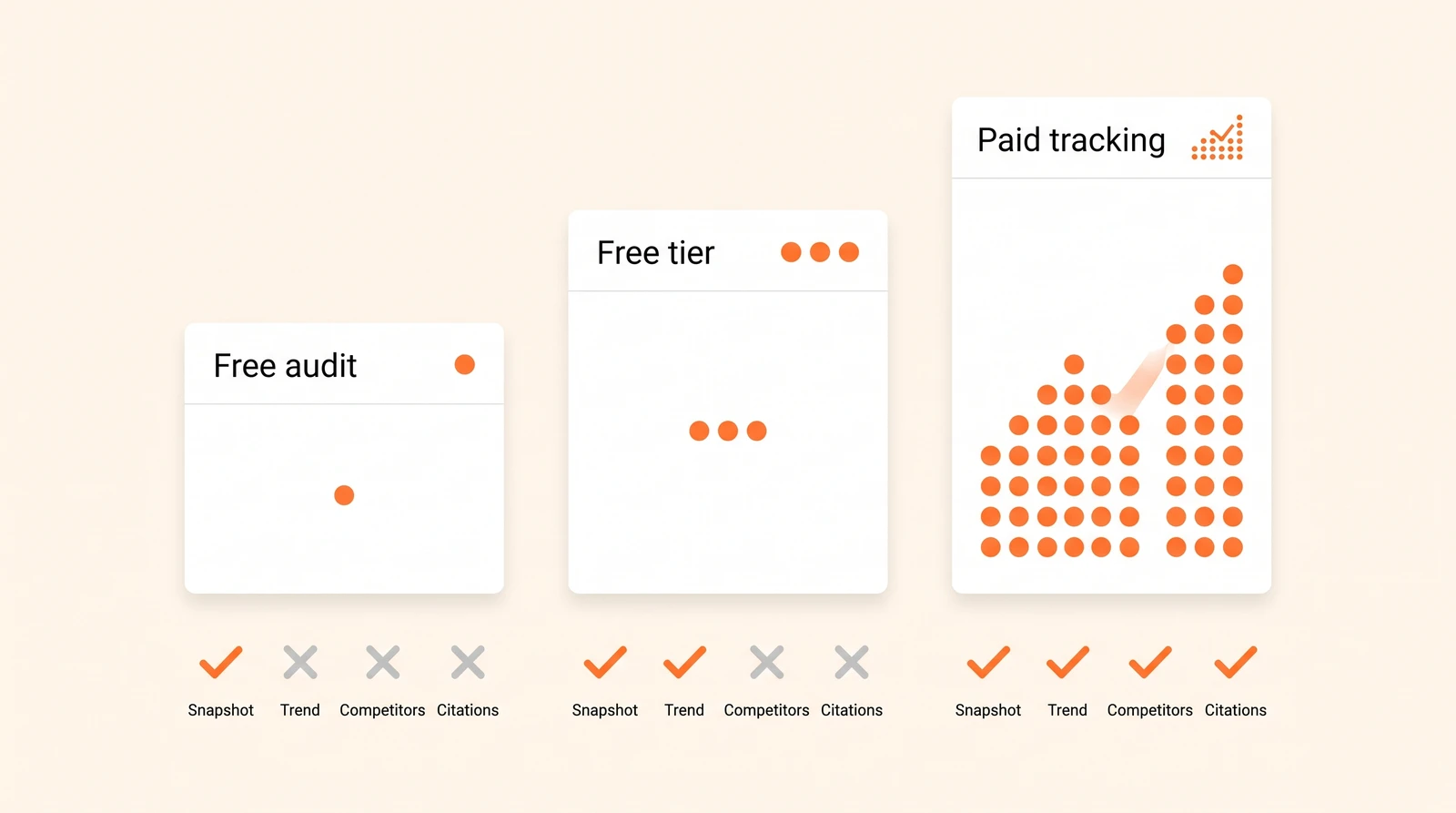
Free one-off audits. You enter a domain, the tool runs a fixed prompt set across one or more engines, and you get a snapshot: are you mentioned, roughly how often, sometimes who appeared instead. Genuinely useful, and the right first step. The limit is in the name — it is one measurement, and one measurement has no direction.
Free tiers of paid platforms. Typically 10–25 tracked prompts, one or two engines, weekly refresh rather than daily. Enough to watch a small number of important questions. You hit the ceiling the moment you want category coverage rather than a handful of hero prompts.
Doing it yourself. No prompt cap, no cost, no automation. Best free option if your time is cheap and your prompt list is short, and the only one that scales down to a single question you care about deeply.
One more category turns up in the same searches and answers a different question. Browser extensions, CMS plugins and APIs. Adobe’s free AI Visibility Checker Chrome extension (part of its LLM Optimizer product) loads a page the way an AI agent does — no JavaScript — and scores how much of it is machine-readable. WordPress plugins such as AI Visibility Booster, MAIO and Rank Press AI Visibility handle on-site readiness: AI crawler rules in robots.txt, llms.txt, schema. DataForSEO’s AI visibility tracker is a pay-per-call API over its index of AI responses, for teams building their own dashboards. None of these tells you whether ChatGPT recommends you. The first two check whether engines can read you; the third hands you raw data and leaves the tracking to you. We break all three form factors down in SEO AEO GEO checker tools: extensions, plugins and APIs.
| Free audit | Free tier | Manual | Paid platform | |
|---|---|---|---|---|
| Prompt coverage | Fixed set | 10–25 | Unlimited | 100s |
| Engines | 1–4 | Usually 1–2 | Any | All major |
| Trend over time | No | Limited | If you log it | Yes |
| Competitor field | Sometimes | Rarely | If you record it | Yes |
| Citation sources | Rarely | Rarely | Visible in Perplexity | Yes |
| Your time cost | Minutes | Low | High and recurring | Low |
How to run a decent free check yourself
This is the part most articles skip, so here is the actual method. It takes about an hour the first time.
1. Write 15–25 prompts your buyers would really type. Not your brand name. The questions someone asks before they know you exist:
best [category] for [use case][competitor] alternativesis [competitor] worth ithow do I [problem your product solves][category] pricing comparisontop [category] tools 2026
Below about 15 prompts, single-answer variance drowns the signal. Above 25 and you will not sustain doing it by hand.
2. Control the session. Log out, or use a fresh chat with memory and personalization off. Keep location consistent. If you check while logged into an account that has discussed your company forty times, you are measuring your own history, not the model’s default behaviour.
3. Record four things per answer, not one:
- Is your brand named?
- Recommended or just mentioned? “X is the best choice for Y” and “alternatives include X” are not the same result.
- Which competitors appear, and in what order?
- Which sources are cited?
That fourth column is the one people leave out and the one that tells you what to do next. Being absent is a symptom. The cited sources are the diagnosis — they are the pages the engine trusted instead of yours.
4. Repeat on a schedule. Same prompts, same conditions, monthly at minimum. One reading is trivia; three readings is a trend.
5. Do Perplexity first if you are short on time. It shows its sources on every answer, so it gives you the citation column for free. ChatGPT and Gemini make you work harder for the same information.
What free will not tell you
Four blind spots, in rough order of how much they cost you.
Trend. A snapshot says where you are. It cannot say whether the content programme you started in March is working. Since almost every real decision is “keep going or stop”, this is the expensive one.
Coverage. Twenty prompts sample your category; they do not represent it. Buyers ask hundreds of variations, and query fan-out means a single question can be answered from a dozen sub-queries you never tested. Narrow coverage systematically overstates or understates you depending on which corner you happened to sample.
The competitive field. Most free tools report your visibility in isolation. “Mentioned in 30% of answers” is meaningless until you know the leader is at 70% or at 32% — those are different situations demanding different budgets.
Citation sources at scale. You can eyeball sources on ten Perplexity answers. You cannot spot that a particular review site is cited in 40% of your category’s answers across four engines, which is the kind of finding that redirects a quarter’s work. Our own engine citation analysis found each engine has a distinct source profile — Perplexity leans on Reddit and community content, others lean elsewhere — and that pattern is invisible from a handful of manual checks.
”Free ChatGPT rank tracker” — two honest caveats
This phrase gets searched a lot, and it contains two assumptions worth unpicking.
There is no “rank” in an AI answer. No position 1 through 10, no numbered list to climb. There is: named or not named, prominent or buried, recommended or hedged, positive or negative. Tools that report a ChatGPT “rank” are mapping prominence onto a rank-like number so it feels familiar. That is a reasonable UI choice, not a measurement of position.
Unlimited free automated tracking does not exist, and the reason is structural rather than stingy. Every tracked prompt is an API call someone pays for, every day, forever. A tool offering unlimited free daily tracking across four engines is either about to change its pricing or not running the prompts it claims to.
What does exist, and is genuinely free: a one-off audit across engines, and small free tiers. Both are real. Neither is unlimited.
When free stops being enough
Three triggers, all of the same shape — you are about to spend money and need the number to be trustworthy:
- You need to prove causation. Someone asks whether the AEO work is working. Only trend data answers that.
- You need position, not presence. Knowing you appear in 30% of answers is not actionable without the field around you.
- You need targets. Source-level citation data tells you which specific pages and platforms to go after. Without it you are guessing at what to publish.
There is also a plain economic trigger. Once the manual process costs you more than about two hours a month, an entry tier is usually cheaper than the labour, and considerably more consistent.
If you want a real baseline without setting anything up, our free AI visibility audit runs your domain across ChatGPT, Gemini and Claude and shows you the prompts it used, which competitors surfaced, and which sources were cited — the four columns above, done for you. It is a snapshot, same as any free audit; the difference is that you can see the working rather than a bare score.
Reading any AI visibility score sceptically
Whatever tool you use, free or paid, three questions separate a number you can act on from a number that just looks confident:
- Which prompts did it run? If you cannot see the prompt list, the score is unfalsifiable. Prompt selection determines the result more than anything else in the pipeline.
- How many samples per prompt? AI answers vary between runs. A score built from one call per prompt has error bars nobody is showing you.
- What exactly is being counted? Any mention? Recommendations only? Is sentiment weighted? A brand named once as “a weaker option” and a brand named as the top pick can produce the same score under a naive count.
A tool that answers all three plainly is worth more than one with a prettier dashboard. This is the same standard we applied when comparing AI visibility platforms, and it filters the market quickly.
The bottom line
Free is genuinely enough to answer are we visible? — through a one-off audit, a small free tier, or an hour of disciplined manual checking with the four columns.
Free is not enough to answer is it improving, against whom, and what do we do next? That needs coverage, repetition and citation data, and those cost money because they cost API calls.
Start free. Get your baseline this week rather than scheduling a tool evaluation for next quarter. Then pay only when you have a decision that the free version genuinely cannot support — which is a much later point than most vendors will tell you.
Related reading: Google AI Overviews tracking guide · How to measure AI visibility · ChatGPT rank tracking guide · Perplexity rank tracking playbook · Tracking brand mentions in AI search
Frequently Asked Questions
Yes, in three forms, and they are not equivalent. First, free audit tools that run a fixed set of prompts once and show you a snapshot — genuinely useful for a baseline. Second, free tiers of paid platforms, which typically cap you at 10–25 prompts and one or two engines with weekly rather than daily refresh. Third, doing it manually, which costs nothing but your time and is the only option with no prompt limit at all. For a one-off answer to 'am I on AI at all?', free is enough. For tracking change over time across engines, free runs out quickly.
Open ChatGPT with search enabled, run 10–20 questions a real buyer would ask in your category — 'best X for Y', 'X alternatives', 'is X worth it' — and record four things per answer: whether your brand is named, whether it is recommended or just mentioned, which competitors appear, and which sources are cited. Use a fresh chat each time and turn off personalization and memory, or you will be measuring your own history rather than the model's default. Repeat on a fixed schedule with the same prompts so the results are comparable.
Perplexity is the easiest engine to check manually because it shows its sources on every answer, so a free approach works better here than elsewhere. Run your prompt set, then record whether your domain appears in the citation list and at what position. For automation, look at free tiers of AI visibility platforms rather than dedicated Perplexity tools — the market has consolidated around multi-engine tracking, and a Perplexity-only tracker measures one of the four surfaces that matter.
Four things, usually. Trend — a single snapshot cannot show whether you are gaining or losing ground. Coverage — free tiers cap prompts, so you see a fraction of the questions buyers actually ask. Competitors — most free tools report your visibility but not the full ranked field around you. Sources — knowing you are absent matters far less than knowing which pages the engine cited instead, because those are your actual targets. Free is good at answering 'where am I?' and poor at answering 'what should I do?'
For a directional baseline, 15–25 prompts covering your main category questions is enough to tell whether you are broadly visible or broadly absent. For decisions you would spend money on, you need enough coverage of the buying journey — problem-aware questions, comparison questions, alternative questions, and branded questions — which usually means 50–200 prompts depending on category breadth. Below roughly 15 prompts, single-answer variance swamps the signal and you will chase noise.
Yes to the first, and it complicates the second. AI answers vary by account history, memory, personalization, location, and model version, and the same prompt can return different answers minutes apart. This is why manual spot-checks disagree with tools and why a single check is weak evidence. The mitigations are the same at every price point: fixed prompt set, logged-out or clean sessions, consistent location, and repeated sampling so you are reading a trend rather than one roll of the dice.
When you are about to make a decision with money attached. Three specific triggers: you need trend data to prove whether work is moving the number, you need competitor share of voice to know where you stand rather than just whether you appear, or you need source-level citation data to know which pages to target. The other trigger is time — once your manual process takes more than about two hours a month, a paid tier usually costs less than the labour it replaces.
For a baseline, yes, with one caveat: accuracy depends on prompt selection. A free audit that runs generic category prompts gives you a real but rough reading. If the prompts do not match how your buyers actually phrase things, the result reflects a category you are not competing in. Always look at which prompts a free tool ran before trusting its score — a good tool shows you them, and a score without visible prompts is a number you cannot act on.
A traditional rank tracker records your numbered position for a keyword in a list of blue links. An AI visibility checker measures something structurally different: whether your brand appears inside a generated answer, how prominently, with what sentiment, alongside which competitors, and citing which sources. There is no position 1 through 10 in an AI answer — there is being named or not being named. Tools that report 'rank' for ChatGPT are usually mapping mention prominence onto a rank-like number for familiarity.
Yes, and it is a reasonable weekend project if you can write a script. Call the ChatGPT, Perplexity, Gemini and Claude APIs with a fixed prompt list on a schedule, parse the responses for your brand and competitor names, store results with a timestamp, and chart mention rate over time. The costs are API spend and maintenance. What you will find harder to replicate is citation parsing, sentiment classification, and keeping up with model and API changes — which is most of what you are paying a platform for.
Yes. Adobe publishes a free one on the Chrome Web Store — AI Visibility Checker, powered by Adobe LLM Optimizer (recently relisted as AI Content Visibility Checker) — and it needs no Adobe licence. It loads the current page the way an AI agent would, without JavaScript, and reports a Citation Readability Score plus a side-by-side of what the agent sees versus what a human sees. Treat it as a page-readability test, not a visibility tracker: it cannot tell you whether ChatGPT or Gemini mention your brand, only whether they could read the page if they tried. It is a good free way to run the JavaScript-rendering check in a GEO audit.
Several on wordpress.org — AI Visibility Booster, MAIO, Rank Press AI Visibility and Alli AI's plugin among them. They work on the site side: opening robots.txt to GPTBot, PerplexityBot and ClaudeBot, generating llms.txt, adding schema, and in some cases logging which AI crawlers fetched which pages. That is useful readiness work, but a plugin running inside your site cannot see what happens inside ChatGPT or Perplexity. Measuring whether you are actually mentioned still means querying the engines from outside — manually, with a free audit, or with a tracking platform.
DataForSEO offers AI visibility data as an API rather than a dashboard — its LLM Mentions and AI Optimization APIs return brand and domain mentions, per-model mention counts and cited sources from a large index of ChatGPT, Perplexity, Gemini and Claude responses, with usage-based pricing and a free trial. It is the build-your-own route: right for agencies and developers who want raw data in their own reporting, and a poor fit for a marketing team that wants an answer without writing code. You supply the prompt strategy, sentiment scoring, alerting and charts yourself.
Ask them. Open ChatGPT with search on, Perplexity, Gemini and Google AI Mode in clean sessions, run ten to twenty questions a customer would ask about your category and your competitors, and record whether you are named, recommended or merely mentioned, which competitors appear, and which sources are cited. Repeat the same prompts a few times because answers vary. For a faster baseline, a free AI visibility audit runs a prompt set across the engines and shows the results, including the prompts it used.
Am I on AI is an AI visibility software product that checks and tracks how a business appears in ChatGPT, Perplexity and other AI search apps, with prompt tracking, competitor comparison, citation analysis and agency features. It offers a free initial check and paid monthly plans for ongoing tracking. It competes with tools such as Sanbi, Peec, Otterly and Profound; the differences are in engines covered, prompts per plan, sampling depth and whether the tool tells you what to publish next.