Perplexity Is Quietly Replacing Google for B2B Research — The Complete Rank Tracking Playbook
Perplexity is not a search engine. It’s an answer engine — and that distinction is quietly making your entire SEO dashboard irrelevant for the fastest-growing segment of B2B research.
B2B buyers are using Perplexity to research vendors, compare solutions, and build evaluation shortlists. When they ask “what are the best tools for [your category],” Perplexity synthesizes an answer from live web sources and cites them explicitly. The brands in those citations get evaluated. The brands that don’t appear don’t make the list.
This is your complete playbook for Perplexity rank tracking, brand monitoring, and improving the only metric that matters in an answer engine: whether you get cited.
1. Why Perplexity Is a Different Animal Entirely
Understanding why Perplexity rank tracking tools have to work differently starts with understanding how Perplexity itself works.
The answer engine model
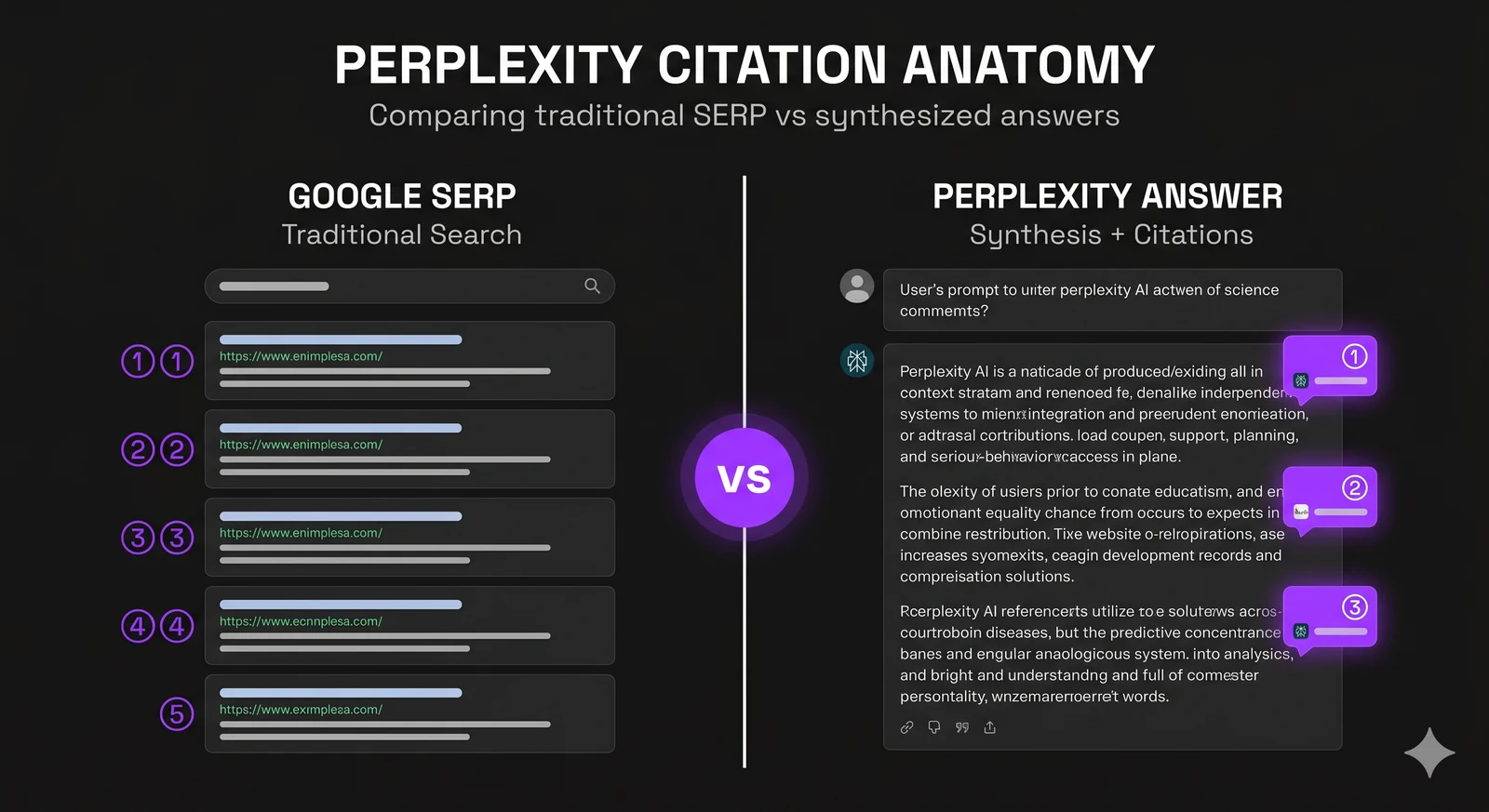
Unlike Google, which returns a list of links, Perplexity synthesizes a direct answer from multiple web sources and presents it inline — with numbered citations that point to the underlying sources. Users read the answer first, then decide whether to click through. Citation = visibility, whether or not a click follows.
This architecture makes Perplexity citation tracking fundamentally different from anything in the traditional SEO toolkit. You’re not tracking position on a results page. You’re tracking whether your domain appears in the source citations for a synthesized answer.
Perplexity’s user base skews high-intent
Perplexity’s audience is disproportionately researchers, engineers, and knowledge workers who are doing serious evaluation tasks. The Pro tier — which unlocks deeper search and more capable underlying models — is populated with users who are paying specifically because they’re doing high-value research. When these users ask about vendor categories, the result is closer to an analyst briefing than a casual Google search.
Why tracking perplexity search engines matters more than most marketers realize
The reason to track Perplexity search engines specifically is conversion quality. Referral traffic from Perplexity converts at significantly higher rates than organic search — studies of AI-driven referral traffic suggest 10–16% conversion rates versus under 2% for organic. The buyers arriving via Perplexity citations have already read a synthesized answer that positioned your brand favorably. They’re arriving pre-educated.
Why this matters for brands: Your standard SEO rank tracking tools measure positions on a page that Perplexity users aren’t looking at. Perplexity search engine rank monitoring requires a different instrument — one built for the citation model, not the link model.
2. What Perplexity Rank Tracking Actually Means
The vocabulary of traditional rank tracking doesn’t map cleanly onto Perplexity. Here’s the translation.
Citation presence vs. keyword position
In Google rank tracking, “rank” means your position (1–10+) for a keyword on a results page. In Perplexity rank tracking, “rank” means:
- Are you cited at all? (presence)
- Are you cited first, third, or sixth? (prominence)
- Which page on your site is cited? (URL-level tracking)
- What does the answer say about you? (sentiment)
The closest Google analog is not keyword ranking — it’s whether you appear in the featured snippet. Except in Perplexity, there can be multiple “featured snippets” per answer, and they’re explicitly sourced.
The query set framework
The right infrastructure for Perplexity SEO tracking is a defined query set: the 50–300 queries your buyers use when researching your category. This includes:
- Problem-first queries: “How do I track my brand in AI search?”
- Category queries: “Best AI visibility monitoring tools”
- Competitor comparisons: “Sanbi vs [competitor]”, “[competitor] alternatives”
- Brand queries: Direct searches for your brand name
A Perplexity rank tracking tool runs these queries regularly, notes which sources are cited, and tracks your domain’s citation frequency across the set.
Why monitor website performance in Perplexity AI separately from other platforms
Perplexity uses live web retrieval — it’s crawling current web pages to build citations, not primarily drawing from training data. This makes Perplexity citation behavior more sensitive to content freshness, crawlability, and real-time authority signals than ChatGPT or Claude. A page published last week can appear in Perplexity citations today. That’s not true of platforms that depend heavily on training data with months-old cutoffs.
Why this matters for brands: Monitoring website performance in Perplexity AI is measuring a real-time signal. Changes you make to your content can show up in Perplexity citations within days, not months. That feedback loop is your fastest iteration cycle in all of AI search optimization.
3. Perplexity Visibility Metrics That Actually Matter
Perplexity brand monitoring isn’t one metric — it’s a stack of measurements that together tell you where you stand.
Citation Frequency
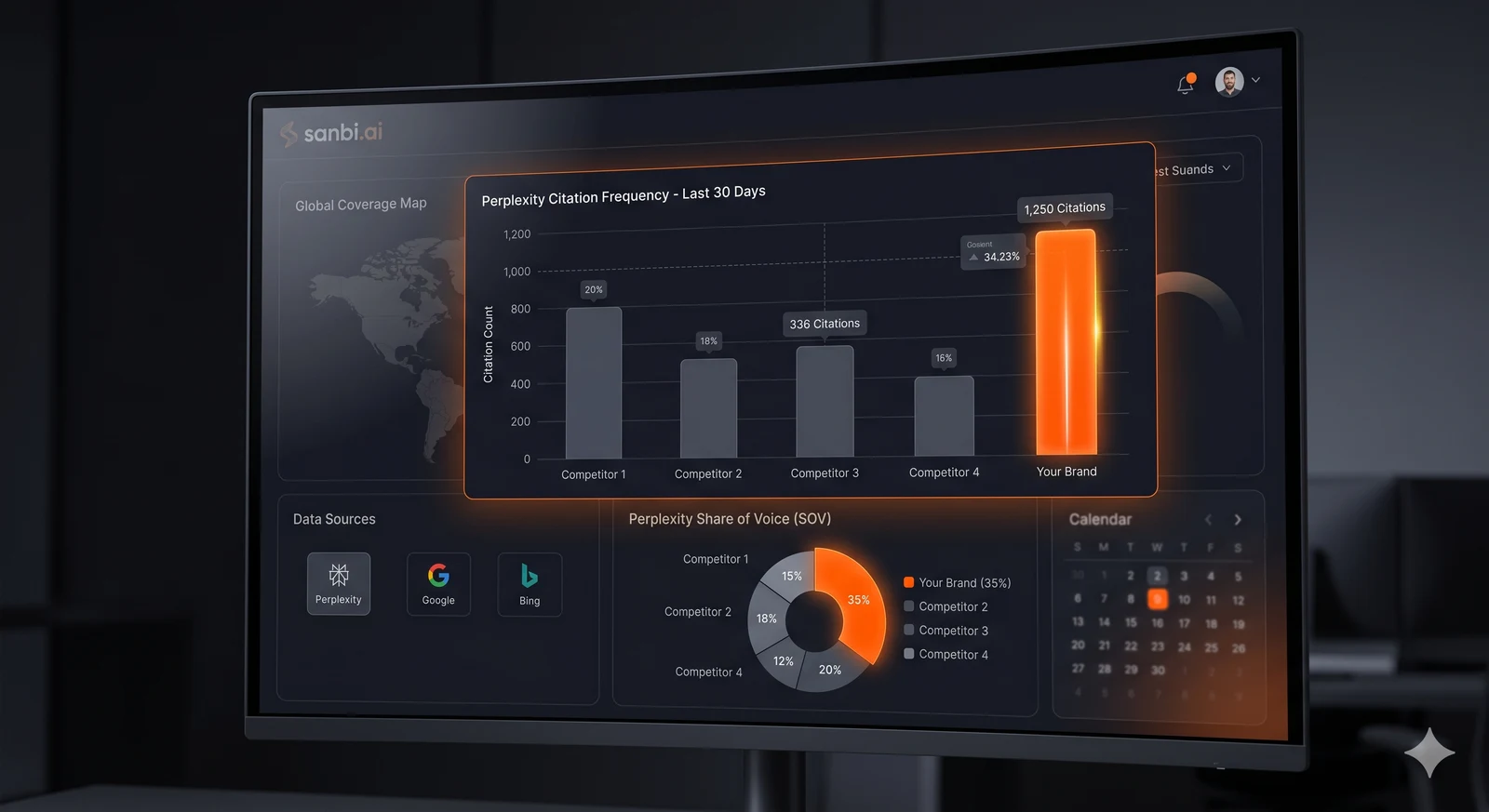
How many of your tracked queries cite your domain, expressed as a percentage. If you track 200 queries and appear in 40 citations, your citation frequency is 20%. This is your headline metric and the baseline for everything else.
Citation Position
Not all citations are equal. Being the first source cited in a Perplexity answer carries more authority than being the sixth. Track where in the citation list your domain appears — first-cited, second-cited, and so on. A Perplexity visibility tracker that only tells you whether you’re cited, not where, is missing half the signal.
Source URL Tracking
Which specific pages on your site is Perplexity citing? This is often surprising. It’s rarely your homepage. It’s usually a specific blog post, comparison page, or technical documentation that Perplexity’s retrieval system found most directly relevant. Tracking Perplexity source URLs tells you which content is already doing the heavy lifting and where to invest further.
Answer Sentiment
When Perplexity synthesizes an answer that includes your brand, how is it described? “The leading platform for X” and “one option for X” and “some users report issues with X” are all citations — but they’re not equivalent. Perplexity AI brand mentions tracking should include sentiment analysis on the answer text, not just presence detection.
Traffic from Perplexity
Checking traffic from Perplexity via referral data in GA4 is a lagging indicator of citation health, but a real one. Perplexity referral traffic appears as perplexity.ai in the source dimension. As citation frequency grows, referral volume follows — with a lag.
Share of Voice
Your citation frequency divided by the total possible citation slots across your tracked query set, benchmarked against competitor citation frequency for the same queries. This is the metric that converts everything above into competitive intelligence.
| Metric | What It Tells You |
|---|---|
| Citation frequency | Raw presence across your query set |
| Citation position | Prominence within individual answers |
| Source URL tracking | Which content drives your citations |
| Answer sentiment | How Perplexity characterizes your brand |
| Referral traffic | Downstream conversion signal |
| Share of voice | Your citation rate vs. competitors |
Why this matters for brands: Perplexity search engine rank monitoring that tracks only one or two of these metrics will consistently mislead. A brand can have high citation frequency but poor sentiment, or strong citation position on low-intent queries but invisible on high-intent ones. The full stack gives you the full picture.
4. What the Best Perplexity SEO Tracking Tools Actually Do
What separates real Perplexity SEO analysis tools from basic monitors
The gap between a genuine Perplexity SEO analysis tool and a basic monitoring dashboard is the difference between intelligence and noise. A real Perplexity SEO tracker:
- Runs your full query set automatically on a defined cadence (daily or weekly)
- Parses citations from each answer and identifies your domain
- Tracks citation position (not just presence) per query
- Records which specific URL is cited
- Compares your citation rate against defined competitors for the same queries
- Surfaces historical trends so you can see movement over time
- Alerts you when citation frequency changes significantly
A basic brand monitoring tool that scans mentions without understanding citation context is measuring the wrong thing.
Free Perplexity rank tracking: what’s actually possible
Free Perplexity rank tracking at any meaningful scale is essentially manual. The free-tier approach is: build a list of queries, run them yourself in Perplexity, record results in a spreadsheet, repeat weekly. This works for brand validation and one-time audits. It does not work as an ongoing Perplexity SEO tracking system at scale.
Some Perplexity SEO checking software offers limited free tiers — typically 5–20 queries per run — which is enough to test a tool’s output format but not enough for real competitive intelligence.
What to evaluate in Perplexity rank tracking tools
When comparing Perplexity SEO trackers:
- Query capacity: How many queries can you track per run? Per month?
- Update cadence: Daily, weekly, or on-demand?
- Multi-engine coverage: Does it also track ChatGPT, Gemini, Claude, and AI Overviews?
- Competitor tracking: Can you run the same queries against competitor domains?
- Source URL visibility: Does it show which specific pages are cited?
- API access: Can you pull data programmatically for custom reporting?
- Alerting: Does it notify you when citation behavior changes?
peec.ai in context
peec.ai has positioned itself as a Perplexity-focused monitoring tool, useful for manual query testing and basic citation checks. As a standalone Perplexity seo checker, it serves brands that only need Perplexity-specific data. The limitation is single-engine focus — buyers moving between Perplexity, ChatGPT, and Gemini throughout their research journey require cross-engine tracking that peec.ai alternatives with multi-engine coverage are better positioned to provide.
Perplexity SEO Checkers: Audit Tools vs. Ongoing Trackers
Perplexity SEO checkers fall into two categories. Audit-style Perplexity SEO checking software runs a one-time assessment: it checks whether specific pages are crawlable by Perplexity’s retrieval system, evaluates content structure for answer-format readiness, validates structured data, and tests a sample of queries to see if your domain appears. These are useful for onboarding a new client, pre-launch content audits, or diagnosing a sudden drop in referral traffic.
Ongoing Perplexity SEO tracking tools run your full query set on a recurring schedule and store results over time. They’re the measurement infrastructure for a sustained Perplexity SEO program — tracking citation frequency week over week, flagging when competitor citation rates change, and surfacing which content updates moved the needle. Both types of Perplexity seo analysis tool serve distinct purposes; a complete Perplexity SEO strategy uses both.
Best Perplexity SEO Checking Software: What Separates Good from Great
The best Perplexity SEO checking software does more than confirm you’re cited — it tells you why you are or aren’t, and what to do about it. Criteria that separate best-in-class from average:
- Citation URL resolution: Does it show which specific page is cited, not just whether your domain appears?
- Perplexity search engine rank monitoring over time: Does it store historical data so you can see trends?
- Competitive benchmarking: Can you compare your Perplexity citation rate against named competitors?
- Query intent segmentation: Does it break down citation rates by informational, commercial, and navigational queries separately?
- Perplexity AI brand mentions tracking: Does it flag every mention of your brand in Perplexity answers — including mentions without a domain citation?
Perplexity search rank tracking tools that cover all five deliver the full picture. Those that cover only one or two are point-in-time monitors, not optimization platforms.
Why this matters for brands: The best Perplexity rank tracking software for your team is the one that scales with your query volume, provides competitive benchmarking, and ideally sits alongside tracking for the full AI search ecosystem in a single dashboard.
5. How to Improve Visibility in Perplexity
Citation frequency is an outcome. Content structure and authority are the inputs.
Content formats Perplexity cites
Perplexity’s retrieval system favors pages that are direct, structured, and authoritative:
- Answer-first structure: The first substantive paragraph should directly answer the most likely query. Perplexity heavily weights the top of each page when constructing answers.
- Question-format headings: H2 and H3 headers phrased as questions (“How does X work?”, “What are the best tools for Y?”) match conversational query patterns and increase relevance scores.
- Specific, quotable statements: “Brand X does Y” is more citable than “Brand X offers a range of solutions.” Specificity drives citations.
- Structured elements: Tables, numbered lists, and comparison sections are disproportionately cited because they’re easy for Perplexity to parse and quote.
- Comparison content: “X vs Y” and “[category] alternatives” content is a high-leverage Perplexity SEO tactic because comparison queries are common in research workflows and competition for citation spots is high.
Third-party citation building
Perplexity also cites third-party sources: Reddit threads, review platforms, forum discussions, and industry media. Being mentioned positively in those sources increases your citation probability for the queries those sources rank for. A Perplexity SEO strategy that focuses only on your own site misses this multiplier effect.
Content freshness
Because Perplexity uses live web retrieval, recently updated content has an advantage over stale content. A page that was last updated 18 months ago will lose citation spots to a competitor who published a more current version last month. Regular content refreshes on your highest-value pages are a direct Perplexity SEO lever.
How to advertise on Perplexity
Perplexity’s advertising program offers sponsored answers — paid placements that appear alongside organic citations for specific query types. How to advertise on Perplexity: apply through Perplexity’s advertising program, define target query categories, and run paid placement alongside organic citation optimization. For high-intent commercial queries where organic citation is competitive, Perplexity advertising can supplement organic visibility while your content authority builds.
Why this matters for brands: Improving visibility in Perplexity is a compounding process. Each piece of content that gets cited reinforces your domain’s authority in Perplexity’s retrieval model. The brands starting that compounding process now will be increasingly difficult to displace by the time competitors realize Perplexity SEO is non-optional.
6. Perplexity Enterprise, Pricing, and API
Perplexity pricing plan
Perplexity operates on a freemium model: a free tier, a Pro plan at ~$20/month (individual), and enterprise options for teams. The Perplexity pricing plan matters for marketers because Pro users have significantly higher query limits and access to more capable underlying models — which means Pro users are typically the higher-value, more research-intensive audience.
Perplexity Enterprise
Perplexity Enterprise provides organizations with managed access, SSO, usage governance, and API integration at scale. B2B brands targeting enterprise buyers should account for this: enterprise buyers using Perplexity through a managed workspace may have different default behavior, model selection, and source prioritization than consumer users. Perplexity search rank tracking tools should distinguish between these user types where possible.
Perplexity API access
Perplexity API access lets developers build applications using Perplexity’s search and answer stack. For marketing teams, this is relevant in two ways: (1) the best Perplexity rank tracking tools use API access to run batch queries cleanly rather than scraping the consumer interface, and (2) understanding API-level citation behavior helps explain discrepancies between what you see in manual testing and what automated tracking reports.
Why this matters for brands: Perplexity enterprise and API tiers represent the portion of the platform where high-value B2B research happens. Perplexity SEO tracking that only monitors consumer-tier behavior is systematically missing the highest-value segment of your audience.
Building Your Perplexity Tracking System: The Checklist
The brands that will own Perplexity visibility in 2027 are the ones building this system in 2026:
- Define your query set — 50–200 queries spanning problem-first, category, comparison, and brand-name searches
- Verify referral tracking — Confirm Perplexity referral traffic is captured in GA4 and establish a baseline
- Select a Perplexity rank tracker tool — Evaluate on query capacity, update frequency, multi-engine coverage, and competitor benchmarking
- Baseline citation frequency — Run your full query set and record which queries cite you, at what position, and from which URLs
- Benchmark competitors — Run the same queries against top competitors; the gap is your share-of-voice deficit
- Audit your cited pages — The pages Perplexity already trusts are your highest-value reinforcement targets
- Map content gaps — Queries where competitors are cited and you’re not are your highest-priority content opportunities
- Establish a measurement cadence — Run the full query set monthly; track citation frequency, position, and share of voice over time
Every step produces data. The brands that build this system now have a 12+ month head start on the competitors who will discover Perplexity tracking is non-optional in 2027.
Your Next Step
Perplexity is sending referral traffic, shaping vendor shortlists, and influencing buying decisions in your category right now. The question is whether your brand appears in those answers or not — and you currently have no way to know without tracking it.
Run a free AI visibility audit at sanbi.ai to see exactly where your brand stands across Perplexity, ChatGPT, Gemini, and Claude — with citation frequency, source URL breakdowns, share of voice against competitors, and a clear map of the gaps you need to close.
Sanbi.ai monitors your brand’s AI visibility daily across ChatGPT, Gemini, Perplexity, and Claude — tracking visibility scores, sentiment, citations, agent accessibility, and competitor movements so you always know where you stand in the agent-first web.
Frequently Asked Questions
A Google rank tracker measures your position (1–10) on a search results page for specific keywords. A Perplexity rank tracker measures something fundamentally different: whether your brand is cited in Perplexity's AI-generated answers, how prominently it's cited, and which specific pages on your site are being used as sources. There are no numbered positions on Perplexity — your 'rank' is your citation frequency and prominence across a defined set of queries. The best Perplexity rank tracking tools run those queries automatically and track citation changes over time.
Free Perplexity rank tracking is limited to manual query testing — literally running queries yourself in the Perplexity interface and noting which sources are cited. This is viable for spot-checking 10–20 queries but doesn't scale. Free Perplexity rank tracking tools that automate this process are rare and typically have severe limits on query volume or update frequency. Most serious Perplexity SEO tracking is done through paid platforms that offer automated query batching, historical tracking, and competitive comparison.
Perplexity sends referral traffic identifiable in GA4 as traffic from the referrer perplexity.ai. In GA4, go to Reports → Acquisition → Traffic Acquisition and filter by Session Source / Medium containing perplexity.ai. This gives you a direct read on how much traffic Perplexity is sending and, with goal tracking, what that traffic converts at. Note that Perplexity citations drive more influence than traffic alone captures — many citations shape research behavior without generating a trackable click.
A Perplexity citation tracker monitors three things: (1) citation presence — whether your domain appears in Perplexity's source citations for a given query, (2) citation position — whether you're cited first, third, or sixth in the sources panel, and (3) citation URL — which specific pages on your site are being cited. Advanced Perplexity monitoring tools also track the sentiment of the answer text around your brand and flag changes in citation behavior over time.
B2B buyers are using Perplexity to research vendors, compare tools, and build shortlists — and Perplexity's user base skews toward technically sophisticated, high-intent researchers who are actually making purchasing decisions. When a buyer asks Perplexity 'what are the best tools for X,' the brands Perplexity cites are the ones that make the evaluation shortlist. Brands that don't appear in those citations don't get evaluated. Perplexity brand monitoring is how you find out whether you're in that shortlist — or invisible to it.
The best Perplexity rank tracker for a given team depends on query volume, reporting needs, and whether you need multi-engine coverage. The key criteria are: automated query batching (not just manual testing), historical citation tracking, competitive benchmarking, source URL tracking, and integration with other AI search engines like ChatGPT, Gemini, and Claude. Single-engine Perplexity-only tools like peec.ai are useful for spot checks but miss the cross-engine visibility picture that most brands need. Sanbi.ai tracks Perplexity alongside ChatGPT, Gemini, and Claude in a unified dashboard.
Monitoring brand mentions in Perplexity at scale requires a tool that (1) runs a defined query set regularly, (2) parses Perplexity's source citations, and (3) flags every instance where your brand name or domain appears. Manual monitoring only works for small query sets. At scale, Perplexity brand monitoring tools automate the full loop — query execution, citation parsing, brand detection, and alerting when citation frequency changes. The query set should include brand-name queries, category-level queries, and competitor comparison queries where your brand might or might not appear.
To track Perplexity source URLs, you need a Perplexity monitoring tool that captures not just whether your domain appears, but which specific URL on your domain is cited for each query. This is the most actionable data point in Perplexity SEO tracking — it tells you which content Perplexity already trusts and where to focus reinforcement. Sanbi.ai's citation tracking captures source URLs at the query level so you can see your full cited-page inventory and identify content gaps.
Improving visibility in Perplexity is primarily a content and authority problem. Perplexity favors pages that directly and specifically answer the query, use structured formatting (H2/H3 headers, lists, tables), are on high-authority domains, and have been updated recently. Key tactics: write answer-first content (direct answer in the first paragraph), use question-format H2 and H3 headings that match conversational queries, own comparison content for 'X vs Y' queries in your category, and build third-party mentions on sites Perplexity also cites (Reddit, review platforms, industry forums).
peec.ai is an early-stage Perplexity-focused monitoring tool. It typically offers manual query testing interfaces and some automated tracking capabilities. Its primary limitation is single-engine focus — it tracks Perplexity but not the broader AI search ecosystem. For brands that need to monitor visibility across ChatGPT, Gemini, Perplexity, and Claude simultaneously, a multi-engine platform like Sanbi.ai provides more comprehensive coverage. peec.ai alternatives that include full multi-engine tracking give a more complete picture of AI search visibility.
Perplexity Enterprise offers organizations managed workspace access, SSO, API integration, usage controls, and admin dashboards. For B2B brands, this matters because enterprise buyers using Perplexity through a managed workspace may have different citation behavior than free-tier users — different model defaults, different search depths, and potentially different source prioritization. Understanding that your target buyers might be using Perplexity through an enterprise plan is relevant when calibrating how you interpret Perplexity rank tracking data.
AEO (Answer Engine Optimization) is the broader discipline of optimizing content to be cited in AI-generated answers across all platforms — ChatGPT, Perplexity, Gemini, Claude, AI Overviews. Perplexity SEO tracking is the specific practice of measuring and optimizing for citations on Perplexity specifically. The distinction matters because citation patterns differ across engines: Perplexity uses live web retrieval, making recency and crawlability critical in a way that doesn't apply the same way to ChatGPT, which relies more heavily on training data. A complete AEO strategy requires tracking all engines, with platform-specific tactics for each.
Why track Perplexity search engines at all if you're already tracking ChatGPT? Because they have completely different citation systems. Perplexity uses live web retrieval — it fetches current pages, evaluates them, and cites sources in real time. ChatGPT (without browsing) draws primarily from training data. A brand that is well-cited in ChatGPT training data can be nearly invisible in Perplexity if its pages aren't crawlable, current, and directly answering the right queries. The inverse is also true. Tracking only ChatGPT misses Perplexity's high-intent buyer segment. Tracking only Perplexity misses the training-data layer that ChatGPT and Claude draw from.
A Perplexity SEO analysis tool that checks specific pages evaluates whether individual URLs on your site are being cited by Perplexity for relevant queries — and why or why not. The best Perplexity SEO checking software combines page-level analysis (structured data, content format, answer-first structure, freshness) with query-level citation tracking (does this page appear in Perplexity answers for your target queries). Point-in-time Perplexity SEO checkers are useful for auditing a page before publishing or after a content update. Ongoing Perplexity seo tracking tools are needed to monitor how citation behavior changes over time across your full query set.