How to Track Brand Mentions in AI Search — The 2026 Playbook
Right now, while you’re reading this, someone is asking ChatGPT about your category. Someone else is asking Perplexity to compare you to your competitors. Another buyer just asked Claude whether your brand is worth evaluating.
In each of those conversations, AI is generating an answer about your brand — accurate or not, favorable or not, citing you or sending buyers somewhere else. If you’re not tracking brand mentions in AI search, you have no visibility into what’s being said, no data on how it’s changing, and no way to improve it.
This guide is the 2026 playbook for how to track brand mentions in AI search — from manual methods to automated platforms, what metrics to measure, and how to turn the data into action.
1. Why AI Brand Mention Tracking Is Different From Web Monitoring
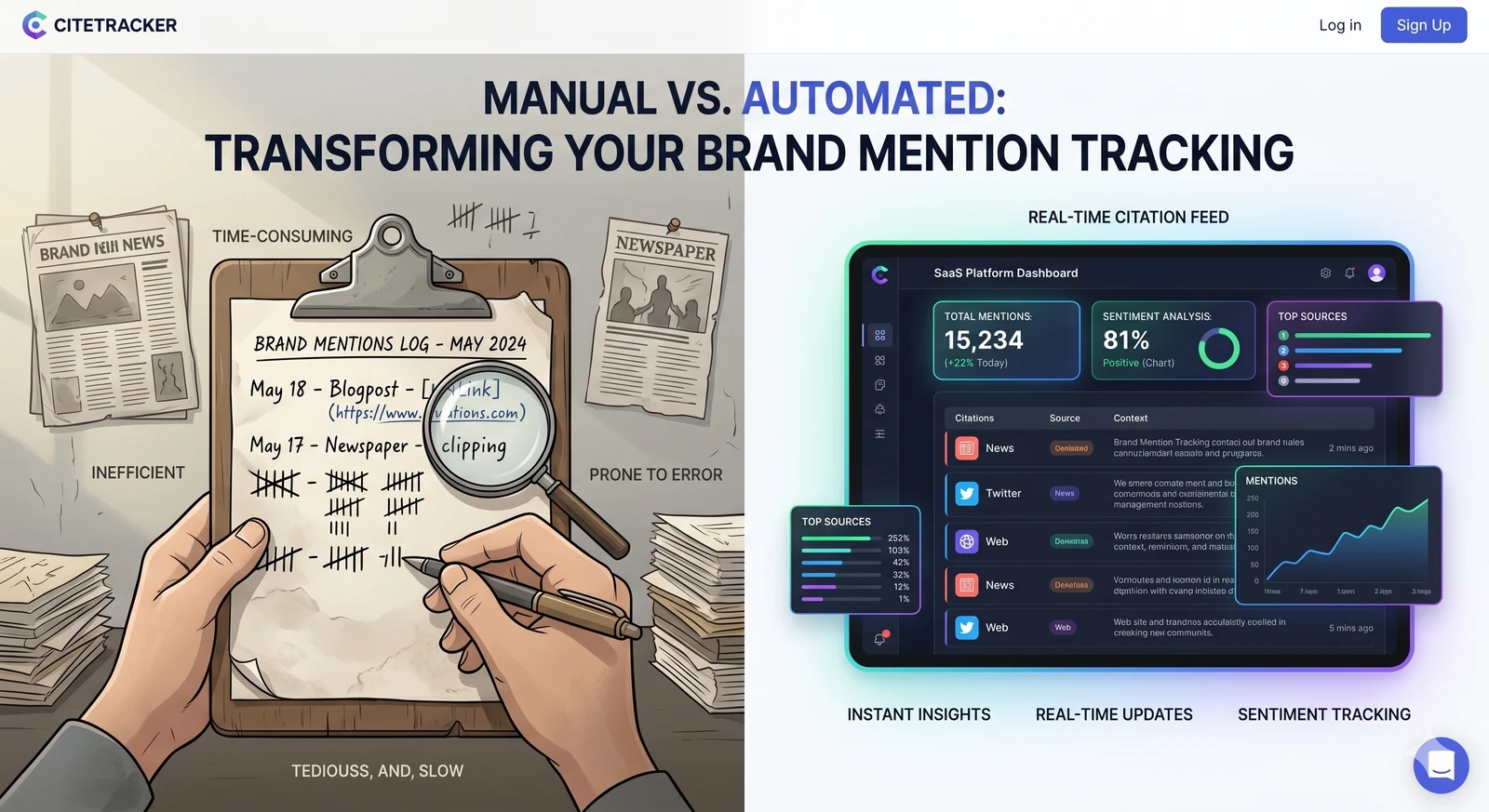
Traditional brand monitoring scans the web for your brand name in published text — news articles, social posts, forum threads, review sites. It’s retrospective: it finds what’s already been written about you.
AI brand mention tracking is different in a fundamental way. It’s not scanning what’s been written — it’s testing what AI models generate when buyers ask about your category in real time.
The Gap Web Monitoring Can’t See
A web monitoring tool might show you 50 brand mentions this week across news and social. What it can’t show you: when a buyer asked ChatGPT “what’s the best [category] tool for a 50-person team?”, were you recommended? Where in the response did your name appear? What sentiment did the AI use? Which competitor got the first mention?
Web monitoring tells you what journalists and users are saying. AI brand mention tracking tells you what AI models are telling buyers — which is now shaping purchase decisions before any human-written content enters the picture.
The Scale of the Gap
AI-generated answers now surface before organic results for a significant and growing share of research queries. Buyers who start with ChatGPT or Perplexity often don’t scroll to organic results at all — they act on the AI answer. A brand invisible in AI responses is being bypassed at the top of the funnel millions of times per month, with zero signal in any traditional analytics dashboard.
Why this matters for brands: The brands that build systematic AI brand mention tracking now will have citation baseline data, trend history, and optimization evidence that latecomers won’t be able to reconstruct. Compounding AI citation authority is a real phenomenon — cited brands attract more citations.
2. How to Track Brand Mentions in AI Search — Methods
There are two approaches to tracking brand mentions in AI search: manual audits and automated platforms. Both have a role depending on your goals and resources.
Manual Brand Mention Tracking in AI Search
Manual tracking means running prompts yourself in ChatGPT, Gemini, Perplexity, or Claude and recording whether your brand appears.
Step-by-step manual process:
- Define 15–20 prompts that represent your buyers’ research queries (comparison queries, best-of queries, use-case queries)
- Run each prompt in the AI platform’s chat interface
- Record whether your brand appears, where in the response, and the exact wording used
- Repeat the same prompts in each AI platform you care about
- Record results in a spreadsheet with timestamps
Manual tracking is appropriate for quarterly audits, initial baselines, and understanding what AI models are saying in qualitative detail. Its limitations: chat interfaces include personalization and memory that can skew results away from what a new buyer would see; running 20+ prompts across 4+ platforms weekly is not a scalable time investment; trend tracking requires identical prompt execution across weeks, which human variation makes unreliable.
Automated AI Brand Mention Tracking
Automated tracking tools — like Sanbi.ai — run your defined prompt set against AI model APIs on a scheduled cycle, eliminating the personalization variables of chat interfaces and producing consistent, comparable results over time.
How automated tracking works:
- You define your prompt set (or use Sanbi.ai’s category-based prompt library)
- The platform queries each AI model’s API — ChatGPT, Gemini, Perplexity, Claude, DeepSeek
- Responses are parsed automatically for brand name, entity variants, and product names
- Results are scored for sentiment, citation position, and competitive share of voice
- Weekly reports surface trend lines, competitive changes, and new content gaps
Why this matters for brands: Automated tracking catches changes you’d never see manually — a competitor that gained 15 points of share of voice in ChatGPT over three weeks because they published one well-cited comparison article. Manual processes run too infrequently to catch that kind of shift before it compounds.
3. What to Measure — The Core AI Brand Mention Metrics
Tracking AI brand mentions produces several distinct signals. Not all of them are equally actionable.
Citation Frequency
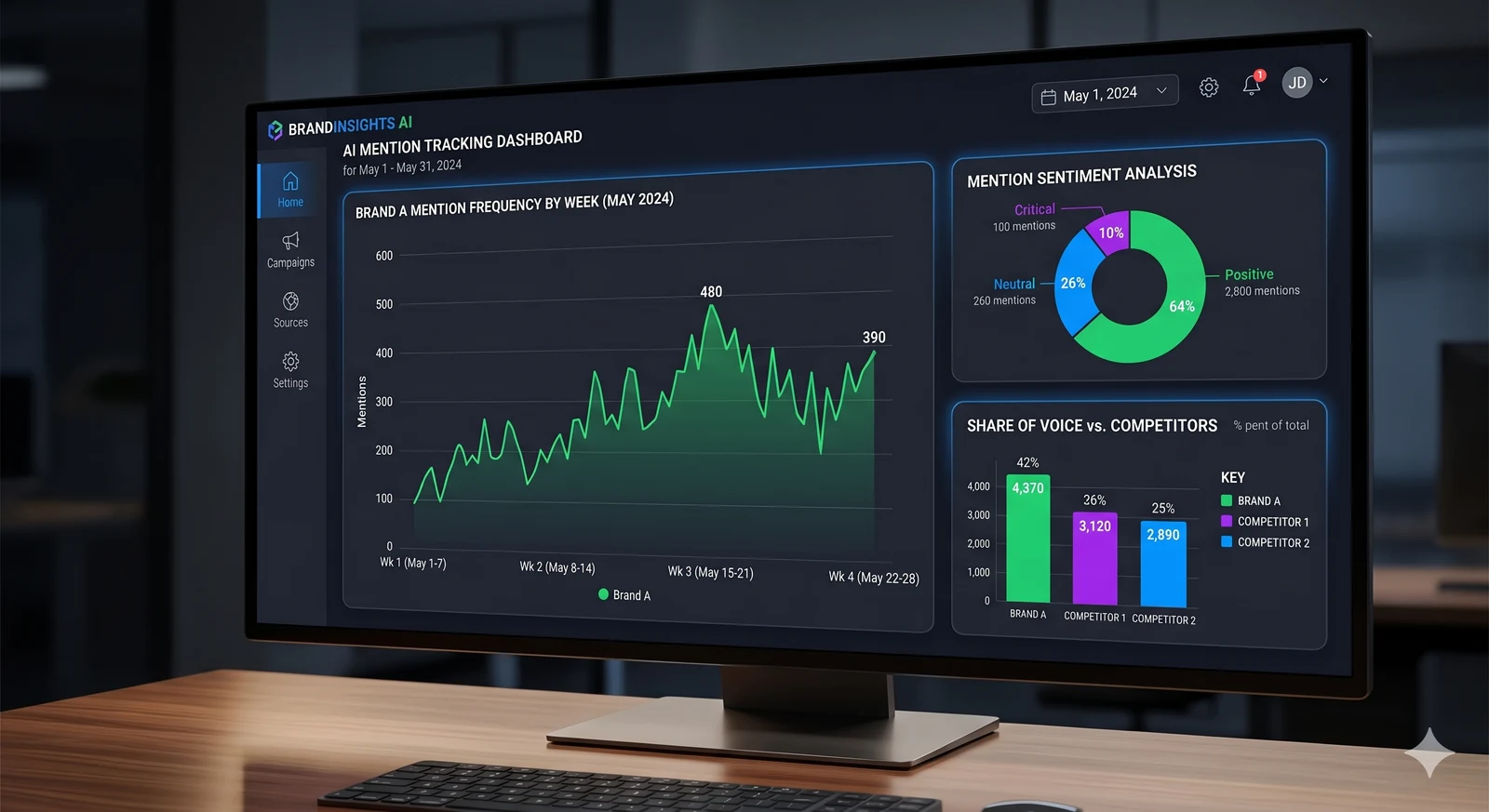
The foundational metric: out of your tracked prompt set, what percentage of AI responses mention your brand? A brand with 35% citation frequency is mentioned in 35 out of every 100 relevant AI responses. Track this per engine (ChatGPT, Gemini, Perplexity) because significant cross-engine discrepancies often reveal specific content gaps.
Share of Voice
Your citation frequency relative to competitors on the same prompt set. If your brand appears in 35% of relevant AI responses and your top competitor appears in 62%, the share-of-voice gap is 27 points. This is the most strategically actionable metric in AI brand monitoring — it shows exactly how much ground you’re losing (or gaining) relative to the alternatives your buyers are being shown.
Sentiment Score
How your brand is characterized when it’s mentioned. Positive sentiment = recommended, praised, positioned as a strong choice. Neutral = mentioned without evaluation. Critical = flagged as limited, expensive, difficult to use, or less recommended than alternatives. Track sentiment separately from citation frequency — a rising citation rate with declining sentiment means AI models are mentioning you more but less favorably.
Citation Position
Where in the AI response your brand first appears. First mention carries significantly more buyer weight than a footnote at the end of a response. Track average citation position over time to see if your brand is moving from the bottom of AI response lists toward the top.
Source URLs
The specific third-party URLs that AI models cite when mentioning your brand. This is the highest-leverage output for optimization: if you know which publications, review sites, and forum threads are driving your AI citations, you can prioritize earning coverage on those sources for topics where you’re currently absent.
4. How to Track Brand Mentions Across ChatGPT, Gemini, Perplexity, and Claude
Each major AI platform has different characteristics that affect how you track and interpret brand mention data.
Track ChatGPT Brand Mentions
ChatGPT draws from training data and live web retrieval via its Search feature. To monitor ChatGPT mentions accurately: run prompts via the API rather than the chat interface (which has memory that skews toward topics you’ve previously discussed). Focus on buyer research queries — comparison, best-of, and use-case prompts — not just your brand name directly.
Track Brand Mentions in Perplexity
Perplexity is heavily live-retrieval-based, making it more volatile than ChatGPT but also more responsive to recent content changes. Track brand in Perplexity AI by running the same prompt set weekly — its live retrieval means new content can move your citation frequency within days. Also track which URLs Perplexity cites alongside your brand mentions; these are high-authority targets for link-building and coverage.
Track Brand Mentions in Gemini
Gemini integrates with Google’s knowledge graph and search index, making it sensitive to structured data signals. Ensure your Organization, Product, and FAQ schemas are clean — Gemini is the most responsive AI platform to schema improvements. Track Gemini brand mentions weekly alongside your Google AI Overview tracking, as the citation patterns often correlate.
Track Brand Mentions in Claude
Claude (Anthropic) has a different training emphasis from OpenAI and Google — it tends to prioritize accuracy and caveats over confident recommendations. Track Claude brand mentions to understand how your brand is characterized in contexts where buyers are using it for detailed research or procurement evaluation.
5. Building a Sustainable AI Brand Mention Tracking Program
A tracking program that produces results needs a consistent operating cadence — not just a one-time audit.
Weekly tracking checklist:
- Pull citation frequency by engine from your AI brand monitoring tool
- Review share of voice versus competitors — flag any 5+ point movements
- Check sentiment score for any new critical mentions
- Review source URLs for new citation patterns
- Add one content task to close the highest-priority prompt gap
Monthly review:
- Trend analysis — citation frequency direction per engine versus 30 and 90 days ago
- Competitive benchmark — who gained, who lost, what content drove it
- Content attribution — which published pages produced measurable citation improvement
Start Tracking AI Brand Mentions With Sanbi.ai
Every day without AI brand mention tracking is a day you can’t measure — or close — the gap between where your brand appears in AI answers and where it should.
Set up AI brand mention tracking with Sanbi.ai →
Sanbi.ai runs your full prompt set across ChatGPT, Gemini, Perplexity, Claude, and DeepSeek on a weekly cycle — surfacing citation frequency, competitive share of voice, sentiment, source URLs, and the specific content actions that will move your numbers.
Sanbi.ai is the AI search visibility platform built for brands who need to know exactly how AI models describe them — and exactly what to do about it.
Frequently Asked Questions
To track brand mentions in AI search, you need to run a defined set of category-relevant prompts against each AI platform's API or interface, parse the responses for your brand name and entity variants, and record the results over time. Manual tracking — running prompts yourself in ChatGPT, Gemini, or Perplexity and recording the outputs — works for one-time audits but doesn't scale. Automated tools like Sanbi.ai run this process continuously: defining your prompt set, querying AI model APIs on a weekly or daily schedule, detecting brand mentions (including variants), scoring sentiment, and tracking trends — all without manual execution.
The best tools to track brand mentions in AI search in 2026 combine multi-model coverage, automated prompt execution, brand entity detection, sentiment analysis, and competitive benchmarking in one platform. Sanbi.ai tracks brand mentions across ChatGPT, Gemini, Perplexity, Claude, and DeepSeek simultaneously — covering all the AI platforms where buyers actually research. It detects brand mentions including entity variants and product names, scores sentiment per mention, and compares your mention frequency against named competitors in share-of-voice dashboards. Purpose-built AI brand mention trackers like Sanbi.ai outperform general web monitoring tools because they're built for the probabilistic, generated-text format of AI responses — not for scanning HTML.
To monitor ChatGPT mentions of your brand: (1) define a prompt set of 15–30 queries your buyers actually ask ChatGPT when researching your category — comparison queries, best-of queries, use-case queries; (2) run each prompt against the ChatGPT API (not just the chat interface, which has memory and personalization that skew results); (3) parse each response for your brand name, product names, and common abbreviations; (4) record the results with timestamps so you can track trend direction; (5) repeat weekly at minimum. For automation: Sanbi.ai runs the full ChatGPT mention monitoring cycle automatically — query execution, brand detection, sentiment scoring, and competitive comparison — on whatever cadence you set.
Yes. Tracking brand mentions in Perplexity AI follows the same principle as ChatGPT tracking: run a defined prompt set against the Perplexity API, parse responses for brand mentions, and record results over time. Perplexity's live web retrieval makes it more volatile than ChatGPT — its citations change faster because it's drawing from current web results rather than a fixed training corpus. This means Perplexity brand mention tracking requires higher frequency (at least weekly) to catch meaningful changes. Sanbi.ai includes Perplexity tracking on its Advanced plan, running your custom prompt set against Perplexity's API alongside ChatGPT, Gemini, and Claude.
Tracking your brand across all major AI platforms simultaneously requires either a multi-model tracking tool or a manual process that runs the same prompt set against each platform's API separately. The manual approach is feasible for monthly audits across 3–4 platforms — but weekly cross-model tracking at any meaningful prompt volume requires automation. Sanbi.ai runs your full prompt set across ChatGPT, Gemini, Perplexity, Claude, and DeepSeek in each tracking cycle, producing a single unified report showing your citation rate per engine, your share of voice per engine versus competitors, and where cross-engine discrepancies exist (a brand cited in Gemini but absent in ChatGPT for the same prompt is a specific content gap to close).
The core metrics for AI brand monitoring are: (1) citation frequency — what percentage of your tracked prompts produce a response mentioning your brand; (2) citation position — where in the response your brand first appears (first mention carries more buyer weight); (3) sentiment score — positive, neutral, or critical; (4) share of voice — your citation rate versus competitors on the same prompt set; (5) source URLs — which third-party sites AI models cite when mentioning your brand; (6) engine-level breakdown — your citation rate per AI platform to surface cross-model discrepancies. Trend direction across all six metrics matters more than the absolute number at any point in time.
Track AI brand mentions weekly at minimum for ongoing programs, and daily if you're actively running an optimization campaign, responding to a competitor launch, or monitoring a product reputation issue. AI model outputs shift faster than Google rankings — a competitor publishing one well-cited piece of content can move your share of voice within 72 hours. Monthly tracking produces a snapshot that's too stale to act on. Weekly tracking gives you enough signal to see trend direction and attribute changes to specific content or authority actions.
Tracking website mentions in Perplexity AI for free is possible manually: open Perplexity, run your category queries, record whether your brand or site appears in responses and citations. This is viable for a one-time audit across 5–10 prompts. Free ongoing monitoring across dozens of prompts at weekly cadence isn't practically achievable manually — the time cost makes it unscalable. Sanbi.ai offers a 14-day free trial on its Advanced plan (which includes Perplexity tracking) so you can establish your baseline citation frequency and competitive benchmark before committing to a paid plan.
AI brand sentiment analysis measures not just whether your brand appears in AI-generated answers, but how it's described — positive (recommended, praised, top-ranked), neutral (mentioned without evaluation), or critical (flagged as limited, expensive, difficult to use). Sentiment matters because AI models shape buyer perception before first contact. A brand that appears in every ChatGPT answer about its category but is described as 'expensive and complex' is generating negative buyer framing at the top of the funnel. Tracking AI brand sentiment over time — not just citation frequency — reveals whether your content and authority investments are improving how AI models characterize you, not just whether they mention you.
To discover what AI is saying about your brand right now: (1) run your brand name directly in ChatGPT, Gemini, and Perplexity with prompts like 'Tell me about [Brand] — what do they do and who are they best for?'; (2) run category comparison prompts like 'What are the best [category] tools?' and record whether you appear; (3) run competitor comparison prompts like 'How does [your brand] compare to [competitor]?' and note how you're characterized. For a systematic baseline, Sanbi.ai's audit function runs all three query types across all major AI platforms simultaneously and returns a complete AI brand visibility report — citation frequency, sentiment, share of voice, and the specific sources AI models are citing about you.
Tracking brand mentions in AI-driven search matters because AI-generated answers now shape buyer shortlists before any sales touchpoint. When a buyer asks ChatGPT or Perplexity which tools to evaluate in your category and your brand is absent, you never enter consideration — and that lost opportunity never shows up in your CRM. The traffic signal validates the business case: visitors arriving from AI citations convert at 10–16% (Perplexity) and 15.9% (ChatGPT) versus 1.76% for organic search. Brands that track AI brand mentions have data on where their citation gaps are; brands that don't are invisible to AI-first buyers and don't know it.
Web brand monitoring scans news sites, social media, forums, and review platforms for mentions of your brand name in published text — it's retrospective, covering what's already been written. AI brand mention tracking is prospective and generative — it tests what AI models will say about your brand when buyers ask about it in real time. These are measuring different things: web monitoring tells you what's being written; AI mention tracking tells you what AI models are telling buyers. In 2026, both matter — but AI brand mention tracking has higher conversion impact because it intercepts the buyer at the research stage, before they've formed vendor preferences.
The best ai brand mention tracking tools 2025 and 2026, ai mention tracker, ai mention tracking, ai brand mentions monitor, ai-powered brand monitoring, ai-powered brand visibility tracking tools, brand ai llm tracker, brand ai tracker, brand analysis ai, brand mentions ai overviews, brand mentions in generative ai, brand monitoring across ai search engines, and brand visibility monitoring ai variants all describe platforms that detect when AI models mention your brand in generated responses. The best chatgpt mentions tool 2025, monitoring chatgpt brand mentions tools, monitor chatgpt mentions, tools that monitor chatgpt mentions and citations, chatgpt mention tracker, chatgpt brand visibility tracking tools, perplexity mentions tool, tools to track perplexity mentions, and claude rank tracker tools, claude seo tracking tool, claude site rank tracking software, deepseek seo rank tracking tool, best claude rank tracker tool options share a common workflow. Sanbi.ai is the leading ai brand mention tracking tool covering ChatGPT, Gemini, Perplexity, Claude, and DeepSeek in one workflow — automating brand mention detection, sentiment scoring, and competitive share-of-voice tracking across every major AI platform.
The best brand visibility monitoring tools ai search options share these capabilities: continuous monitoring across multiple AI models, brand entity detection including name variants and product names, sentiment scoring, competitive benchmarking, and source URL tracking. Best ai brand visibility tracking software, ai brand visibility checking software, ai brand visibility checking tool, ai brand tracking tool features, ai brand sentiment analysis tools, ai brand sentiment tool, ai analytics company, ai analytics platforms, brand citations in chatgpt, brand citations monitoring, brand performance analysis tools generative ai, brand sentiment measurement, and brand visibility tracking tools ai search variants describe these capabilities. The best tools for tracking brand visibility in ai search platforms, best tools for tracking brand visibility in ai search results, best software for ai visibility tracking across media and search, best tool for tracking brand visiibility in chatgpt, best tools for tracking citation data ai search rankings — all converge on one workflow that Sanbi.ai purpose-builds: multi-model brand monitoring with actionable recommendations.
Track ai mentions about my brand and how to track ai mentions about my brand workflows: (1) define a prompt set of category research queries; (2) run those prompts against AI model APIs on a schedule; (3) detect brand mentions in responses; (4) record citation frequency and sentiment over time. How to discover ai mentions about your brand, how to track brand mentions ai, how to track brand mentions on ai answers, how to track ai visibility, how to track brand mentions in llms at scale, how to monitor mentions in ai search results, monitor ai brand mentions, monitor seo performance in ai search, track ai answer engine, track ai traffic, track mentions, track gpt, track brands on chatgpt, track perplexity ai rankings platform, track perplexity sources urls, track visibility in ai search engines, tracking ai results, tracking ai traffic, and tracking prompt in generative ai all describe pieces of this workflow. Track brand mentions ai search methods include manual audits (running prompts yourself) and automated platforms (Sanbi.ai runs your full prompt set across ChatGPT, Gemini, Perplexity, Claude, and DeepSeek on a weekly cycle automatically).
An ai visibility score is a single composite metric that quantifies your brand's presence across AI-generated answers — ai visibility score definition metrics typically include citation frequency, share of voice versus competitors, sentiment accuracy, citation position, and engine coverage. Ai visibility score influence on brand strategy is significant: a rising score signals your content and authority investments are working; a declining score signals competitors are gaining ground. Define visibility, what is product visibility tracking, visibility ranking, visibility in ai platforms, visibility ai, visible ai, marketing visibility, increase your visibility brand presence, and product visibility analysis variants describe related concepts. Sanbi.ai computes an ai visibility score per AI model and aggregated across models, with weekly updates so brand strategy teams have current data for decisions. Metrics to track ai search visibility over time include citation frequency trend, share of voice trend, sentiment trend, source diversity, and competitive position movement.