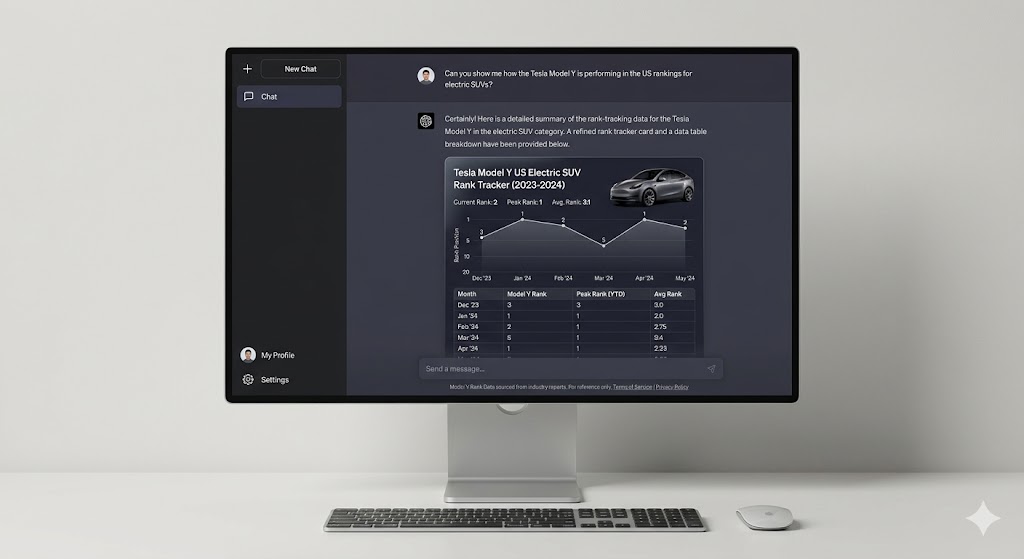
ChatGPT Rank Tracking: How to Monitor Your Brand Inside ChatGPT
Two years ago, ChatGPT rank tracking wasn’t a category. Today it’s table-stakes for any brand whose buyers research before they buy — which is essentially every B2B and most B2C categories.
ChatGPT now drives more high-intent referral traffic than Bing for many SaaS companies, and ChatGPT-sourced visitors convert at 15.9% versus 1.76% for organic search. If you can’t see whether ChatGPT is recommending you, you can’t fix the gap.
This guide covers how ChatGPT rank tracking works, the best tools to do it, how to do it for free, and a step-by-step playbook for moving up.
What Is ChatGPT Rank Tracking?
A ChatGPT rank tracker is the AI-era equivalent of a Google rank tracker. Instead of monitoring your blue-link position for keywords, it monitors:
- Whether your brand is mentioned for a given prompt
- Where in the response (first paragraph vs footnote)
- How you’re characterized (recommended vs neutral vs warned against)
- Which competitors are mentioned in the same answer
- Which sources ChatGPT cites to support the recommendation
Classic SEO asks “what’s my rank for crm software?” ChatGPT rank tracking asks “if a buyer asks ChatGPT what’s the best CRM for a 20-person sales team, am I recommended? At what point in the answer? Against whom? And which sources is ChatGPT citing?”
That last piece — the cited sources — is the lever. ChatGPT’s recommendations come from somewhere. If you know where, you know what to influence.
How ChatGPT Decides What to Recommend
ChatGPT’s brand recommendations are produced by four layers:
- Training data — what was published on the web before its cutoff
- Live web retrieval via ChatGPT Search (powered by Bing index + OpenAI’s own crawl)
- Partner data feeds like ACP-integrated commerce (Etsy, Shopify merchants)
- User memory for logged-in users with prior context
For most B2B prompts, layers 1 and 2 dominate. That means the brands ChatGPT recommends are the ones whose names appear most often in authoritative comparison content, listicles, Reddit threads, G2 reviews, and niche trade publications.
This is why chatgpt seo is converging with — but not identical to — classic SEO. The on-page mechanics matter (schema, semantic HTML, llms.txt), but the off-page citation profile is the bigger factor.
The Best ChatGPT Rank Tracking Tools
Every tool below tracks ChatGPT — the difference is how much they show you beyond a mention count, and whether they ship fixes or just dashboards.
1. Sanbi.ai — Best overall ChatGPT rank tracker
Sanbi tracks ChatGPT (OpenAI) on every plan, and adds Gemini + Perplexity on Advanced and Claude on Professional. Every audit feeds a Site Health report (SEO + AEO + ARO), a Recommended Tasks board, and an AI content engine that drafts AEO-optimized comparison and “best/top” pages targeting the exact prompts where you currently rank 0. Competitor tracking is included on every plan; Product Visibility and Geographic Dominance — region-based ChatGPT tracking across US, EU, APAC and China/Taiwan with a map view and per-location drill-down — unlock on Professional. Pricing is the most aggressive in the category — from solo founders at $37.25/mo annual through enterprise deployments.
- Engines: OpenAI / ChatGPT (Starter+), Gemini & Perplexity (Advanced+), Claude (Professional+)
- Best for: Anyone serious about ChatGPT visibility — SMB, agency or enterprise
- Strengths: Lowest pricing in the category, Site Health + content engine bundled, Geographic Dominance for region-based ChatGPT tracking + Product Visibility on Pro, dedicated account specialist on Pro
- Weaknesses: Starter is OpenAI-only — you have to step up to Advanced for Gemini and Perplexity
- Free trial: 7-day on Starter, 14-day on Advanced
- Starts at: $37.25/mo (Starter, billed annually) — Advanced $75/mo, Professional $275/mo, Enterprise custom
2. Otterly — Best low-cost ChatGPT-only tracker
If you only care about ChatGPT and you’re optimizing for absolute lowest price over breadth, Otterly is the simplest paid option in the category. Engine coverage stops at ChatGPT and Perplexity, there’s no Site Health auditing, and competitor tracking is basic — but for a solo founder running a weekly check on “is my brand mentioned for these 10 prompts”, it gets the job done.
- Engines: ChatGPT (primary), Perplexity
- Best for: Solo founders and bootstrapped brands monitoring ChatGPT only
- Strengths: Lowest entry price in the category, fast setup, simple UI
- Weaknesses: No Site Health auditing, no content engine, basic competitor tracking, no Claude or Gemini
- Starts at: ~$29/mo
3. Profound — Best for very high prompt volume
Profound popularized answer-engine optimization as a category and remains the heavyweight for Fortune 500 deployments that need hundreds of thousands of prompts per month and a dedicated GEO team to consume the data. The prompt volume conversation explorer is genuinely best-in-class. The trade-off is enterprise pricing and a light optimization layer — you walk away with data, not a fix list.
- Engines: All 4 major LLMs at very high volume
- Best for: Fortune 500 with dedicated GEO teams
- Strengths: Prompt-volume scale, conversation explorer, strong enterprise reporting
- Weaknesses: Enterprise-only pricing, limited optimization recommendations, long onboarding
- Pricing: Enterprise (typically $30k+/yr)
4. Peec.ai — Best for region-based ChatGPT tracking
Peec runs the same prompt across multiple geos and shows how ChatGPT’s answer changes by location — critical for brands that operate across the EU, APAC or LATAM, where the same prompt in different languages or markets returns very different competitor sets. Strong reputation among European brands; often shortlisted alongside Profound on enterprise RFPs. Worth noting: Sanbi.ai’s Geographic Dominance on Professional ($275/mo annual) covers the same region-based use case — US, EU, APAC and China/Taiwan with Mandarin/Cantonese prompts — at a fraction of the cost, so Peec is most defensible when you specifically need EU data-residency.
- Engines: All 4 major LLMs with region-based prompt sets
- Best for: EU and multi-region brands needing geo-fenced tracking
- Strengths: Best-in-class region/locale variants, clean dashboards, EU data-residency story
- Weaknesses: Optimization recommendations are limited; you still need a separate fix workflow
- Pricing: Mid-market
5. Athena HQ — Best for fast onboarding
Athena is built for marketing teams that need to demonstrate ROI to leadership in the first sprint. Most accounts are tracking inside an hour, with a single composite visibility score on top of the dashboard. Less flexibility than power-user tools, but the speed-to-insight is the differentiator.
- Engines: ChatGPT, Gemini, Perplexity, Claude
- Best for: Marketing teams that need to prove value fast
- Strengths: Onboarding speed, single composite score, executive-friendly reporting
- Weaknesses: Less flexibility for power users; harder to customize prompt sets
- Pricing: Mid-market
6. Semrush AI Visibility / SE Ranking AI Visibility — Best add-on for existing customers
If you already pay for Semrush or SE Ranking for classic SEO, their AI Visibility modules give you a serviceable chatgpt visibility tracker inside the dashboard you already check daily — no second login, no second contract. Model coverage is narrower than dedicated tools and the optimization layer is lighter, but for many SMB teams that’s an acceptable trade.
- Engines: ChatGPT, Gemini AI Overviews, Perplexity (limited Claude)
- Best for: Existing Semrush or SE Ranking customers
- Strengths: Single-vendor stack, no extra procurement, familiar UX
- Weaknesses: Narrower engine coverage, lighter on sentiment/narrative, no content engine
- Pricing: Add-on to existing subscription
At-a-glance
| Tool | Engines tracked for ChatGPT | Site Health | Content engine | Starts at |
|---|---|---|---|---|
| Sanbi.ai | ChatGPT + (Gemini + Perplexity + Claude on higher tiers) | ✅ SEO + AEO + ARO | ✅ AEO pages drafted from your audit | $37.25/mo annual |
| Otterly | ChatGPT, Perplexity | ❌ | ❌ | ~$29/mo |
| Profound | All 4 at very high volume | ⚠️ Limited | ⚠️ Limited | $30k+/yr |
| Peec.ai | All 4 with region splits | ⚠️ Limited | ⚠️ Limited | Mid-market |
| Athena HQ | All 4 | ⚠️ Light | ⚠️ Light | Mid-market |
| Semrush / SE Ranking AI | ChatGPT + AIO (limited Perplexity/Claude) | ⚠️ Light | ❌ | Add-on |
Free ChatGPT Rank Tracking: How Far Can You Get?
You can get pretty far before you have to pay:
- Manual prompt runs — pick 25 buyer prompts, paste them into ChatGPT weekly, log the responses in a spreadsheet. Tedious but free.
- Sanbi.ai 7-day free trial on Starter (or 14-day free trial on Advanced) — runs your prompt set across ChatGPT (and Gemini + Perplexity on Advanced), returns a visibility score, Site Health report, and a Recommended Tasks list. No credit card.
- ChatGPT Search reverse-lookup — open ChatGPT Search, query your category, click the source citations. Those are the sites ChatGPT trusts for your category. Build relationships with them.
The honest limit: anything beyond ~50 prompts per week stops being tractable manually. If your category matters, you’ll need a paid tool inside a quarter.
A Step-by-Step ChatGPT Visibility Playbook
The playbook that works in 2026:
Step 1 — Build your prompt set (week 1)
Start with 50 prompts grouped into buyer-journey stages: awareness, consideration, comparison, decision. Include the obvious head terms (“best CRM software”) and the long-tail buyer questions (“crm for 10-person sales team with hubspot integration”).
Step 2 — Baseline (week 1)
Run all 50 prompts in ChatGPT and record: are you mentioned, where, with what sentiment, alongside whom. This is your starting point.
Step 3 — Map your citation gaps (week 2)
For every prompt where you’re NOT mentioned, click the citation sources ChatGPT used. Those are the domains you need to be on. Build a hit-list.
Step 4 — Earn citations on the hit-list (weeks 3–12)
Pitch listicles, contribute to G2/Capterra/TrustRadius, get reviewed on niche trade publications, seed honest Reddit threads in relevant subreddits, publish comparison content on your own site that’s strong enough other sites cite you back.
Step 5 — Fix on-page accessibility (week 2)
Implement Product, Organization and FAQ schema. Publish an llms.txt. Ensure GPTBot and OAI-SearchBot are explicitly allowed in robots.txt. Serve clean Markdown to LLM user agents where possible.
Step 6 — Re-track weekly (ongoing)
Re-run your prompt set every week. Movement is fast — a single well-cited article can shift share of voice within 72 hours. The brands that win are the ones that close the feedback loop fastest.
ChatGPT Tracking vs Perplexity, Gemini and Claude
ChatGPT is the biggest engine but tracking it alone is a mistake. Same prompt, four engines, four different brand mixes is the norm:
| Engine | Retrieval style | Citation behavior |
|---|---|---|
| ChatGPT | Training data + ChatGPT Search | Implicit; cites in Search mode |
| Perplexity | Live web-first | Explicit numbered citations |
| Gemini | Google Search + Gemini reasoning | AI Overviews cite source domains |
| Claude | Retrieval-light, training-heavy | Rarely cites unless prompted |
A serious ai search visibility tool tracks all four because the optimization tactics differ per engine. Google’s AI Overviews are a fifth surface with its own measurement discipline — covered in our Google AI Overviews tracking guide.
Your Next Step
ChatGPT visibility is the single highest-leverage channel most brands aren’t measuring. Every week you wait, a competitor’s citation profile compounds.
Start a free trial of Sanbi.ai and see exactly where you stand inside ChatGPT — your visibility score, sentiment, citations, competitor share, Site Health report, and a Recommended Tasks list. 7-day free trial on Starter ($50/mo), 14-day free trial on Advanced ($99/mo). No credit card.
Sanbi.ai monitors your brand’s AI visibility across ChatGPT, Gemini, Perplexity and Claude — tracking visibility scores, sentiment, citations, Site Health (SEO + AEO + ARO), competitor movements, and shipping the AI-written content that closes the gap. From $37.25/mo billed annually.
Frequently Asked Questions
ChatGPT rank tracking is the practice of monitoring whether and how your brand is mentioned inside ChatGPT's responses to category-relevant prompts. Instead of tracking blue-link positions like classic SEO, a ChatGPT rank tracker captures the full response, scores brand mentions, citation URLs, sentiment and share of voice against competitors — usually on a daily or weekly schedule.
Sanbi.ai offers a 7-day free trial on its $50/mo Starter plan and a 14-day free trial on its $99/mo Advanced plan, both of which include ChatGPT rank tracking, competitor tracking and Site Health auditing. Otterly has a low-cost entry tier focused on ChatGPT. Free trials are great for baselining; serious programs need a paid platform that runs hundreds of prompts weekly with sentiment and competitor scoring.
ChatGPT's recommendations come from a blend of its training data, retrieval from live web search via ChatGPT Search, partner data feeds (Etsy, Shopify via ACP), and increasingly user memory. Brands that have strong schema, clear comparison content, lots of high-quality citations on authoritative sites, and presence in retrieval indexes tend to be cited more often.
At least weekly for steady-state monitoring, daily if you're actively running an optimization campaign or launching a product. ChatGPT's responses shift far faster than Google's rankings — a competitor publishing one well-cited article can move your share of voice within 72 hours.
Each engine retrieves and ranks differently. ChatGPT relies heavily on training data plus its own Search index. Perplexity is more aggressive about live web retrieval and explicit citations. Gemini integrates AI Overviews with classic Google search. A good AI visibility platform tracks all of them in parallel because the same prompt produces very different brand mixes per engine.
Yes. The core levers are: publish comparison and listicle content for the prompts your buyers actually ask, earn citations on the high-authority domains ChatGPT pulls from (Reddit, G2, niche review sites, top trade publications), implement Product / Organization / FAQ schema, ensure your site is crawlable by GPTBot and OAI-SearchBot, and publish an llms.txt. Track weekly to see what's moving the needle.
ChatGPT rank tracking free options exist in limited form: you can manually run a set of category prompts in ChatGPT and record whether your brand appears. This works for a one-time audit but doesn't scale — manual tracking can't run hundreds of prompts consistently, can't compare across model versions, and can't produce trend data over time. A paid ChatGPT SEO tracker automates this entire workflow: defining your prompt set, running it against the ChatGPT API on a regular cadence, detecting brand mentions, scoring sentiment, and reporting competitive share of voice. When to upgrade: the moment you need trend data (not just a snapshot), competitive benchmarking, or tracking across multiple AI platforms simultaneously. Sanbi.ai provides the full ChatGPT SEO tracker workflow — from prompt definition to citation trend dashboards — that manual free methods can't replicate.
The best tools to track ChatGPT brand mentions combine API-level query automation, brand detection across entity variants, sentiment analysis, and competitive benchmarking in a single platform. When evaluating ChatGPT brand mention trackers: look for platforms that run your buyer's actual research prompts (not just brand-name queries), that track trend data over weeks and months rather than point-in-time snapshots, and that benchmark your ChatGPT visibility against named competitors. The best ChatGPT visibility tracker also covers the other major AI platforms — Gemini, Perplexity, Claude, DeepSeek — because buyers rarely use only one AI tool. Sanbi.ai is built specifically for this: automated ChatGPT brand mention tracking, multi-model coverage, and share-of-voice competitive dashboards that show you exactly where you stand versus competitors in every major AI search environment.
ChatGPT rank tracking works by sending a defined set of prompts to the ChatGPT API, parsing the text responses for brand mentions, and recording the results with timestamps. A complete ChatGPT SEO analysis measures: (1) citation frequency — what percentage of relevant prompts produce a response that mentions your brand; (2) citation position — where in the response your brand first appears; (3) sentiment — whether the mention is positive, neutral, or negative; (4) competitive share of voice — your citation rate versus competitors on the same prompt set; (5) trend direction — whether your citation frequency is rising or falling week over week. ChatGPT rank tracking differs from traditional rank tracking because there is no fixed position 1–10 — instead you're measuring probabilistic mention rates across a response language model, which means sample size, prompt wording, and model version all affect results. Best-practice ChatGPT SEO trackers run each prompt multiple times per measurement cycle and average the results to reduce response variance.