
Otterly AI Review and Alternatives (2026): Pricing, What It Tracks, and When to Move Up
Otterly AI is the cheapest serious way to start tracking your brand in AI answers, and the tool most teams outgrow within two quarters. Both halves of that sentence are compliments. It does a narrow job cleanly at a price that removes every excuse for not measuring — and the moment you need competitor share of voice, more engines, or an answer to “so what do we do about it,” you will feel the ceiling.
This is a review from the perspective of someone who has to decide whether to sign up, stay, or move — with the current pricing, what each tier actually includes, and the honest alternatives at every budget.
The short version
| Otterly AI | |
|---|---|
| Starting price | $29/month (Lite: 15 prompts) |
| Engines by default | ChatGPT, Google AI Overviews, Perplexity, Microsoft Copilot |
| Engine add-ons | Claude, Gemini, Google AI Mode — $9 to several hundred/month by tier |
| Best for | Solo founders, small teams, a first read on AI visibility |
| Runs out when | You need competitor SoV, 5+ engines, or recommendations |
| Free trial | Yes, no commitment |
What Otterly AI is
Otterly.AI is an AI search monitoring tool. Within the wider category of AI visibility tracking tools it sits at the entry end: fewer AI platforms covered by default, but the lowest price of anything serious. You define prompts — the questions your buyers ask — and it runs them daily against a set of engines, recording whether your brand was mentioned, whether your links were cited, and the sentiment of the answer. It reports this over time, so you see trend rather than a snapshot.
It was one of the first tools built specifically for ChatGPT tracking, which is why it still shows up first in ChatGPT rank tracker searches. That heritage explains both its strengths (simple, focused, cheap) and its limits (built for one engine, extended outward).
Pricing, tier by tier
Verified against Otterly’s pricing page in September 2026. Tiers and engine coverage have changed several times, so check before deciding.
| Tier | Monthly | Annual (≈15% off) | Prompts | Notable inclusions |
|---|---|---|---|---|
| Lite | $29 | $25/mo | 15 | 4 engines, daily tracking, unlimited team members, ChatGPT Ads tracking, 1,000 GEO URL audits/mo |
| Standard | $189 | $160/mo | 100 | + API & MCP access (2,000 req/mo), Agent Analytics (200k events), Looker Studio connector, 5,000 URL audits |
| Premium | $489 | $422/mo | 400 | + API/MCP 5,000 req/mo, Agent Analytics 1M events, 10,000 URL audits, personal onboarding |
| Enterprise | From ~$1,000 | Custom | Custom | SSO, dedicated success manager, quarterly health checks |
Add-ons: an extra 100 prompts is $99/month. Claude, Gemini and Google AI Mode are each paid engine add-ons priced from $9/month on Lite up to several hundred on higher tiers.
The number to focus on is prompts, not price. Fifteen prompts is enough to prove the concept and not enough to run a programme — you need 25 to 50 per market to read a trend with any confidence, which puts a real first deployment on Standard at $189. Compare that per-prompt cost, not the $29 headline, with whatever else you are evaluating.
What it does well
- Honest, low-friction entry. No sales call, a real free trial, cancel monthly. That matters more than it sounds in a category full of “book a demo.”
- Four engines on every tier. The 2026 base set — ChatGPT, AI Overviews, Perplexity, Copilot — is a genuine improvement on its ChatGPT-only origins.
- Daily tracking as standard. Answers vary run to run; a daily cadence is the minimum for a trend, and some competitors charge extra for it.
- API, MCP and Looker Studio on Standard. For $189 you can get the data out, which is more than several pricier tools offer at their entry tier.
- Agent Analytics and URL audits bundled. Crawler-hit logging and page-readiness checks are the leading indicators most teams ignore — having them in the same tool is a real convenience.
Where it runs out
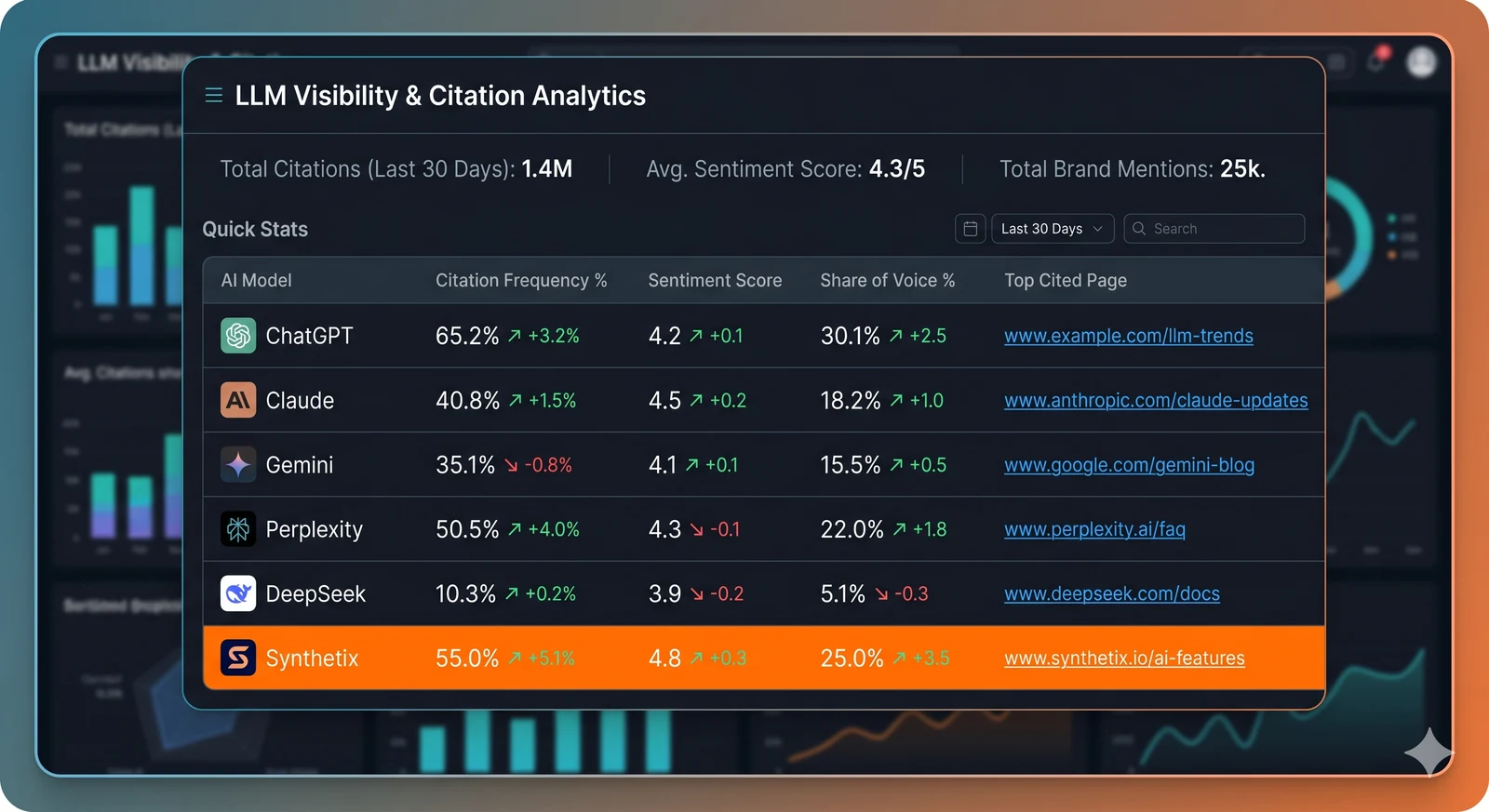
- Gemini, Claude and AI Mode cost extra. For a B2B brand, Gemini and AI Mode are not optional surfaces in 2026 — Google’s AI layer passed a billion monthly users. Paying per engine changes the maths quickly.
- Competitor view is thin. You can see whether you were mentioned. Understanding who was mentioned instead, on the same prompts, over time, is the question that actually directs work — and it is where lightweight trackers stop.
- It measures; it does not recommend. A dashboard that says “cited 31% of the time, down from 38%” leaves the hardest part to you: which pages to fix, which third-party sources to earn, which sub-questions you are missing.
- No sentiment repair or misinformation workflow. When an engine describes you inaccurately, you want the claim, the source it came from, and a correction path — not a sentiment score.
- Prompt ceilings bite. 100 prompts on Standard covers one product line in one market. Multi-product, multi-market brands hit Premium fast.
None of these are flaws in what Otterly set out to be. They are the reasons the best AI visibility tools ranking puts it where it does: the right first tool, rarely the right only tool.
The alternatives, by what you have outgrown
1. Sanbi.ai — the direct step up
Same self-serve, no-sales-call posture, at a comparable entry price, with the three things Otterly lacks: competitor share of voice on every prompt, all major engines included (ChatGPT, Gemini, Perplexity, Claude, AI Overviews, AI Mode) rather than sold as add-ons, and a recommendations layer that turns a citation gap into a specific page to write or a specific third-party source to earn. Adds geographic dominance tracking, misinformation detection with a correction loop, and prompt-level export. If the reason you are leaving Otterly is “what do we do now,” this is the answer. Run the free audit to see it on your own prompts before signing up for anything.
2. Profound — the enterprise alternative
The category’s enterprise reference point: prompt-volume data, a REST API for warehouses and BI tools, analyst-style workflows and enterprise pricing to match. Right for large organisations with a dedicated analyst; overkill for a marketing team of four. Our Profound alternatives guide covers the trade-offs in depth.
3. Peec AI — the European regional-reporting alternative
Strong per-country prompt reporting and a clean interface, priced above Otterly and below enterprise. See the Peec AI alternatives breakdown.
4. Scrunch AI — the citation-source alternative
Persona-simulation and citation-source analysis: which domains engines are pulling from for your category. See Scrunch alternatives.
5. Semrush AI Toolkit — the bolt-on
If you already pay for Semrush, the AI Toolkit gives a basic read on AI Overviews, ChatGPT, Gemini and Perplexity mentions inside a familiar interface, sold per domain on top of your subscription. Convenient; limited on prompt depth, sampling frequency, and — like Otterly — it reports rather than recommends.
The enterprise brand-research tier: Bluefish and Evertune
Two names that come up in the same searches but solve a different problem. Bluefish AI monitors and manages brand representation across AI assistants for large consumer and B2B companies, with a brand-safety emphasis, sold as an enterprise engagement. Evertune runs large prompt volumes to produce brand indexes — how often and how favourably a category recommends you — positioned closer to brand research than to SEO tooling. Both are insights-team purchases at enterprise prices; neither is an Otterly replacement for a performance marketer.
Not an alternative: Windsor AI
Windsor.ai appears in these comparisons because it is a marketing data integration platform — it pipes ad, analytics and CRM data (and increasingly AI visibility data) into warehouses and dashboards. It does not track ChatGPT answers. Pair it with a tracker if you want the reporting layer; it is not the tracker.
The decision table: which AI monitoring tools fit which need
| You need… | Stay on Otterly | Move to |
|---|---|---|
| A first read, ≤15 prompts, one market | ✅ | — |
| Competitor share of voice on the same prompts | Sanbi | |
| Gemini + AI Mode + Claude without add-on fees | Sanbi | |
| Recommendations, not just measurement | Sanbi | |
| Enterprise API, analyst workflows | Profound | |
| European per-country reporting | Peec | |
| Citation-source analysis first | Scrunch | |
| Everything inside Semrush | Semrush AI Toolkit | |
| Brand-research indexes for an insights team | Evertune / Bluefish |
The broader four-way comparison — Peec, Profound, Scrunch and Sanbi on the same criteria — is in our AI visibility platform comparison, and the free-tier landscape is covered in free AI visibility checkers.
How to run a fair comparison in two weeks
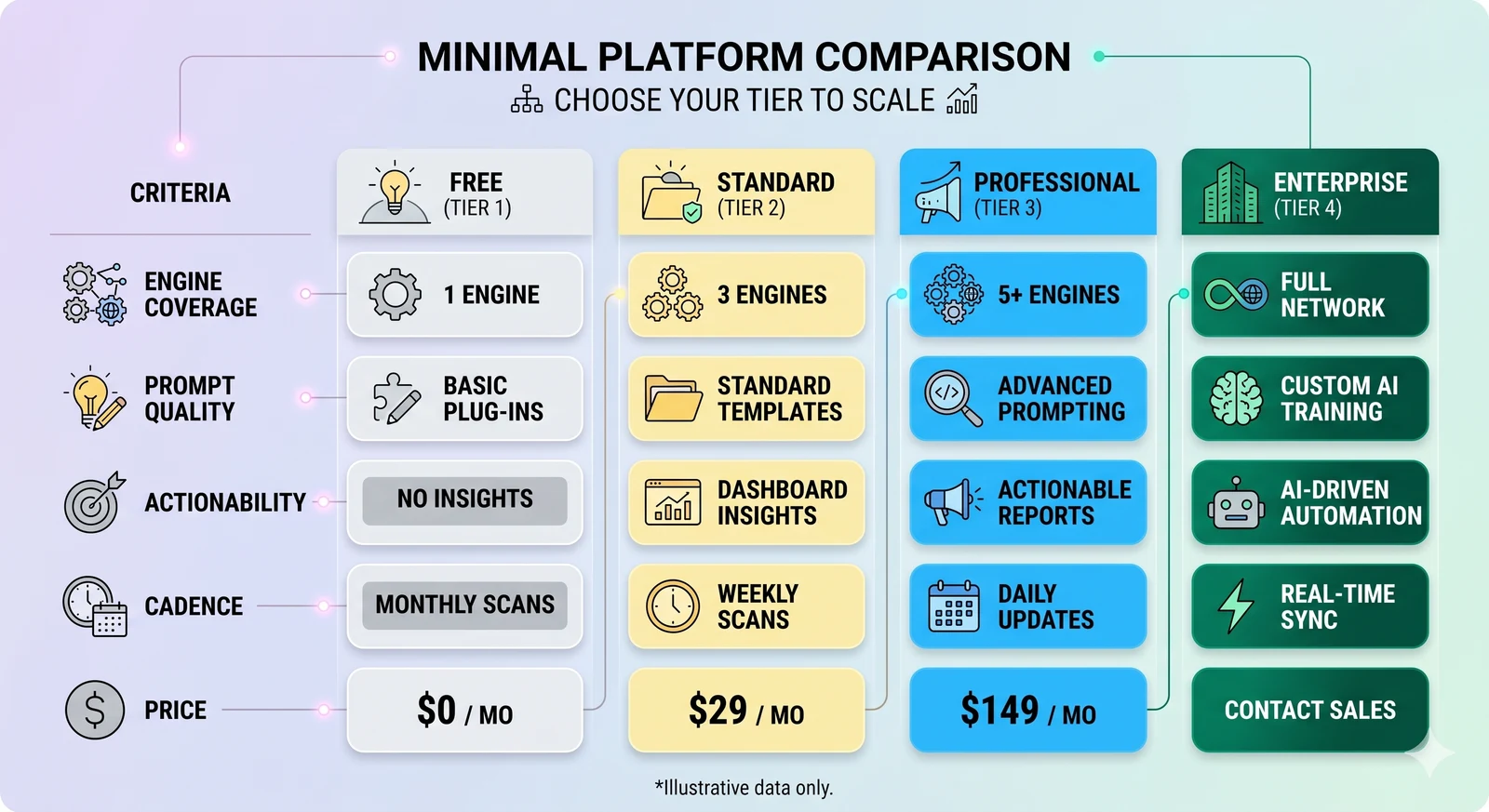
Every tool in this category will show you a number. The question is whether it is a number you can defend. Run the same 20 prompts through each candidate for two weeks and compare:
- Engines covered — and which ones cost extra.
- Full answer text stored, or just a mention flag? You cannot diagnose an answer you cannot read.
- Samples per prompt. Once a day is a minimum; a single run is noise.
- Competitor citations on the same prompts, not in a separate report.
- Recommendations. Does it tell you what to do, or just what happened?
Then divide the monthly price by tracked prompts. That number, not the headline, is what you are comparing. The fuller methodology is in how to measure AI visibility.
The bottom line
Otterly AI earns its place: it is the right first tool for a founder or small team who needs to start measuring today, at $29, with no one to call. Sign up, run 15 prompts for a month, and you will learn something real.
You will also learn, fairly quickly, that measuring is the easy half. The moment the question becomes who is being cited instead of us, on which engines, and what do we change — that is the moment to move up.
Run a free AI visibility audit — same prompts, every major engine, with the competitor view and the recommendations included.
Frequently Asked Questions
Otterly.AI is an AI search monitoring tool that tracks how brands and links appear in ChatGPT, Google AI Overviews, Perplexity and Microsoft Copilot for a set of prompts you define, reporting mentions, link citations and sentiment over time, with Claude, Gemini and Google AI Mode available as paid add-on engines. It started as one of the first ChatGPT-focused trackers and is known for a simple interface and a low entry price, with plans starting at 29 dollars a month for 15 prompts and scaling with prompt volume. It suits individuals and small teams checking a handful of prompts.
It depends on what outgrew Otterly. For more engines, competitor share of voice and recommendations on what to publish at a similar price point, Sanbi.ai is the direct step up. For enterprise prompt-volume data and analyst workflows, Profound. For regional prompt reporting in Europe, Peec AI. For citation-source analysis, Scrunch. For a Semrush-native option, the Semrush AI Toolkit. Compare on engines covered, prompts included per tier, whether full response text is captured, and whether the tool tells you what to do next.
As of September 2026 Otterly publishes four tiers: Lite at 29 dollars a month for 15 prompts, Standard at 189 dollars for 100 prompts, Premium at 489 dollars for 400 prompts, and Enterprise from roughly 1,000 dollars with custom tracking and SSO. All paid tiers track four engines by default; Claude, Gemini and Google AI Mode are add-ons priced from 9 dollars to several hundred a month depending on tier, and an extra 100 prompts costs 99 dollars. Annual billing takes about 15 percent off. Prompt allowance is the real unit of cost: budget for at least 25 to 50 prompts per market to get a meaningful read.
Otterly reports mention rate, link citations and sentiment per prompt rather than a single composite brand visibility score. That is a reasonable design choice — a blended score hides which engine moved — but it means you assemble the headline number yourself, and comparing two AI monitoring tools on 'score' is meaningless unless both disclose the formula. What matters more than the score is the inputs behind it: how many prompts, how many samples per prompt, which AI platforms, and whether competitor mentions are captured on the same run. Ask for those four before trusting any vendor's visibility score.
Bluefish AI is an enterprise platform for monitoring and managing how brands are represented by AI assistants, aimed at large consumer and B2B companies and their agencies. It emphasises brand safety and accuracy, tracking what models say about a brand, flagging incorrect or negative claims, and measuring share of voice against competitors, and is sold as an enterprise engagement rather than a self-serve subscription. Mid-market teams usually find the same core tracking in self-serve platforms at a fraction of the cost.
Evertune is an AI brand-measurement company that runs large volumes of prompts against major models to produce brand indexes: how often and how favourably a brand is recommended in a category, and which attributes models associate with it. Its positioning is closer to brand research than to SEO tooling, with enterprise pricing and a focus on consumer categories. It is a good fit for brand and insights teams; performance marketers usually need prompt-level citation data that self-serve visibility tools provide.
Not primarily. Windsor.ai is a marketing data integration platform that connects ad platforms, analytics and CRM data into warehouses and BI tools, and it has added connectors relevant to AI search reporting. It appears in AI visibility comparisons because teams use it to pipe AI referral and visibility data into dashboards, not because it tracks ChatGPT answers itself. If you need the tracking, pair a visibility platform with Windsor for the reporting layer.
Searchable is an AI visibility platform that reports how brands show up across ChatGPT, Gemini, Perplexity and Google's AI surfaces, positioned for marketing teams that want visibility scores and content recommendations in one place. The bare term searchable is also a common English word, so search results for it mix the company with dictionary and software results; when comparing tools, search for the full brand name or the domain to reach the product.