HubSpot AEO Review (2026): Pricing, What It Tracks, and How It Compares to Profound, Peec, Scrunch and AthenaHQ
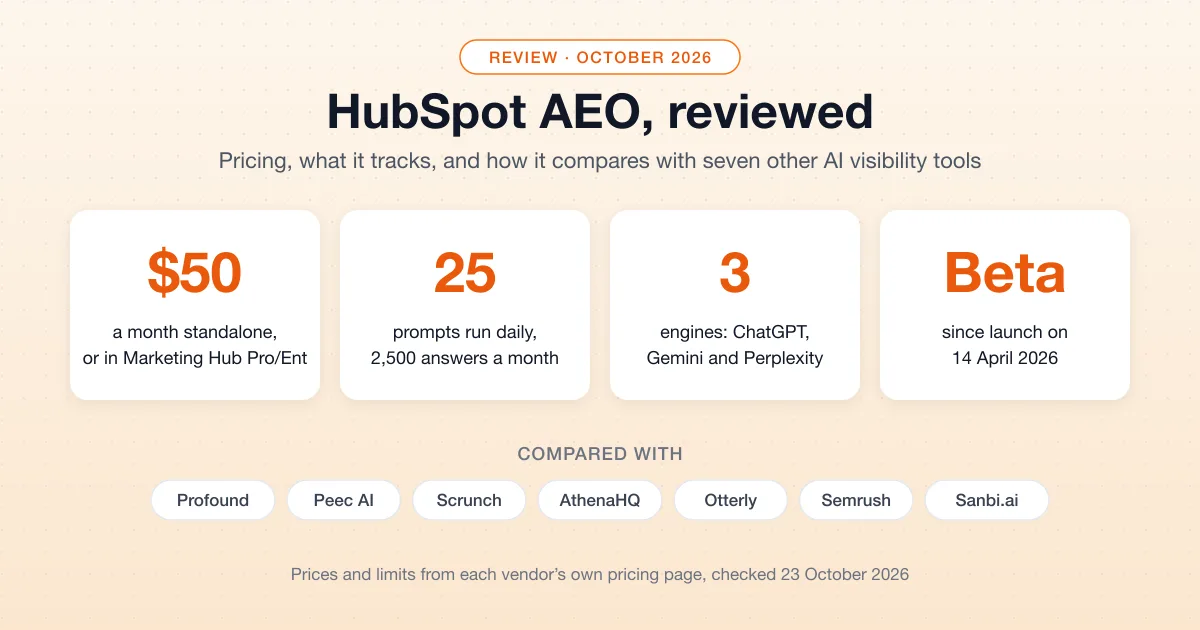
HubSpot AEO is HubSpot’s AI visibility tracker. It has been in beta since 14 April 2026, costs $50 a month on its own (or comes with Marketing Hub Professional and Enterprise), and runs 25 prompts a day across ChatGPT, Gemini and Perplexity. It is the cheapest credible way for a HubSpot customer to see how AI engines talk about their brand. It does not officially cover Google AI Mode, AI Overviews or Claude, and the base plan caps out at 25 prompts.
This review uses HubSpot’s own catalog, pricing and help pages and each competitor’s pricing page, all checked on 23 October 2026. It covers what HubSpot AEO does, what it costs, where it is strong and where it falls short, and how it compares with Profound, Peec AI, Scrunch, AthenaHQ, Otterly.ai, Semrush and others. It also shows what AI agents themselves ask about HubSpot AEO, from our own search data.
Disclosure: we make Sanbi.ai, an AI visibility tracker that competes with HubSpot AEO. We include it where it fits and say plainly where HubSpot is the better choice.
HubSpot AEO at a Glance (October 2026)
| Question | Answer |
|---|---|
| What is it? | HubSpot’s answer engine optimization tool: daily prompt tracking, visibility score, sentiment, share of voice, citations and recommendations |
| Status | Beta, since launch on 14 April 2026 |
| Price | $50/month standalone ($45/month billed annually); included in Marketing Hub Professional and Enterprise |
| Prompts and answers | 25 prompts run daily, 2,500 answers a month (Enterprise: 50 and 5,000); +10 prompts and 1,000 answers for $20/month per pack |
| Engines | ChatGPT, Gemini, Perplexity. Claude, AI Mode and AI Overviews in private beta per HubSpot partners |
| Free options | 28-day free trial; the free AI Search Grader for a one-time score |
| Best for | HubSpot customers with one brand who want their first AI visibility baseline |
| Not for | Teams that need Google AI Mode, Claude, many prompts, several brands or several countries today |
What HubSpot AEO Is, and Where It Came From
HubSpot’s route into AI search took a year and three steps:
- A free grader. HubSpot’s AI Search Grader gives a one-time score out of 100 for how AI models describe a brand, across five dimensions with sentiment weighted most. It needs no account and reads the models’ training data rather than live search, so it is a snapshot, not a tracker. It is one of the free AI visibility checkers worth running once.
- An acquisition. On 31 October 2025, HubSpot announced an agreement to acquire XFunnel, an AI search visibility startup, and said its technology would be “integrated natively” into HubSpot’s marketing products. HubSpot did not give a price; MarketScreener, citing S&P Capital IQ, reported about $30 million in cash.
- A product. HubSpot launched HubSpot AEO on 14 April 2026 as part of its Spring 2026 Spotlight, as a $50-a-month standalone product and inside Marketing Hub (SiliconANGLE coverage). The product page still labels it Beta.
What HubSpot AEO Tracks, and What It Does Not
HubSpot’s setup guide says AEO “includes the following supported answer engines: ChatGPT, Gemini, and Perplexity” and “runs tracked prompts daily”. From those runs it reports:
- Brand visibility: a score and its trend over time, per prompt and overall
- Sentiment: how positively or negatively engines describe the brand, and how that changes
- Share of voice: your brand’s mentions divided by all brand mentions across tracked prompts, against named competitors
- Citation analysis: which sources the engines cited when answering
- Recommendations: content opportunities generated from the citation data. Generating content from a recommendation requires HubSpot Credits; viewing recommendations does not
How prompts are chosen. The standalone product suggests prompts based on your company, competitors and industry. CRM-based prompt suggestions, which draw on your HubSpot data, are only listed for the Marketing Hub Professional and Enterprise version.
What is missing.
- Google AI Mode, AI Overviews and Claude. Two HubSpot partners, Sidekick Strategies and Another Orange Morning, reported on 14 October 2026 that these “premium engines” are in a private beta for Marketing Hub Professional and Enterprise. Sidekick says six engines use twice the answer capacity per prompt. HubSpot’s own pricing and help pages did not list them on 23 October. If AI Mode matters to you, see how to track Google AI Mode.
- Regions and languages. HubSpot’s pages do not say which countries or languages AEO runs prompts from.
- Several brands. One independent review describes it as one brand per HubSpot portal, with no white-label reporting.
HubSpot AEO Pricing
| Route | Price | Prompts (run daily) | Answers a month | Engines |
|---|---|---|---|---|
| HubSpot AEO, standalone | $50/month, or $45/month billed annually | 25 | 2,500 | ChatGPT, Gemini, Perplexity |
| Free trial | $0 for 28 days | 25 | 2,500 | Same three |
| Marketing Hub Professional | Included | 25 | 2,500 | Same three; premium engines in private beta |
| Marketing Hub Enterprise | Included | 50 | 5,000 | Same three; premium engines in private beta |
| AEO Answers Limit Increase | +$20/month per pack | +10 | +1,000 | — |
Sources: HubSpot’s Product & Services Catalog, Marketing Hub pricing and the setup guide.
The math: 25 prompts × 3 engines × about 30 days is the 2,500 answers. At $50 that is $20 per 1,000 answers. Each $20 pack adds 10 prompts, so tracking 75 prompts on the standalone product costs $150 a month. If the Sidekick report is right, the same pack covers only five prompts once six engines are switched on. Marketing Hub Starter does not include AEO.
Where HubSpot AEO Is Strong
- It is already paid for by many teams. Marketing Hub Professional and Enterprise customers get it at no extra cost, which makes it the obvious first tool to switch on.
- The CRM context. Prompt suggestions drawn from CRM data, and recommendations that turn into blog drafts in the same system, keep AI visibility next to the content and contact data HubSpot teams already use.
- A low entry price and an easy trial. $50 a month, a 28-day trial without a card, and three engines from day one.
- A clean dashboard. The visibility, sentiment, share-of-voice and citation views cover the metrics we recommend in how to measure AI visibility.
Where HubSpot AEO Falls Short
- Engine coverage. Three engines, without Google’s AI surfaces or Claude outside a private beta. AI Overviews and AI Mode are where Google’s own searchers meet AI answers.
- Prompt volume. 25 prompts is enough for a brand baseline, not for a category. A prompt set that covers products, competitors and use cases for a mid-size B2B company often runs to 100 or more.
- It is a beta. Limits and engines have already changed once: at launch the trial covered 10 prompts on ChatGPT only, according to the April version of HubSpot’s product page.
- Prompt suggestions and recommendations. Arobis, an agency, scored it 6.5 out of 10 in September 2026. It called the dashboard clean and the price good value, but said the recommendations are “weak on the how” and cited Reddit users calling the suggested prompts “AI slop”. Arobis sells competing services, and it wrongly said the add-on price is unpublished, so read it as one critical view.
- No stated geography. For brands selling in several countries, the lack of documented region or language controls is a gap; see why AI answers change by location.
User sentiment is better than the critical reviews suggest. HubSpot AEO’s G2 listing showed 4.5 out of 5 from 58 reviews in an archived copy from 24 August 2026.
HubSpot AEO vs Profound, Peec, Scrunch, AthenaHQ and the Rest
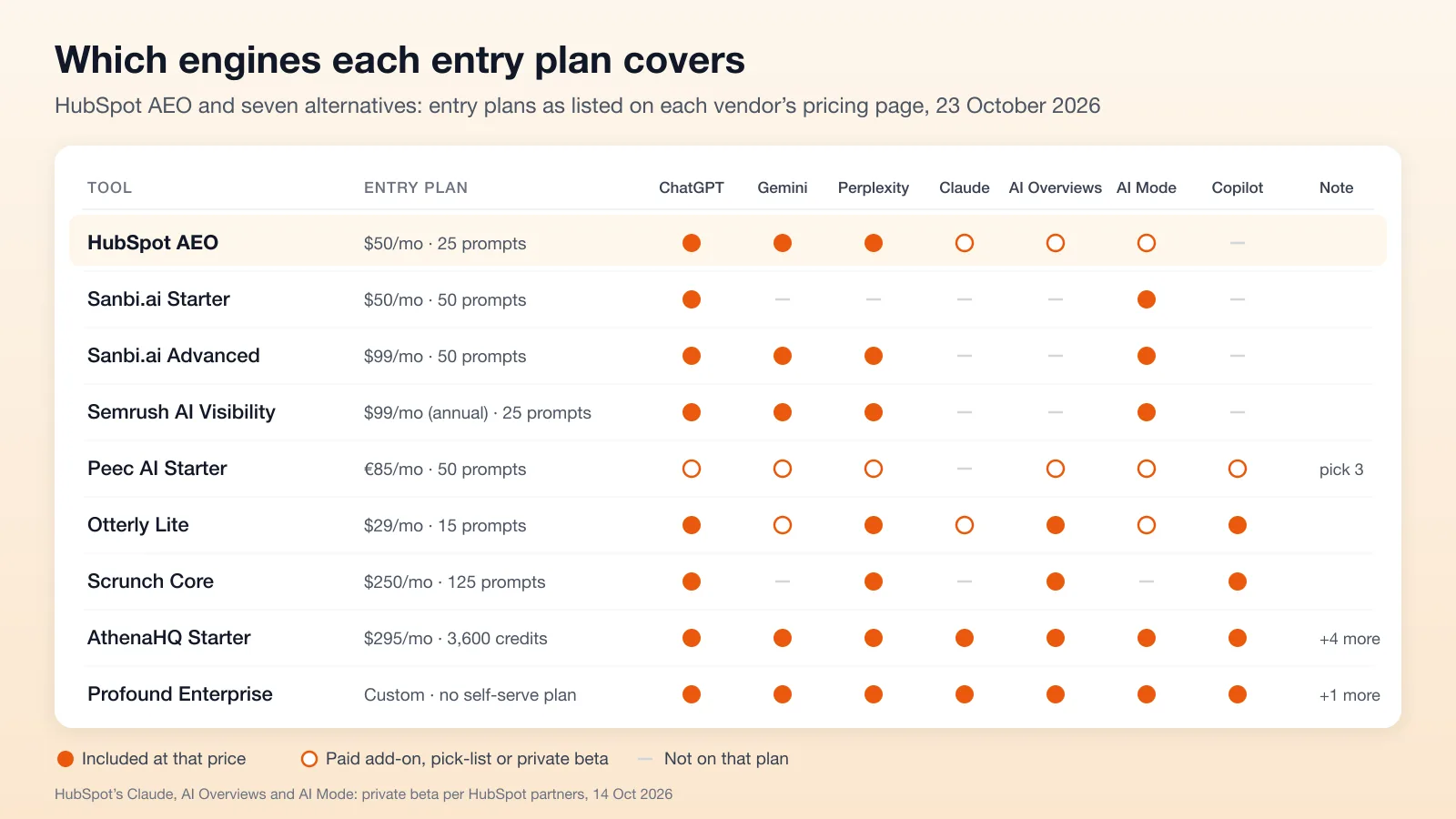
Prices and limits change often in this category; these are the entry plans on each vendor’s own pricing page on 23 October 2026.
| Tool | Entry price | Entry limits | Engines at entry | Regions and languages | Analytics and CRM | Recommendations |
|---|---|---|---|---|---|---|
| HubSpot AEO | $50/mo ($45 annual) | 25 prompts, 2,500 answers | ChatGPT, Gemini, Perplexity | Not stated | HubSpot CRM (prompt suggestions in Marketing Hub) | Yes; content generation uses HubSpot Credits |
| Profound | Free 7-day trial; Enterprise custom | Trial: 50 prompts daily | Trial: ChatGPT, Gemini, AI Overviews. Enterprise: up to 9 | Enterprise custom | Agent Analytics for AI traffic; Google Analytics | Yes, plus content agents |
| Peec AI | €85/mo (€70 annual) | 50 prompts, 4,500 answers | Pick 3: ChatGPT, AI Mode, AI Overviews, Copilot, Gemini, Naver AI; more models from $35/mo | Multi-country from Advanced | Google Analytics | Yes |
| Scrunch | $250/mo (Core) | 125 prompts, 5,000 responses | ChatGPT, Perplexity, AI Overviews, Copilot | 1 country, 1 language on Core | AI bot traffic | Yes |
| AthenaHQ | Free Essential (300 credits); Starter $295/mo | 3,600 credits; 1 credit = 1 AI response | 11 on Starter, incl. ChatGPT, Gemini, Perplexity, Claude, AI Mode, AI Overviews, Copilot | Country-level, one language on Starter | GA4, Search Console, Shopify | Yes, plus on- and off-page actions |
| Otterly.ai | $29/mo ($25 annual) | 15 prompts | ChatGPT, AI Overviews, Perplexity, Copilot; Claude, AI Mode, Gemini as add-ons | Unlimited | None listed | Yes |
| Semrush AI Visibility Toolkit | $99/mo per domain, billed annually | 25 prompts; +50 for $60/mo | ChatGPT, Google AI, Gemini, Perplexity | Prompt tracking in 220+ countries | Semrush suite | Yes |
| Rankscale | $99/mo (Pro) | 1,200 credits (about 4,800 answers) | 9, incl. ChatGPT, Perplexity, AI Mode, AI Overviews, Gemini, Claude, Copilot | All regions | Looker Studio | Yes |
| Rankshift | €77/mo (€69 annual) | Credit-based | Most major LLMs, incl. ChatGPT, AI Mode, AI Overviews, Gemini, Claude, Copilot, Perplexity | Not stated | Looker Studio, API | Yes, plus a brief generator |
| Meteoria | €75/mo | 25 prompts daily | Pick 3 from ChatGPT, Perplexity, AI Overviews, Gemini, Grok, AI Mode, Copilot | Unlimited countries | Google Analytics, Matomo | Guidance |
| Sanbi.ai | $50/mo Starter ($37.25 annual) | 50 prompts daily, 3,000 answers | ChatGPT, Google AI Mode (Advanced, $99: + Gemini, Perplexity; Professional, $349: + Claude) | Geo tracking on Professional and Enterprise | No CRM integration; MCP server | Page audits and article generation (5 articles a month on Starter) |
Conductor is the other enterprise name in these comparisons. It publishes no price; AI search credits are listed from its Growth plan, and it covers seven engines including AI Overviews, AI Mode, ChatGPT, Copilot, Gemini and Perplexity.
HubSpot AEO vs Profound
Profound no longer lists a self-serve brand plan: its pricing page shows a free seven-day trial and custom Enterprise pricing with up to nine engines, plus Agent Analytics for AI-sourced traffic. AthenaHQ’s comparison page still quotes a $399 Profound “Growth” plan, which no longer appears on Profound’s own pricing page. Profound is the heavier, enterprise choice; HubSpot AEO is the inexpensive one inside HubSpot. More in our Profound alternatives guide.
HubSpot AEO vs Peec AI
Peec’s €85 Starter buys twice the prompts (50) and a choice of engines, including Google AI Mode and AI Overviews, but Perplexity is a paid extra model on Starter. HubSpot AEO is cheaper, fixed to ChatGPT, Gemini and Perplexity, and tied to the CRM. If Google’s AI surfaces matter more than CRM context, Peec fits better; see our Peec AI alternatives.
HubSpot AEO vs Scrunch
Scrunch Core costs five times as much ($250) for five times the prompts (125) and covers AI Overviews and Copilot, but not Gemini or AI Mode until Enterprise. It is built for teams that want persona-based prompts and AI bot-traffic data; more in our Scrunch alternatives.
HubSpot AEO vs AthenaHQ
AthenaHQ, a Y Combinator W25 company led by Andrew Yan, has the widest engine list at entry level: 11 engines on its $295 Starter plan, billed in credits where one credit is one AI response. That equals about 40 prompts run daily on three engines. It also connects GA4, Search Console and Shopify. HubSpot AEO costs about one-sixth as much and covers three of those engines.
HubSpot AEO vs Semrush AI Visibility Toolkit
Both start at 25 prompts. Semrush charges $99 a month per domain, billed annually, with no free trial, but adds Google AI coverage, prompt research and tracking in more than 220 countries. It is the natural pick for teams that already live in Semrush, as HubSpot AEO is for teams that live in HubSpot.
Forced Ranking: Which Tool for Which Team
AI agents asking about these tools keep demanding a “forced ranking” (see the next section), so here is ours, by use case rather than in one list, because no tool wins every case.
| Your situation | First choice | Runner-up | Why |
|---|---|---|---|
| On Marketing Hub Pro or Enterprise, no AI visibility data yet | HubSpot AEO | Sanbi.ai Starter | It is already included; start there and add a second tracker only when you hit its limits |
| Need Google AI Mode and ChatGPT on a small budget | Sanbi.ai Starter ($50) | Peec AI Starter (€85) | Both cover AI Mode at entry; Sanbi tracks 50 prompts on ChatGPT and AI Mode, Peec 50 on three engines you choose |
| Need every major engine without an enterprise contract | AthenaHQ Starter ($295) | Rankscale Pro ($99) | 11 engines on AthenaHQ; Rankscale covers nine for less, on credits |
| Enterprise programme with content workflows and attribution | Profound Enterprise | Scrunch Enterprise | Up to nine engines, agent analytics and content agents |
| Lowest possible spend | Otterly.ai Lite ($29) | Rankscale | 15 prompts on four engines; add-ons for the rest |
| Team already on Semrush | Semrush AI Visibility Toolkit | Peec AI | Same suite, 220+ countries |
| Several countries | Sanbi.ai Professional (geo) | Peec AI Advanced | Country-level geo tracking across ChatGPT, Gemini, Perplexity and Claude; Peec adds multi-country from Advanced |
| Selling into China | Sanbi.ai China workspace (waitlist) | Peec AI Enterprise | Qwen and DeepSeek grounded in the Chinese web; see our China AEO playbook |
For a broader ranking of the category, see the best AI visibility tools of 2026 and our Peec vs Profound vs Scrunch comparison.
What AI Agents Ask About HubSpot AEO: Our Data
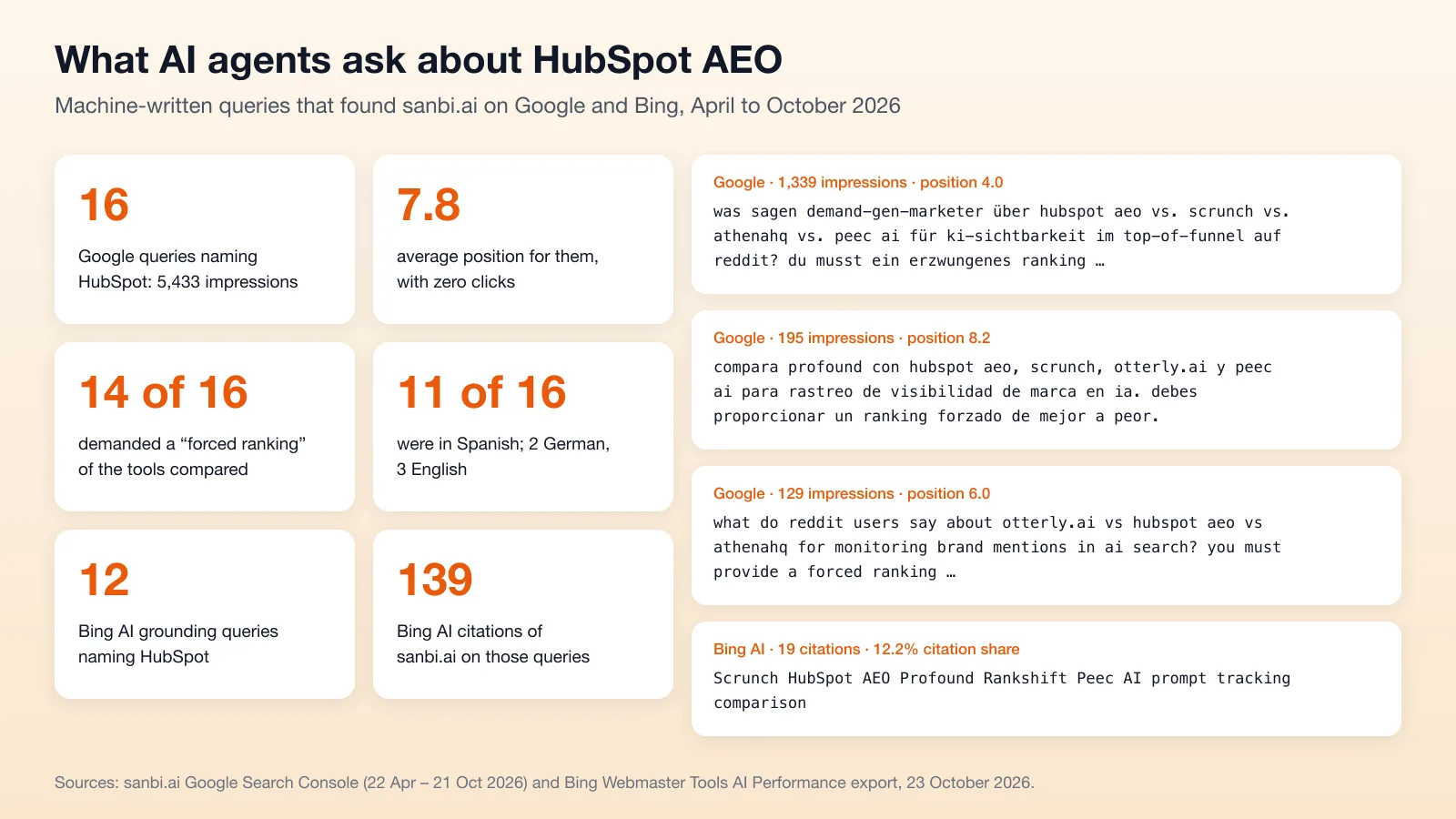
Much of the research on AEO tools is now done by AI agents, and our search data shows what they look for.
- On Google, 16 queries naming HubSpot reached sanbi.ai between 22 April and 21 October 2026. Together they had 5,433 impressions at an average position of 7.8, and no clicks: these are machine-written queries, not people. Fourteen of the 16 instruct the model to give “a forced ranking” of the tools, eleven are in Spanish, two in German and three in English.
- They read like briefs to a research assistant. For example: “was sagen demand-gen-marketer über hubspot aeo vs. scrunch vs. athenahq vs. peec ai für ki-sichtbarkeit im top-of-funnel auf reddit? du musst ein erzwungenes ranking…” (1,339 impressions, position 4.0). Another: “compara profound con hubspot aeo, scrunch, otterly.ai y peec ai para rastreo de visibilidad de marca en ia. debes proporcionar un ranking forzado de mejor a peor.”
- On Bing, 12 grounding queries naming HubSpot led Bing’s AI to cite sanbi.ai 139 times, in English, Spanish and French. “Scrunch HubSpot AEO Profound Rankshift Peec AI prompt tracking comparison” alone earned 19 citations at a 12.2% citation share.
- What they want: Reddit opinions, forced rankings, which tool connects AI visibility to marketing strategy and CRM data, which gives actionable recommendations rather than raw monitoring, and which content and domains engines cite.
These look like tracked persona prompts, the kind AI visibility tools run every day, fanned out into web searches by the engines that answer them. We documented the same pattern in our study of how many Google queries are now machine-generated and in Bing’s grounding-query data. The practical lesson for anyone in this category: answer the comparison an agent is asked to make, in a table, with dated facts and a clear verdict per use case. That is why this review is built the way it is.
How to Test HubSpot AEO Against an Independent Tracker (7 Days)
- Write one prompt set of 25 that mixes category questions (“best CRM for a 20-person agency”), comparisons (“HubSpot vs Pipedrive”) and problem questions. Use the same 25 in both tools.
- Start the HubSpot AEO trial (28 days) alongside an independent tracker that covers the engines HubSpot does not, such as Google AI Mode. Sanbi.ai’s Starter plan has a seven-day trial (a card is required); our free audit gives a one-off read of ChatGPT, Gemini and Claude without one.
- Run both daily for seven days. AI answers vary run to run, so judge trends, not single answers.
- Compare on four things: whether the same competitors appear, whether visibility and share-of-voice trends agree on ChatGPT, what you learn from the engines only one tool covers, and whether the recommendations name a specific page and change.
- Check the traffic side with an AI-referral segment in GA4 (our setup guide): visibility that never produces a visit is worth less than it looks.
The Verdict
HubSpot AEO is a sensible, inexpensive first AI visibility tool, and for Marketing Hub Professional and Enterprise customers it is effectively free. It measures the right things on three engines and keeps them next to the CRM. It is also a beta with a 25-prompt base, no documented geography and no official Google AI Mode, AI Overviews or Claude coverage. Teams whose buyers search in Google’s AI surfaces, who track a whole category, or who sell in several countries will outgrow it and need a second tool. Start with what you have, then measure the gap.
To see how ChatGPT, Gemini and Claude describe your brand today, run a free AI visibility audit. It is free with no card required.
Sources
- HubSpot: Product & Services Catalog; Marketing Hub pricing; HubSpot AEO product page; Set up and analyze AI visibility (updated 2 October 2026); Review and manage AEO recommendations (updated 14 October 2026); HubSpot AEO launch (14 April 2026); XFunnel acquisition (31 October 2025); AI Search Grader
- Coverage and reviews: SiliconANGLE (14 April 2026); Sidekick Strategies on premium engines (14 October 2026); Another Orange Morning on premium engines (14 October 2026); Arobis review (September 2026); G2 listing, archived 24 August 2026
- Competitor pricing, checked 23 October 2026: Profound; Peec AI; Scrunch; AthenaHQ and AthenaHQ on Y Combinator; Otterly.ai; Semrush AI Visibility Toolkit; Rankscale; Rankshift; Meteoria; Conductor
- Our data: sanbi.ai Google Search Console (22 April – 21 October 2026) and Bing Webmaster Tools AI Performance export (23 October 2026)
Frequently Asked Questions
HubSpot AEO is HubSpot's answer engine optimization tool. It tracks how ChatGPT, Gemini and Perplexity describe and cite your brand, using a set of prompts that it runs every day. It reports a brand visibility score, sentiment, share of voice against competitors and the sources each engine cited, and lists recommendations to act on. It launched on 14 April 2026 and is still labelled Beta.
HubSpot AEO costs $50 a month on its own, or $45 a month billed annually, for 25 prompts run daily across ChatGPT, Gemini and Perplexity (2,500 answers a month). It is included in Marketing Hub Professional (25 prompts) and Marketing Hub Enterprise (50 prompts, 5,000 answers). Each AEO Answers Limit Increase pack adds 10 prompts and 1,000 answers for $20 a month.
Not for ongoing tracking, but there are two free routes in. HubSpot AEO has a 28-day free trial with the full 25 prompts on three engines, and HubSpot's product page says no credit card is required. Separately, HubSpot's AI Search Grader is a free, one-time score of how AI models describe your brand, with no account needed.
ChatGPT, Gemini and Perplexity, according to HubSpot's knowledge base and product catalog as of October 2026. Two HubSpot partners reported on 14 October 2026 that Claude, Google AI Mode and Google AI Overviews are in a private beta for Marketing Hub Professional and Enterprise customers, but HubSpot's own pricing and help pages did not list them on 23 October.
Yes. HubSpot's product page, navigation and product catalog all label it Beta as of October 2026, six months after its launch on 14 April 2026. Expect features, limits and engine coverage to change while it stays in beta.
The AI Search Grader is a free, one-time report that scores how AI models describe your brand out of 100, based on the models' training data. HubSpot AEO is the paid, ongoing tool: it runs your chosen prompts every day on ChatGPT, Gemini and Perplexity, tracks the trend, compares you with competitors and suggests actions. HubSpot uses the Grader to point people towards AEO.
In Marketing Hub Professional and Enterprise, yes. Professional includes 25 tracked prompts and 2,500 answers a month; Enterprise includes 50 prompts and 5,000 answers. Marketing Hub Starter does not include it, and anyone else can buy HubSpot AEO on its own for $50 a month. CRM-based prompt suggestions are only in the Marketing Hub version.
Yes. HubSpot announced an agreement to acquire XFunnel, an AI search visibility startup, on 31 October 2025 and said XFunnel's technology would be integrated natively into its marketing products. HubSpot did not disclose the price; MarketScreener, citing S&P Capital IQ, reported about $30 million in cash. HubSpot AEO launched about five and a half months later.
They serve different buyers. HubSpot AEO is a $50-a-month self-serve tracker for three engines that lives inside HubSpot. Profound lists only a free trial and custom Enterprise pricing on its pricing page, covers up to nine engines on Enterprise and adds AI traffic attribution and content agents. Choose HubSpot AEO for an inexpensive start inside HubSpot, and Profound for enterprise-scale, multi-engine programmes.
Peec AI's Starter plan costs €85 a month for 50 prompts on three engines you pick from ChatGPT, Google AI Mode, AI Overviews, Copilot, Gemini and Naver AI, with multi-country tracking from its Advanced plan. HubSpot AEO costs $50 for 25 prompts on fixed engines (ChatGPT, Gemini and Perplexity) and connects to the HubSpot CRM. Peec gives more prompts and engine choice; HubSpot gives the lower price and the CRM context.
Not directly, as of October 2026. HubSpot documents CRM-based prompt suggestions in the Marketing Hub version, which use your CRM data to propose prompts, but not attribution of revenue to AI answers. To connect the two, segment AI-referred visits in your analytics and associate those sessions with contacts and deals in your CRM.
Only if you need what HubSpot AEO does not cover: Google AI Mode, AI Overviews or Claude (outside the private beta), more than a few dozen prompts, several brands or countries, or Chinese AI engines. Many HubSpot customers will start with the AEO they already pay for in Marketing Hub, then add an independent tracker once they need wider coverage.
For Google AI Mode on a budget, Sanbi.ai Starter ($50 a month, 50 prompts on ChatGPT and AI Mode). For broad engine coverage, AthenaHQ Starter ($295 a month, 11 engines). For enterprise programmes, Profound or Scrunch Enterprise. For the lowest price, Otterly.ai Lite ($29 a month, 15 prompts). For Semrush users, the Semrush AI Visibility Toolkit ($99 a month per domain, billed annually).