Scrunch AI Alternatives 2026: Honest Competitor Breakdown for AI Search Visibility
Scrunch AI has carved out a real position in the AI visibility market: simulate how buyers actually phrase questions, track the answers, present it beautifully. And yet — searches for Scrunch AI alternatives, scrunch competitors, and scrunch ai lower cost competitors keep climbing.
This is the honest breakdown: what Scrunch does well, why teams still shop around, and every serious Scrunch alternative in 2026 — compared on the things that actually separate these tools.
What Is Scrunch AI?
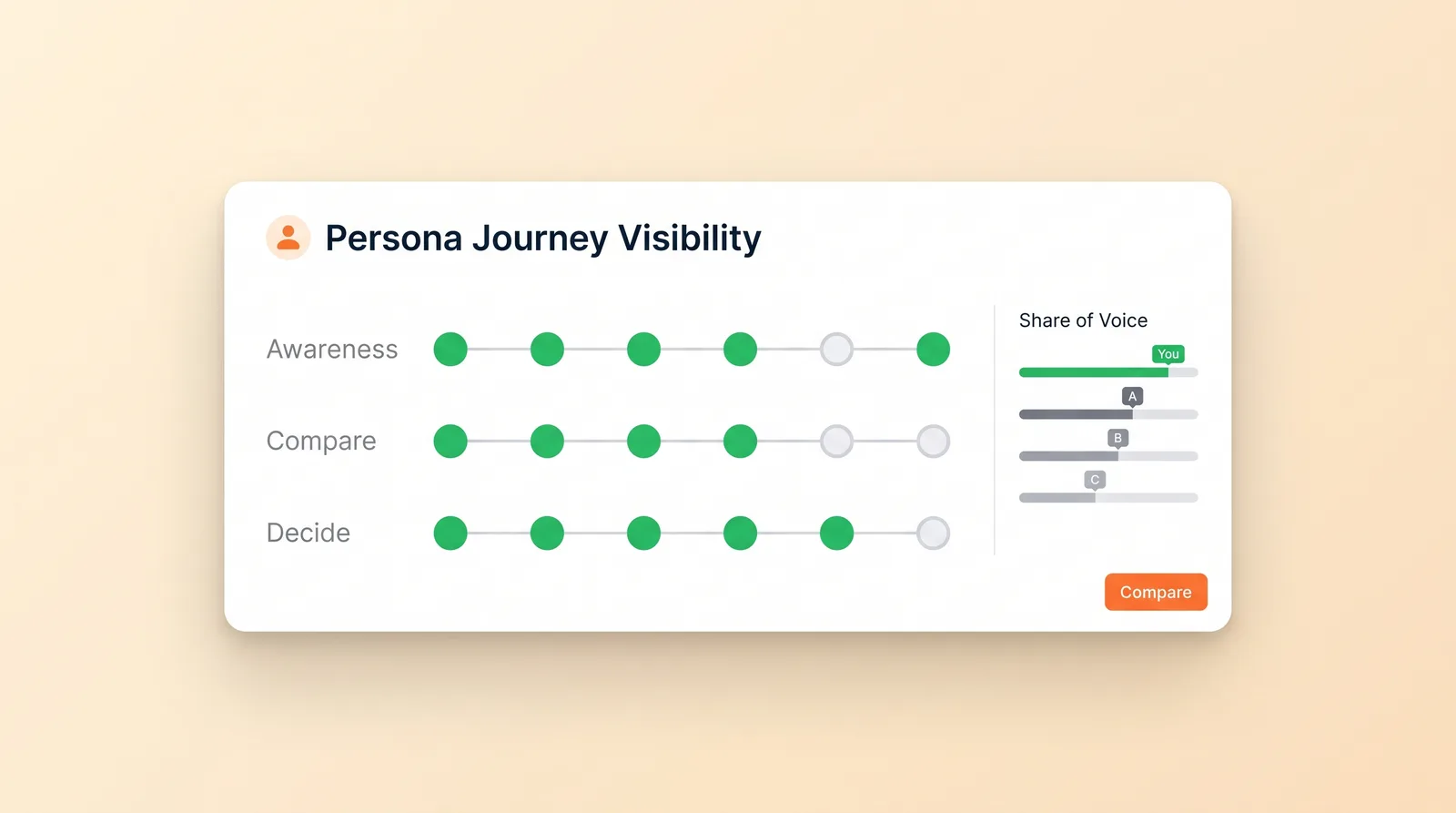
Scrunch AI is an AI search visibility platform with a persona-first design. Where most tools in the category start from a keyword or prompt list, Scrunch starts from the buyer: it models how different customer types phrase their questions across a journey — awareness, comparison, decision — and tracks your brand’s presence in AI answers along that path, across ChatGPT, Gemini, Perplexity, Claude, and Google’s AI surfaces.
Its strengths are real:
- Persona and journey simulation — the most developed version of this idea in the category
- Visual dashboards — clean, stakeholder-ready reporting
- Citation tracking — which sources AI engines lean on in your category
For a US mid-market team that wants to understand how buyers encounter them inside AI answers, Scrunch is a legitimate shortlist item.
Why Teams Look for Scrunch AI Alternatives
Five reasons come up again and again:
- Price. Scrunch positions mid-market-to-enterprise. Self-serve and small-team buyers hit a gap between “free trial” and “talk to sales.”
- Google AI Overviews depth. Teams searching “scrunch ai alternatives with google ai overviews tracking” want per-keyword, per-location AIO citation parsing with change alerts — a specialist capability that generalist dashboards under-serve.
- Region-based prompts. AI answers differ by market. Rivals like Peec made per-region prompt tracking their headline feature; buyers with multi-market footprints notice.
- Historical trends. Long, exportable time series — the thing that proves progress to a CMO — varies by plan tier across the whole category.
- Tracking without execution. Like most of the category, Scrunch reports the problem. Turning the report into ranked tasks and published content is left to you.
The Best Scrunch AI Alternatives in 2026
1. Sanbi.ai — The Tracking-to-Action Alternative
Sanbi.ai covers ChatGPT, Gemini, Perplexity, Claude and Google AI Mode (for AI Overviews, see our AIO tracking guide) — and then closes the loop that dashboards leave open:
- Recommended Tasks — a prioritized board of fixes and content plays generated from your data
- AI content engine — drafts AEO-optimized pages against your visibility gaps
- GEO site audits — agent-accessibility and Site Health checks built in
- Geographic Dominance — region-based tracking across US, EU, APAC on the base platform
- Price — from $37.25/mo billed annually, self-serve
The honest trade: Scrunch’s persona simulation is deeper. Sanbi.ai’s everything-after-measurement is deeper.
2. Peec AI — The Regional-Tracking Alternative
Peec runs your prompt set per geographic market with the cleanest agency reporting in the mid-market tier. EU-first DNA, transparent pricing. Weak on execution, like Scrunch. Full breakdown: Peec AI alternatives.
3. Profound — The Enterprise Alternative
Enterprise prompt volumes, Agent Analytics, API/MCP integrations, quote-only pricing. The right answer for five-figure monthly budgets with BI requirements; the wrong answer for everyone who has to ask what it costs. Full breakdown: Profound AI alternatives.
4. Otterly.ai — The Budget Alternative
Lightweight prompt monitoring at the lowest price point in the category. Fine for validating that AI visibility matters for your brand; thin on citations, audits, and competitive depth.
5. AthenaHQ — The Reporting Alternative
Enterprise-adjacent, dashboard-heavy. Shortlist it when leadership reporting is the primary deliverable.
6. Semrush AI Visibility — The Bolt-On
Already paying for Semrush? Its AI visibility features add basic LLM tracking to your stack. An indicator, not an audit system — same verdict as its AIO features.
The Decision Table
| You need | Pick |
|---|---|
| Buyer-persona journey simulation | Scrunch AI |
| Tracking + ranked tasks + drafted content | Sanbi.ai |
| Per-region prompt reporting, agency decks | Peec AI |
| Enterprise volume, BI integrations | Profound |
| Cheapest validation | Otterly.ai |
| One less vendor | Semrush bolt-on |
One caveat that applies to the whole table: LLM answers are probabilistic. Whatever you pick, judge it on trends across repeated runs — never a single snapshot. Our AI search visibility workflow shows how to set a baseline that survives scrutiny.
How to Evaluate Any Scrunch Alternative in One Week
- Load your real prompts — the questions your buyers ask, plus named competitors. Demo prompt sets flatter every tool.
- Test AIO depth — does it show per-location AI Overviews presence and every cited domain? Run the checklist from our AIO tracking guide.
- Test the time series — can you export week-over-week share of voice? How far back?
- Test the loop — when a competitor takes your citation, what does the tool tell you to do about it? Count the analyst hours the answer implies.
The Bottom Line
Scrunch AI earned its place: persona-based simulation is a genuinely useful lens, and the dashboards are excellent. If understanding buyer journeys inside AI answers is your core problem — and the budget fits — stay on the shortlist.
Look for a Scrunch AI alternative when your gap is price, per-location AI Overviews depth, multi-market prompt coverage, or the distance between “we have a dashboard” and “we shipped the fix.”
Run a free AI visibility audit to baseline your brand across ChatGPT, Gemini and Claude in about two minutes — and see what a tracking-to-action platform does with the same data.
Sanbi.ai monitors your brand’s AI visibility daily across ChatGPT, Gemini, Perplexity, Claude and Google AI Mode — tracking visibility scores, sentiment, citations, agent accessibility, and competitor movements so you always know where you stand in the agent-first web.
Frequently Asked Questions
Scrunch AI is an AI search visibility platform that tracks how brands appear across AI answer engines — ChatGPT, Gemini, Perplexity, Claude, and Google's AI surfaces. Scrunch is best known for its persona-based approach: it simulates how different buyer types phrase questions along a customer journey and reports brand visibility across those simulated journeys, alongside citation tracking and clean visual dashboards aimed at marketing teams and agencies.
Scrunch AI measures brand presence and prominence in AI answers across a tracked prompt set: mention frequency, share of voice versus competitors, the sources AI engines cite in your category, sentiment, and trend over time. Its differentiator is journey and persona simulation — modeling the sequence of questions a specific buyer type asks and measuring where your brand shows up (or disappears) along that sequence.
The recurring reasons teams search for a Scrunch alternative: (1) lower-cost entry — Scrunch positions mid-market-to-enterprise and self-serve budget buyers feel the gap; (2) deeper Google AI Overviews tracking — per-keyword, per-location AIO citation parsing with change alerts; (3) region-based prompt tracking across markets, which EU-focused rivals like Peec lead on; (4) historical trend depth — long time-series views of visibility data; and (5) an execution layer — turning visibility findings into prioritized tasks and drafted content rather than another dashboard.
The best Scrunch AI alternatives in 2026, ranked by combined capability and price-to-value: (1) Sanbi.ai — full tracking stack plus Recommended Tasks, GEO audits, and an AI content engine from $37.25/mo; (2) Peec AI — region-based prompt reporting and polished agency reports at mid-market pricing; (3) Profound — enterprise prompt volumes, Agent Analytics, and BI integrations at enterprise pricing; (4) Otterly.ai — lightweight low-cost prompt monitoring; (5) AthenaHQ — reporting-heavy enterprise-adjacent option; (6) Semrush AI visibility features — a bolt-on for existing Semrush subscribers. The right pick depends on whether your gap is price, AIO depth, regional coverage, or actionability.
Yes. Sanbi.ai starts at $37.25/mo billed annually with ChatGPT and Google AI Mode tracking, competitor benchmarking, citation analytics, and Site Health auditing included (Gemini, Perplexity and Claude on higher tiers) — a self-serve entry point well below mid-market platform pricing. Otterly.ai is the other budget option for basic prompt monitoring, with a correspondingly thinner feature set. If cost is the blocker, baseline on one of these and upgrade only when a specific missing capability starts costing you real visibility.
Profound is the enterprise-grade option in the category: large prompt volumes, Agent Analytics for AI-agent traffic, REST API and MCP integrations for BI stacks, and dedicated support — at quote-only pricing that typically starts mid-four-figures monthly. AthenaHQ also positions toward enterprise reporting needs. Enterprise teams should evaluate Profound directly against Scrunch's upper tiers; our Profound alternatives guide covers that decision in depth.
Both track the major AI engines with share-of-voice benchmarking. Scrunch's edge is persona and journey simulation — modeling how buyer types phrase questions. Sanbi.ai's edge is the loop after measurement: Google AI Mode tracking on every plan, GEO site audits, a Recommended Tasks board that ranks fixes by impact, an AI content engine that drafts the pages, and a lower entry price ($37.25/mo annual). Teams whose bottleneck is understanding buyer journeys lean Scrunch; teams whose bottleneck is acting on visibility data lean Sanbi.ai.
Scrunch and Peec are the two most-compared mid-market AI visibility platforms. Scrunch leads on persona-based prompt simulation and US-market positioning. Peec leads on region-based prompt tracking across geographic markets and on report polish for agency client decks. Neither ships a strong execution layer, which is why shortlists that start as 'Scrunch vs Peec' often end as 'Scrunch vs Peec vs Sanbi.ai' once the team realizes tracking alone doesn't move the numbers.
Scrunch covers Google's AI surfaces among its tracked engines, but searches like 'scrunch ai alternatives with google ai overviews tracking' come from teams that need AIO depth specifically: per-keyword and per-location AIO presence detection, parsing of every cited domain (competitors included), and alerts when citations change. If AI Overviews is your main battleground, test any platform — Scrunch or its alternatives — against the checklist in our Google AI Overviews tracking guide before signing, and shortlist tools that treat AIO as a first-class surface.
Historical time-series depth — how far back you can see visibility, citation, and share-of-voice trends — varies more across this category than vendors advertise. When evaluating Scrunch or any alternative, check: how long data is retained on your plan tier, whether you can export the full time series, and whether week-over-week change alerts are included or gated. A platform that only shows you a current-week snapshot cannot prove progress to leadership; the trend line is the deliverable.
Export your Scrunch visibility, share-of-voice, and citation reports before renewal; document your tracked prompt set, personas, and competitor list; run the new platform in parallel for two to four weeks to confirm directional consistency (LLM answers are probabilistic — expect close, not identical, numbers); then cut over. Sanbi.ai's onboarding supports importing an existing prompt configuration, which keeps the parallel window short.