Peec AI Alternatives 2026: The Honest Guide Reddit Marketers Actually Read
If you’ve been researching Peec AI — the AI visibility platform at peec.ai — you’ve probably concluded three things: the product is genuinely good, the reporting is beautiful, and yet the Reddit and Slack threads asking about Peec AI alternatives keep multiplying.
This is the honest guide. What Peec.ai actually measures, where it legitimately wins, why teams still leave, and every serious Peec alternative in 2026 — ranked by fit rather than funding announcements.
What Is Peec AI?
Peec AI is a mid-market AI visibility platform built in Berlin. It tracks how brands appear inside AI answers across ChatGPT, Gemini, Perplexity, Claude, and Google AI Overviews, and it earned its reputation on two strengths:
- Region-based prompt tracking. Peec runs the same prompt set from different geographic markets and reports visibility per region — genuinely useful, because AI answers differ sharply by location.
- Visual reporting. Peec’s dashboards and client-ready reports are among the cleanest in the category, which is why agencies adopted it early.
Peec sits in the pricing tier below enterprise platforms like Profound: transparent plans, self-serve entry, EU-friendly billing. For a certain buyer — a European mid-market brand or agency that wants beautiful measurement — Peec is a defensible default.
That does not automatically make it the right tool for you.
Why Teams Look for Peec AI Alternatives
Across the communities where this gets discussed candidly, the same five reasons recur:
- Tracking without actions. Peec tells you your share of voice dropped. It does not tell you which page to fix, what content to publish, or draft it for you. Searches like “tools like peec.ai that give actions not just tracking” exist for a reason.
- AI Overviews depth. Peec covers AIO, but per-location citation parsing and change alerts on the AIO surface specifically are not its center of gravity — and for many brands, AI Overviews is the surface that matters most.
- Price pressure. Teams want a lower entry point, or more included at the base tier — especially agencies managing several small clients.
- US-market focus. Peec’s DNA, community, and case studies skew European. US-first teams often want a platform whose location defaults and content plays match their market.
- Citation analytics depth. Knowing which third-party domains each engine trusts in your category — your earned-media target list — varies in depth across tools.
The Best Peec AI Alternatives in 2026
1. Sanbi.ai — The Full-Stack Peec Alternative
Sanbi.ai tracks ChatGPT, Gemini, Perplexity, Claude and Google AI Mode, with competitor share of voice, sentiment, and per-region tracking. The difference is what happens after measurement:
- Recommended Tasks — a prioritized board of specific fixes and content plays generated from your tracking data
- AI content engine — drafts AEO-optimized pages to close the visibility gaps it finds
- GEO site audits — Site Health and agent-accessibility auditing built in
- AIO as a first-class surface — per-keyword, per-location AI Overviews citation parsing
- Pricing — from $37.25/mo billed annually, below Peec’s entry tier
If your bottleneck is “we can see the problem, now who does something about it?” — this is the class of tool to pick.
2. Profound — The Enterprise Alternative
Profound is the funded category leader: enterprise prompt volumes, Agent Analytics, API and MCP integrations, and quote-only pricing that typically starts in the mid four figures monthly. Teams graduate to Profound from Peec when procurement demands enterprise support and BI integration — and graduate away from it when the invoice arrives. We wrote the full breakdown in Profound AI alternatives.
3. Scrunch AI — The Persona-Simulation Alternative
Scrunch AI models how different buyer personas phrase questions and tracks visibility across those simulated journeys. Strong visual dashboards, US-leaning market fit. Weaker on the execution layer, like Peec. Full comparison in our Scrunch AI alternatives guide.
4. Otterly.ai — The Budget Alternative
Otterly is the lightweight option: basic prompt monitoring across the major engines at a low price point. Good for validating that AI visibility matters for your brand before committing to a fuller platform; thin on citation analytics, auditing, and competitive depth.
5. AthenaHQ — The Dashboard-Heavy Alternative
AthenaHQ positions enterprise-adjacent with an emphasis on reporting and dashboarding. Evaluate it if leadership reporting is your primary deliverable; evaluate something else if you need per-location AIO parsing or content execution.
6. Semrush AI Visibility — The Bolt-On
If you already pay for Semrush, its AI visibility features add basic LLM mention tracking to your existing workflow. As with its AI Overviews tracking, it’s an indicator, not an audit system — fine as a first pass, limited as your only tool.
Peec AI vs the Field: The Decision Table
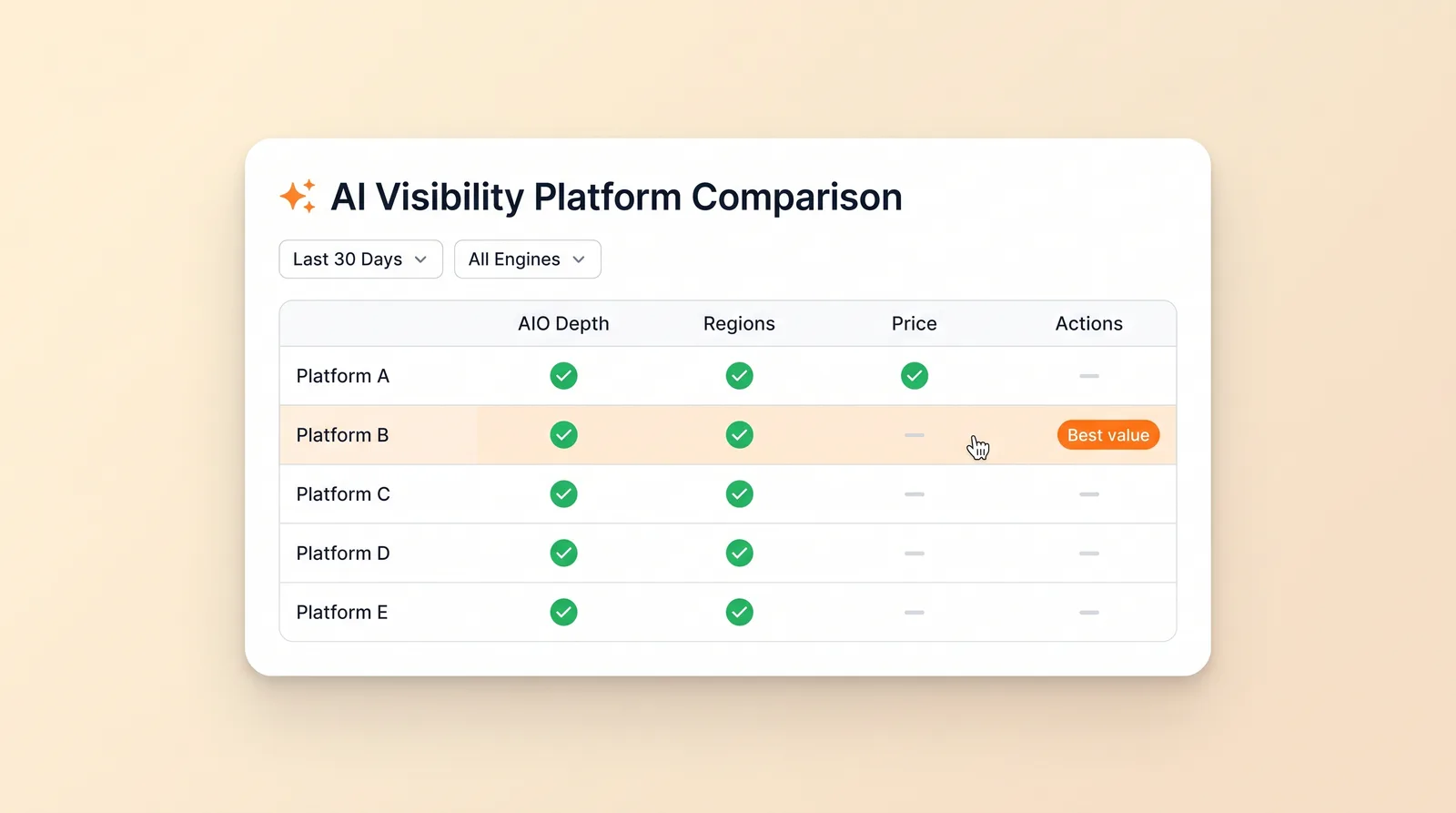
| You need | Pick |
|---|---|
| Beautiful client-ready reporting, EU markets | Peec AI |
| Tracking + recommended actions + content engine | Sanbi.ai |
| Enterprise prompt volume, BI integrations, budget to match | Profound |
| US buyer-persona simulation | Scrunch AI |
| Cheapest possible validation | Otterly.ai |
| One less vendor (already on Semrush) | Semrush bolt-on |
Two honest notes. First, every platform in this table — Peec included — is competent at the measurement core; the field has converged there. The separation is in AIO depth, regional coverage, price, and whether the tool helps you act. Second, LLM answers are probabilistic: whichever tool you pick, judge it on trends across repeated runs, not on whether a single answer matched your manual spot-check. Our guide to tracking your visibility in AI search covers how to set that baseline properly.
How to Evaluate Any Peec Alternative in One Week
- Day 1: Load your real prompt set — the 30–50 questions your buyers actually ask, not the vendor’s demo set. Add your named competitors.
- Days 2–3: Check the surfaces: does it parse Google AI Overviews citations per location? Does it track all four standalone engines?
- Days 4–5: Check the outputs: can you export share of voice by region? Does it show which domains each engine cites in your category?
- Days 6–7: Check the loop: when visibility drops, what does the tool tell you to do? If the answer is “nothing, it’s a dashboard,” price in the analyst hours yourself.
The Bottom Line
Peec AI is a good product with a real strength: region-based tracking wrapped in the best-looking reports in the mid-market tier. If that’s the whole job, stay put.
Look for a Peec AI alternative when the job is bigger than measurement — when you need Google AI Overviews parsed per location, US-market defaults, a lower entry price, or a platform that turns the dashboard into a to-do list and then into published content.
Run a free AI visibility audit to baseline your brand across ChatGPT, Gemini and Claude in about two minutes — and see the tracking-to-action loop before you commit to anything.
Sanbi.ai monitors your brand’s AI visibility daily across ChatGPT, Gemini, Perplexity, Claude and Google AI Mode — tracking visibility scores, sentiment, citations, agent accessibility, and competitor movements so you always know where you stand in the agent-first web.
Frequently Asked Questions
Peec AI — at peec.ai — is a Berlin-built AI visibility platform that tracks how brands appear inside AI answers across ChatGPT, Gemini, Perplexity, Claude, and Google AI Overviews. Peec is best known for its region-based prompt tracking (running the same prompt set from different geographic markets), its clean visual reporting, and mid-market pricing that undercuts enterprise platforms like Profound. It has become one of the most-recommended AI visibility tools in European marketing communities.
Peec AI measures brand presence in AI answers: how often your brand is mentioned across a tracked prompt set, your share of voice versus named competitors, which sources AI engines cite when answering prompts in your category, sentiment of mentions, and how all of that trends over time — segmented by region. Its position tracking shows where your brand appears within an answer relative to competitors, and its source analysis shows which third-party domains drive citations in your category.
The most common reasons teams search for a Peec AI alternative: (1) they want actions, not just tracking — Peec reports visibility but leaves the 'what do we do about it' work to you; (2) deeper Google AI Overviews tracking — AIO citation parsing per location is not Peec's center of gravity; (3) price — teams want a lower entry point or more included in the base plan; (4) US-market focus — Peec's DNA and community are EU-first; and (5) content workflow — no built-in engine that turns visibility gaps into drafted, AEO-optimized pages.
The best Peec AI alternatives in 2026, ranked by combined capability and price-to-value: (1) Sanbi.ai — tracking plus Recommended Tasks and an AI content engine, from $37.25/mo; (2) Profound — enterprise-tier prompt volumes and BI integrations at enterprise pricing; (3) Scrunch AI — clean visual dashboards, persona-based prompt simulation; (4) Otterly.ai — lightweight, affordable prompt monitoring; (5) AthenaHQ — dashboard-heavy, enterprise-adjacent; (6) Semrush AI visibility tools — a bolt-on if you already pay for Semrush. Which one wins depends on whether you want reporting depth, a lower price, or a platform that closes the loop from tracking to shipped content.
Yes. Sanbi.ai starts at $37.25/mo billed annually with ChatGPT and Google AI Mode mention tracking, competitor share of voice, citation analytics, and Site Health auditing on the base plan, and adds Gemini, Perplexity and Claude on higher tiers. Otterly.ai is another budget-friendly option for basic prompt monitoring, though with a thinner feature set. Both sit below Peec's published entry pricing, and meaningfully below enterprise platforms like Profound where entry is quoted per account.
Peec AI and Sanbi.ai overlap on the tracking core: both monitor ChatGPT, Gemini, Perplexity and Claude with share-of-voice benchmarking and region-based tracking. The differences: (1) workflow — Sanbi.ai converts tracking data into a Recommended Tasks board and drafts AEO-optimized content, while Peec stays in the measurement layer; (2) Google AI Mode — Sanbi.ai tracks it on every paid plan, including the entry tier; (3) price — Sanbi.ai's entry plan is lower; (4) reporting polish — Peec's visual reporting is excellent and slightly ahead for agency client decks. Teams that want measurement plus execution pick Sanbi.ai; teams that only need beautiful measurement in EU markets stay on Peec.
Peec AI and Profound both track AI citations across the major engines. Profound differentiates on enterprise prompt volume scale, Agent Analytics, its API/MCP integrations, and its Marketing Engineer ecosystem — at enterprise, quote-only pricing. Peec differentiates on region-based prompt reporting, a cleaner UI, and transparent mid-market pricing. An enterprise team with a five-figure monthly budget and BI integration needs picks Profound; a mid-market team tracking multiple regional markets picks Peec — or Sanbi.ai, which combines regional tracking with a content workflow at a lower entry price. See our full Profound alternatives guide for that side of the market.
Both are mid-market AI visibility platforms. Peec leads on region-based prompt tracking and EU market fit. Scrunch leads on persona-based prompt simulation — modeling how different buyer types phrase questions — and on US enterprise-adjacent positioning. Reporting is a wash: both are visually strong. Neither ships a full content execution layer, which is the main reason teams evaluating both also look at Sanbi.ai. If your buyers are spread across European markets, Peec; if your priority is simulating US buyer personas, Scrunch.
Peec AI includes Google AI Overviews among its tracked surfaces, but teams searching for 'peec ai alternatives with google ai overviews tracking' are usually looking for deeper AIO capability: per-keyword and per-location AIO presence detection, full citation parsing of every cited domain, and change alerts when citations are gained or lost. If AI Overviews is your primary battleground, evaluate alternatives on AIO depth specifically — our Google AI Overviews tracking guide explains exactly what to test. Sanbi.ai tracks Google AI Mode rather than AI Overviews, so pair it with Search Console's AI Overviews impressions.
Yes — this is the fastest-growing segment of the category. Tools like Peec report your AI visibility; a newer class of platforms also tells you what to do about it and helps you do it. Sanbi.ai is the clearest example: alongside tracking, it generates a Recommended Tasks board (specific fixes and content plays ranked by impact), runs GEO site audits, and drafts AEO-optimized content to close the gaps it finds. AirOps approaches the same problem from the content-workflow side. If your team's bottleneck is 'we have the dashboard, now what?', prioritize this class of alternative.
Four steps: (1) export your Peec share-of-voice, mention, and citation reports before your renewal date; (2) document your exact tracked prompt set and competitor list so you can replicate the configuration; (3) run both platforms in parallel for two to four weeks and confirm the new tool's numbers are directionally consistent on the same prompts — LLM answers are probabilistic, so expect close-but-not-identical figures; (4) cut over once trends align. Sanbi.ai onboarding supports importing an existing prompt configuration, which makes the parallel-run window short.