Nearly 1 in 4 Google Queries Hitting Our Site Weren't Human (GSC Study)
Last week we exported a routine 24-hour query report from Google Search Console. Buried in the usual keyword rows — ai overviews tracker, chatgpt rank tracking — were queries like this one, verbatim:
“i’m a cfo at an energy company. suede web systems vs profound ai on enterprise terms, security, and support: how do they compare for a regulated buyer?”
Nobody types that into Google. A machine sent it — an AI assistant, running a search on behalf of a user, or a monitoring tool running a scheduled prompt. So we classified every query in the sample.
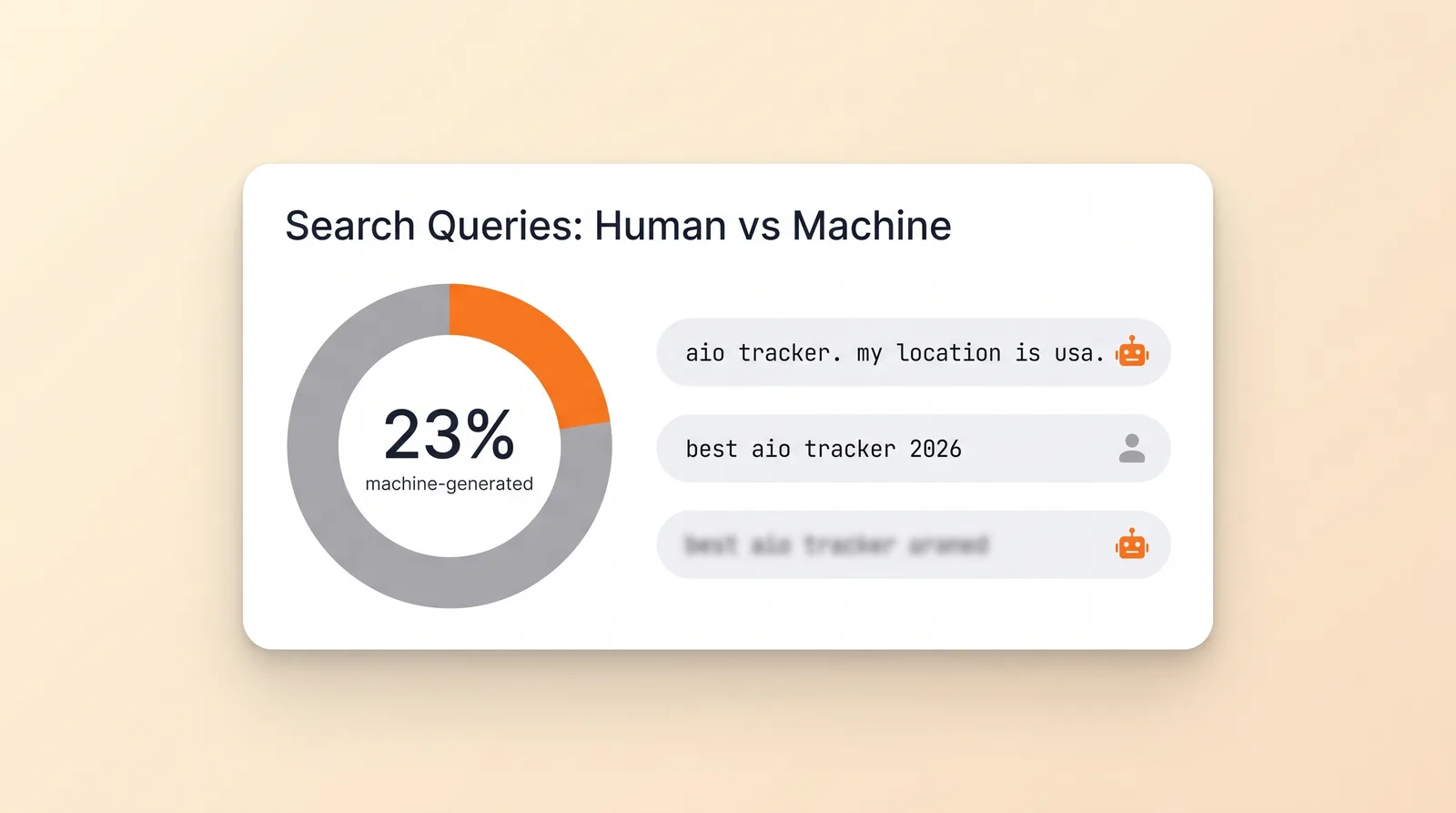
The result: 23% of distinct queries reaching our site in 24 hours carried unambiguous machine signatures — nearly one in four. Here’s the full breakdown, the five signatures you can hunt for in your own Search Console, and what a SERP increasingly read by machines means for anyone doing SEO.
Methodology
- Source: Google Search Console query report for sanbi.ai, web search type, a single 24-hour window (Aug 29–30, 2026).
- Sample: 265 distinct queries, 1,173 impressions. (Site-wide impressions for the window were ~1,380; GSC omits some rare queries for privacy, so the classified sample covers ~85% of reported impressions.)
- Classification: conservative, signature-based. A query counts as machine-generated only if it carries an explicit structural signature (below). Long conversational questions without such signatures were tracked as a separate “conversational” bucket and excluded from the headline figure. Ambiguous rows defaulted to human.
That last rule matters: 23% is a floor, not an estimate. Plenty of machine queries look like clean keywords and are invisible to this method.
The Five Signatures of a Machine Query
1. Location-appended queries (15 queries, 37 impressions)
“aio tracker. my location is usa.” “chatgpt rank tracker. my location is spain.”
A keyword, a period, and a localization string — the trace of an AI assistant grounding a search for its user. This is the most mechanical signature and the most consequential one, as you’ll see below.
2. Persona-injected prompts (21 queries, 21 impressions)
“i’m a pr agency account director. standardizing our agency on [tool A] vs [tool B]: which do agencies prefer and why?” “i am a 25-34 year old in the consumer goods industry. i work at a company with 250-1k employees…”
Full prompt templates — persona, constraints, question — passed to Google intact. Twenty-one arrived in one day, each exactly once: template-generated, not typed.
3. Eval-harness templates (10 queries, 19 impressions)
“evaluate the ai visibility products company [name] conversation explorer on model coverage”
Ten near-identical variants, each swapping one slot (“…on competitor analysis”, “…on llm optimization”). This is software benchmarking a product category on a schedule — someone’s monitoring tool at work, visible in our server’s mirror.
4. Leaked context blocks (9 queries, 9 impressions)
“between [tool A] and [tool B], who has superior customer support? <context> company url: https://… market: united states </context>”
The smoking gun: literal prompt-template markup that a tool failed to strip before searching. You can occasionally identify which vendor’s monitoring stack generated a query, because its client context ships inside it.
5. Forced-format instructions (6 queries, 9 impressions)
“…provide a definitive answer, along with a list of pros and cons specific to visibility tracking at the sku level for each. * * *”
Output-formatting commands — and in one case trailing markdown separators — addressed to an LLM, delivered to a search engine.
What the Numbers Say
| Bucket | Distinct queries | Impressions | Weighted avg. position |
|---|---|---|---|
| Human-shaped keywords | 194 (73.2%) | 1,067 (91.0%) | 19.3 |
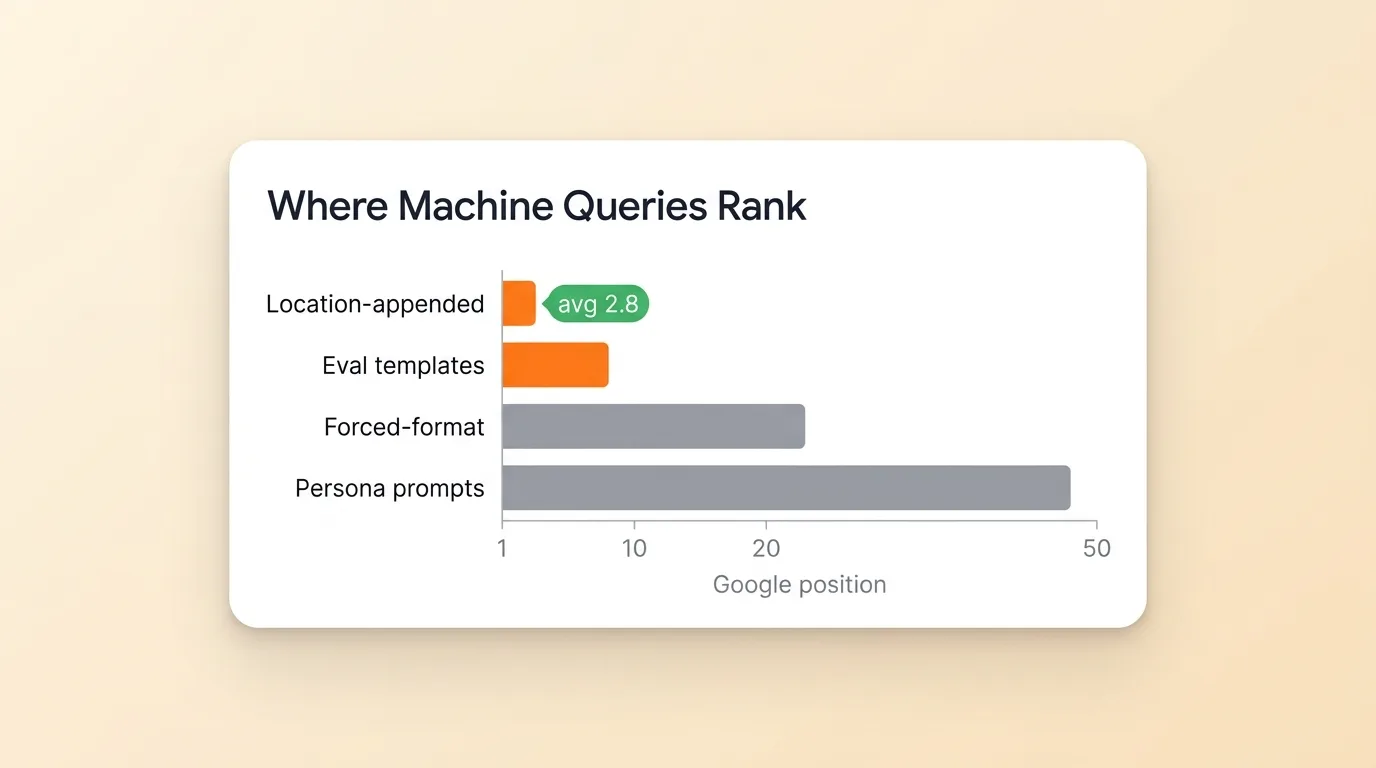
| Location-appended | 15 | 37 | 2.8 |
| Persona-injected | 21 | 21 | 48.0 |
| Eval-harness | 10 | 19 | 8.1 |
| Context-block leaks | 9 | 9 | 46.3 |
| Forced-format | 6 | 9 | 23.0 |
| Conversational (no hard signature) | 10 | 11 | 28.8 |
| Machine total (strict) | 61 (23.0%) | 95 (8.1%) | — |
Three findings stand out.
Finding 1: A quarter of queries, a twelfth of impressions
Machine queries are long-tail by construction — templates generate many unique strings, each searched once. So they’re 23% of distinct queries but only 8% of impressions. Both numbers matter: the impression share tells you the volume today; the query share tells you how much of the query surface is already machine-authored. The second number is the leading indicator.
Finding 2: Agent queries rank at position 2.8
The location-appended queries — the purest “assistant searching for a user” signature — landed at an average position of 2.8, with 35 of 37 impressions in the top six results. Strip the location string and these are clean commercial keywords; the pages that rank for them are being read directly into an AI assistant’s answer to a real buyer.
Meanwhile persona-injected prompts averaged position 48: a 40-word prompt drives Google deep into long-tail retrieval, surfacing pages that would never rank for the head term. Agents are creating a parallel long-tail SERP where different sites win — and almost nobody is optimizing for it on purpose.
Finding 3: Machines don’t click
Machine-signature queries produced zero clicks. Zoom out and the fingerprint is all over our aggregate data: 22.4% of sampled impressions sat in Google’s top 10 and earned nothing; over three months our property logged 383,000 impressions against 203 clicks — a 0.1% CTR that looks like failure until you segment it. The reading is happening; it’s just happening without the click.
Who’s Sending These Queries?
Three sources, in likely order of volume:
- AI assistants with live search — ChatGPT Search, Gemini, Perplexity, Copilot — running localized searches mid-conversation. The location-appended pattern matches this exactly, and it’s the same query fan-out behavior Google’s own AI Mode uses.
- AI-visibility and prompt-monitoring tools — including, we note with full irony, tools in our own category — running scheduled prompt sets through engines that search Google. The eval-harness templates and leaked context blocks are their unmistakable trace.
- Autonomous agents doing multi-step research tasks, whose intermediate searches inherit the phrasing of the instructions that spawned them — the persona and forced-format buckets.
What This Means If You Do SEO
Segment your CTR before you diagnose it. A blended 0.1% CTR mixes two populations: humans who might click and machines that never will. Flag the five signatures in your own query export and read human CTR separately — the metric you’ve been staring at is contaminated.
Treat machine impressions as a channel, not noise. When an assistant searches “best [your category] tool. my location is usa.” and your page sits at position 3, you are in the consideration set an AI is assembling for a real buyer. No click, no session, no attribution — and it may still be the impression that decides the deal. This is the metric shift we keep writing about: presence in the answer layer, not traffic from it.
Be deliberately legible to machines. The strategy that follows from this data is the opposite of blocking: allow reputable AI crawlers in robots.txt, ship an llms.txt, keep money pages fast, structured, and answer-first, and extend the same discipline to Google’s AI Overviews — the surface where Google’s own machine does the reading.
Measure the half you can’t see in GSC. These queries are the visible edge of agent research — the same assistants answer most questions without touching Google at all. Tracking your presence inside ChatGPT, Gemini, Perplexity, Claude and Google AI Mode answers is the other half of the measurement problem, and a free Sanbi.ai visibility audit baselines ChatGPT, Gemini and Claude in about two minutes.
Reuse This Data
This study is a single-property, single-day sample — deliberately small, fully disclosed, and easy to replicate on your own Search Console in an afternoon: export a 24-hour query report, flag the five signatures, count. If you publish your numbers, we’d genuinely like to compare notes. Cite this page; we’ll link back to serious replications.
Sanbi.ai monitors your brand’s AI visibility daily across ChatGPT, Gemini, Perplexity, Claude and Google AI Mode — tracking visibility scores, sentiment, citations, agent accessibility, and competitor movements so you always know where you stand in the agent-first web.
Frequently Asked Questions
There is no public global figure, but site-level Search Console data now makes the machine share directly observable. In our 24-hour sample of 265 distinct queries reaching sanbi.ai, 23% of distinct queries (61 of 265) carried unambiguous machine signatures — appended location strings like 'my location is usa.', injected personas ('i'm a cfo at an energy company…'), eval-harness templates, leaked <context> blocks, and forced-format instructions. Including long conversational prompts that strongly resemble assistant inputs, the share reaches 26.8%. By impressions the machine share was smaller — about 8% — because machine queries are long-tail: many unique queries, few repeats.
Five signatures give it away: (1) location-appended queries — a keyword followed by 'my location is usa.', the trace of an assistant localizing a search on a user's behalf; (2) persona-injected prompts — queries beginning 'i'm a [job title] at a [company type]…', which are prompt templates, not search behavior; (3) eval-harness templates — near-identical queries varying one slot, like 'evaluate the ai visibility products company X on [dimension]'; (4) leaked context blocks — queries containing literal '<context> company url: … </context>' markup that a tool failed to strip; and (5) forced-format instructions — 'provide a definitive answer, along with a list of pros and cons', which no human types into Google.
Essentially never, in our data. Machine-signature queries in our sample generated zero clicks — the agent reads the results page (and often the pages behind it) without registering a click the way a human browser session does. This is a major reason average CTR is collapsing on affected sites: our property showed 383,000 impressions and 203 clicks (0.1% CTR) over three months, with 22.4% of sampled impressions sitting in Google's top 10 yet earning no clicks. The impression happened; a machine did the reading.
Because they're phrased differently, they land on different result sets. In our sample, location-appended agent queries ('aio tracker. my location is usa.') hit an average position of 2.8 — near the top, because the core keyword is clean and the appended location barely changes retrieval. Persona-injected prompts averaged position 48: a 40-word prompt pushes Google deep into long-tail matching, surfacing pages that would never rank for the underlying head term. Agents querying Google are effectively creating a parallel long-tail SERP — one where different sites win than in the human-typed rankings.
Three practical consequences. First, your Search Console CTR is contaminated: machine impressions never convert to clicks, so blended CTR understates human engagement — segment before you panic. Second, impressions have a new meaning: a machine impression is your content being read into an AI answer pipeline, which can influence a recommendation without ever producing a session. Third, ranking for machine-shaped queries is a new, measurable channel: if an assistant searches 'best [category] tool. my location is usa.' and your page is position 3, you are inside the consideration set the AI presents to its user — visibility that analytics will never attribute.
Eval-harness queries are machine-generated query batches that vary one template slot at a time — in our data, ten variants of 'evaluate the ai visibility products company [name] [feature] on [dimension]' arrived within the same 24-hour window. They're the visible trace of AI-visibility and prompt-monitoring tools running scheduled evaluations through engines that search Google. If you see stilted, template-shaped query families in your GSC with zero clicks, another company's monitoring software is likely benchmarking your category — and your pages are part of its evidence base.
Two layers. In Search Console: export your query report, flag the five machine signatures (location-appended, persona-injected, eval templates, context blocks, forced-format), and track the machine share and its positions separately from human queries. Beyond Google: the same agents run prompts directly inside ChatGPT, Gemini, Perplexity, Claude, and DeepSeek, where Search Console sees nothing — measuring your presence in those answers requires an AI visibility tracker that runs a prompt set on a schedule and parses mentions, sentiment, and citations. Sanbi.ai does both sides: AI-surface tracking plus agent-accessibility auditing of your site.
For most brands, no — the opposite. An AI agent searching Google on a buyer's behalf is a buyer researching you; being readable to it is distribution, not leakage. Blocking AI crawlers removes you from the answer layer where a growing share of consideration happens, while your competitors remain in it. The defensible strategy is to be deliberately legible: allow reputable AI crawlers in robots.txt, publish an llms.txt, keep key pages fast and structured, and measure your presence in AI answers so you know what's being said.