Query Fan-Out, Explained: How AI Search Really Answers Your Prompts — and What It Means for AEO in 2026
Here’s a question that quietly rewrote AEO strategy in 2026: when you ask an AI search engine one question, how many searches does it actually run?
The answer is: a lot more than one. Google calls the technique query fan-out, and it’s the mechanic behind AI Mode and AI Overviews. Understanding it explains why brands that dominate a keyword can be completely absent from the AI answer for that exact topic — and what to do about it.
What is query fan-out?
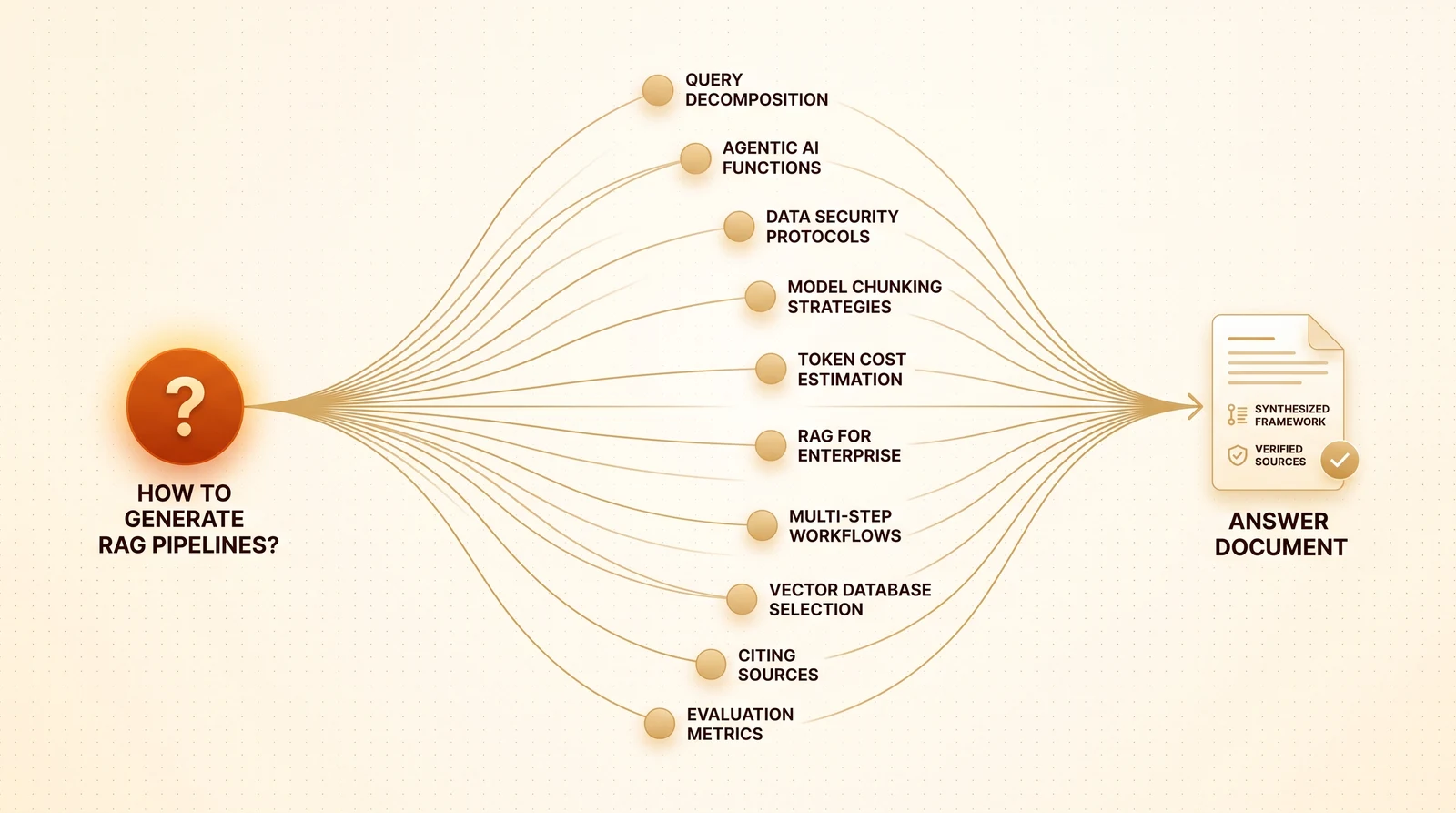
Query fan-out — an AI-era evolution of the classic information-retrieval idea of query expansion — is what an AI search engine does under the hood to answer your question. Instead of running one search for your exact query, it:
- Decomposes your question into many related sub-queries — synonyms, sub-questions, comparisons, and follow-on intents.
- Runs them in parallel, retrieving results for each.
- Synthesizes the overlapping results into a single written answer with citations.
You see one clean answer. Behind it, the engine may have run a dozen or more searches you never see. The “fan-out” is that expansion from one query into many.
A concrete example
Ask an AI engine: “best running shoes for a marathon on a budget.”
A classic search matches that phrase. Query fan-out instead runs something like:
| Sub-query | Intent it covers |
|---|---|
| best marathon running shoes | head recommendation |
| budget running shoes under $100 | price constraint |
| marathon shoes for beginners | experience level |
| cheap carbon plate running shoes | feature + price |
| most durable running shoes | longevity |
| best value running shoes 2026 | recency + value |
…then merges the overlapping results into one recommendation.
Now the punchline: a brand that ranks #1 for the exact phrase “best running shoes for a marathon on a budget” can be missing from every sub-query that actually builds the answer. That’s how you win the keyword and lose the AI answer.
Why fan-out breaks the old SEO model
Traditional SEO was a one-to-one game: one keyword, one optimized page, one ranked position. Query fan-out makes it one-to-many:
- One question → many sub-queries. You have to be retrievable by the cluster, not the head term.
- The answer is synthesized, not ranked. Being on page one of one sub-query isn’t enough; you need to appear across enough sub-queries to be pulled into the synthesis.
- Breadth compounds. The more sub-queries your content is retrieved by, the higher your odds of being cited in the final answer.
This is why AEO and GEO have shifted from “rank for the keyword” to “own the topic cluster.”
Query fan-out = topic clusters, formalized
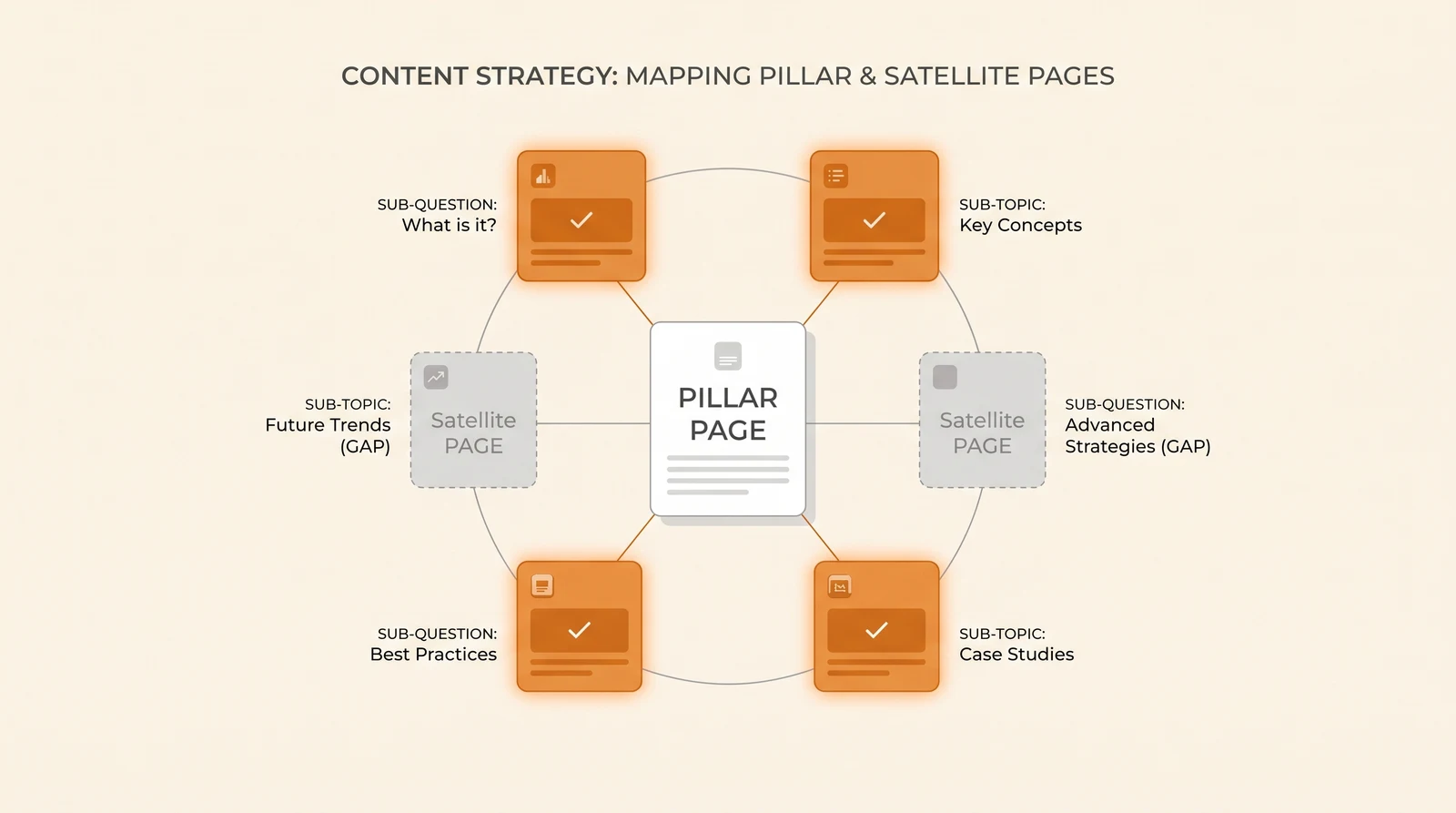
If you’ve built topic clusters before — a pillar page plus supporting articles covering every sub-question — you’ve already been optimizing for fan-out without knowing it.
A well-linked cluster that answers the head term and its sub-intents means more of the fan-out sub-queries retrieve your content. The difference now is that this coverage isn’t a nice-to-have for topical authority — it’s the mechanic that determines whether you’re in the AI answer at all.
How to reverse-engineer the fan-out
You can’t see the sub-queries directly, but you can map them:
- Start with the head query and ask: what sub-questions must be answered for a complete response? (Definitions, comparisons, “best for X,” pricing, alternatives, how-tos, follow-ups.)
- Mine the SERP signals — People Also Ask, related searches, and autocomplete are literally Google showing you adjacent intents.
- Read the forums — Reddit and Quora threads reveal the real sub-questions humans ask.
- Run the query in AI Mode and note which sources it cites — that hints at which sub-queries were retrieved.
- Follow the follow-ups — the follow-up questions AI Mode suggests are fan-out intents made visible.
The output is a sub-query map for each priority topic — your new keyword-research deliverable.
How to optimize content for query fan-out
Once you have the sub-query map:
- Cover every node. Answer each sub-question directly and concisely, with a clear heading, either on one comprehensive page or across a linked cluster — the kind of thorough, helpful content Google prioritizes.
- Lead with the answer. Answer-first formatting (the direct answer, then the detail) is easier to retrieve and quote.
- Structure it. Clear headings, tables, and schema (FAQ, HowTo, Article) make your content easier for retrieval systems to parse.
- Earn citations. Fan-out pulls from sources the engine already trusts — get cited on those third-party domains and pages. Our GEO playbook covers the earned-citation side.
- Embrace the long tail. Fan-out sub-queries are often specific, long-tail questions. Comprehensive long-tail coverage is now an advantage, not an afterthought.
Fan-out is the mechanic behind Google AI Mode specifically, so if that is the surface you care about, our guide to ranking in Google AI Mode applies this map to that engine’s eligibility and citation rules.
How to measure whether you’re winning the fan-out
Turn the black box into a checklist. For each priority topic, run the head query and its likely sub-queries through the AI engine and record where you’re mentioned or cited:
- Appear across most sub-queries → you’re winning the fan-out.
- Appear only for the head term → you have coverage gaps.
- Absent → a competitor with broader coverage is winning the citation.
Do this on a schedule and fan-out becomes a measurable coverage map instead of a mystery. This is exactly what an AI-visibility tracker automates across a prompt set — the same way you’d track ChatGPT rank or AI Mode visibility.
The bottom line
- Query fan-out turns one question into many hidden sub-queries, then synthesizes the results — it’s the mechanic behind AI Mode and AI Overviews.
- It breaks the one-keyword-one-page model: you can win the head term and still be absent from the AI answer.
- The winning play is topical coverage — map the sub-queries, answer every node, structure it well, and earn citations.
- Fan-out is measurable: track your appearance across the sub-query cluster and fill the gaps.
Want to see which sub-queries you’re already winning — and which are handing the answer to competitors? Run a free AI visibility audit and get a coverage map across ChatGPT, Gemini and Claude in about two minutes.
Frequently Asked Questions
Query fan-out is the technique modern AI search systems (like Google AI Mode and AI Overviews) use to answer a question. Instead of running a single search for your exact query, the system silently generates and runs many related sub-queries — synonyms, sub-questions, comparisons, and follow-on intents — retrieves results for each in parallel, and then synthesizes everything into one answer. The 'fan-out' is the expansion from one query into many; you only see the final synthesized answer, not the dozen searches behind it.
Google has publicly described query fan-out as the technique behind AI Mode, and the same pattern underpins AI Overviews and other retrieval-augmented answer engines. Perplexity, ChatGPT with search, and Gemini use conceptually similar multi-query retrieval — they decompose a question, run multiple searches or retrievals, and synthesize. The specific name 'query fan-out' is most associated with Google, but the underlying behavior — one question, many hidden sub-queries — is now standard across AI answer engines.
Ask an AI search engine 'best running shoes for a marathon on a budget.' Rather than one search, query fan-out might run: 'best marathon running shoes,' 'budget running shoes under $100,' 'marathon shoes for beginners,' 'carbon plate shoes cheap,' 'most durable marathon shoes,' 'running shoes for long distance,' and 'best value running shoes 2026' — then synthesize the overlapping results into a single recommendation. A brand that only ranks for the exact phrase 'best running shoes for a marathon on a budget' can be completely absent from the sub-queries that actually build the answer.
Because it breaks the one-keyword, one-page model. In classic SEO you targeted the exact query. With query fan-out, the answer is assembled from many sub-queries you never targeted — so you can rank for the head term and still be missing from the answer. Answer Engine Optimization (AEO) for a fan-out world means covering the whole cluster of related sub-questions, comparisons, and intents around a topic, so your content is retrieved by as many of the fan-out sub-queries as possible.
Traditional search matches your query against an index and returns a ranked list; one query, one result set. Query fan-out decomposes your query into many sub-queries, runs each against the index (or a retrieval layer), and merges the results into a synthesized answer. The practical difference: traditional search rewards ranking for the exact keyword; fan-out rewards topical coverage across the whole question cluster, because being retrieved by more sub-queries increases the chance you're cited in the final answer.
You can't see them directly, but you can reverse-engineer them. Start with your head query and brainstorm the sub-questions a person (or model) would need answered to give a complete response: definitions, comparisons, 'best for X', pricing, alternatives, how-tos, and follow-ups. Tools like People Also Ask, related searches, autocomplete, and forum/Reddit threads reveal the real sub-intents. Running the query in AI Mode and reading which sources it cites also hints at which sub-queries were retrieved. The goal is to map the cluster, then make sure your content answers each node.
A query fan-out tool helps you map the hidden sub-queries around a topic so you can cover them in content. Some tools attempt to simulate or predict the fan-out (the sub-queries an AI engine would generate); others aggregate People Also Ask, related searches, and prompt variations into a topical cluster. The practical output is the same: a list of sub-questions and related intents to cover on a page or across a content cluster, so your brand is retrieved by more of the searches that build the AI answer.
Not necessarily longer — more complete, and better structured. Because fan-out retrieves against many sub-queries, a page that answers a question fully, with clear headings for each sub-question, is more likely to be retrieved and cited than a thin page or a bloated one. Sometimes the right answer is one comprehensive page with well-labeled sections; sometimes it's a cluster of interlinked pages, each nailing one sub-intent. Structure and completeness beat raw length.
They map almost perfectly. A topic cluster — a pillar page plus supporting articles covering every sub-question — is essentially content built for query fan-out. Because fan-out runs many sub-queries, having a well-linked cluster that answers the head term and its sub-intents means more of the fan-out sub-queries retrieve your content, increasing your odds of being synthesized into the answer. If you already build topic clusters, you're already optimizing for fan-out; you just need to make the sub-question coverage deliberate.
Both, depending on coverage. If your content covers the full question cluster, fan-out helps you — you get retrieved by many sub-queries and cited more often. If your content only targets head terms, fan-out hurts you — the answer gets built from sub-queries you never addressed, and a competitor with broader coverage wins the citation. The technique rewards breadth of authoritative, well-structured coverage and punishes thin, keyword-only pages.
Map the cluster, then cover it: (1) identify the head query and its sub-questions, comparisons, and follow-ons; (2) answer each sub-question directly and concisely, with clear headings, on your page or across a linked cluster; (3) add structured data and answer-first formatting so the content is easy to retrieve and quote; and (4) earn citations on the trusted third-party sources the engine already pulls from. Then measure which sub-queries you appear for and fill the gaps.
They're related. Query expansion is a long-standing information-retrieval technique where a search system adds synonyms or related terms to a query to improve recall. Query fan-out is a broader, AI-era version: the model generates whole sub-questions and parallel searches — not just synonym expansion — and then synthesizes the multi-query results into a written answer. Fan-out is query expansion turned into a multi-step, generative retrieval process.
Run the head query and its likely sub-queries through the AI engine and record whether your brand is mentioned or cited in each. If you appear across most of the sub-queries, you're winning the fan-out; if you appear only for the head term (or not at all), you have coverage gaps. Doing this on a schedule for your priority topics turns fan-out from an invisible black box into a measurable checklist of sub-queries to win. An AI-visibility tracker automates this across a prompt set.
Yes. Instead of researching one keyword and its volume, you research the whole cluster: the head term plus every sub-question, comparison, and follow-on intent the AI engine is likely to fan out into. People Also Ask, related searches, autocomplete, forum threads, and AI-engine follow-up suggestions become the raw material. The deliverable shifts from a keyword list to a sub-query map for each priority topic.
It elevates them. The sub-queries generated by fan-out are frequently long-tail, specific questions — exactly the kind of query that thin head-term pages ignore. Content that answers specific long-tail sub-questions is more likely to be retrieved by the fan-out and cited in the synthesized answer. In a fan-out world, comprehensive long-tail coverage is a competitive advantage, not an afterthought.
Structured data (schema markup like FAQ, HowTo, and Article) makes your content easier for retrieval systems to parse and quote, which helps when fan-out sub-queries pull from your page. It doesn't guarantee citation, but clean, structured, answer-first content — with explicit question-and-answer formatting — tends to be retrieved and synthesized more readily than unstructured prose. Structured data plus a well-mapped sub-question cluster is a strong combination for fan-out visibility.
Query fan-out is the retrieval mechanic; Answer Engine Optimization (AEO) and Generative Engine Optimization (GEO) are the disciplines for winning it. AEO/GEO in a fan-out world means building content that gets retrieved by, and synthesized from, as many of the fan-out sub-queries as possible — through topical coverage, structure, and earned citations. Understanding fan-out is what makes AEO/GEO strategic rather than keyword-by-keyword. See our AEO vs GEO guide for the framework.
Add your head queries and the sub-queries you expect to your Sanbi.ai prompt set and it runs them against ChatGPT, Gemini, Perplexity, Claude and Google AI Mode on a daily schedule, records where your brand is mentioned and cited across the whole cluster, and shows which sub-queries you're winning and which you're missing. That turns query fan-out from an invisible process into a measurable coverage map — so you can see exactly which sub-questions to target next. Start with a free AI visibility audit across ChatGPT, Gemini and Claude to baseline your coverage.
There is no official one — Google does not expose the sub-queries AI Mode or AI Overviews run — but you can approximate the fan-out three ways. Ask Gemini or ChatGPT directly to list the 8–12 sub-questions a search engine would need to answer to respond fully to your prompt, grouped by intent. Use People Also Ask and related searches for the head term as a real-world sample of the fan-out. Or use an AI visibility platform that logs the citations behind each AI answer, which reveals the sub-queries indirectly through the sources that were fetched. Whichever generator you use, treat the output as a coverage checklist for your page: every sub-question you fail to answer is one the engine will answer from someone else.