llms.txt: The Complete Guide to the AI Content Standard in 2026
Every few months a new “AI SEO” acronym or file promises to be the thing that gets you cited by ChatGPT. In 2026, the one people keep asking about is llms.txt — a small Markdown file that hands AI models a clean map of your best content.
So: what is it, how do you make one, and — the question everyone actually wants answered — does it even work? Here’s the honest, complete guide.
What is llms.txt?
llms.txt is a proposed standard: a plain-text (Markdown) file placed at the root of your site — yoursite.com/llms.txt — that gives large language models a curated, concise map of your most important content.
The problem it tries to solve: when an AI model encounters your website, it has to crawl and parse everything — navigation, ads, scripts, cookie banners, boilerplate — to find the actual content. llms.txt short-circuits that by offering a clean, human- and machine-readable summary that points straight to your key pages.
It was proposed in September 2024 by Jeremy Howard of Answer.AI — the full spec lives at llmstxt.org — as a way to make sites more usable by LLMs at inference time. Think of it as a welcome map for AI, written in Markdown.
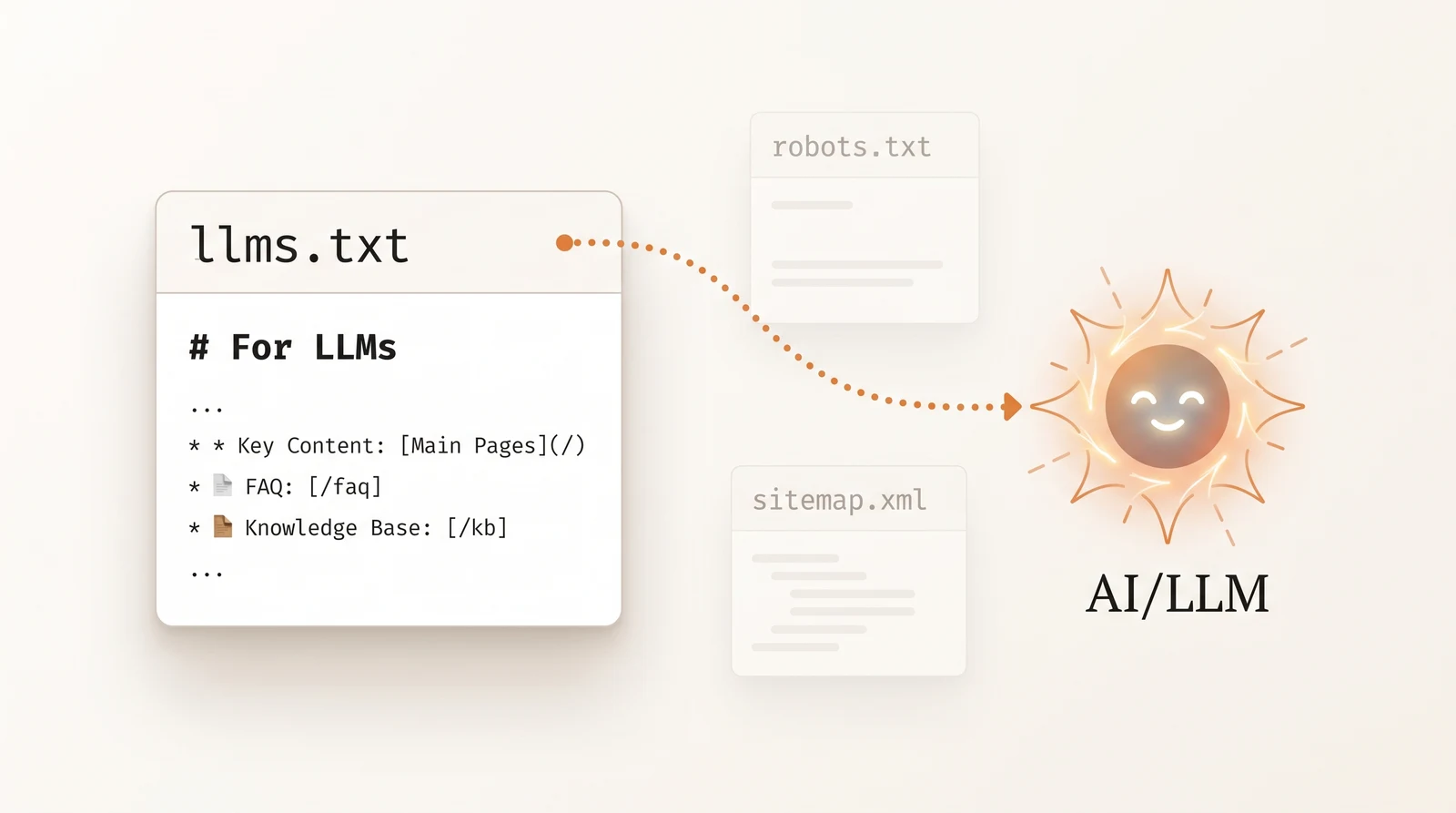
llms.txt vs robots.txt vs sitemap.xml
These get confused constantly. They’re different tools:
| File | Purpose | Audience | Style |
|---|---|---|---|
| robots.txt | Access rules — what crawlers can’t touch | All crawlers | Directives (Allow/Disallow) |
| sitemap.xml | Every URL, for discovery/indexing | Search crawlers | Exhaustive XML list |
| llms.txt | Curated map of your best content | AI models / LLMs | Concise Markdown + descriptions |
The key mental model: robots.txt controls access, sitemap.xml lists everything, llms.txt curates understanding. They coexist — publishing llms.txt doesn’t replace or conflict with the other two.
What an llms.txt file looks like
The format is deliberately simple — an H1, an optional summary blockquote, then H2 sections of curated links:
# Your Brand

> One or two sentences describing what your site is and does.

## Core Features
- [Feature A](https://yoursite.com/feature-a): Short description.
- [Feature B](https://yoursite.com/feature-b): Short description.

## Docs
- [Getting Started](https://yoursite.com/docs/start): How to begin.
- [API Reference](https://yoursite.com/docs/api): Endpoints and auth.

## Pricing
- [Plans](https://yoursite.com/pricing): Tiers and features.
That’s it. Both a human and a model can parse it in seconds — which is the whole point.
llms.txt vs llms-full.txt
There are two flavors:
llms.txt— the concise index: name, summary, curated links by section.llms-full.txt— the expanded version that inlines the full text of those key pages into one big Markdown file, so a model can ingest your core content in a single request without following links.
Documentation-heavy sites often publish both: the lightweight map and the full-content dump.
The honest part: does llms.txt actually work?
Here’s where most articles oversell it. The truthful answer in 2026:
No major AI company has officially confirmed that its crawlers read llms.txt at scale, and Google’s search advocates have publicly expressed skepticism about it.
Some AI-native tools and documentation platforms do consume it, and adoption among sites is growing — but you should treat llms.txt as a low-cost, forward-looking best practice, not a guaranteed citation lever. It costs little to publish, positions you well if adoption grows, and carries no SEO downside. Just don’t expect it to single-handedly change your AI visibility.
Anyone promising that a llms.txt file will get you cited by ChatGPT is overselling. The things that actually move AI citations are content and authority — which we’ll get to.
How to create an llms.txt file (step by step)
- Write the header. An H1 with your brand/site name, and a one- or two-sentence blockquote summary of what your site is.
- Group your best pages into H2 sections (Core Features, Docs, Pricing, Blog, etc.).
- Add curated links in the format
- [Title](URL): short description.— link your best 10–40 pages, not everything. - Keep it honest and clean — no keyword stuffing, no gated or private pages, no links blocked by robots.txt.
- Save it as
llms.txtand upload it to your site root so it resolves atyoursite.com/llms.txt, served as plain text. - (Optional) Generate
llms-full.txtif you want to hand models your full core content.
Pro tip: generate it in your build process. Because llms.txt is curated (not auto-derived from every URL), manual files drift out of date. A small script that regenerates it on each build keeps it in sync with your live content — which is exactly how we keep Sanbi’s own llms.txt current.
Where llms.txt fits in a real AI visibility strategy
Publish it — but keep it in perspective. llms.txt is a small technical-hygiene piece. The levers that actually move whether AI engines cite you are:
- Clear, answer-first content that fully answers real buyer questions.
- Topical coverage that satisfies query fan-out — being retrievable across the whole cluster of sub-questions.
- Structured data (schema) so each page is machine-parseable — a higher priority than llms.txt today. See our structured data guide.
- Earned citations on the third-party sources AI already trusts, covered in our GEO playbook.
Do the technical hygiene (llms.txt, schema, crawlability), then spend the real effort on content and citations — and measure whether it’s working across AI engines, because that feedback loop is what turns AEO from guesswork into a system.
Google is explicit that no AI text file is needed to appear in AI Overviews or AI Mode, so if Google’s surfaces are your priority, start with the eligibility and answer-shape work in our guide to ranking in Google AI Mode rather than with llms.txt.
The bottom line
- llms.txt is a curated Markdown map of your best content, placed at your site root — an inclusion file, the opposite of robots.txt.
- It’s a community proposal, not an official standard, and major AI crawlers haven’t confirmed reading it at scale — treat it as low-cost, forward-looking hygiene.
- Creating one is easy: H1, summary, H2 sections, curated links; generate it in your build to keep it fresh.
- It won’t move the needle on its own — content, topical coverage, structured data, and earned citations do the heavy lifting.
Publishing llms.txt is good hygiene. Knowing whether AI actually cites the content it points to is the real question. Run a free AI visibility audit and see where your brand stands across ChatGPT, Gemini and Claude in about two minutes.
Frequently Asked Questions
llms.txt is a proposed, plain-text (Markdown) file placed at the root of your website (yoursite.com/llms.txt) that gives large language models a curated, concise map of your most important content. Instead of forcing an AI model to crawl and parse your entire site — navigation, ads, scripts and all — llms.txt offers a clean, human- and machine-readable summary with links to your key pages. It was proposed in September 2024 by Jeremy Howard of Answer.AI as a way to make websites more usable by LLMs at inference time.
No. robots.txt tells crawlers what they are and aren't allowed to access — it's about permission and exclusion. llms.txt is the opposite: it's an inclusion file that proactively points AI models to your best, most relevant content and summarizes it in clean Markdown. robots.txt controls access; llms.txt curates understanding. They serve different purposes and can coexist — robots.txt for crawl rules, llms.txt for AI-friendly content guidance.
A sitemap.xml lists every URL on your site for search-engine crawlers to discover and index — it's exhaustive and machine-oriented. llms.txt is curated and concise: rather than every URL, it highlights the handful of pages that best represent your site, organized by topic, in readable Markdown with short descriptions. Think of sitemap.xml as 'everything, for indexing' and llms.txt as 'the essentials, for AI comprehension.' Many sites publish both.
It's Markdown with a defined structure: an H1 with your site/brand name, an optional blockquote summary, then H2 sections (like Core Features, Docs, Blog, Pricing) each containing a bulleted list of links with short descriptions. For example: '# Sanbi.ai' followed by '> Sanbi.ai is the AI visibility platform…' followed by '## Docs' and bullet links like '- [Pricing](https://sanbi.ai/pricing): Plans and features.' The format is deliberately simple so both humans and LLMs can parse it instantly.
llms.txt is the concise index — an H1, a summary, and curated links by section. llms-full.txt is the expanded version that inlines the actual full content of those key pages into one large Markdown file, so a model can ingest your important documentation in a single request without following links. Use llms.txt as the lightweight map and llms-full.txt when you want to hand a model the complete text of your core content (common for documentation-heavy sites).
This is the honest, contested part. As of 2026, no major AI company (OpenAI, Google, Anthropic) has officially confirmed that its crawlers read llms.txt at scale, and Google's search advocates have publicly expressed skepticism. Some AI-native tools and documentation platforms do consume it, and adoption among sites is growing, but treat llms.txt as a low-cost, forward-looking best practice — not a guaranteed ranking or citation lever. It costs little to publish and positions you well if adoption grows; just don't expect it to single-handedly change your AI visibility.
Potentially, at the margin. The theory behind Answer Engine Optimization (AEO) and Generative Engine Optimization (GEO) is that making your content easier for AI to find, parse, and quote improves your odds of being cited. llms.txt supports that by giving models a clean, curated map of your best content. But it's a supporting tactic, not a core one — clear on-page content, structured data, topical coverage, and earned citations do far more heavy lifting. Treat llms.txt as a tidy addition to a real AEO/GEO program, not a substitute for it.
Write a Markdown file with: (1) an H1 of your brand/site name; (2) a one- or two-sentence blockquote summarizing what your site is; (3) H2 sections grouping your most important pages (e.g., Core Features, Docs, Pricing, Blog); and (4) under each section, bullet links in the format '- [Title](URL): short description.' Keep it curated — link your best 10–40 pages, not everything. Save it as llms.txt and upload it to your site root so it's reachable at yoursite.com/llms.txt.
At the root of your domain, so it's accessible at https://yoursite.com/llms.txt — exactly like robots.txt. It should be served as plain text (Markdown), publicly reachable, and not blocked by robots.txt or authentication. Sub-path or sectioned files are possible for very large sites, but the canonical location is the root llms.txt.
Whenever your key content changes — new flagship pages, restructured docs, updated pricing, or major new blog pillars. Because llms.txt is curated (not auto-generated from every URL), it can drift out of date if you forget it. A good practice is to regenerate it as part of your build or publishing workflow so it stays in sync with your live content, and to review it quarterly for stale links.
Yes. Many sites generate llms.txt as part of their build process — a script pulls the curated set of pages (and their titles/descriptions) and writes the Markdown file. Documentation frameworks and some CMS plugins now support llms.txt generation. Automation keeps it in sync with your live content and prevents the stale-link problem that manual files eventually hit. The key is to keep the selection curated even when generation is automated — quality of the linked set matters more than quantity.
No — it's a community proposal, not an official standard ratified by a body like the W3C or endorsed by the major AI companies. It was proposed by Jeremy Howard in 2024 and has gained grassroots adoption, tooling, and directories, but it remains a convention rather than a mandate. That's important context: publishing llms.txt is a bet on an emerging convention, not compliance with a required spec.
No. llms.txt is a separate, additive file that doesn't affect how Google indexes or ranks your normal pages — it isn't robots.txt and it doesn't change crawl permissions. The worst case is that AI crawlers ignore it and it simply sits there harmlessly. So there's no SEO downside to publishing a well-made llms.txt; the only cost is the small effort to create and maintain it.
It's optional and low-priority for small sites. If you have a handful of pages, an AI model can already crawl and understand your site easily, so llms.txt adds little. It's most useful for larger, content- or documentation-heavy sites where a curated map genuinely helps a model find the signal in the noise. For a small business, your effort is better spent on clear on-page content and structured data first; add llms.txt later as a tidy extra.
Don't dump every URL (that defeats the curation purpose), don't include private, gated, or sensitive pages, and don't stuff it with keywords or marketing fluff — LLMs parse it for structure and clarity, and noise reduces its usefulness. Keep it to your genuinely important, publicly accessible pages with honest, concise descriptions. Also avoid linking to pages that are blocked by robots.txt or require login, since a model following those links will hit a wall.
No — they're complementary and operate at different layers. Schema markup (JSON-LD) annotates individual pages so search and AI systems understand entities, articles, FAQs, and products on that page. llms.txt is a site-level curation file pointing to your best content. A strong AI-readiness setup uses both: schema for per-page machine understanding, llms.txt for a curated site map. Neither replaces the other, and structured data is the higher-priority of the two today.
It's a small, technical foundation piece — useful, low-cost, forward-looking, but not a growth lever on its own. The things that actually move AI visibility are clear, answer-first content, topical coverage that satisfies query fan-out, structured data, and earned citations on sources AI trusts. Publish llms.txt as part of good technical AI hygiene, then invest the real effort in content and citations — and measure your visibility across AI engines so you know what's working.
Sanbi.ai treats llms.txt as one part of technical AI readiness, alongside structured data and crawlability, and focuses the bulk of measurement on what actually moves the needle: whether your brand is cited across ChatGPT, Gemini, Perplexity, Claude and Google AI Mode. Publishing an llms.txt is a sensible foundation; Sanbi tells you whether the content it points to is actually being cited in AI answers. Start with a free AI visibility audit to see where your brand stands.
Treat them as two files with two different jobs. robots.txt controls access: list each AI crawler by user-agent — GPTBot and OAI-SearchBot (OpenAI), ClaudeBot, PerplexityBot, Google-Extended, Bingbot, Applebot-Extended, CCBot — and decide per bot whether to Allow or Disallow, keeping private and API paths disallowed for every group. Blocking training-only bots while allowing search-time bots is a legitimate pattern, for example disallowing CCBot but allowing OAI-SearchBot. llms.txt is a curated guide to your best pages for the crawlers you do allow. Two mistakes to avoid: a blanket Disallow that also catches the search-time bots you want, and a CDN or WAF rule — Cloudflare has blocked AI crawlers by default for new domains since mid-2025 — that silently overrides a permissive robots.txt.
llms.txt is a Markdown file at your site root that lists your most important pages with one-line descriptions, intended as a guide for language-model agents. It does not control access; robots.txt does that. No major engine has confirmed using it as a ranking or retrieval signal. It is cheap to maintain and some agents and tools do read it, so it belongs in the checklist as a low-cost hygiene item, not as a substitute for crawlable HTML and correct robots.txt rules.
Not a separate file, but a curated one. An ecommerce llms.txt should list category pages, best-selling product pages, buying guides, shipping and returns policies and the about page, each with a plain description, rather than dumping thousands of SKU URLs. Point to a llms-full.txt only if you can keep it current. The more valuable ecommerce work is Product schema with price, availability and identifiers, and server-rendered product details, since that is what engines actually quote.