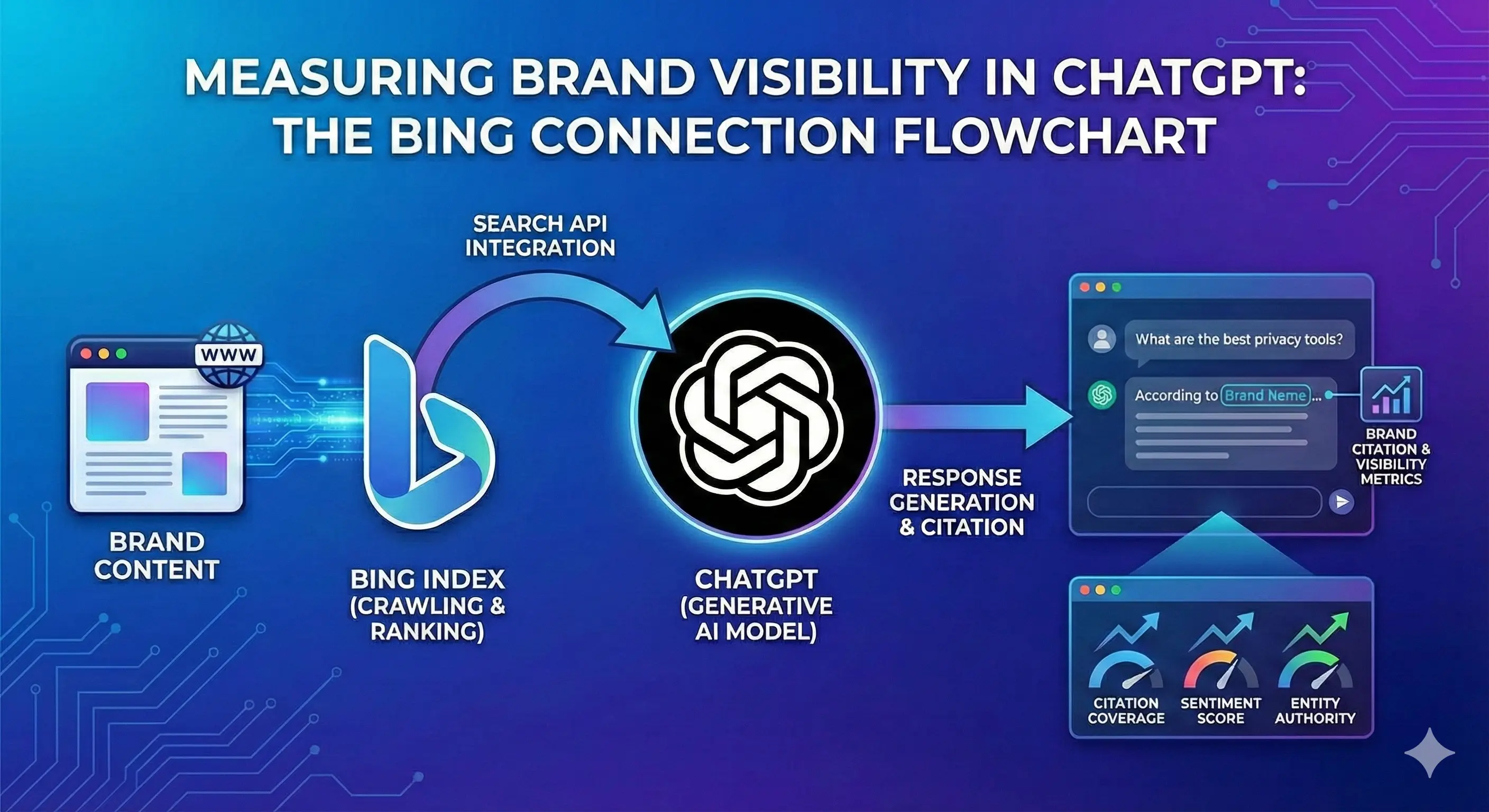
How to Appear in ChatGPT Answers: The Bing Connection You Can't Ignore
We often treat Bing as an afterthought—the “other” search engine with a small market share. But in the age of AI, that logic is dangerous. If you are trying to figure out how to measure brand visibility in ChatGPT, the answer actually starts with Bing.
The data suggests that Bing has quietly become the backbone of the AI revolution. If you ignore it, you are effectively invisible to the world’s biggest AI agents.
Here is why Bing matters more than ever, and how to start auditing your performance.
1. Bing is the “Source of Truth” for ChatGPT
It didn’t happen by accident. Microsoft rebuilt Bing around a next-generation OpenAI model, effectively positioning it as the “copilot for the web.”
- The Shift: At Build 2023, Microsoft made Bing the default search engine for ChatGPT’s browsing experience.
- The Consequence: When you ask ChatGPT a question about current events or a specific business, it uses Bing’s index to find the answer.
- The Risk: If your site is not indexed or ranks poorly on Bing, you have almost zero chance of being cited in ChatGPT’s answers.
2. Rankings vs. Citations
In traditional SEO, you fight for a “Ranking” (Slot #1). In AI Search, you fight for a Citation. Analyses of browsing behavior show that the URLs ChatGPT cites closely match the top organic results on Bing. This means Bing SEO is effectively a hidden lever for Generative Engine Optimization (GEO).
If you optimize for Bing, you are optimizing for the AI.
3. How to Audit Your Performance
The “Command Center” for fixing your AI visibility is Bing Webmaster Tools (BWT), but reading the raw data can be confusing. You need to look for specific signals:
- Crawl Errors: If Bingbot is blocked, ChatGPT is blocked.
- Snippet Control: Bing rewards explicit, exact-match keywords in titles. Unlike Google (which is nuanced), Bing needs you to be literal.
Frequently Asked Questions (FAQ)
We analyzed the most common questions marketing teams are asking about AI visibility. Here are the answers.
How to check brand visibility in ChatGPT?
Checking manually is impossible because AI answers change based on the user’s location and chat history. You need software that automates “Prompt Testing”—running hundreds of queries to see if your brand appears in the response.
What are the best metrics for measuring ChatGPT visibility?
Forget “Organic Traffic.” The KPIs for 2026 are:
- Citation Coverage: The % of times you are listed as a source.
- Sentiment Score: Is the AI describing you positively or negatively?
- Entity Authority: Does the AI know you are a real business, or does it hallucinate details?
Is there a Semrush AI visibility tool?
Yes. Semrush launched their AI Visibility Toolkit in late 2025. It is an excellent tool for tracking “Share of Voice” on national keywords. However, it largely focuses on text-based citations. If your business relies on local traffic (restaurants, clinics, services), you likely need an Adaptive Platform like Sanbi.ai that also tracks visibility in AI-generated Map Packs.
How does this compare to AthenaHQ AI traffic tools?
AthenaHQ is a powerful tool for creating content that ranks in AI. However, measuring the downstream effect—AthenaHQ AI traffic—is different from auditing your technical visibility. Sanbi.ai focuses on the audit phase: ensuring your technical infrastructure (Schema, Maps, Bing Indexing) is actually readable by the bots in the first place.
Ready to stop guessing? You don’t need to manually check Bing every day. Run a free AI Visibility Audit at Sanbi.ai to see your Universal Score across ChatGPT, Perplexity, and Gemini instantly.
Frequently Asked Questions
You cannot measure ChatGPT visibility with standard SEO metrics like clicks. Instead, you must audit your presence in Bing's index (which powers ChatGPT) and track 'Citation Frequency'—how often your brand is cited as the source in generated answers.
Yes, the Semrush AI Visibility Toolkit is a powerful option for enterprise brands tracking national keywords. However, for local businesses or those needing 'Geospatial AI tracking' (Maps in Chat), Sanbi.ai offers more granular data.
Each engine works differently: ChatGPT uses Bing, Gemini uses Google, and Perplexity uses a hybrid model. Sanbi.ai unifies these into a single 'Universal Visibility Score' so you don't have to check them manually.
AthenaHQ focuses heavily on content generation for AI. However, for deep technical auditing and tracking actual 'AI Traffic' potential from map packs and local citations, Sanbi's geospatial logic provides a more granular view.
Microsoft made Bing the default search engine for ChatGPT's browsing experience. When ChatGPT answers questions about current events or businesses, it pulls from Bing's index. If your site ranks poorly on Bing, you have near-zero chance of being cited in ChatGPT answers.
Make the engines able to find, verify and trust you. Findable: allow GPTBot, OAI-SearchBot, PerplexityBot and ClaudeBot in robots.txt and render key content without JavaScript. Verifiable: state what you do, for whom and at what price consistently on your site, in Organization and Product schema, and on your profiles. Trusted: get onto the third-party pages engines already cite for your category — review platforms, best-of roundups, Reddit and community threads, Bing-indexed press — because recommendations are assembled mostly from those sources, not from your homepage. Then track 20–50 buyer prompts across ChatGPT, Gemini and Perplexity so you can see which sources the engines cite instead of you, and close those gaps first.
Almost always because the sources the engines read mention them more, not because their site is better. Pull the citation list for your money prompts and you will usually find the same review pages, roundups and threads cited repeatedly, with the competitor present and you absent. Other causes: their facts are easier to verify, they publish comparisons, or your pages hide key content behind JavaScript. The citation list is the diagnosis; fix presence on those sources first.