China's AI Internet: How Web Use, AEO and Agentic Marketing Diverge from the West
China’s internet is not the Western internet with different apps. It is a mobile, platform-contained system where search, social, video, payments, shopping and local services live inside a handful of super-apps, and AI is becoming the interface across all of them. 602 million Chinese people had used generative AI by the end of 2025, Baidu shows AI-generated answers on roughly 70% of its mobile results pages, and Alibaba’s Qwen assistant processed more than 120 million orders in six days. For brands, that means answer engine optimization (AEO) in China has to target several closed, platform-owned knowledge systems, and marketing has to be ready for AI agents that don’t just answer but buy.
This guide sets out the numbers, the structural differences from the US and Europe, and a practical operating model. For the tactical B2B playbook (Baidu Baike, Zhihu, WeChat, Baiduspider), see our companion guide on AEO for DeepSeek, Qwen and ERNIE.
Key China AI Statistics for 2026
| Metric | Figure | Source |
|---|---|---|
| Internet users, end of 2025 | 1.125 billion (80.1% penetration) | CNNIC via gov.cn |
| Generative-AI users, December 2025 | 602 million (42.8% of population, +141.7% YoY) | CNNIC via gov.cn |
| AI-native app MAU, June 2026 (deduplicated) | 499 million (+85.4% YoY) | QuestMobile H1 2026 |
| Doubao MAU, June 2026 | 382.3 million (#1 AI app) | QuestMobile H1 2026 |
| Baidu mobile SERPs with AI content, Oct 2025 | ~70% | Baidu Q3 2025 results |
| Baidu AI-native marketing revenue, Q3 2025 | RMB 2.8 billion (+262% YoY) | Baidu Q3 2025 results |
| Qwen orders in 6 days, Lunar New Year 2026 | 120 million+ | Alibaba Cloud |
| Livestream e-commerce market, 2024 | ~$807 billion | USDA FAS |
How China’s Internet Differs from the West
China’s web is enormous, almost entirely mobile and unusually transactional. At the end of 2024, 99.7% of Chinese internet users went online by mobile phone and 87.9% shopped online (CNNIC 55th report). By June 2025 there were 976 million online shoppers and more than 1.12 billion internet users.
The structure matters as much as the scale. In the US and Europe, discovery usually starts on Google, social happens on separate networks, and the purchase finishes on a merchant site or marketplace. China compresses that journey: a consumer can discover a product in a short video or livestream, discuss it socially, open a mini-program, pay and receive service without ever touching the open-web funnel.
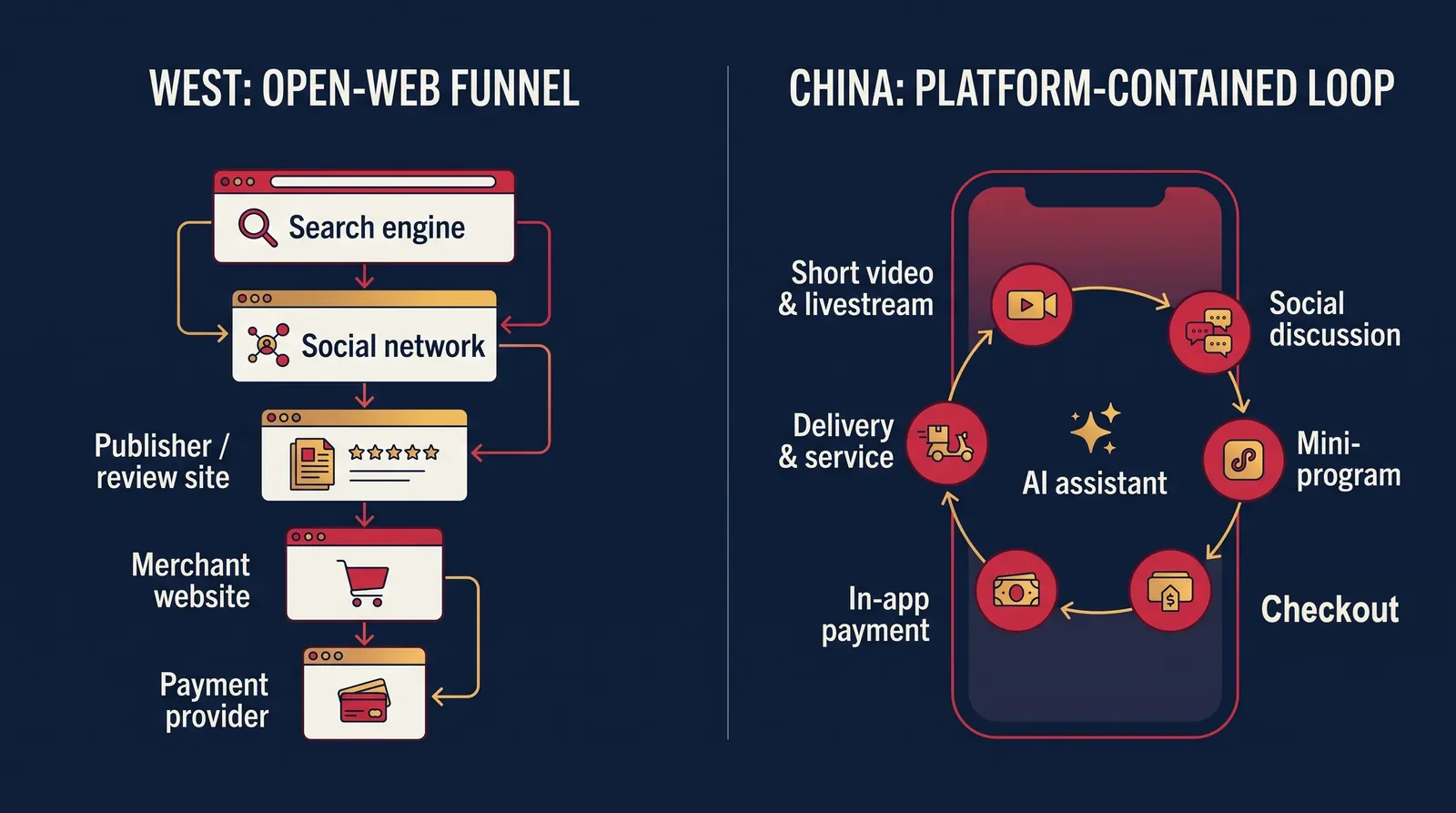
Livestreaming shows how different that is. China’s livestream e-commerce market was worth about $807 billion in 2024, and 833 million people (75.2% of internet users) watched online livestreams (USDA FAS). Livestreaming isn’t a niche content format there. It’s a major retail interface.
| Dimension | China | United States and Europe |
|---|---|---|
| Primary architecture | Mobile apps, super-apps, mini-programs, marketplaces | Open web, websites, search engines, apps, marketplaces |
| Main discovery routes | Baidu, Douyin, WeChat, Xiaohongshu, Zhihu, marketplaces, AI assistants | Google, social platforms, marketplaces, publishers, AI assistants |
| Commerce journey | Often contained in one platform ecosystem | Usually crosses search, social, merchant sites and payment providers |
| Dominant AI assistants | Doubao, DeepSeek, Qwen, Yuanbao, ERNIE, Kimi | ChatGPT, Gemini, Copilot, Meta AI, Claude, Perplexity |
| Regulatory emphasis | Content control, service filing, security assessment, synthetic-content labeling | Privacy, competition, copyright, transparency, risk classification |
| AEO challenge | Visibility across several closed or semi-closed domestic corpora | Visibility across the open web plus a few major AI and search systems |
Don’t exaggerate this into “closed China versus open West.” Western discovery is also becoming platform-controlled as Google, OpenAI, Meta, Microsoft, Amazon and Apple mediate more of the journey. The real difference is one of degree: China’s separation from foreign services and its mature super-app economy have already made platform-contained behaviour normal.
Generative AI Adoption: China vs the US and Europe
China’s generative-AI adoption accelerated sharply through 2025. Users went from 249 million in December 2024 to 515 million in June 2025 and 602 million by December 2025, which is 42.8% of the population, up 25.2 points in a year. In CNNIC’s June 2025 survey, 80.9% of generative-AI users used it to answer questions, which makes AI an answer engine first and a content tool second (CNNIC generative-AI report summary).
| Market | Latest measure | Result | Caveat |
|---|---|---|---|
| China | Generative-AI users, Dec 2025 | 602M; 42.8% of population | Whole-population measure; not monthly activity |
| United States | Adults using AI chatbots, Feb 2026 | ~49%; ~24% daily | Adults only; broader “chatbot” wording (Pew) |
| European Union | Ages 16–74 using generative AI in prior 3 months, 2025 | 32.7% | Three-month window; varies widely by country (Eurostat) |
All three markets have crossed into mass adoption. They just use different products. In the US, ChatGPT reaches 44% of adults, Gemini 24%, Copilot 17% and Meta AI 14%. In China’s 2025 CNNIC survey, Doubao (72.2%) and DeepSeek (62.0%) led usage among generative-AI users, and respondents could pick more than one.
That’s more than a branding difference. A Western user picks ChatGPT or Claude, then moves to a browser, marketplace or merchant to act. Chinese AI is increasingly embedded where the user already chats, watches, shops and pays, which shortens the distance between an answer and a transaction.
Why ChatGPT and Google Aren’t in China’s AI Race
You can’t understand China’s AI market without the Great Firewall and the content-governance regime around it.
- Blocked services. Freedom House’s 2025 report scores China’s internet freedom at 9 out of 100. Google Search, YouTube, Facebook, Instagram and many foreign news sites are unreachable through normal mainland connections.
- No ChatGPT, no OpenAI API. ChatGPT has never been officially available in mainland China. From July 9, 2024, OpenAI also blocked API traffic from unsupported regions including China, and Baidu, Alibaba and Zhipu launched free migration programs with matching token credits.
- Filing before launch. China’s interim measures for generative-AI services took effect in August 2023. By March 2025, 346 generative-AI services had completed filing with the Cyberspace Administration of China, and providers must display model names and filing numbers.
- Mandatory AI-content labels. Since September 1, 2025, the labeling measures for AI-generated synthetic content require a visible label and a machine-readable identifier on AI-generated text, images, audio, video and virtual scenes. Removing either one is prohibited. For marketers, provenance becomes part of publishing operations.
The West isn’t unregulated; its priorities are just different. The EU AI Act’s general-purpose AI obligations took effect in August 2025 and require technical documentation, copyright policies and training-content summaries. The US still runs on a patchwork of sector rules, state laws, platform policies and litigation. The practical result is the same everywhere: global brands will run region-specific AI stacks.
The Chinese AI Assistants That Matter, and the Ecosystems Behind Them
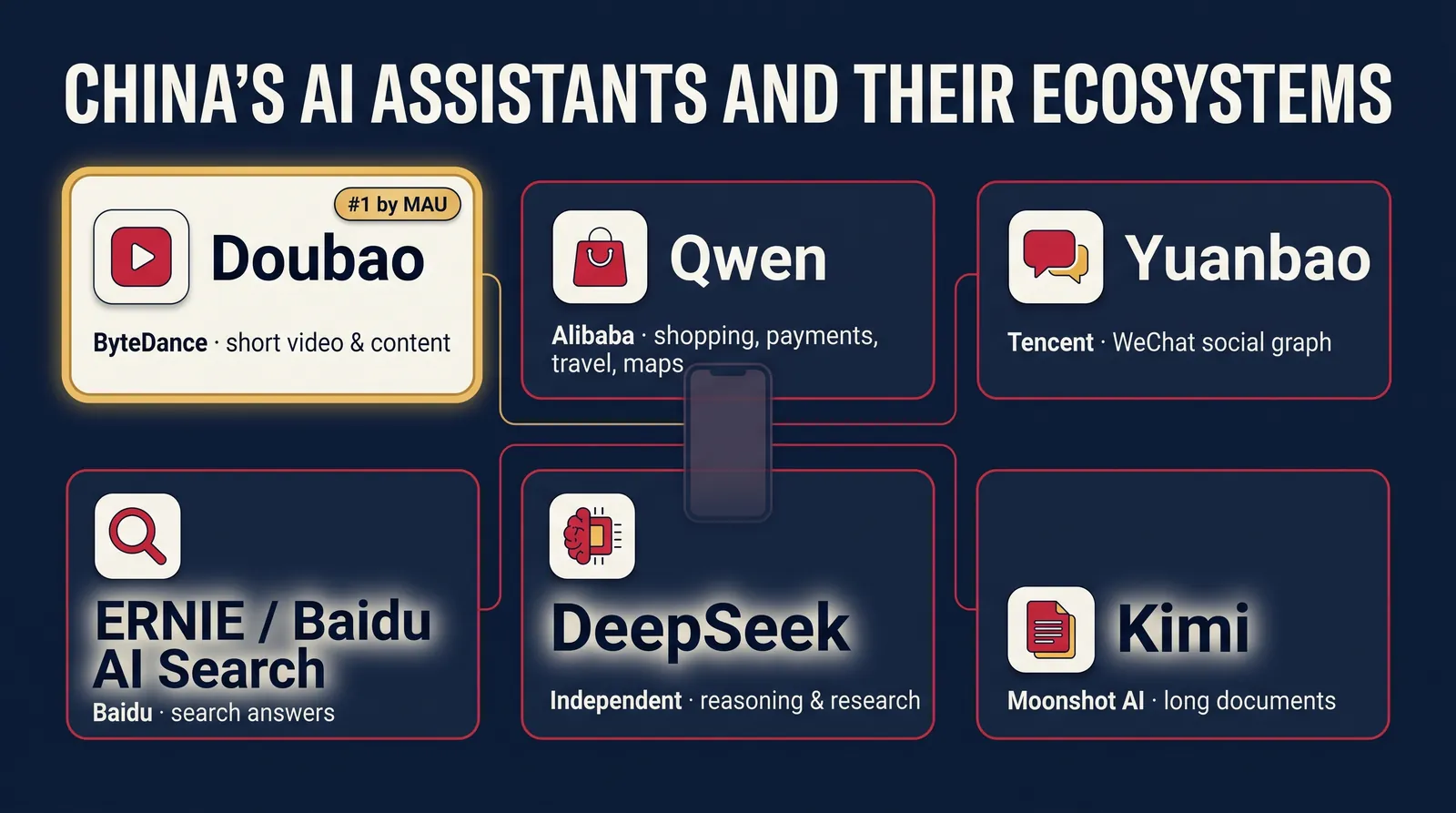
China’s consumer AI market is crowded, but each leading assistant owns a distribution advantage, not just a model:
| Assistant | Owner | Distribution advantage | Latest scale signal |
|---|---|---|---|
| Doubao | ByteDance | Douyin, Toutiao and short-video content | 382.3M MAU, June 2026 (#1) |
| Qwen | Alibaba | Taobao, Alipay, Fliggy, Amap, local services | 100M MAU within 2 months of Nov 2025 beta |
| DeepSeek | DeepSeek | Reasoning and research reputation | ~130M MAU, #3 app, users −20.3% |
| Yuanbao | Tencent | WeChat (Weixin) ecosystem | AI rolled into Yuanbao and Weixin (Tencent) |
| ERNIE / Baidu AI Search | Baidu | Search, rebuilt around generated answers | ~70% of mobile SERPs with AI content |
| Kimi and specialists | Moonshot AI and others | Long-context research, documents, education, health | Part of 346+ filed services |
Sources: QuestMobile H1 2026 via China Internet Watch, Alibaba Group, Baidu Q3 2025.
Two caveats. First, MAU figures overlap because Chinese users often run several assistants. The deduplicated AI-native total was 499 million in June 2026. Second, AI embedded in search, phones, office tools and marketplaces doesn’t show up in “AI-native app” rankings at all. The strategic question isn’t only which chatbot has the most users. It’s which assistant controls the most valuable intent, identity, payment and fulfilment pathways.
DeepSeek’s position is worth a note for Western teams: its MAU fell 20.3%, but time spent per user more than doubled, so a smaller audience is using it more heavily for research. It’s also the Chinese model Western visibility tools most often cover. If you already track it, our DeepSeek rank-tracking guide explains how to run prompts and score the results.
Why AEO in China Is Different from Western SEO
Traditional SEO asks: “How can this page rank for a query?” AEO asks: “How can this brand, fact or product become part of the generated answer?” In China, you have to ask that separately for Baidu AI Search, DeepSeek, Doubao, Qwen and Yuanbao, because their accessible content, platform affiliations and retrieval systems differ.
The shift is already visible in Baidu search:
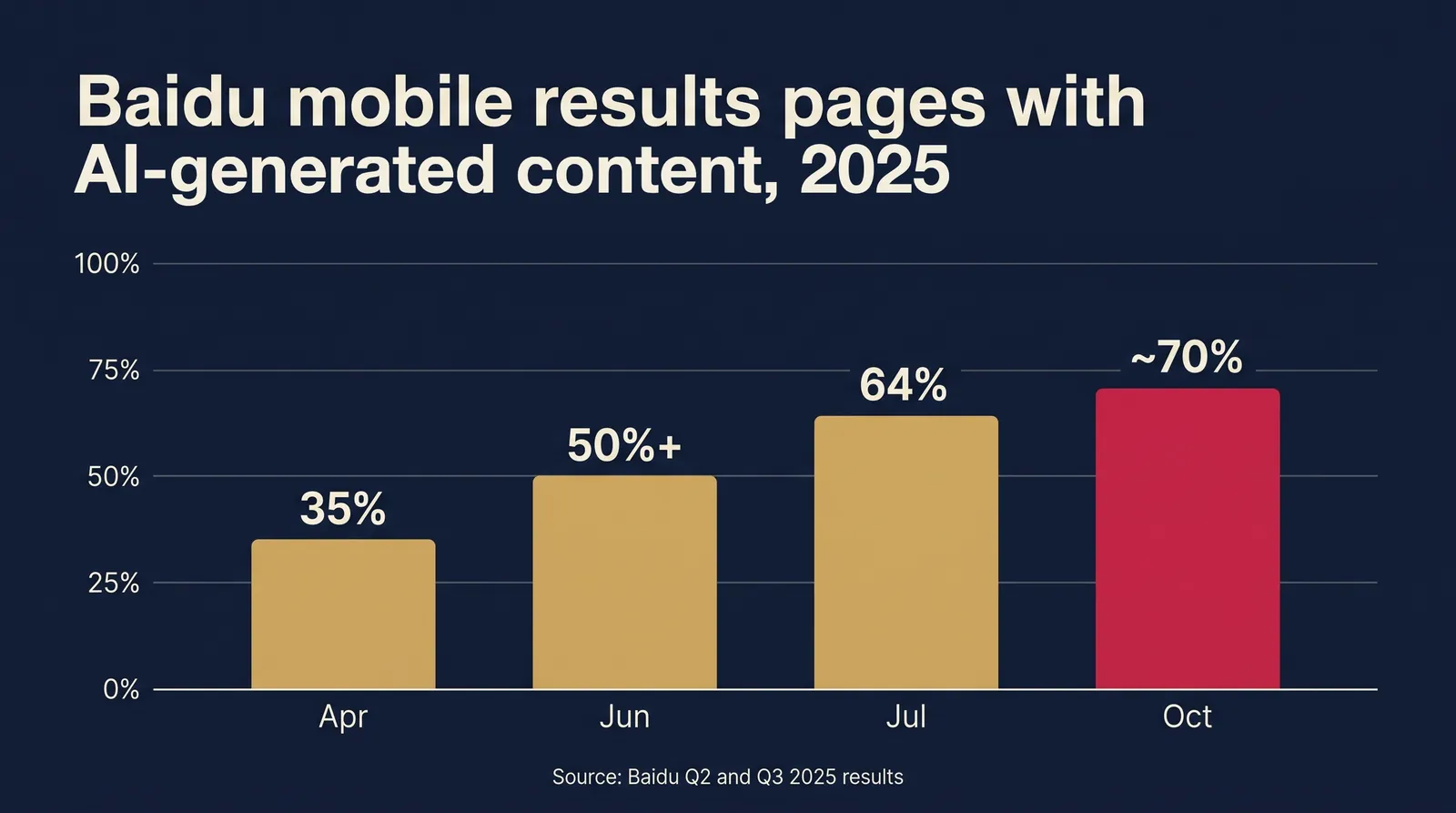
- April 2025: ~35% of mobile results pages contained AI-generated content
- June 2025: more than 50% (Baidu Q2 2025)
- July 2025: 64%, with Baidu describing link-based results as “progressively replaced” by structured, multimodal AI answers
- October 2025: roughly 70% (Baidu Q3 2025)
A brand can therefore rank organically on Baidu and still lose the user, because the answer resolves the query before anyone clicks. That’s the same dynamic Google AI Overviews created in the West, only further along.
China AEO is also less domain-centric. Practitioner research points to domestic knowledge and content environments (Baidu Baike, Zhihu, WeChat Official Accounts, Baijiahao, Toutiao, Douyin and major industry media) as important sources for Chinese AI systems (KAWO, iClick). Model providers don’t disclose these hierarchies, and they change, so treat them as testable hypotheses, not permanent algorithm facts. For a Western comparison, see our study of the most-cited domains in LLMs by industry.
The six layers of a China AEO program
- Entity consistency. Use one Simplified-Chinese brand name, description, product taxonomy, ownership statement and set of proof points across your website, Baidu properties, WeChat, marketplaces and third-party coverage.
- Answer-shaped content. Put a concise answer directly under each question-led heading, then back it with dated statistics, tables, expert attribution and primary-source links. The AEO fundamentals are the same; the platforms and language aren’t.
- Domestic authority. Earn coverage and corroboration in Chinese industry media, expert communities and platform-native publications, not just a translated corporate site.
- Technical accessibility. Make sure mainland users and Baiduspider can reliably load the site. Remove blocked third-party scripts, server-render mobile pages, submit sitemaps and watch crawl errors. Mainland hosting needs an ICP filing or licence; overseas hosting can still be indexed but adds latency (SEO Agency China, Sekkei Digital). Our AI crawler optimization guide covers allowing Baiduspider and Bytespider through Cloudflare.
- Multimodal evidence. Turn core claims into Chinese-language product tables, diagrams, demos and short videos, because discovery spans text, image, video and livestream.
- Prompt-level measurement. Test recurring commercial questions in every major Chinese assistant. Measure mention rate, citation rate, factual accuracy, recommendation position, sentiment and the sources used, not just referral clicks.
The biggest mistake is translating a Google strategy and calling it China AEO. A corporate .com page can be technically excellent and still be absent from Chinese-language authority sources, or unreachable by the retrieval layer that builds the answer. The same mistake shows up in other non-English markets, as we covered for Arabic-first AI search in the UAE.
From Funnels to Agents: Agentic Marketing in China
Agentic marketing starts when AI moves from assisting a shopper to executing for them. A conventional chatbot recommends three hotels. An agent reads the traveller’s constraints, checks availability, picks one, books it, pays and updates the itinerary, with permission and guardrails.
China is structurally ahead here because its tech giants already combine audience, identity, media, merchants, logistics, maps, local services and payment in one account.
- Alibaba (Qwen): the commerce agent. On January 15, 2026, Alibaba connected Taobao, Taobao Instant Commerce, Alipay, Fliggy and Amap to one Qwen conversational interface. Users could order food, pay in the chat, plan travel and have the assistant call restaurants. During the 2026 Lunar New Year campaign, Qwen drove more than 120 million orders in six days (February 6–11), backed by RMB 3 billion in incentives. Nearly half came from county and rural users, and 1.56 million people aged 60+ made their first online purchase through the app.
- Baidu: AI-native marketing inside search. Baidu earned RMB 2.8 billion from AI-native marketing services in Q3 2025, up 262% year over year, while its traditional online-marketing revenue fell 18% (Baidu Q3 2025). Ad money is starting to move from buying positions in a list of links to buying participation in generated answers, agents and digital humans.
- Tencent: agents next to WeChat. Tencent is deploying new AI capabilities in Yuanbao and Weixin and building autonomous-agent tools on top of China’s largest social graph (Tencent 2025 results).
Read the Qwen numbers carefully. They prove operational scale, not durable organic demand. Subsidies can teach a behaviour without proving retention or profitable unit economics. But the infrastructure is real: the path from intent to paid order already runs through one assistant. For the global picture, see our agentic commerce guide.
How the marketing funnel changes
| Old funnel assumption | Agentic reality |
|---|---|
| The audience is a human reacting to creative | The agent is an audience. Product data has to persuade a machine working from stated constraints |
| Persuasion comes first | Eligibility comes first. Availability, delivery area, price, certifications, returns, ratings and stock decide whether an agent can recommend or transact at all |
| Conversion happens on your site | Conversion can be invisible. The platform’s agent may complete the whole journey without a site visit |
| Optimize impressions and clicks | Optimize outcomes: qualified recommendations, completed tasks, transactions, repeat purchases, agent-mediated lifetime value |
A China-Ready Agentic Marketing Stack
A Western brand entering this environment needs two connected systems: a knowledge layer to be understood and an action layer to be selected and transacted.
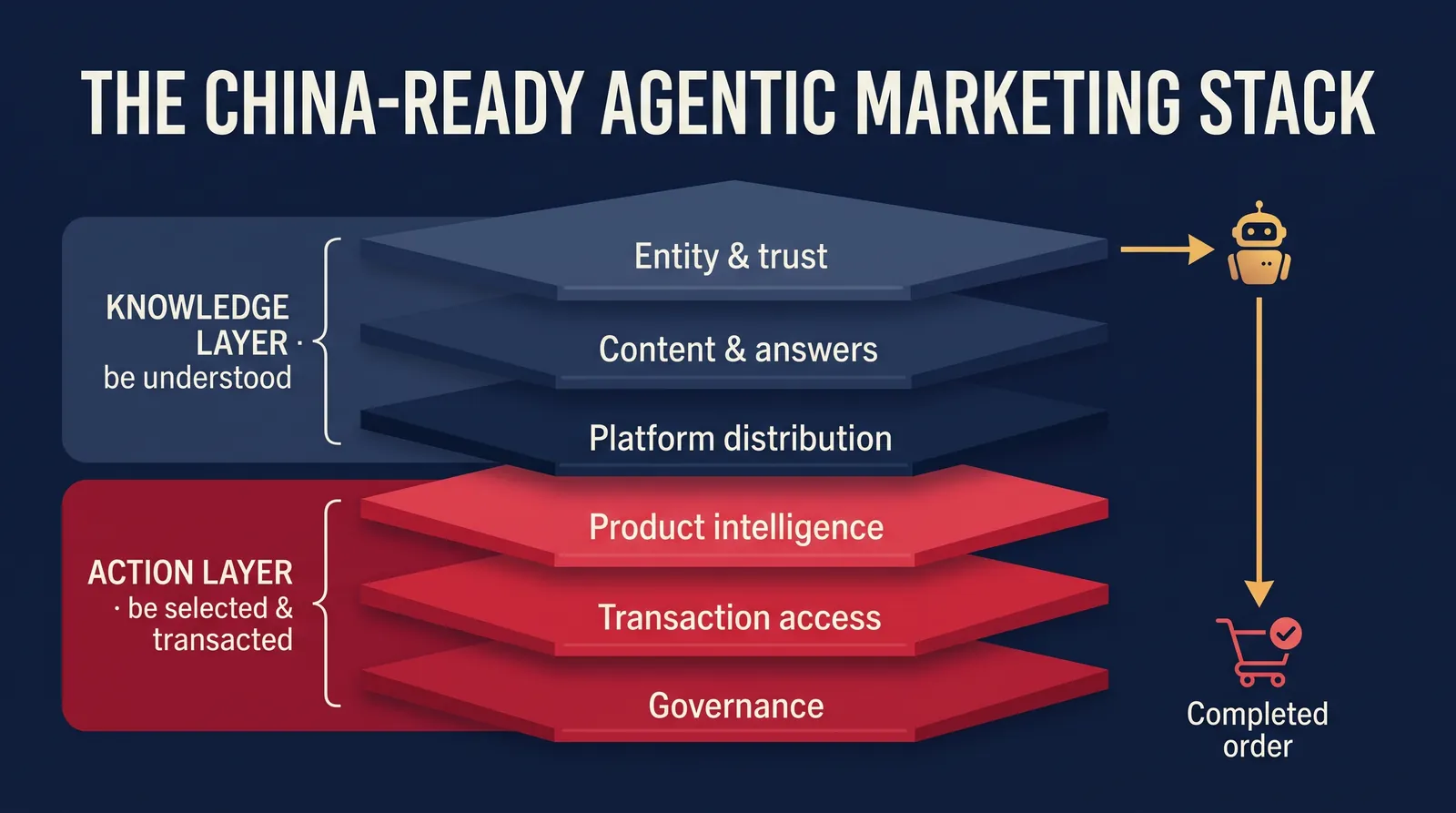
| Layer | What to build | Key measures |
|---|---|---|
| Entity and trust | Verified Chinese identity, consistent facts, authoritative third-party mentions | Correct entity recognition, source authority, factual accuracy |
| Content and answers | Question-led articles, comparison tables, FAQs, demos, expert evidence | Answer inclusion, citation share, recommendation share |
| Platform distribution | Baidu, WeChat, Zhihu, Douyin, Xiaohongshu, relevant marketplaces | Platform reach, saves, branded search, assisted demand |
| Product intelligence | Structured catalogue, live price, stock, attributes, policy and location data | Catalogue completeness, agent eligibility, error rate |
| Transaction access | Mini-programs, marketplace stores, platform payments, fulfilment integrations | Agent-assisted conversion, completion rate, repeat orders |
| Governance | Model/vendor review, consent, AI-content labels, logging, escalation | Compliance rate, provenance coverage, incident volume |
The content team should own a reusable fact base, not a string of disconnected campaigns. Product, legal, customer service and communications should agree on canonical claims, approved evidence and prohibited statements. That fact base then feeds human content, AI answers, customer-service agents, marketplace listings and sales tools.
Measure visibility, influence and execution separately
Standard attribution blends three outcomes that agentic marketing needs to separate:
- Visibility. Was the brand mentioned?
- Influence. Did the AI frame it favourably and accurately?
- Execution. Did an agent complete an action?
Referral traffic only captures a fraction of this. The metric that ties it together is share of model: the percentage of commercially valuable prompts in which a brand is accurately mentioned, cited or recommended across a weighted basket of AI systems. We explain how to audit it in the metric that matters, and how to measure AI visibility covers the prompt-set method.
Predictions for China’s AI Internet Through 2028
1. China will move faster from answers to actions. By 2028, leading Chinese assistants will be judged less by chatbot engagement and more by completed bookings, orders, service requests and merchant revenue. The winners will pair model quality with execution rights inside high-frequency platforms.
2. AEO will fragment by ecosystem. Google-era SEO rewarded a fairly portable set of practices. Chinese AEO needs a shared factual core but different distribution plans for Baidu, ByteDance, Tencent, Alibaba and independent models. “Share of model” will become a standard board-level metric.
3. Product feeds will become media. Agents can’t act on slogans. They need normalized attributes, live inventory, machine-readable policies, trusted reviews and clear constraints. Catalogue operations, APIs and knowledge graphs will move closer to marketing, and the brands with the best agent-readable data, not the most content, will win more recommendations.
4. Paid media will become paid participation. Baidu’s AI-native marketing growth is the start of a commercial layer around generated experiences. Brands will buy access to agentic moments (sponsored recommendations, merchant eligibility, agent tools) rather than only keywords and audiences. Pressure to separate organic from paid recommendations will follow.
5. Compliance will become infrastructure. China’s filing and labeling rules already build governance into AI products, and the EU is doing the same through a rights- and risk-based framework. Global brands will keep region-specific AI stacks, content policies and audit trails.
6. The open web will lose clicks, not relevance. AI answers and in-platform transactions will cut some website visits, but assistants still need authoritative sources to establish facts. The corporate website becomes a canonical evidence hub that supplies trustworthy, structured facts to people, platforms and agents, even when the final interaction happens somewhere else.
Strategic Takeaway: What Western Brands Should Do Now
China offers an early look at the post-search internet: mobile, platform-contained, AI-mediated and increasingly transactional. Its restrictions produced a domestic model market, its super-apps compressed the customer journey, and its payment and commerce infrastructure gives AI agents a direct path from intent to action.
The right response isn’t to abandon SEO, websites or brand building. It’s to add a layer: engineer the brand to be understood, trusted, selected and executed by AI across China’s separate ecosystems. Brands that keep optimizing only for rankings and clicks will measure a shrinking share of their influence.
A 90-day starting plan:
- Weeks 1–2: Write 30–50 commercial prompts in Simplified Chinese and run them in Baidu AI Search, Doubao, DeepSeek, Qwen and Yuanbao. Record mention, citation, position, accuracy and cited sources.
- Weeks 3–6: Build the Simplified-Chinese fact base (name, taxonomy, specs, prices, policies, proof) and fix Baiduspider access and mobile performance.
- Weeks 7–10: Publish answer-shaped content where each assistant actually reads it (Baidu properties, WeChat, Zhihu, Douyin, marketplaces) and pitch Chinese industry media.
- Weeks 11–13: Structure your product catalogue for agent eligibility, add AI-content labels to your workflow, and re-run the prompt set to measure share of model.
Sanbi.ai tracks DeepSeek alongside ChatGPT, Gemini, Perplexity, Claude and Google AI Overviews in one dashboard, so you can see where your China-facing visibility diverges from your Western visibility. Doubao, Qwen and Yuanbao aren’t tracked in Sanbi yet, so run those prompts manually with the same scoring rubric for now.
Run a free AI visibility audit to get your cross-engine baseline, then read the China AI search AEO playbook for the platform-by-platform tactics.
Sources
- CNNIC via gov.cn: China’s internet user base hits 1.125 billion as AI adoption surges (Feb 2026)
- CNNIC via gov.cn: China’s generative AI users double to 515 million (Oct 2025)
- CNNIC via gov.cn: China has over 1.12 billion internet users (Jul 2025)
- CNNIC: 56th Statistical Report on China’s Internet Development (Chinese, PDF)
- CNNIC: 55th Statistical Report on China’s Internet Development (PDF)
- CAIADA: Mainland China’s Development Report on Generative AI Applications (2025)
- China Internet Watch: QuestMobile H1 2026 top AI apps
- USDA Foreign Agricultural Service: Selling in China: The Rise of Livestreaming E-commerce (PDF)
- Digital China Summit: China’s AI industry surpasses 700 billion yuan in 2024
- Pew Research Center: Americans and AI 2026: chatbots, smart devices and views on impact
- Pew Research Center: ChatGPT tops the list of chatbots Americans use
- Eurostat: 32.7% of EU people used generative AI tools in 2025
- Freedom House: China: Freedom on the Net 2025
- UK Home Office: Country policy and information note: opposition to the state, China (Jan 2026)
- Pandaily: OpenAI cuts off API supply to China; Chinese model companies launch relocation plans
- gov.cn: China moves to support generative AI, regulate applications
- China Law Translate: Interim Measures for the Management of Generative AI Services
- SCIO: 346 generative AI services filed with the Cyberspace Administration of China
- China Law Translate: Measures for Labeling AI-Generated Synthetic Content
- SCIO: China requires labeling of AI-generated online content
- European Commission: General-purpose AI obligations under the AI Act
- European Commission: General-purpose AI models in the AI Act: Q&A
- Alibaba Group: Qwen App advances agentic AI strategy (Jan 2026)
- Alibaba Cloud: Qwen App’s CNY campaign attracts over 120 million orders
- Tencent: 2025 fourth quarter and annual results presentation (PDF)
- Baidu via PR Newswire: Third quarter 2025 results
- Baidu via PR Newswire: Second quarter 2025 results
- iClick: AI search optimization in China: the 2026 GEO guide
- KAWO: The complete guide to GEO in China
- SEO Agency China: How to build a website that works in China: hosting, ICP and more
- Sekkei Digital Group: Baidu SEO in 2026 for foreign brands
Measurement notes: China’s generative-AI user count is a whole-population “have used” measure; Pew surveys U.S. adults; Eurostat uses a three-month window for ages 16–74, so cross-market comparisons are directional. App MAU figures overlap across assistants; the 499 million total is QuestMobile’s deduplicated figure. Qwen’s Lunar New Year orders were heavily subsidized and don’t indicate organic retention. Citation-source hierarchies for Chinese AI are practitioner observations, not disclosed by model providers.
Frequently Asked Questions
602 million people in China had used generative AI by December 2025, according to the China Internet Network Information Center (CNNIC). That is a 141.7% increase on the end of 2024 and equals 42.8% of China's total population, up 25.2 percentage points in a year. The figure rose from 249 million in December 2024 to 515 million in June 2025 before reaching 602 million. It measures people who have used generative AI, not monthly active users, so it should not be compared directly with app MAU rankings.
ByteDance's Doubao. QuestMobile's H1 2026 ranking puts Doubao at 382.3 million monthly active users in June 2026, up 172.1% year over year, and far ahead of every other AI-native app. DeepSeek ranked third with roughly 130 million MAU after a 20.3% decline in users, even though time spent per user more than doubled. Across all AI-native apps, China had 499 million deduplicated monthly active users in June 2026, up 85.4% year over year. AI built into Baidu search, WeChat, smartphones and marketplaces does not appear in these app rankings, so real AI exposure is larger.
All three have reached mass adoption, but the official measures are not directly comparable. China reports 602 million generative-AI users, or 42.8% of its total population, at December 2025. Pew Research found in February 2026 that about half (49%) of U.S. adults use AI chatbots, with roughly a quarter using them daily. Eurostat reported that 32.7% of EU residents aged 16 to 74 had used generative-AI tools in the previous three months during 2025. China's figure covers the whole population, the U.S. figure adults only, and the EU figure a three-month window, so the gap between them is directional rather than exact.
ChatGPT has never been officially available in mainland China, and Google Search, YouTube, Facebook and Instagram are also inaccessible through normal mainland connections. Freedom House's 2025 report gave China an internet-freedom score of 9 out of 100. On July 9, 2024 OpenAI also blocked API traffic from unsupported regions including China, and Baidu, Alibaba and Zhipu responded with free migration programs and matching token credits. Public generative-AI services in China must also complete a filing with the Cyberspace Administration of China; 346 services had been filed by March 2025. The combined effect is a domestic model market with its own assistants, sources and rules.
Roughly 70% of Baidu's mobile search-result pages contained AI-generated content in October 2025, according to Baidu's third-quarter 2025 results. The share climbed fast: about 35% in April 2025, more than 50% at the end of June and 64% in July. Baidu describes traditional link-based results as being progressively replaced by structured, multimodal AI answers. For brands, that means a page can still rank organically on Baidu and lose the user's attention because the generated answer resolves the query before anyone clicks.
Agentic marketing is marketing aimed at AI agents that make or carry out decisions on a user's behalf, not just at people reading an ad or a page. A conventional chatbot recommends three hotels; an agent reads the traveller's constraints, checks availability, picks one, books and pays. For marketers that changes the job in four ways: the agent becomes an audience that must be persuaded with structured facts, eligibility such as stock, price, delivery area and returns decides whether the brand is considered at all, conversion can happen without a website visit, and success is measured in completed tasks and transactions rather than impressions and clicks.
Alibaba's January 15, 2026 Qwen upgrade connected Taobao, Taobao Instant Commerce, Alipay, Fliggy and Amap to one conversational interface, so users could order food, pay in the chat, book travel and have the assistant call restaurants. During the 2026 Lunar New Year campaign, Qwen drove more than 120 million consumer orders in six days (February 6 to 11), backed by RMB 3 billion in incentives. Nearly half of the orders came from county and rural users, and about 1.56 million people aged 60 or over made their first online purchase through the app. That proves operational scale, but not durable organic demand: subsidies can teach a behaviour without proving retention.
Western AEO optimizes one broadly shared open web that most AI systems retrieve from. China AEO has to be planned separately for several platform-owned knowledge systems: Baidu AI Search, Doubao inside ByteDance's content ecosystem, Qwen inside Alibaba commerce, Yuanbao near WeChat, and independent models such as DeepSeek and Kimi. Each has different accessible content, platform affiliations and retrieval behaviour, and much Chinese content lives inside apps rather than on crawlable websites. A single translated Google strategy therefore under-performs; you need one shared factual core in Simplified Chinese with a distribution plan for each ecosystem.
Since September 1, 2025, China's Measures for Labeling AI-Generated Synthetic Content require two kinds of labels on AI-generated text, images, audio, video and virtual scenes: an explicit label visible to users and an implicit, machine-readable identifier such as metadata. Deleting, altering or concealing the required labels is prohibited, and platforms must check for them. For marketers producing AI-assisted content for Chinese channels, provenance is therefore an operational publishing requirement, not a voluntary ethics statement.
Share of model is the percentage of commercially valuable prompts in which an AI system mentions, cites or recommends your brand accurately, measured across a weighted basket of AI assistants. It is the AI-era counterpart of share of voice. In China the basket should include Baidu AI Search, Doubao, DeepSeek, Qwen and Yuanbao at minimum, because the same brand can be well represented in one ecosystem and absent from another. Track mention rate, citation rate, recommendation position, factual accuracy and sentiment per assistant rather than one blended score.
No, but the website's job changes. In-platform agents and AI answers will absorb some visits, yet assistants still need authoritative source material to establish facts, and Baidu's shift to AI answers makes the quality of the sources behind the answer more important, not less. The corporate website becomes a canonical evidence hub: the structured, dated, Simplified-Chinese source of truth for product facts, prices, policies and proof that platforms, agents and people all draw from, even when the final transaction happens inside Qwen, Doubao or a mini-program.
China's livestream e-commerce market was worth roughly $807 billion in 2024, and 833 million people, or 75.2% of internet users, used online livestreaming services, according to a USDA Foreign Agricultural Service report. Livestreaming is a mainstream retail interface in China where entertainment, influencer endorsement, product demonstration and checkout happen in one place, which is why video and demonstration evidence matter for AI visibility there as much as text pages do.