Two Webs, Two Citation Graphs: Western vs Chinese AI Engines (October 2026)
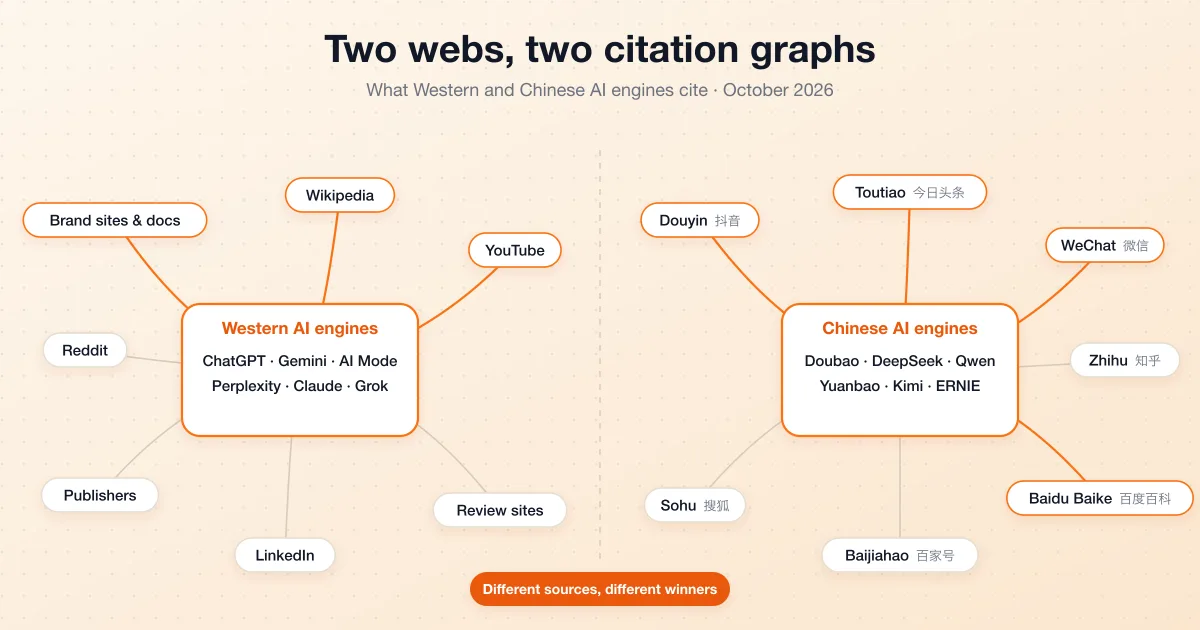
Western and Chinese AI engines are not ranking the same web in a different order. They are reading two different webs. ChatGPT, Google’s AI Overviews, AI Mode and Gemini, Perplexity, Claude and Grok draw mostly on the open, English-language web: company sites and documentation, Wikipedia, YouTube, Reddit and the major publishers. Doubao, DeepSeek, Qwen, Tencent Yuanbao, Kimi and Baidu’s ERNIE draw on the Mandarin platform web: Douyin, Toutiao, WeChat Official Accounts, Baidu Baike and Baijiahao, Sohu, Bilibili and CSDN. In the West, company websites are the single biggest source of AI citations. In China they are a minor source, and content platforms take their place.
For a brand that sells in both markets, that changes the job. Global GEO is not one SEO program translated into Mandarin. It is two coordinated distribution programs that share one fact base. This brief sets out the best 2026 evidence for both citation graphs, how prompt language rewires them, what “being cited” actually measures, and how to win and track visibility in both. For the market background, read China’s AI internet versus the West. For China’s largest assistant, read Doubao in China. For one category measured engine by engine, see our 120,000-citation study.
Updated October 16, 2026. Every figure is tied to its study, sample and date. The studies use different prompts, engines and definitions, so compare directions, not decimals.
Western vs Chinese AI Engines at a Glance (October 2026)
| Western AI engines | Chinese AI engines | |
|---|---|---|
| Main engines | ChatGPT, Google AI Overviews, AI Mode and Gemini, Perplexity, Claude, Grok, Copilot | Doubao, DeepSeek, Qwen, Tencent Yuanbao, Kimi, Baidu ERNIE (Wenxin) |
| What they retrieve from | The open, mostly English-language web | The Mandarin platform web, much of it inside apps |
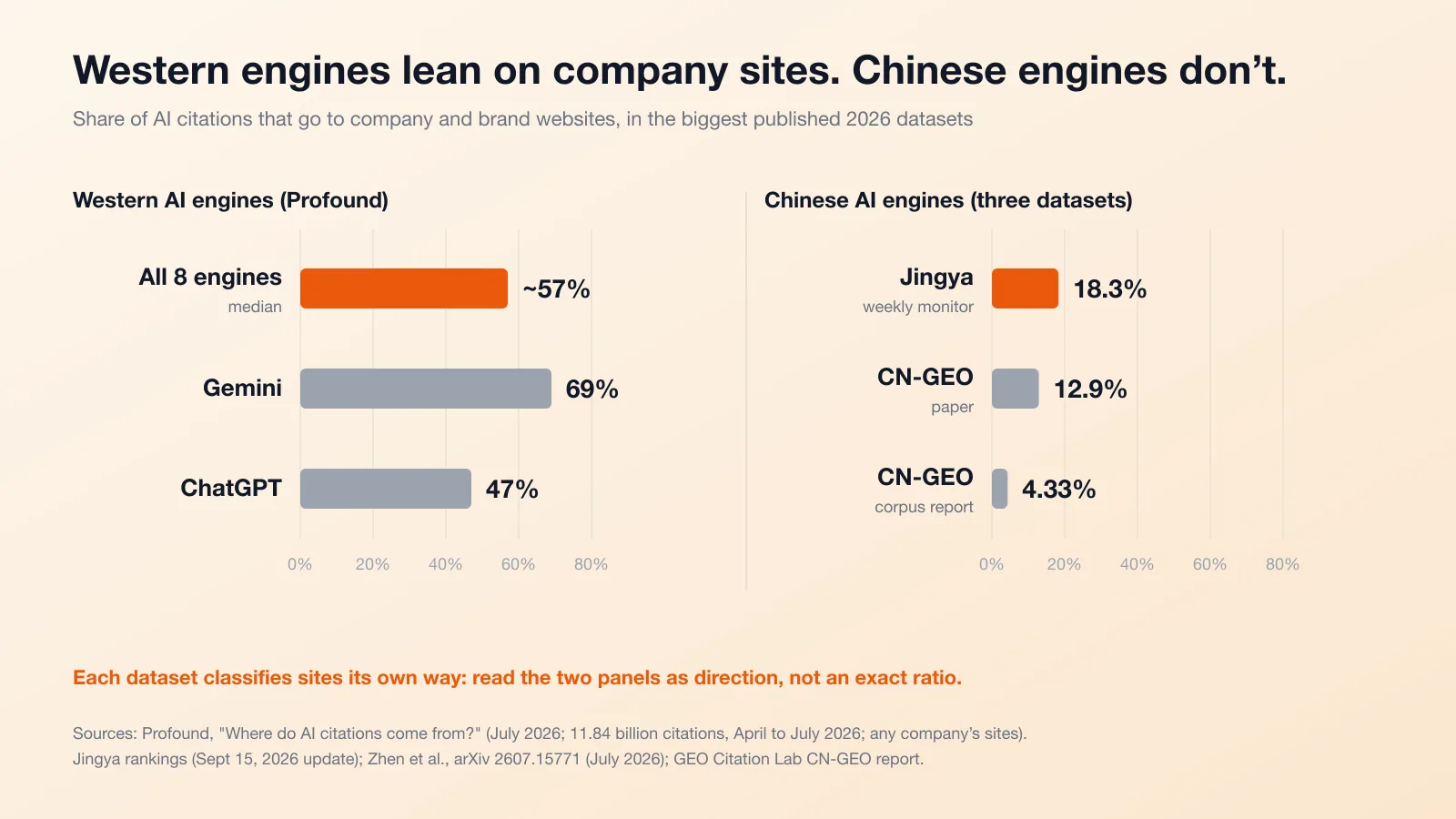
| Company and brand sites | About 57% of 11.84 billion citations; 47% on ChatGPT, 69% on Gemini (Profound) | 4.33% to 18.3% of citations across three datasets (CN-GEO, Zhen et al., Jingya) |
| Platforms and communities | Social platforms 15.3% of AI Overviews’ citations and 14.4% of AI Mode’s (Profound) | 29.63% of citations from 4.68% of sources in CN-GEO; content and community platforms 21.9% in Jingya |
| Reference layer | Wikipedia | Baidu Baike |
| Community answers | Reddit, LinkedIn | Zhihu |
| Video | YouTube | Douyin, Bilibili |
| Publishing layer | News publishers, trade media, review sites | WeChat Official Accounts, Baijiahao, Toutiao, Sohu, NetEase |
| Parent-company effect | AI Mode turns to Google’s own properties for purchase questions (Conductor); YouTube tops AI Overviews’ health citations (Dartmouth) | WeChat Official Accounts take 46.49% of Yuanbao’s citations and Douyin 23.90% of Doubao’s (Jingya) |
| Language of sources | 83% to 95% English for ChatGPT, AI Overviews and Perplexity (arXiv 2604.25707) | 72% to 89% mainland-Chinese sources named by DeepSeek, Qwen and Doubao in an API panel (Eastbound) |
Each market’s figures come from different prompts, industries and classification schemes, and the three Chinese datasets classify brand sites differently from each other. Read the comparison as direction, not as a like-for-like ratio.
Why There Is No Single AI Citation Leaderboard
There is no universal top-ten list of AI sources, and any chart that claims one is averaging away the signal. Source mix shifts with the engine, the interface, the query intent, the language, the country, the industry, the model version and whether the product decides to search at all. Even one company’s products disagree. Conductor tracked seven engines across seven intents from September 2025 to March 2026 and found that Google’s AI Overviews, AI Mode and Gemini “don’t share a source preference. Not for Education. Not for Purchase. Not for Support.” It also found that “ChatGPT and ChatGPT Search are separate products with meaningfully different citation behavior” (Conductor).
The pools also churn. Sistrix followed 82,619 prompts in six countries for 17 weeks and found that 56% of the domains cited by Google AI Mode were new each week; for ChatGPT Search in Germany it was 74% (Sistrix). When Orbit Media re-ran the same 72 questions two days apart, Claude kept only 30% of the URLs it had cited, Gemini 38% of its domains and Perplexity 65% (Orbit Media). A single screenshot is an anecdote, not a benchmark.
The best evidence available in October 2026 is still observational. None of it is a view inside a vendor’s retrieval system:
| Evidence type | Best 2026 examples | What it can show | Main caveat |
|---|---|---|---|
| Open controlled studies | GEO Citation Lab: 602 prompts, 21,143 citations across ChatGPT, AI Overviews and Perplexity. CN-GEO: 160,860 cleaned citations from four Chinese engines. Fudan University: 17,211 citations from ten engines in both markets | Engine contrasts, language effects, whether a cited page shaped the answer | Designed prompts; snapshots; incomplete model versions and timestamps |
| Commercial telemetry | Profound: 11.84 billion citations, eight engines, 29 industries. Profound: 3.25 billion citations, seven models, 14 countries | Source categories and language patterns at scale | Proprietary prompts, no raw data, no Chinese market |
| Longitudinal panels | Conductor: seven engines, seven intents, seven months. Sistrix: 82,619 prompts, 17 weeks | Persistence and drift | Conductor reports the top domain per cell; Sistrix covers Google and ChatGPT only |
| Focused audits | Prefer: 960 answers. PeakMetrics: 25,200 answers. Orbit Media: 13,184 citations | Concrete domain examples | Topic-specific; several ran API models rather than consumer apps |
| China field panels | Jingya: 19,622 questions a week across six engines. Eastbound: 540 API calls. Jademond: 40,000+ citations | Platform-level direction inside China | Methods are summarized, not published; Eastbound queried international APIs, not the consumer apps |
What Western AI Engines Cite
The biggest source of Western AI citations is company websites, not Reddit or the press. Profound classified 11.84 billion citations across ChatGPT, Claude, Google AI Mode, Google AI Overviews, Gemini, Grok, Microsoft Copilot and Perplexity, collected between April 16 and July 16, 2026, and found that “AI citations are roughly 57% brand citations”: corporate sites, product sites, brand-owned blogs and documentation. ChatGPT used them least, at 47%; on Gemini they were 69% of all citations (Profound).
Read that number carefully. “Brand” here means company-operated sites of any company in the category, including competitors, manufacturers and vendors, and Profound reports medians across categories. Your own site’s share is much smaller. In our 120,000-citation study of one B2B category, the brand’s own domain took 7.9% of ChatGPT’s citations and 26% of Perplexity’s (most-cited domains by industry). The lesson is not that AI cites your website. It is that AI treats first-party documentation as a class of evidence, so yours has to be the best in your category.
The mix shifts by engine. ChatGPT had the highest earned-media share, at 30%, and Google AI Overviews the lowest, at 17.0%. AI Overviews (15.3%) and AI Mode (14.4%) cited social platforms at about 1.3 times ChatGPT’s rate and four times Copilot’s. A separate controlled study of 21,143 citations found official, news and vertical sources made up 87.5% of ChatGPT’s citations, 87.3% of AI Overviews’ and 79.1% of Perplexity’s (Zhang, He and Yao, arXiv 2604.25707).
| Engine | Citation profile | What 2026 panels found |
|---|---|---|
| ChatGPT / ChatGPT Search | Fewest citations per answer, 6.88 per prompt, but the deepest use of each; highest earned-media share (30%) | ChatGPT Search favoured Wikipedia for education, recommendation, comparison and purchase questions; conversational ChatGPT leaned on Reddit for support questions in five of seven months (Conductor) |
| Google AI Overviews | Broad citation lists (12.06 per prompt); highest social share (15.3%); lowest earned media (17.0%) | YouTube led most intents (Conductor). On shopping questions Reddit was the top domain, in 40.6% of overviews, with YouTube second, in a small sample of 32 overviews (PeakMetrics) |
| Google AI Mode | Exploratory; leans on Google’s own surfaces for commerce | Google properties led purchase questions, and it was the only engine citing LinkedIn for education questions (Conductor) |
| Gemini | The most brand-site-heavy engine (69%, Profound) and the most YouTube-heavy | YouTube anchored nearly every intent (Conductor) and appeared in 113 of 240 Gemini answers in Prefer’s test, where no other engine cited YouTube at all (Prefer) |
| Perplexity | The longest citation lists: 16.35 per prompt (arXiv 2604.25707), 19.2 per answer (Orbit Media) | YouTube led education and recommendation questions every month (Conductor); LinkedIn (374 citations), YouTube (248) and Reddit (232) led Orbit’s B2B panel; Reddit was its top source in Prefer’s |
| Claude | Sparse and primary-source-led | Never put YouTube, Wikipedia or Reddit in any of 16 rank-one slots in February and March 2026, favouring brand and institutional domains (Conductor); zero Reddit citations in 5,040 answers (PeakMetrics) |
| Grok | Live web plus a separate X Search tool (xAI) | 8.4 domains per answer, with Forbes its most-cited domain at 1.1% (PeakMetrics) |
Our own data points the same way: in the citation DNA study, Claude leaned on owned, patent and analyst sources while Perplexity leaned on Reddit, LinkedIn and YouTube.
Wikipedia, YouTube and Reddit do different jobs
Wikipedia supplies definitions. In the GEO Citation Lab data, encyclopedia pages had the highest average influence on answers of any source type, 0.2144 against 0.0726 for news, and Wikipedia was ChatGPT Search’s top source for four of seven intents in Conductor’s panel. It is not dominant everywhere, and Claude never put it first.
YouTube is a Google-and-Perplexity source. It was the most-cited domain in the GEO Citation Lab pool (560 of 21,143 citations, ahead of Wikipedia’s 352 and Reddit’s 315), and it led most intents for AI Overviews, Gemini and Perplexity in Conductor’s panel. Its weight depends on language too: YouTube made up 38.0% of AI Overviews’ social citations for English prompts, 50.5% for Spanish, 65.0% for Portuguese and 26.0% for Arabic (Profound).
Reddit is the most measurement-sensitive of the three. Reddit accounted for 51% to 76% of ChatGPT’s social citations in every country Profound measured. Yet across PeakMetrics’ 25,200 assistant answers, Reddit was under 1% of citations on corporate questions, appeared in 0.4% of ChatGPT’s answers and 16.7% of Gemini’s, and Claude cited it zero times. On shopping questions in AI Overviews it was the top domain. These figures do not contradict each other; they use different denominators (share of social citations, share of all citations, share of answers), topics and model versions. Ask which denominator a Reddit statistic uses before acting on it, and see how unstable the global list is from month to month.
English dominates the Western citation pool
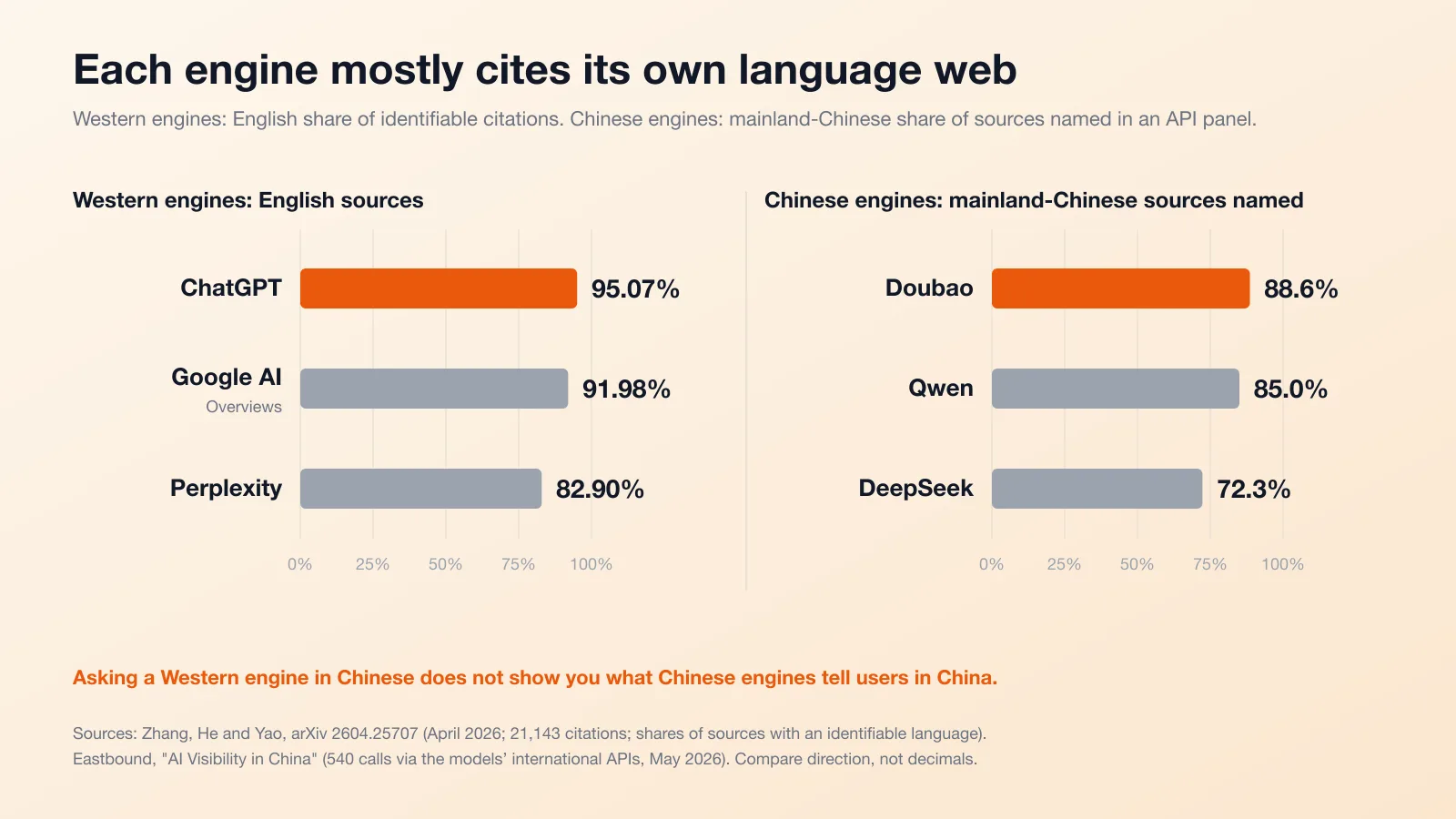
In the GEO Citation Lab sample, English made up 95.07% of ChatGPT’s identifiable citations, 91.98% of AI Overviews’ and 82.90% of Perplexity’s, and US sources 82.7% to 86.8%. The authors warn that “high authority and US-English dominance may disadvantage smaller, local, multilingual, or long-tail sources” (arXiv 2604.25707). Sistrix saw the same pull outside English: 68% of ChatGPT’s core sources were in English even for German queries, while 80% of Google AI Mode’s core domains were German (Sistrix).
What Chinese AI Engines Cite
Chinese engines cite content platforms, not company websites. The largest open dataset, CN-GEO, was collected in June and July 2026 by Beijing’s Aidso Wendao Research Institute and released as open data (Zhen et al., arXiv 2607.15771). Its raw layer holds 214,119 citation records from twelve Chinese platform and interface codes, including Doubao, DeepSeek, Yuanbao and Qwen on both web and app, plus Baidu AI, Kimi, Wenxin and AI Douyin, resolved to 9,878 sources and 107,659 pages. The GEO Citation Lab’s analysis of that corpus (CN-GEO report, in Chinese) found the most-cited sources were Douyin, Tencent’s news portal qq.com, Toutiao and Baidu Baike, and that the top ten sources took 41.47% of 187,818 deduplicated citations. Platform and community properties were 4.68% of sources but captured 29.63% of citations. Brand and corporate sites were 18.9% of sources and captured just 4.33%.
That last pair is the sharpest contrast with the West. In China, company sites are plentiful in the source pool and rarely cited. Other Chinese datasets classify sites differently and put brand and corporate sites higher, at 12.9% under the CN-GEO paper’s own taxonomy and 18.3% in Jingya’s weekly monitor of six engines (Jingya), but every one of them sits far below the roughly 57% Profound measured for Western engines.
The CN-GEO paper also found that “source sets differed systematically between the App and Web interfaces of the same platform.” Qwen’s two versions overlapped least, with a domain-level Jaccard index of 0.190, and on 64.2% of queries they cited no URL in common. If you test Qwen in a browser, you are not seeing what the app shows.
Jingya’s monitor, which samples 19,622 questions a week across DeepSeek, Kimi, Yuanbao, Doubao, Wenxin and Qwen, ranks WeChat Official Accounts and Baijiahao jointly first at 7.89% of citations each, then Sohu at 6.02%, Douyin 4.19%, Bilibili 2.64%, Zhihu Columns 2.55%, Toutiao 2.48% and CSDN 2.47%, in its September 15, 2026 update. Treat it as a cross-check rather than a strict ranking: its table lists only media and content platforms, and its method is summarized rather than published.
Ownership sharpens the picture. In Fudan University’s ten-platform measurement, Doubao sent 25.9% of its citations to ByteDance-owned domains, 13.5 times the share those domains got elsewhere; Baidu’s Wenxin sent 24.4% to Baidu-owned domains, led by Baijiahao at 20.0%; and Tencent’s Yuanbao sent 14.2% to Tencent’s (Liu et al., arXiv 2610.11932). Jingya’s per-engine view is starker: WeChat Official Accounts took 46.49% of Yuanbao’s citations, Baijiahao 24.44% of Wenxin’s and Douyin 23.90% of Doubao’s. The counterexample is Alibaba’s Qwen, which drew only 0.8% of its citations from Alibaba domains in a 40,000-citation study of smartphones, electric vehicles and industrial machinery (Jademond). The ten engines in the Fudan study, Western and Chinese, shared only about a fifth of their top-20 source domains on average. The detail is in our Doubao brief.
Chinese engine profiles
| Engine | Most-cited sources | Citations per answer | How local |
|---|---|---|---|
| Doubao (ByteDance) | Douyin first (28.5% of app citations, 11.9% of web), then Toutiao and Sohu (CN-GEO); Douyin 23.90%, Toutiao 13.49%, mobile Sohu 11.65% (Jingya) | About 18 | 88.6% mainland-Chinese sources (Eastbound) |
| DeepSeek | The flattest profile, with no single domain above about 5% (CN-GEO paper); business media, Sohu and GitHub lead in Jingya; Baidu Baike leads its web citations in CN-GEO | 9.2, the fewest | 72.3% mainland, the lowest; Wikipedia and YouTube lead its foreign sources (Eastbound) |
| Qwen (Alibaba) | Business and regional news sites, Toutiao, Bilibili and CSDN (Jingya); Baidu Baike and Toutiao on both web and app (CN-GEO); 0.8% from Alibaba domains (Jademond) | 20.1 on the web, 11.0 in the app | 85.0% mainland (Eastbound); 96% of cited pages had Chinese titles (Fudan) |
| Tencent Yuanbao | WeChat Official Accounts, 46.49% of citations (Jingya); Tencent’s qq.com about a fifth of its web and app citations (CN-GEO) | About 13 to 14 | No public split |
| Kimi (Moonshot AI) | Sohu (15.57%), WeChat Official Accounts (9.88%), the developer blog network cnblogs (8.24%) and business media (Jingya) | Not measured in CN-GEO | No public split |
| Baidu ERNIE / Wenxin | Baijiahao (24.44%), Sohu (10.81%) and Zhihu Columns (7.31%) in Jingya; Baijiahao 20.0% in Fudan | Not measured in CN-GEO | Chinese-first by design |
Citations per answer come from the CN-GEO paper (June and July 2026). Jingya shares are each engine’s citations in its September 15, 2026 weekly update.
Zhihu, Toutiao, Baijiahao and Xiaohongshu
Zhihu is where the measurements disagree most. It plays the roles of Wikipedia-style explainer and Reddit-style experience at once, with long-form answers in indexable text, and in Eastbound’s handbag panel DeepSeek named Zhihu in 97% of its responses. Yet in the CN-GEO corpus Zhihu ranked only 36th, with 0.34% of deduplicated citations, while Jingya puts Zhihu Columns at 2.55% of all citations and 7.31% of Wenxin’s. The gap comes from engine, category and counting: the share of answers that mention a source is not the share of all citations. Check which one a Zhihu statistic reports before building a plan on it.
Toutiao is ByteDance’s news feed. It was Doubao’s top domain in Fudan’s March 2026 measurement and second only to Douyin in CN-GEO and Jingya, and it also feeds Yuanbao, Qwen and Wenxin answers: 2.48% of all citations in Jingya’s monitor.
Baijiahao, Baidu’s publishing platform, is the clearest case of a property escaping its owner’s engine. It took 7.89% of all citations in Jingya’s monitor, with coverage across DeepSeek, Qwen and Wenxin, and 24.44% of Wenxin’s own. Treat it as a distribution layer, not an authority signal. Corroboration from your own site, a primary document or a reputable third party still matters.
Xiaohongshu is the most contradictory finding in the China evidence. In a 1,620-response handbag panel in May 2026, Doubao named it in 64% of answers (Eastbound). In QuestMobile’s April to May 2026 study, it did not make the top ten sources of Doubao, DeepSeek or Qwen for travel, automotive or insurance questions (36Kr). The likely explanation is category, counting method, crawlability and app context, not that one study is wrong. Xiaohongshu is a strong discovery channel; its value for AI citations has to be proven category by category.
How Prompt Language Rewires the Citation Graph
The language of a prompt changes which web an engine reads, and it does not change it the same way for every engine. A University of Toronto team translated 100 English queries across ten consumer verticals into Chinese, Japanese, German, French and Spanish and compared the sources. GPT “effectively switches to different site ecosystems by language”, Perplexity also localizes, and Claude “reuses English-language authority domains across languages”. Classic Google results stayed more than three-quarters English for Chinese queries (Chen et al., arXiv 2509.08919). That study ran in 2025 on earlier models, but the pattern recurs in 2026 data. In a Dartmouth audit of 1,920 health queries across 12 countries, asking Google’s AI Overviews in the local language instead of English raised the share of locally sourced citations 3.5 to 13.5 times, from 16.6% to 57.5% in Japan and from 2.7% to 36.4% in South Korea (Zha and Chang, arXiv 2609.06798). Profound found ChatGPT’s social citations fall from about 10% in English markets to 3% to 5% elsewhere, because “ChatGPT’s social pipeline is a Reddit pipeline, and Reddit is an English-first platform” (Profound).
Citation volume moves too, in different directions. In GEO Citation Lab’s paired language layer, ChatGPT gave slightly more citations to Chinese prompts than to English ones (7.77 vs 7.03), AI Overviews far fewer (7.53 vs 11.57) and Perplexity about the same (15.93 vs 16.43). That layer is small, 60 prompts, and counts citations rather than their language, but it retires the assumption that English always gets broader sourcing.
Chinese engines are local in the other direction. In Eastbound’s May 2026 panel, run through the models’ international APIs, 88.6% of the sources Doubao named were mainland-Chinese, 85.0% of Qwen’s and 72.3% of DeepSeek’s. Category matters as much as engine: Jademond found Chinese-language sources above 95% for electric-vehicle questions but about 62% for smartphones. The practical reading is that asking ChatGPT in Chinese does not show you what Chinese users see in Doubao, and asking DeepSeek in English does not show you what it tells users in Shanghai. A dual-market panel needs both languages on both sides, which is how we track DeepSeek.
Cited Is Not the Same as Used
Three measurements from 2026 split “being cited” into separate steps, and each one undercuts a common assumption.
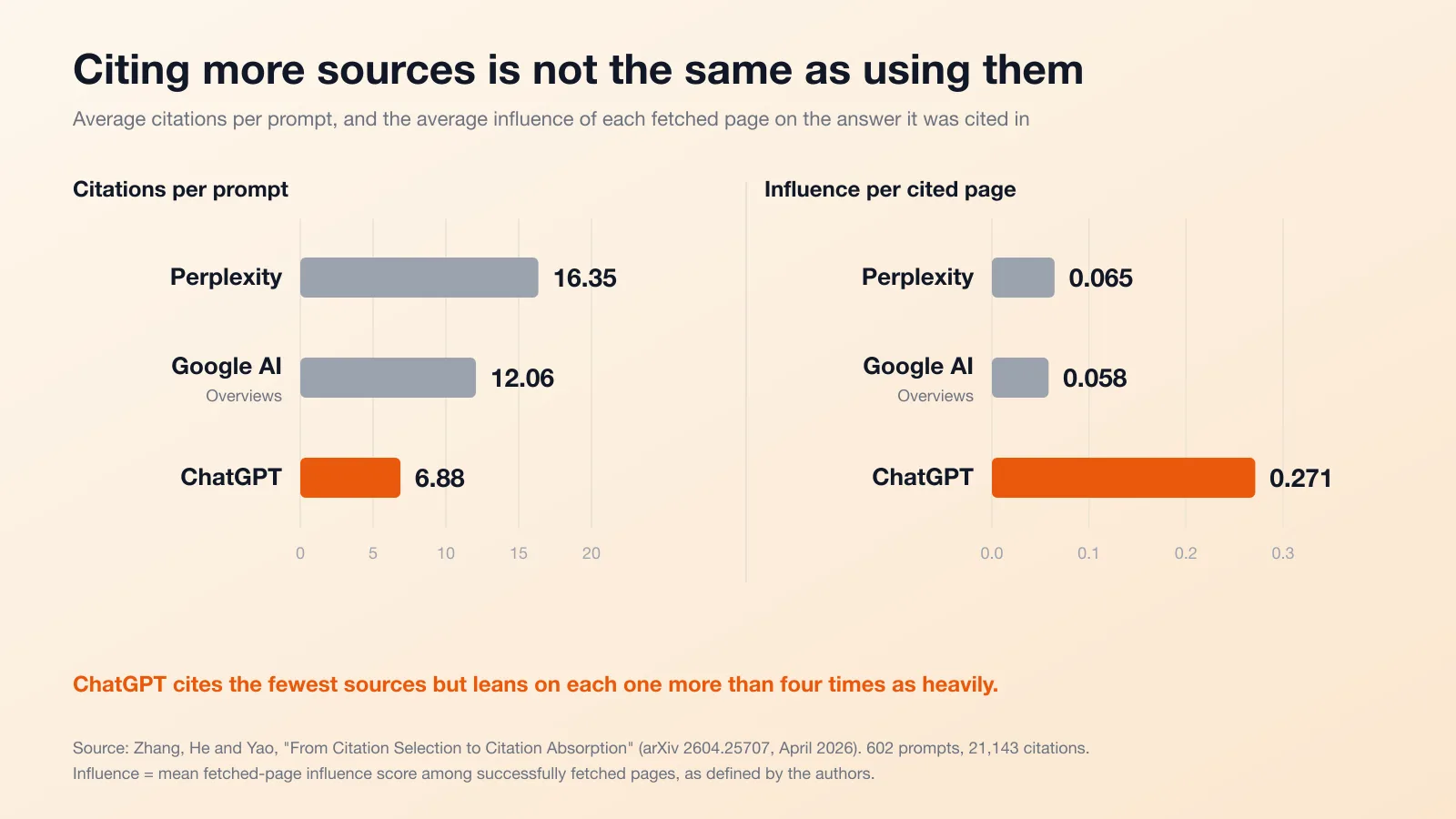
More citations do not mean deeper use. In the GEO Citation Lab data, Perplexity averaged 16.35 citations per prompt and AI Overviews 12.06, against ChatGPT’s 6.88. But among the pages the researchers could fetch, ChatGPT’s cited pages had a mean influence score on the answer of 0.2713, more than four times Perplexity’s 0.0646 and AI Overviews’ 0.0584. A Perplexity citation is one of many. A ChatGPT citation is more likely to have shaped what the user read. Chinese engines vary just as much: DeepSeek averaged 9.2 citations per answer in the CN-GEO paper, Doubao about 18, and Qwen 20.1 on the web but 11.0 in its app.
FAQ formatting is not a shortcut. Pages formatted as Q&A had slightly lower average influence than other pages (0.0947 vs 0.1005, a 5.74% gap). Pages containing statistics showed 61.55% higher influence than pages without, definitions 57.33%, comparisons 55.28% and how-to steps 41.20%, and high-influence pages were “longer, more modular, more semantically aligned with the generated answer” (arXiv 2604.25707). Write the evidence first, then format it.
Being in the citation pool does not mean being named. In the CN-GEO paper, only 8.3% of the brands found in the engines’ cited sources also appeared in the answer, and 13.02% of brand mentions in answers could not be matched to any source cited at the time (Zhen et al., arXiv 2607.15771). Repetition moves the odds: a brand present in one cited source reached the answer 2.1% of the time, while one present in eleven or more reached it 59.9% of the time. Citations, absorption and brand mentions are three different metrics, and a tracker that only counts the first will overstate your visibility.
Citations go stale. Among dated pages in the CN-GEO data, fitted citation half-lives were about 39 days for time-sensitive queries and 68 days for the rest. In the West, 56% weekly domain churn in AI Mode says the same thing another way. What earned a citation last quarter may not hold it this one.
How to Be Cited in Both Webs
Start with one canonical evidence layer
Keep authoritative English and Simplified-Chinese pages with the same facts: entity and product names, specifications, prices, availability, legal claims and dates. Server-render them, keep URLs stable, show authorship and update dates, and keep essential claims out of images, video and client-side widgets. Build each page as an evidence container rather than a keyword container, with definitions, numbers, comparisons and steps an engine can lift. That is what the influence data rewards, and it is the layer both webs eventually check their sources against. The technical half is in our GEO website-readiness checklist and in how each engine indexes content.
Distribute for Western engines
- Publish primary pages: documentation, help, pricing, methodology and data. Company-operated sites are the largest citation bucket.
- Earn independent coverage on the publishers, institutions and vertical sites that dominate your exact category, not a generic “top AI sources” list; the most-cited domains by industry is the starting map.
- Make substantive YouTube videos for Google’s AI surfaces and Perplexity, with descriptive titles, transcripts, chapters and links back to the canonical page.
- Take part in Reddit and LinkedIn honestly: support threads, comparisons and experience posts, not planted promotion. Their weight swings by engine and intent.
- Keep entity data consistent for reference-style engines. Wikipedia is not a channel you control, but accurate, independently notable facts help.
- For Grok, watch X as well as the web, because xAI runs separate Web Search and X Search tools.
Distribute for Chinese engines
- Run a genuine Simplified-Chinese site that loads reliably from the mainland, mirroring the canonical facts rather than translating marketing copy literally. The access and hosting detail is in our China AEO playbook.
- Win coverage in Chinese business, trade and news media. Media and vertical or editorial publications made up 37% to 70% of cited source types across industries in one six-engine study (Jademond), and business media and Sohu lead Kimi’s and DeepSeek’s citations in Jingya’s data.
- Publish WeChat Official Account articles for Yuanbao, where they take nearly half of all citations, and for Kimi, with the critical facts in text rather than images.
- Use Douyin and Toutiao for Doubao, turning video claims into searchable titles, captions, transcripts and companion text.
- Use Baijiahao and an accurate Baidu Baike entry for Wenxin, knowing Baijiahao also travels into DeepSeek and Qwen citations.
- Publish deep, sourced Zhihu answers for definitions and comparisons, and check their pickup engine by engine.
- For technical products, add CSDN, developer blogs and GitHub. CSDN ranks among Doubao’s and Qwen’s top sources, cnblogs among Kimi’s and GitHub among DeepSeek’s in Jingya’s data.
- Test Xiaohongshu category by category before investing in it for citations.
| To be cited by… | Prioritize |
|---|---|
| ChatGPT and ChatGPT Search | Documentation and reference pages, consistent entity facts, earned editorial coverage |
| Google AI Overviews, AI Mode and Gemini | Well-indexed pages, YouTube, Google Business Profile and product data |
| Perplexity | YouTube, LinkedIn, Reddit, documentation |
| Claude | Primary sources: your docs, institutional and analyst pages |
| Grok | The open web plus credible X discussion |
| Doubao | Douyin, Toutiao, Sohu, CSDN, vertical trade media |
| DeepSeek | Business and industry media, Sohu, GitHub, Baidu Baike |
| Qwen | Business and regional news sites, Toutiao, Bilibili, CSDN, Baidu Baike |
| Tencent Yuanbao | WeChat Official Accounts |
| Baidu ERNIE / Wenxin | Baijiahao, Sohu, Zhihu Columns, Baidu Baike |
| Kimi | Sohu, WeChat Official Accounts, developer blogs, business media |
How to Measure Brand Visibility Across Both Webs
Track a fixed prompt panel by market, language, engine, interface and intent, not one global share-of-voice number. At minimum, separate ChatGPT from ChatGPT Search; AI Overviews, AI Mode and Gemini from each other; and each Chinese engine’s app from its web version, because the CN-GEO paper found their source sets differ systematically.
Then measure four stages separately:
- Retrieval: was a page you control, or a third-party page about you, cited?
- Absorption: did its facts, framing or wording shape the answer?
- Entity exposure: were you actually named, described accurately and placed on the shortlist?
- Outcome: did the visibility produce referral traffic, branded search, leads or assisted conversions?
Repeat every prompt across runs and dates. With 56% to 74% weekly domain churn in the West and Claude keeping only 30% of its URLs over two days, one run tells you what an engine said once, not what it usually says. And map each citation to its source, because the useful output is not “we were mentioned” but “this domain earned the mention”, which tells you where to publish next.
What Nobody Discloses
- Retrieval internals. No vendor publishes its retrieval index, source weights, ranking features, citation thresholds, or how training data relates to live retrieval.
- One Google AI. There isn’t one. AI Overviews, AI Mode and Gemini are separate surfaces with separate source behavior.
- Claude and Grok rankings. Public domain-level data for both is thinner than for ChatGPT, Google and Perplexity. Anthropic’s help center confirms that with web search “every response includes citations” but documents no source hierarchy (Anthropic); xAI documents its Web and X search tools but not how they are weighted.
- Chinese language splits. Comparable English-versus-Chinese figures for Yuanbao, Kimi and Wenxin have not been published, and the best locality figures come from international APIs rather than the consumer apps.
- Raw-data gaps. The CN-GEO raw records lack complete answers, answer batches, model versions and collection timestamps, which rules out trend, sentiment and strict ranking analysis from the raw layer alone.
- Whether a citation supports the answer. xAI’s API separates “All Citations (a complete list of all sources encountered)” from inline citations, and warns that “not every URL in this list will necessarily be directly referenced in the final answer” (xAI). A source list is not proof of support.
How Sanbi Tracks Both Halves of the Graph
Sanbi’s global plans track ChatGPT, Gemini, Perplexity, Claude and Google AI Mode on a fixed prompt set, score mention, position and sentiment, map the domains behind every citation, and benchmark competitors on the same prompts. Run a free AI visibility audit across ChatGPT, Gemini and Claude to see your Western baseline.
Sanbi’s Chinese AEO tracker is launching with Qwen and DeepSeek, and the waitlist is open. It will run your prompts in Chinese and in English, and resolve every citation to the Chinese platform it came from: Baidu, Zhihu, Weibo, Xiaohongshu, WeChat, CSDN, Bilibili, Douban, Juejin and Kuaishou. Running both languages also shows the Western sources these models cite when they answer in English outside China. More Chinese models will follow. China plans start at $29/month: join the China waitlist or book a demo.
The Decision Rule
A brand that wants to be visible in both ecosystems should spend its effort in this order:
- Make the first-party fact base accurate, crawlable, modular and bilingual.
- Find the source type that wins each engine, intent and market you care about.
- Earn corroboration on open Western authority surfaces and on Chinese platform and vertical surfaces.
- Adapt the format, whether reference page, video, community answer or official-account article, without changing the facts.
- Measure citations, absorption and brand mentions separately, by app and web and by language, over repeated runs.
The wrong question is “which ten domains do AI engines cite most?” The useful one is “for this buyer intent, in this language, on this interface, which sources keep entering the citation pool, and which of them actually shape the answer?”
Sources
- Zhang, He and Yao: From Citation Selection to Citation Absorption: A Measurement Framework for Generative Engine Optimization Across AI Search Platforms, arXiv 2604.25707 (April 2026)
- Zhen, Liu, Zhang and Niu, Aidso Wendao Research Institute: What Do Chinese-Language Generative Search Engines Cite and Surface? A Large-Scale Empirical Study, arXiv 2607.15771 (July 2026); data at WENDAOstudy/cn-geo-citation-dataset
- GEO Citation Lab: project repository and CN-GEO multi-dimensional analysis report (Chinese)
- Liu et al., Fudan University: From Public Posts to AI-Search Citations: Measuring the Fragility of AI Search, arXiv 2610.11932 (October 8, 2026)
- Profound (Jasman Singh): Where do AI citations come from? (July 30, 2026)
- Profound (Davis McCain): How query language reshapes AI citations (April 21, 2026)
- Conductor (Jia-Rong Li): How AI Engines Choose and Cite Sources: A 7-Month Analysis (May 7, 2026)
- Sistrix (Johannes Beus): AI citation drift: how stable are sources in AI search results? (May 1, 2026)
- Orbit Media (Bill Widmer): LLM Citation Study: 13,184 Citations Across 4 AI Tools (September 2, 2026)
- Prefer (Javed Khatri): How AI engines search and cite: 960 answers measured (September 19, 2026)
- PeakMetrics: Does Reddit Dominate AI Answers? Google AI Overviews vs AI Assistants (September 30, 2026)
- Chen, Wang, Chen and Koudas, University of Toronto: Generative Engine Optimization: How to Dominate AI Search, arXiv 2509.08919 (September 2025)
- Zha and Chang, Dartmouth College: Who Anchors AI Overviews in Health? Baidu, Google, and the Geography of Authority, arXiv 2609.06798 (September 2026)
- Jingya (鲸牙启量): AI citation source rankings, weekly update of September 15, 2026 (Chinese)
- Jademond Digital (Marcus Pentzek and Kun Tang): Chinese GEO: How DeepSeek, Doubao & Co. Choose Sources (September 28, 2026)
- Eastbound: AI Visibility in China and Xiaohongshu AI visibility (May 2026)
- 36Kr: Will AI Silently Replace Xiaohongshu?, citing QuestMobile (May 27, 2026)
- xAI: Citations and X Search documentation
- Anthropic: Enable and use web search (Claude help center)
Method notes: Profound’s 57% is a median across categories and counts company-operated sites of any company, not only the brand being asked about. GEO Citation Lab’s “Google” is Google AI Overviews in Search, its English shares are shares of identifiable sources, and its influence scores cover successfully fetched pages. The Toronto study’s “Google” is classic organic results, and its models date from 2025; the Dartmouth language test covered Google only. Sistrix’s 74% weekly churn is ChatGPT Search in Germany; its six-country AI Mode figure is 56%. PeakMetrics, Prefer and Orbit Media ran API or agent setups, not consumer apps. CN-GEO’s corpus figures come from the GEO Citation Lab analysis of the Aidso dataset and describe the most-cited sources in that dataset, not a strict ranking; the paper’s own cleaning gives slightly different shares. Jingya ranks only media and content platforms and samples one week at a time. Eastbound’s locality figures come from the engines’ international APIs and from the sources the models named. QuestMobile’s travel figures are rates per question. The datasets use different engines, prompts and classifications, so they show direction rather than comparable shares. Nothing here is legal or investment advice.
Frequently Asked Questions
They read different webs. Western engines such as ChatGPT, Google's AI Overviews, AI Mode and Gemini, Perplexity, Claude and Grok draw mostly on the open, English-language web: company sites and documentation, Wikipedia, YouTube, Reddit and major publishers. Chinese engines such as Doubao, DeepSeek, Qwen, Tencent Yuanbao, Kimi and Baidu's ERNIE draw on the Mandarin platform web: Douyin, Toutiao, WeChat Official Accounts, Baidu Baike and Baijiahao, Sohu, Bilibili and CSDN. Company websites are the largest Western citation source, about 57% of 11.84 billion citations in Profound's 2026 data, while three Chinese datasets put brand and corporate sites at only 4.33% to 18.3% of citations.
Far more in the West. Profound's analysis of 11.84 billion citations across eight engines, collected April to July 2026, found about 57% came from company-operated sites, meaning any company's corporate pages, product pages, blogs and documentation, from 47% on ChatGPT to 69% on Gemini. In China, brand and corporate sites took 4.33% of citations in the CN-GEO corpus even though they made up 18.9% of its sources, 12.9% under the CN-GEO paper's own classification, and 18.3% in Jingya's weekly monitor of six engines. The datasets classify sites differently, so the gap shows direction, not an exact ratio.
Baidu Baike plays Wikipedia's reference role: it was one of the four most-cited sources in the CN-GEO corpus, alongside Douyin, Tencent's news portal qq.com and Toutiao. Zhihu is the closest match to Reddit and to Wikipedia-style explainers, but its measured weight varies widely: 0.34% of citations in CN-GEO, 2.55% for Zhihu Columns in Jingya's weekly monitor and 7.31% of Wenxin's citations, yet named in 97% of DeepSeek's responses in one product panel. Check the engine and the counting method before you invest.
Baijiahao (百家号) is Baidu's content-publishing platform, where media outlets, companies and creators post articles that Baidu indexes. Baidu's own Wenxin leans on it heavily: it took 20.0% of Wenxin's citations in Fudan University's 2026 measurement and 24.44% in Jingya's weekly monitor. It also travels into other engines. Jingya ranks it joint first across six Chinese engines at 7.89% of all citations, with coverage in DeepSeek, Qwen and Wenxin. Treat it as a distribution layer for Chinese-language claims, backed by your own site and reputable third parties.
It depends heavily on the category. In a 1,620-response handbag panel run in May 2026, Doubao named Xiaohongshu in 64% of its answers. Yet in QuestMobile's April to May 2026 study, Xiaohongshu did not make the top ten sources of Doubao, DeepSeek or Qwen for travel, automotive or insurance questions. The difference comes from category, counting method and how much Xiaohongshu content engines can crawl. It is a strong discovery channel; measure its citation value in your own category before investing in it for AI visibility.
Less than you would expect. In a study of more than 40,000 Chinese AI citations across smartphones, electric vehicles and industrial machinery, only 0.8% of Qwen's citations came from Alibaba-owned domains, fewer than the 8% from Baidu properties, and Fudan University's 2026 measurement found Baidu was Qwen's single most-cited domain at 10.1%. In Jingya's weekly monitor, Qwen's most-cited sources are business and regional news sites, Toutiao, Bilibili and CSDN. Shopping categories may behave differently, so test your own.
DeepSeek. In a 540-call panel run through the engines' international APIs in May 2026, 72.3% of the sources DeepSeek named were mainland Chinese, against 85.0% for Qwen and 88.6% for Doubao, with Wikipedia and YouTube leading its foreign sources. DeepSeek also had the flattest source profile in Fudan University's ten-platform study, with no single domain above 3.1% of its citations, and GitHub is among its top sources in Jingya's weekly monitor, which makes it the likeliest bridge between Chinese and international sources.
Yes, and not in the same direction for every engine. In a University of Toronto study of 100 queries translated into five languages, GPT switched to different site ecosystems by language and Perplexity also localized, while Claude kept reusing English-language authority domains. In a 2026 Dartmouth audit of 1,920 health queries, asking Google's AI Overviews in the local language instead of English raised the share of locally sourced citations 3.5 to 13.5 times. Sistrix found 68% of ChatGPT's core sources were English even for German queries, while 80% of Google AI Mode's core domains were German.
Partly. A 2025 University of Toronto study found GPT switches to different, local-language site ecosystems when the query is in another language, rather than translating its English sources, and in the 2026 GEO Citation Lab data ChatGPT gave slightly more citations to Chinese prompts than to English ones, 7.77 versus 7.03. But ChatGPT can only cite what it can retrieve, and much of China's platform web sits inside apps. Asking ChatGPT in Chinese does not show you what Doubao, DeepSeek or Qwen tell users in China.
No. Conductor's seven-month study of seven engines found the three Google products do not share a source preference for education, purchase or support questions. AI Overviews favoured YouTube for most intents, AI Mode turned to Google's own properties for purchase questions and was the only engine citing LinkedIn for education questions, and Gemini was anchored on YouTube for nearly every intent. Profound also found Gemini the most brand-site-heavy engine, at 69% of citations. Track them as three channels.
Citation absorption is how much a cited page actually shapes the AI answer, as opposed to simply appearing in the source list. Researchers behind the 2026 GEO Citation Lab study measured it as a fetched-page influence score and found ChatGPT cited the fewest pages, 6.88 per prompt, but leaned on each one more than four times as heavily as Perplexity or Google AI Overviews. Pages with statistics, definitions, comparisons and how-to steps had markedly higher influence than pages without them.
Because being in the citation pool and being named in the answer are separate steps. In a study of four Chinese engines, only 8.3% of the brands found in the cited sources also appeared in the answer, and 13.02% of brand mentions in answers could not be matched to any source cited at the time. Repetition moves the odds: a brand present in one cited source reached the answer 2.1% of the time, one present in eleven or more, 59.9%. Track mentions, accuracy and position separately from citations.
Not long. Among dated pages cited by Chinese AI engines, fitted citation half-lives were about 39 days for time-sensitive queries and 68 days for others. In the West, Sistrix measured 56% of the domains cited by Google AI Mode as new each week, and 74% for ChatGPT Search in Germany, and Orbit Media found Claude kept only 30% of its cited URLs when the same questions were re-run two days later. Refresh key pages and re-measure on a schedule.
Build one bilingual fact base, then distribute it twice. Keep authoritative English and Simplified-Chinese pages with identical facts, server-rendered and full of extractable statistics, definitions and comparisons. For Western engines, add documentation, earned editorial coverage, YouTube and genuine community discussion. For Chinese engines, publish native-language content where they cite: Douyin and Toutiao for Doubao, Baijiahao and Baidu Baike for Wenxin, WeChat Official Accounts for Yuanbao and Kimi, Sohu and business media across engines, and CSDN or GitHub for technical topics. Then measure each market, language and engine separately.
Run a fixed prompt panel split by market, language, engine, interface and intent, rather than one global share-of-voice number. Separate ChatGPT from ChatGPT Search, AI Overviews from AI Mode and Gemini, and each Chinese engine's app from its web version. Measure four stages separately: whether you were cited, whether the cited page shaped the answer, whether you were named accurately, and whether it produced traffic or leads. Repeat each prompt across runs and dates, because citation pools churn weekly.
Sanbi's global plans track ChatGPT, Gemini, Perplexity, Claude and Google AI Mode, and the free audit covers ChatGPT, Gemini and Claude. Sanbi's Chinese AEO tracker is launching with Qwen and DeepSeek: it will run prompts in Chinese and in English, and resolve each citation to the Chinese platform behind it, including Baidu, Zhihu, WeChat, Xiaohongshu and CSDN. More Chinese models will follow, and the China waitlist at https://app.sanbi.ai/signup?market=china is open now.