Doubao in China: Scale, Information Sources, Citations and Agentic Commerce (October 2026)
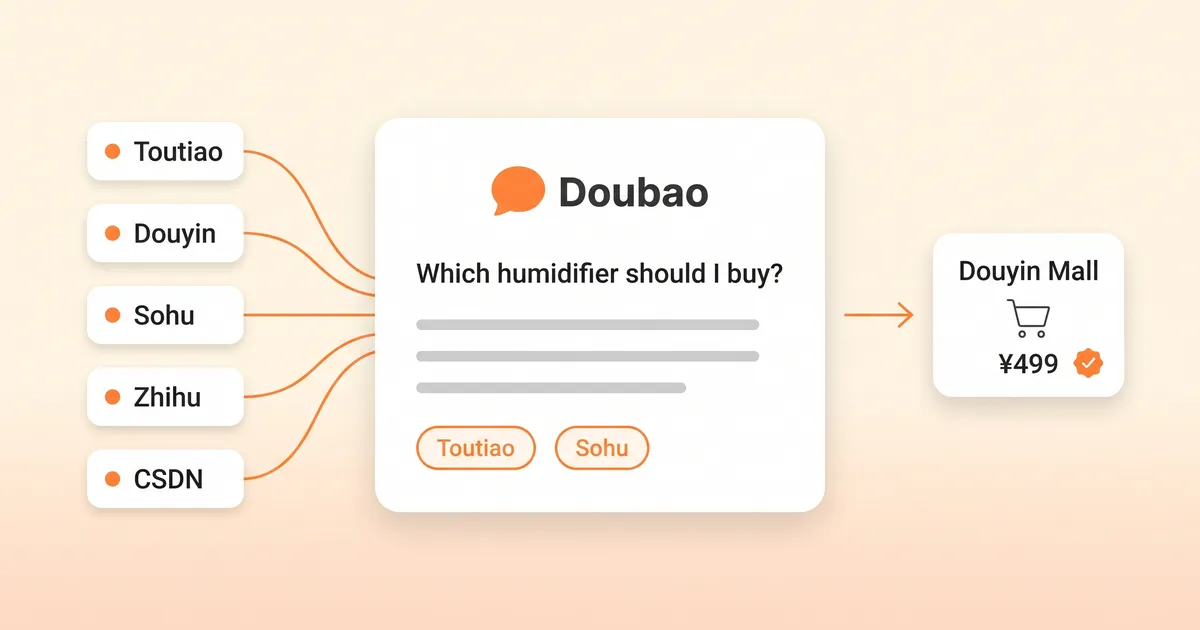
Doubao is the AI assistant more Chinese people use than any other, and it is the one most Western brands know least about. ByteDance’s app had 382.3 million monthly active users in June 2026, more than Qwen and DeepSeek combined. It builds its answers from the Chinese web, and disproportionately from ByteDance’s own Toutiao and Douyin. It picks up new posts within a day, and in one controlled test it cited a paid placement within an hour. And it is turning answers into orders, with checkout on Douyin wired into the chat.
This brief sets out the numbers, what a Fudan University study found about where Doubao’s citations come from and how fragile they are, where Doubao’s shopping sits in October 2026, and what all of it means for a brand that wants to be recommended in China. For the wider market picture, read China’s AI internet versus the West. For the platform-by-platform playbook, read AEO for DeepSeek, Qwen and ERNIE.
Updated October 15, 2026. Figures are the latest published; Doubao’s shopping rollout is moving fast, so we say what is confirmed and what is still a plan.
Doubao at a Glance (October 2026)
| Metric | Figure | As of | Source |
|---|---|---|---|
| Monthly active users | 382.3 million, up 172.1% YoY | June 2026 | QuestMobile via China Internet Watch |
| Next two AI apps | Qwen ~167 million, DeepSeek ~130 million | June 2026 | QuestMobile via Guandian |
| Daily active users | Passed 100 million (Dec 2025); 145 million peak (Spring Festival 2026); above 200 million (June 2026) | 2025 to 2026 | 36Kr via KrASIA, DoNews, 36Kr |
| Engagement | 76.7 opens and 143.7 minutes per user per month | June 2026 | QuestMobile via China Internet Watch |
| Share of China’s generative-AI users who use it | 72.2% (DeepSeek 62.0%) | 2025 survey | CNNIC via The Egg |
| Doubao model usage | 180 trillion tokens per day | June 2026 | Jiemian |
| Paid tiers | ¥68, ¥200 and ¥500 per month; basic assistant free | Late June 2026 | TechNode, Seoul Economic Daily |
| Most-cited source | Toutiao, 13.6% of Doubao’s citations; ByteDance-owned domains 25.9% | March 2026 | Fudan University study |
| Time to cite a paid post | 1 hour after delivery, 88 minutes after payment | April 2026 | Fudan University study |
| Shopping | In-app ordering and payment via Douyin e-commerce, in testing since March 2026 | Oct 2026 | DoNews, Guandian |
What Is Doubao?
Doubao (豆包, “bean bun”) is ByteDance’s consumer AI assistant. It launched in 2023, runs on ByteDance’s own Doubao model family, and covers chat, web search, writing, image and video generation, voice and video conversation, and a growing set of agent features. It is free to use for all of that. The paid tiers that arrived in June 2026 cover heavier productivity work.
Three things make Doubao different from a Western chatbot:
- It is inside ByteDance’s distribution. The company that owns Douyin, Toutiao and Xigua can put an assistant in front of hundreds of millions of people without buying ads. A ByteDance insider told 36Kr that Doubao’s marketing spend was the lowest of any company product to pass 100 million daily users (KrASIA).
- It is also an infrastructure business. Volcano Engine, ByteDance’s cloud arm, sells the same models to enterprises. Daily token usage on the Doubao models passed 120 trillion in April 2026 and 180 trillion by June, more than tenfold year over year (WIC, Jiemian).
- It reaches into hardware and commerce. ByteDance shipped a Doubao phone with ZTE in December 2025, and the app’s shopping features connect directly to Douyin’s e-commerce platform. More on both below.
Doubao is built for mainland China. ByteDance runs a separate assistant, Dola (formerly Cici), for other markets; third-party trackers put Dola above 10 million daily users at the end of 2025, mostly in Southeast Asia, Latin America and the UK, and report that it is not offered in the US, Canada, Australia or mainland China (How AI Works).
How Big Is Doubao in China?
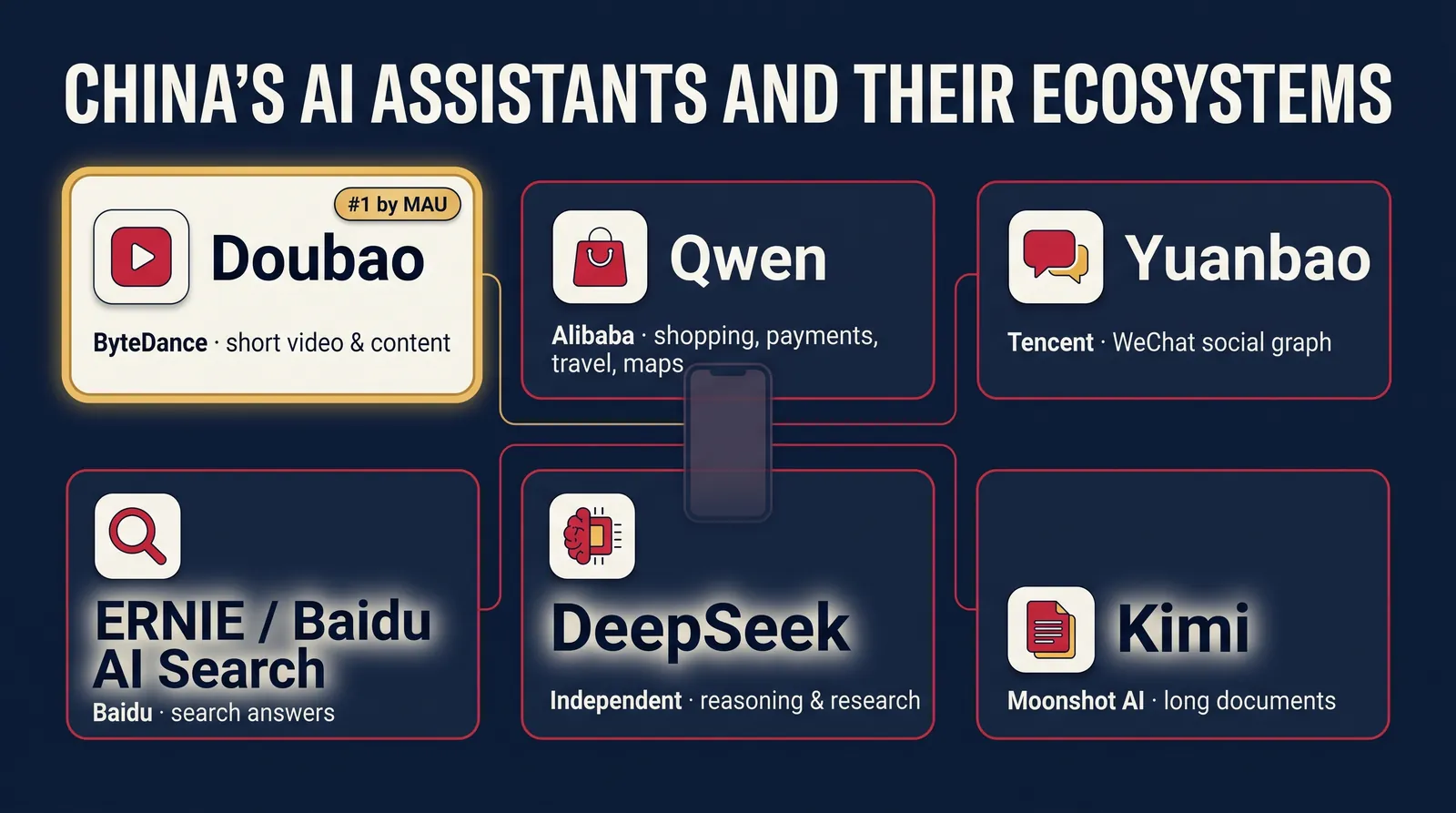
Doubao is the first AI app in China to reach mass-market scale, and the gap to second place is wide. QuestMobile’s first-half 2026 ranking, released in July, put Doubao at 382.3 million monthly active users in June, up 172.1% year over year. Qwen was second at roughly 167 million and DeepSeek third at roughly 130 million, so Doubao had more users than the next two combined. Tencent’s Yuanbao was fourth at about 50 million (China Internet Watch, Guandian). Across all AI-native apps, China had 499 million deduplicated monthly users in June 2026, so Doubao alone reaches about three quarters of that audience.
The daily numbers tell the same story. Doubao’s daily active users passed 100 million in December 2025, peaked at 145 million during the 2026 Spring Festival, when Doubao provided interactive features for the CCTV gala, and were reported above 200 million by June 2026 (KrASIA, DoNews, 36Kr). Engagement is deepening too: the average user opened Doubao 76.7 times a month in June 2026 and spent 143.7 minutes in it, up 66.1% and 61.9% year over year.
Two caveats. The monthly-user figures overlap, because Chinese users run several assistants. And Doubao’s lead in app rankings understates the reach of AI that is embedded elsewhere, such as Baidu’s AI answers inside search or Yuanbao inside WeChat. The strategic point stands: when CNNIC asked China’s 602 million generative-AI users which tools they used in 2025, 72.2% named Doubao and 62.0% named DeepSeek (gov.cn, The Egg).
Scale has a price, and ByteDance started charging for it
Serving a free assistant to hundreds of millions of people is expensive. 36Kr reported in June 2026 that Doubao’s daily compute cost ran to tens of millions of yuan against daily revenue of under a million yuan, and cited a Guolian Minsheng Securities estimate from May that the free service cost 132 million to 240 million yuan a day (36Kr). In late June ByteDance launched paid tiers at about 68, 200 and 500 yuan a month, or roughly $9, $28 and $69, for presentation generation, data analysis and video production, while the basic chatbot stayed free (TechNode, Seoul Economic Daily). The same 36Kr reporting said the second half of the plan was commerce: fold e-commerce into Doubao’s paid scenarios in the third quarter and run it at scale in the fourth. That is why the shopping section below matters to the business, not just to users.
Where Does Doubao Get Its Information?
Doubao’s answers lean on the Chinese web, and within it on ByteDance’s own properties, more heavily than any other engine leans on its parent. The evidence comes from a measurement study by researchers at Fudan University and the Shanghai Pudong Research Institute of Cryptology, posted to arXiv on October 8, 2026 and carrying the header of the NDSS 2027 security symposium (Liu et al.). The team built a browser-automation tool, ran 120 queries across ten AI-search platforms in March 2026, and extracted every cited URL. The panel covered four query types, product recommendation, technical documentation, news and opinion, roughly half in Chinese and half in English. The platforms were Grok, Doubao, ChatGPT, Wenxin, Google AI, Yuanbao, Perplexity, DeepSeek, Kimi and Qwen. In total: 17,211 citations across 6,356 domains.
Doubao produced 1,745 citations, about 14.5 per query, second only to Grok. Its single most-cited domain was Toutiao, ByteDance’s news aggregator, at 13.6% of citations. Add the rest of ByteDance’s properties and the share rises to 25.9%, which the authors calculate is 13.5 times the share those same domains receive on the other nine platforms.
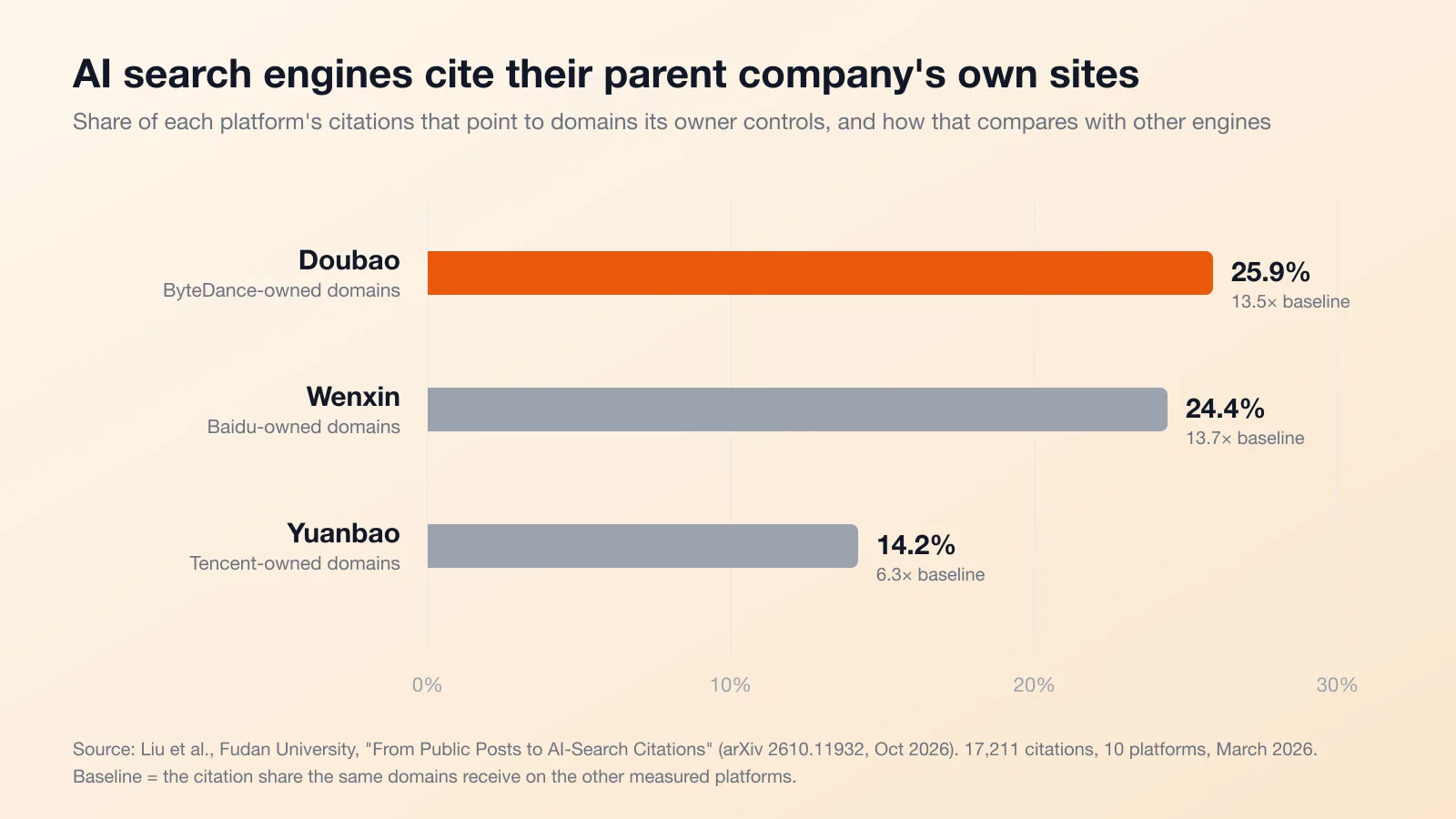
Doubao is not alone. Baidu’s Wenxin sent 24.4% of its citations to Baidu-owned domains, led by Baijiahao at 20.0%, which is 13.7 times baseline. Tencent’s Yuanbao sent 14.2% to Tencent-owned domains, 6.3 times baseline. The paper calls this a same-owner effect rather than self-preferencing, because it cannot say whether the cause is deliberate ranking policy, crawl coverage or simply that ByteDance’s apps hold more of the relevant Chinese content. The effect is real either way. If your category lives on Toutiao and Douyin, Doubao can see it. If it lives only on your .com, Doubao mostly cannot.
Doubao concentrates; DeepSeek spreads
The second finding is how narrow Doubao’s source base is. For news queries, Doubao’s ten most-cited domains captured 59.4% of all its citations, and its single top domain took 27.4%. For product recommendations the top ten took 50.3%. DeepSeek, by contrast, had the flattest profile of any platform: its top domain, Taobao/Tmall, took 3.1% of citations overall and its top twenty took 20.5%.
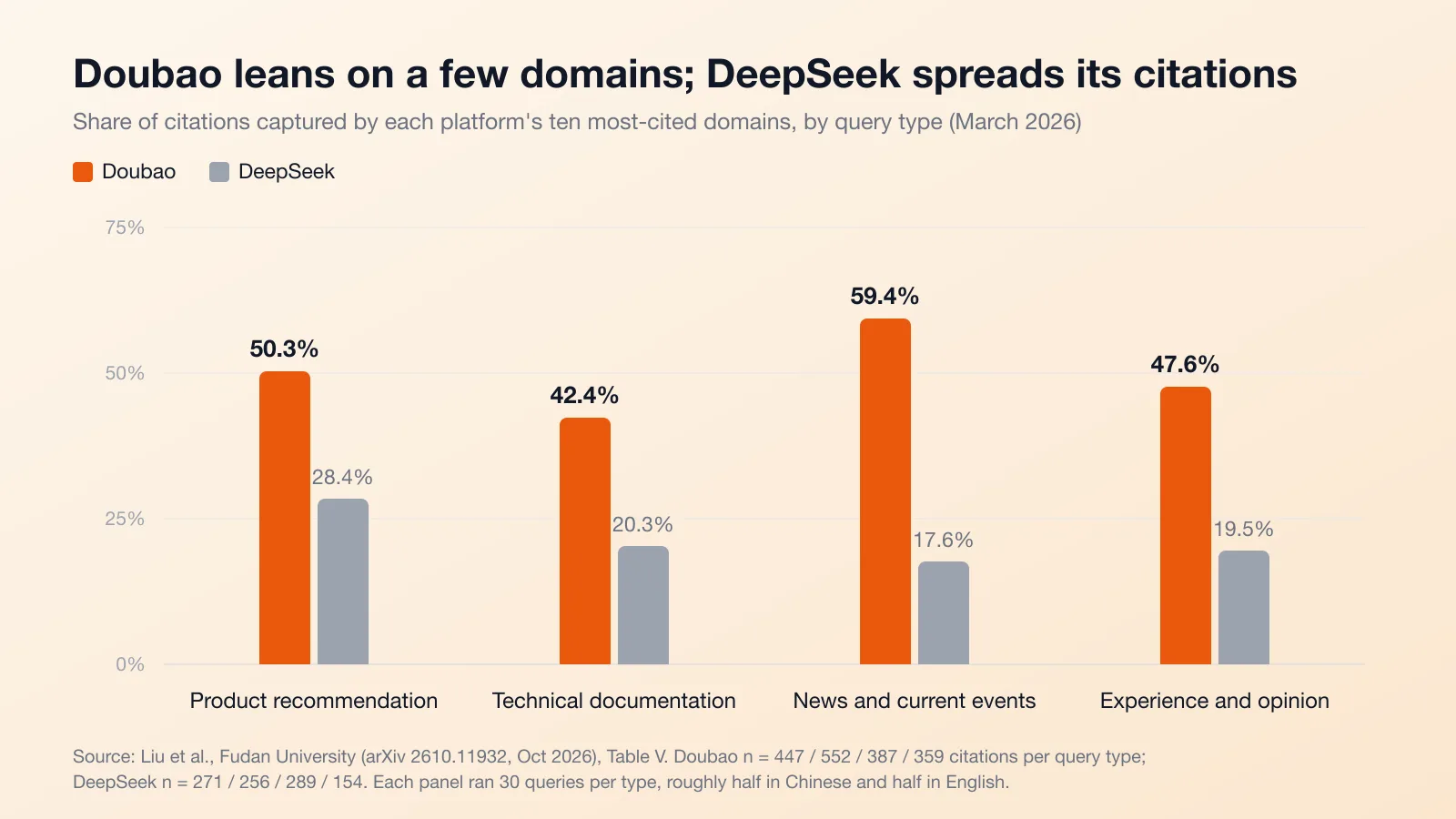
Qwen sits between them, with Baidu as its top domain at 10.1% and the fewest unique domains of any platform at 247. The Western engines look different again: Reddit was the top domain on Google AI and Grok, YouTube on Perplexity, and Wikipedia on ChatGPT. Across all ten platforms, the average overlap between any two platforms’ top-20 domains was 0.201 on the Jaccard index, meaning they share about a fifth of their core sources. For a Western comparison, see our study of the most-cited domains in LLMs by industry and our explainer on where ChatGPT gets its information.
| Engine | Owner | Most-cited domain | Same-owner share | Source base |
|---|---|---|---|---|
| Doubao | ByteDance | Toutiao, 13.6% | 25.9% (13.5x baseline) | Concentrated: top 10 = 42% to 59% by query type |
| Wenxin | Baidu | Baijiahao, 20.0% | 24.4% (13.7x baseline) | Most concentrated: top 20 = 70.8% |
| Yuanbao | Tencent | Not reported | 14.2% (6.3x baseline) | Moderate |
| Qwen | Alibaba | Baidu, 10.1% | Not reported | Fewest domains (247); 96% Chinese-titled pages |
| DeepSeek | DeepSeek | Taobao/Tmall, 3.1% | Not applicable | Flattest: top 20 = 20.5% |
Source: Liu et al., Fudan University, March 2026 panel. Sohu and CSDN appear among frequently cited domains across many platforms; Baijiahao appears only on Wenxin.
Doubao Search: the retrieval layer is now a product
In July 2026 Volcano Engine opened Doubao Search (豆包搜索) to enterprises and developers as a search service for AI agents. It combines “global internet information, industry expertise and ByteDance-exclusive content resources”, grades sources on two dimensions, site authority and creator authority, to filter out low-quality pages and SEO spam, and is already the information engine behind the assistants of about 90% of China’s top phone makers, according to the launch coverage (China Daily, 10jqka). Developers get 500 free searches a month and can connect by API, Skill or MCP. One third-party developer wrapper describes what comes back: Toutiao article text returns frequently, Douyin’s encyclopedia tends to rank first for “what is” and “who is” questions, and English queries return first-party sources such as official documentation (GitHub). Treat that as a practitioner’s observation, not a disclosed ranking policy, but it lines up with the Fudan numbers.
How Fast Doubao Cites New Content
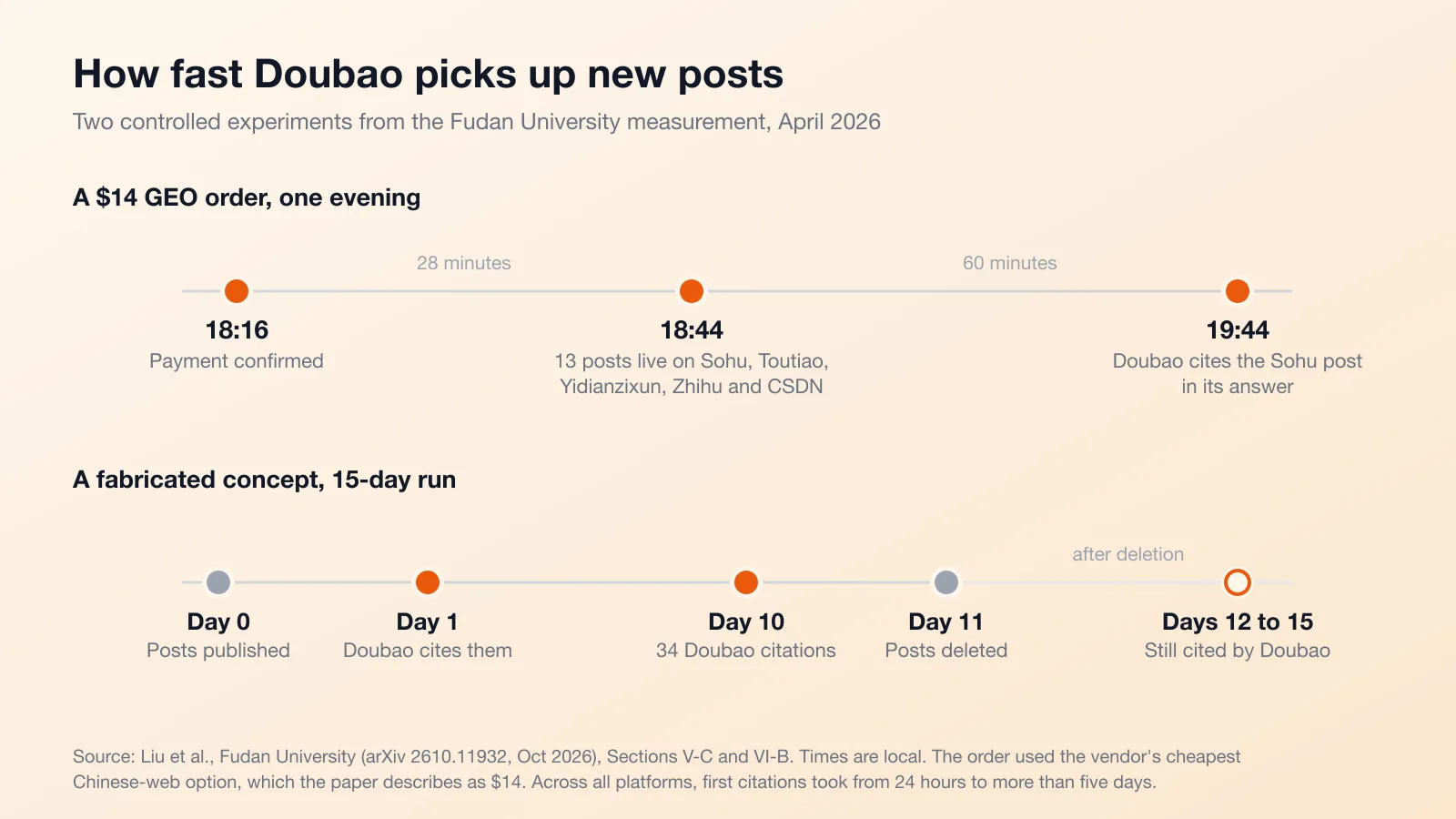
Doubao is the fastest of the ten platforms to pick up new posts, which makes it both the easiest Chinese engine to influence and the one most exposed to manipulation. The Fudan team tested this directly. They published posts about a fabricated concept on public Chinese platforms, then queried every engine daily for fifteen days.
- Eight of ten platforms cited the fake concept: Grok, Yuanbao, Doubao, Kimi, Wenxin, Google AI, Perplexity and ChatGPT. Qwen and DeepSeek never did.
- Doubao cited it on day one and rose to 34 citations by day ten. ChatGPT and Wenxin built up more slowly, on days three to five. Across platforms, first citations took from 24 hours to more than five days.
- Deleting the posts did not stop the citations. The posts came down after the day-11 measurement; Doubao kept citing them on days 12 to 15. The authors point to cached pages, delayed index refresh or stale retrieval state.
- Where you post matters more than how much. Forty posts on a self-hosted WordPress site earned no citation in a week. The best “low-preference” case needed twenty posts to earn three citations, two from Kimi and one from Wenxin.
- It replicates. A follow-up with ten fabricated topics, three queries each, on ten platforms over seven days produced 2,100 responses, 32.4% of which cited a planted article. DeepSeek cited none.
The $14 test
The most quotable experiment is the smallest. The researchers surveyed thirteen commercial “AI visibility” vendors, eight serving the Chinese market at $280 a year to $1,130 a month and five serving English markets at $29 to $2,500 a month, then bought the cheapest Chinese-web option they could find, which the paper describes as $14. Payment was confirmed at 18:16. By 18:44 the vendor had delivered thirteen public posts: five on Sohu, four on Toutiao, two on Yidianzixun, one on Zhihu and one on CSDN. At 19:44, Doubao cited the Sohu article in its answer, with the researchers’ tracking markers reproduced in the text. One hour from delivery, 88 minutes from payment. No other platform was reported citing the purchased posts.
The authors are careful about what this proves. It is a single case on an obscure topic, not a rate, and the paper’s limitations section says that higher-competition commercial topics would likely need more volume, account history and engagement. They also note an ambiguity in the vendor’s pricing, which was quoted per platform. But the mechanism is clear: Doubao’s retrieval trusts recent posts on a handful of Chinese platforms, and recent posts on those platforms can be bought for less than lunch.
The team proposed defences they did not test, including source-domain diversity, provenance-aware reranking and anomaly detection on citation timing, and reported their findings to all ten platforms. Six acknowledged receipt, Doubao among them, and said the findings would be “an important reference for future product optimization”.
What Doubao’s Citation Behavior Means for Brands
For a brand, Doubao is a platform-first engine with a short memory and a fast index. Five implications follow.
- Publish on the platforms Doubao reads, in Simplified Chinese. Toutiao, Douyin, Sohu, Zhihu and CSDN earned citations in the Fudan tests; a stand-alone website earned none. That is the Chinese version of the platform-over-domain dynamic we describe in parasite SEO in the AI era, with the difference that in China the platforms belong to the engine’s owner.
- Speed works for you and against you. A new Toutiao post about your product can shape Doubao’s answers within a day. So can a competitor’s, or a fake. Monitoring has to run at the same cadence.
- Corrections take time to land. Because Doubao kept citing deleted posts for days, taking down inaccurate content is not enough. You need fresh, accurate coverage on the same platforms to overwrite it.
- DeepSeek and Qwen are harder to move and worth more when you do. Neither cited the planted content. A mention there reflects durable presence rather than last week’s posts, which is why we treat them as the baseline engines for Chinese tracking (see below).
- Measure by source, not just by mention. The useful question in China is not only “was my brand named” but “which platform earned the citation”, because that tells you where to publish next.
Doubao and Agentic Commerce: From Answer to Douyin Order
Doubao is becoming a shopping agent for Douyin’s 3.5-trillion-yuan e-commerce business, and the pieces are arriving in stages.
| When | What happened | Status |
|---|---|---|
| Mid-October 2025 | Doubao quietly added shopping across electronics, appliances, mother-and-baby, cosmetics and home goods, with product cards linking to Douyin’s shopping platform; also restaurant deals and tickets via Douyin group-buying | Live |
| December 2025 | ByteDance and ZTE launched a Doubao phone whose system-level agent can operate other apps; Taobao, Alipay and WeChat blocked it within days | Contested |
| Late March 2026 | In-app ordering and payment entered grayscale testing: pick a product in chat, open the detail page, enter an address and pay without leaving Doubao; first categories digital, home and beauty from Douyin stores rated 4.8 or higher | Testing, expanding |
| June 2026 | 36Kr reported the plan: paid tiers in late June, e-commerce features folded into Doubao’s paid scenarios in Q3 with subsidised traffic to Douyin Mall, stable operation in Q4 | Plan; Q3 full rollout not publicly confirmed as of October 15, 2026 |
Sources: Hello China Tech, Lawfare, DoNews, Guandian, TechNode.
The shopping experience is already close to agentic. In October 2025, a query for a humidifier returned five products priced from 499 to 2,999 yuan with links into Douyin’s store, and the path from question to checkout took about 30 seconds (Hello China Tech). By March 2026 the handoff to Douyin was disappearing: DoNews reported that “after users get product recommendations by chatting with AI in the Doubao app, they can place orders and pay directly, with no need to jump to Douyin or other external apps”, with the launch batch limited to Douyin stores rated 4.8 or above (DoNews). Local services ride the same rails: Doubao recommends Douyin attraction tickets and dining deals, and ByteDance’s separate group-buying app handles fulfilment.
The phone that got blocked
The sharpest agentic move was hardware. The Doubao phone, built with ZTE and released in early December 2025, put an agent into the operating system with permission to read the screen and act as the user inside any app, without the app’s cooperation. Critics called it “god’s fingertips”. Within days Alibaba’s Taobao and Alipay blocked the device, WeChat followed on security grounds, and banks said they could not distinguish agent actions from user actions. A viral video showed a user’s bank balance visible on other devices logged into Doubao. ByteDance said the permission is used only with explicit consent and that memory is off by default (Lawfare).
The regulatory response is the part to watch. Chinese scholars have proposed treating AI agents as digital gatekeepers under the Anti-Monopoly Law, which would bar Doubao from steering users to ByteDance’s own Douyin e-commerce, and mandatory standards that suspend an agent’s control during payments. None of that is law yet, but it describes exactly the conflict of interest the Fudan citation data already shows in the answer layer: the engine that recommends and the store that sells have the same owner.
The economics are unproven
Doubao’s shopping push is part of a wider race. Alibaba connected Taobao, Alipay, Fliggy and Amap to its Qwen app in January 2026 and drove more than 120 million orders in six days during the Lunar New Year campaign, backed by 3 billion yuan in incentives (Alibaba Cloud). Tencent is pushing Yuanbao deeper into WeChat (CNBC). Hello China Tech estimated in late 2025 that ByteDance, Alibaba and Tencent were together spending about 300 million yuan a month on AI shopping tools with no proven business model behind them (Hello China Tech). Subsidised orders prove the pipes work; they do not prove people will keep buying through a chatbot once the coupons stop. We make the same point about Meta’s agent in Meta Muse and agentic shopping, and the global framing is in our agentic commerce guide.
For brands, the practical consequences are concrete:
- Eligibility comes before persuasion. Doubao’s launch batch was Douyin stores rated 4.8 or higher. If your products are not sold through a well-rated Douyin store, the agent cannot pick them.
- Product data is the new creative. Price, stock, variants, delivery and returns have to be correct in the catalogue the agent reads, because the chat shows a card, not your product page.
- The answer and the checkout are now one surface. A citation in Doubao’s answer is the top of a funnel that ends inside the same app. Visibility work and marketplace operations have to be run together.
How to Track Your Brand in Doubao and Other Chinese AI Engines
Doubao can be tested by hand today; Qwen and DeepSeek can be tracked automatically. Start with the manual rubric, because it is the only way to see Doubao, then put the two engines you can automate on a schedule.
- Write 30 to 50 commercial prompts in Simplified Chinese that match how Chinese buyers ask: category recommendations, “which is better” comparisons, “is X worth it” questions, and problem-first questions that should lead to your product.
- Run them in Doubao on a fixed schedule. For each answer record mention (yes or no), position among named brands, sentiment, whether a product card appeared, and the cited source domain. Doubao’s answers vary between runs, so sample each prompt several times before you trust a number.
- Watch the cadence that matters. Given day-one pickup, weekly is the minimum and daily is right for launches and incidents. If an inaccurate post appears, expect it to persist for days after removal.
- Score by source. Tally which platforms earned the citations. Toutiao, Douyin, Sohu, Zhihu and CSDN will dominate; that tally is your publishing plan.
- Automate Qwen and DeepSeek. Sanbi’s China tracker runs your prompt set against Qwen and DeepSeek in Chinese and in English, scores mention, position and sentiment, and resolves every citation to the Chinese platform it came from: Baidu, Zhihu, Weibo, Xiaohongshu, WeChat, CSDN, Bilibili, Douban, Juejin and Kuaishou. The tracker launches with Qwen and DeepSeek, and more Chinese models are coming later. Doubao is not in it today, so keep the manual rubric for it and use the same scoring so the numbers compare.
Sanbi’s Chinese AEO tracker is coming soon. It will show how Qwen and DeepSeek answer about you, in Chinese and in English; book a demo for early access. For your Western baseline, run a free AI visibility audit across ChatGPT, Gemini and Claude, and see the DeepSeek rank-tracking guide for the scoring method we use on every engine.
Why Chinese AI Visibility Needs a Dedicated Tracker
Everything above points to the same conclusion: a tool built to watch ChatGPT cannot tell you what Chinese AI says about your brand. Three reasons, each with a number behind it.
1. China runs on its own web. The sources Chinese engines read are Toutiao, Baijiahao, Zhihu, Sohu, CSDN, WeChat and Xiaohongshu, not Reddit, Wikipedia and YouTube. The Fudan measurement found that the ten platforms it tested shared only about 20% of their top-20 source domains on average, and that the Chinese engines each lean hardest on their own parent’s properties. Most of that content sits behind app walls that Western crawlers do not reach. A tracker whose source graph was built for the open English web is reading the wrong map.
2. The data is grounded in the Chinese internet. The tracker runs Chinese-language prompts against Qwen and DeepSeek, the first two engines, with more Chinese models coming later, and resolves each citation to the Chinese platform behind it: Baidu, Zhihu, Weibo, Xiaohongshu, WeChat, CSDN, Bilibili, Douban, Juejin and Kuaishou. You see not only that you were mentioned but which Chinese platform earned the mention, which is the only signal that tells you where to publish next.
3. It also shows you the Western links. Qwen and DeepSeek are used far beyond China. DeepSeek topped app stores worldwide in 2025, Qwen’s open models are built into products everywhere, and both answer in English to users in Singapore, Jakarta, Dubai, Berlin and San Francisco. The tracker runs the same prompts in English, so when these models are used outside China you see the English-language and Western sources they cite too. One tracker covers both halves of the citation graph.
The Chinese AEO tracker is coming soon, starting with Qwen and DeepSeek, with more Chinese models to follow. Book a demo for early access and become the brand Chinese AI recommends.
Sources
- Liu, Hong, Zhang, Chen, Li and Yang (Fudan University, Shanghai Pudong Research Institute of Cryptology): From Public Posts to AI-Search Citations: Measuring the Fragility of AI Search, arXiv 2610.11932, October 8, 2026; HTML version
- China Internet Watch: Top 10 AI apps in China, H1 2026 (QuestMobile) (August 11, 2026)
- QuestMobile: 2026 China mobile internet half-year report (July 14, 2026)
- Guandian: QuestMobile: Doubao at 382 million June MAU leads AI-native apps (August 5, 2026)
- Tencent News: QuestMobile: Doubao 382 million June MAU (August 5, 2026)
- KrASIA (36Kr): Doubao hits 100 million DAUs as ByteDance extends its AI lead (December 29, 2025)
- DoNews: Doubao opens the full Douyin e-commerce loop for in-app shopping (March 31, 2026)
- Guandian: Doubao connects Douyin e-commerce, tests direct purchase and order management (March 2026)
- 36Kr: Doubao was forced to charge fees to support its operations (June 26, 2026)
- 36Kr: Doubao to go paid in late June and accelerate the Douyin e-commerce link (June 2026, Chinese)
- TechNode: ByteDance’s Doubao to launch paid plans in late June, link with Douyin e-commerce push (June 2, 2026)
- Seoul Economic Daily: China’s top AI app Doubao goes paid, ending free-service race (June 25, 2026)
- Pandaily: ByteDance Doubao launches paid subscription up to 500 yuan per month as AI compute costs bite (June 2026)
- Caixin Global: ByteDance plans subscriptions for AI chatbot Doubao (May 5, 2026)
- Jiemian: Doubao model’s daily token usage hits 180 trillion (June 2026)
- World Internet Conference: Volcano Engine says Doubao model hits 120 trillion daily tokens (April 3, 2026)
- China Daily: Doubao Search opens, giving agents real-time, authoritative, trusted search (July 30, 2026, Chinese)
- 10jqka: Volcano Engine launches Doubao Search for AI agents (July 28, 2026, Chinese)
- GitHub: huashu-doubao-search, a third-party MCP wrapper for Doubao Search
- The Egg: China’s AI search ecosystem: key LLMs, data sources and GEO trust signals (May 10, 2026)
- gov.cn (CNNIC): China’s internet user base hits 1.125 billion as AI adoption surges (February 2026)
- Hello China Tech: The AI shopping paradox in China: billions spent, no proven business model (October 29, 2025)
- Lawfare (Samm Sacks): China’s agentic AI controversy (March 6, 2026)
- CNBC: Chinese tech giants enter the agentic commerce race as AI reshapes super apps (January 21, 2026)
- Alibaba Cloud: Qwen app’s CNY campaign attracts over 120 million orders (February 2026)
- Woshipm: Doubao opens the Douyin e-commerce loop: is “shop while you chat” reliable? (2026, Chinese)
- How AI Works: Dola (formerly Cici)
Method notes: user figures are QuestMobile’s mobile-app measurements for mainland China and overlap across apps; the 499 million total is QuestMobile’s deduplicated figure. Daily-user figures come from 36Kr reporting and vary by date. All citation statistics are from the Fudan University measurement, which ran its query panel in March 2026 and its publication experiments in April 2026; the authors note the rates may drift as platforms update. The paper describes the GEO order as $14 and separately as the vendor’s cheapest “per-platform” option, so the total paid for all thirteen posts is not certain. Doubao’s Q3 2026 e-commerce rollout is reported as a plan by 36Kr; we found no public confirmation that it had completed by October 15, 2026. Nothing here is investment or legal advice.
Frequently Asked Questions
Doubao (豆包) is ByteDance's consumer AI assistant and the most-used AI app in China. It launched in 2023, runs on ByteDance's own Doubao model family, and handles chat, search, writing, image and video generation and voice conversation. The same models are sold to businesses through Volcano Engine, ByteDance's cloud arm, which reported 180 trillion tokens of daily usage in June 2026. Doubao is built for mainland China. ByteDance serves other markets with a separate app, Dola, formerly called Cici.
QuestMobile put Doubao at 382.3 million monthly active users in June 2026, up 172.1% year over year and more than the next two AI apps combined, Qwen at about 167 million and DeepSeek at about 130 million. Doubao's daily active users passed 100 million in December 2025, peaked at 145 million during the 2026 Spring Festival and were reported above 200 million by June 2026. In CNNIC's 2025 survey, 72.2% of China's generative-AI users said they used Doubao, the highest share of any assistant.
From the Chinese web, and disproportionately from ByteDance's own platforms. A Fudan University study of 17,211 AI-search citations across ten platforms found that Doubao's single most-cited domain was Toutiao, ByteDance's news app, at 13.6% of citations, and that ByteDance-owned domains took 25.9% of everything Doubao cited, 13.5 times the share those domains get on other engines. Other frequently cited Chinese sources include Sohu, Zhihu and CSDN. Doubao's search layer also grades sources by site and creator authority, according to Volcano Engine.
Yes, measurably. In the Fudan University measurement, 25.9% of Doubao's citations pointed to ByteDance-owned domains, 13.5 times the baseline share those domains receive on the other nine platforms. The pattern is not unique to ByteDance: Baidu's Wenxin cited Baidu-owned domains 24.4% of the time, 13.7 times baseline, and Tencent's Yuanbao cited Tencent-owned domains 14.2% of the time, 6.3 times baseline. For brands, it means a presence on Toutiao and Douyin matters for Doubao in a way that a presence on your own website does not.
Within a day, and sometimes within an hour. When Fudan researchers published posts about a fabricated concept on Chinese platforms, Doubao cited them on day one and had produced 34 citations by day ten. ChatGPT and Wenxin took three to five days to build up. In a separate test, the researchers paid a GEO vendor; thirteen posts went live 28 minutes after payment, and Doubao cited the Sohu post one hour after delivery. Across all ten platforms, first citations took from 24 hours to more than five days.
The Fudan University study showed that it is possible, at least for an obscure topic. The researchers chose a vendor's cheapest Chinese-web option, described in the paper as $14, and got thirteen posts published on Sohu, Toutiao, Yidianzixun, Zhihu and CSDN within 28 minutes. Doubao cited the Sohu post one hour later. No other platform was reported citing the purchased posts. The authors stress that this is one case, not a platform-wide rate, and that competitive commercial topics would likely need more volume and account history.
For a few days, yes. In the Fudan University experiment the fabricated posts were deleted after the day-11 measurement, and Doubao still cited them on days 12 to 15. The authors attribute this to cached pages, delayed index refresh or stale retrieval state. For brands, that means a bad or inaccurate post can keep shaping Doubao's answers after it has been taken down, and a correction needs time and fresh coverage to overwrite it.
Increasingly, yes. Doubao quietly added shopping across electronics, appliances, mother-and-baby products, cosmetics and home goods in October 2025, with results linking to Douyin's e-commerce platform. In March 2026 it began testing ordering and payment inside the app, starting with digital products, home goods and beauty from Douyin stores rated 4.8 or higher, so users no longer have to switch to Douyin to pay. ByteDance's plan, reported by 36Kr in June 2026, was to fold e-commerce into Doubao's paid scenarios in the third quarter and run it at scale in the fourth.
In December 2025 ByteDance and ZTE released a phone with a Doubao agent built into the operating system that could read the screen and act as the user inside any app, without that app's cooperation. Within days Taobao and Alipay blocked the device and WeChat followed, citing security. Banks said they could not tell agent actions from user actions. The dispute prompted proposals in China to treat AI agents as digital gatekeepers under the Anti-Monopoly Law, which would stop Doubao steering users to ByteDance's own Douyin e-commerce.
The basic assistant is free, including chat, search, writing, image generation and voice and video conversation. In late June 2026 ByteDance launched paid tiers at roughly 68, 200 and 500 yuan a month, about $9, $28 and $69, for heavier productivity use such as presentation generation, data analysis and video production. The move followed reports that serving Doubao for free cost tens of millions of yuan a day against daily revenue of under a million yuan.
Doubao is aimed at mainland Chinese users and its content, sources and shopping are tied to the Chinese internet. For other markets ByteDance runs a separate assistant, Dola, which launched in 2023 as Cici and was renamed in November 2025. Third-party trackers report Dola passed 10 million daily active users by the end of 2025, concentrated in Southeast Asia, Latin America and the UK, and that it is not offered in the United States, Canada, Australia or mainland China.
Doubao is the mass-market assistant with ByteDance's distribution behind it, DeepSeek is the research and reasoning app, and Qwen is Alibaba's commerce assistant. Their citation behaviour differs too. In the Fudan University measurement Doubao's top ten domains took 42% to 59% of its citations depending on query type, while DeepSeek's took 18% to 28%, the flattest profile of any platform. Doubao cited fabricated posts on day one; DeepSeek and Qwen never cited them at all. Qwen's most-cited domain was Baidu, and 96% of its cited pages had Chinese titles.
Publish where Doubao reads. Its citations concentrate on Toutiao, Douyin, Sohu, Zhihu and CSDN rather than on brand websites, so a Simplified-Chinese presence on those platforms, with consistent facts about your products, is the first lever. Keep it fresh, because Doubao picks up new posts within a day. Make sure your products are sold through well-rated Douyin stores so Doubao's shopping layer can surface them. Then test recurring buyer prompts in Doubao on a schedule and record whether you are mentioned, where, and which source was cited.
Write 30 to 50 commercial prompts in Simplified Chinese, run them in Doubao on a fixed schedule and record mention, position, sentiment and the cited source domain for each answer. Repeat runs, because answers vary. Doubao has no public consumer API for this kind of monitoring, so the Doubao test stays manual. For Qwen and DeepSeek, Sanbi's China tracker runs Chinese and English prompts automatically and resolves every citation to the Chinese platform it came from, so you can see the trend without the spreadsheet. More Chinese models are coming to the tracker later.
Because Chinese AI engines read a different web. The Fudan University study found that the ten platforms it measured shared only about 20% of their top-20 source domains on average, and Chinese engines lean on Toutiao, Baijiahao, Zhihu, Sohu and CSDN rather than on Reddit, Wikipedia and YouTube. A tracker built for ChatGPT resolves citations to the wrong map. A dedicated Chinese tracker runs Chinese prompts, grounds its source data in Baidu, Zhihu, WeChat, Xiaohongshu and the other Chinese platforms, and also captures the Western links these models cite when they are used in English elsewhere.