Parasite SEO Isn't Dead — It Moved: What Google's Crackdown Killed and What Still Works in 2026
Parasite SEO is the oldest shortcut in search: instead of spending three years earning authority, you publish on a domain that already has it, and borrow the rankings.
For most of the last decade it worked embarrassingly well. Then in 2024 Google shipped a policy that broke the core assumption, and a large share of the industry declared the tactic dead.
It isn’t dead. It moved.
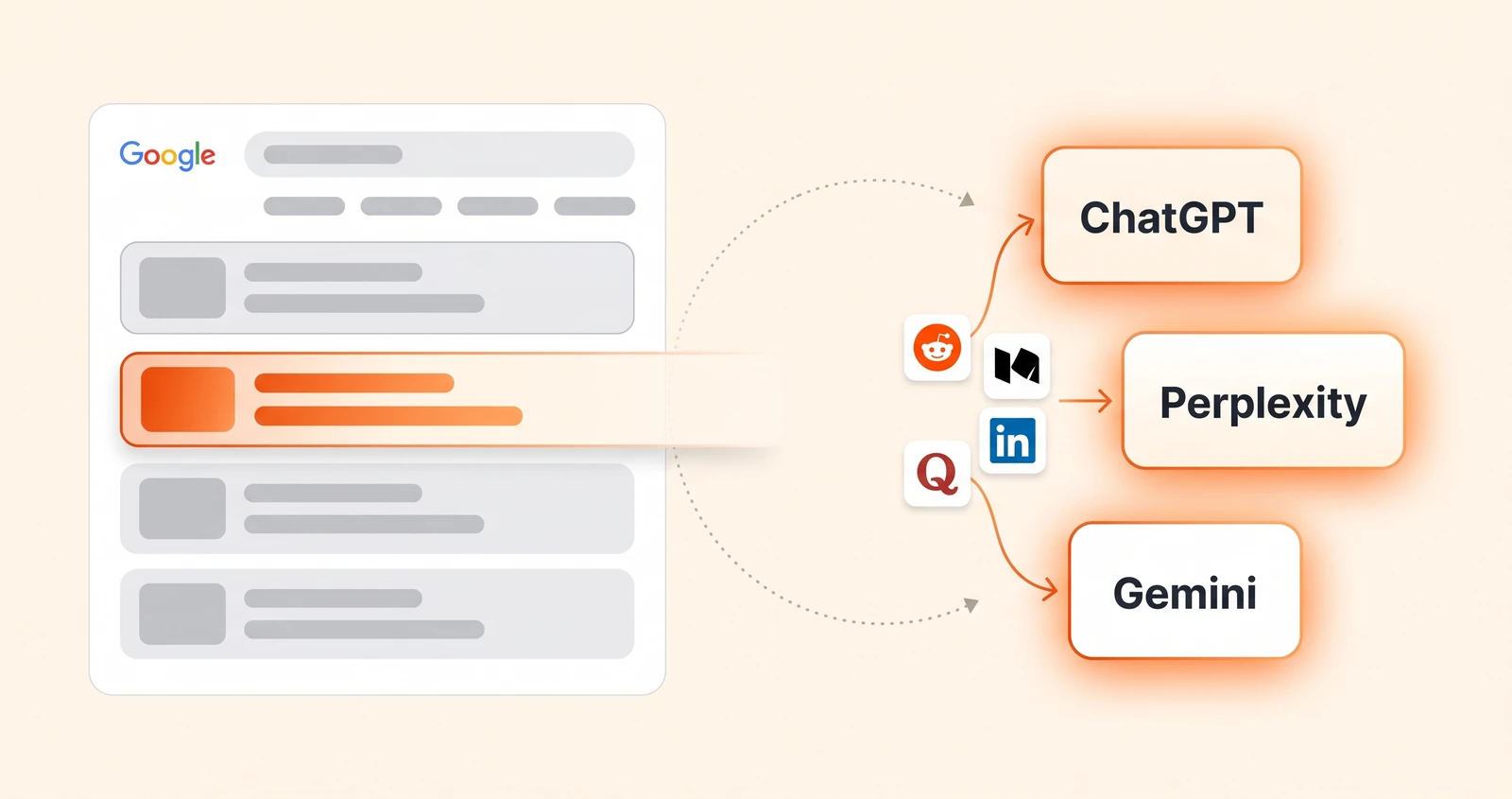
The interesting story in 2026 isn’t whether parasite SEO still ranks in Google — mostly it doesn’t, not the way it used to. It’s that the same third-party surfaces Google is busy devaluing are the ones ChatGPT, Perplexity and Gemini lean on hardest. The tactic didn’t die. Its payoff migrated from blue links to citations.
What parasite SEO actually is
Parasite SEO means publishing original, keyword-optimized content on an established third-party domain specifically to exploit its authority for rankings — usually for queries your own site can’t yet win.
The ranking page lives on the host: a news site’s /sponsored/ directory, a Medium post, a LinkedIn article, a Reddit thread, a partner subfolder. Monetization happens somewhere else — affiliate links, lead forms, or a redirect to your own property.
A typical campaign runs like this:
- Find high-authority hosts with strong organic visibility, generous crawl budgets, and an open contribution model — sites that accept user-generated content, guest contributions, or sponsored placements.
- Pick queries you can’t win yourself — competitive, high-intent, monetizable terms where your domain lacks the authority to compete.
- Publish optimized content on the host — titles, meta tags, headers, internal links within the host, structured data where the platform allows it.
- Build links to the parasite page, not to your own site. Tier-2 backlinks from web 2.0s, guest posts, niche edits — treating the host page as the money page.
- Capture the traffic through embedded CTAs, affiliate links, or links back to your primary site.
- Monitor and iterate — rankings, traffic, conversions, and host behaviour, because editors can and do change things.
The trade is simple and it has never changed: faster rankings in exchange for less control.
Parasite SEO vs barnacle SEO vs guest posting
These get used interchangeably and they aren’t the same thing. The distinctions matter because they carry very different risk profiles.
| Aspect | Barnacle SEO | Parasite SEO |
|---|---|---|
| Primary asset | Existing profile or listing (directory, marketplace, review site) | New content published on a host domain |
| Objective | Improve visibility of a known entity or listing | Rank a fresh page for specific keywords |
| Risk profile | Generally low — aligned with platform intent | Higher — can cross into site reputation abuse |
| Ownership | You own the business or profile, not the platform | You own the content, not the host domain |
Guest posting aims to contribute genuine editorial value on a relevant site, building brand authority and earning natural links. Parasite guest posts are more transactional — placed mainly to exploit host authority for commercial queries. Same format, different intent, and Google’s enforcement is essentially an attempt to tell them apart.
Content syndication is not parasite SEO at all. Syndication republishes content from your own site elsewhere, with a canonical tag pointing home. Parasite SEO originates net-new content on the host, with no canonical back to anything you own.
Google’s site reputation abuse policy: what actually changed
In March 2024 Google announced a set of new spam policies alongside a core update, one of which was site reputation abuse. The spam policy documentation defines it as third-party pages published with little or no first-party oversight or involvement, where the purpose is to manipulate rankings by exploiting the host site’s signals.
The effect was surgical. Mass-produced sponsored posts on news sites — the coupon sections, the “best casino” subfolders, the programmatic product reviews sitting under major mastheads — lost rankings or were deindexed outright.
The mechanism matters more than the enforcement. Google didn’t just penalize pages; it worked to decouple host authority from contributed content. A page on a DR 90 domain stopped automatically inheriting DR 90 trust. That is the assumption the entire tactic was built on.
What the policy does not say
This is where most coverage overcorrects. Google updated the policy in November 2024 and later folded that guidance into the main documentation, and the clarifications matter:
- Hosting third-party content is not automatically abusive. Forums, user-generated content, syndicated articles and genuine editorial contributions are all explicitly fine.
- Affiliate and freelance content is permitted when it isn’t manipulating rankings and carries the right link attributes —
rel="sponsored"orrel="nofollow". - Intent is the dividing line. The abusive examples Google cites are unrelated content — coupon pages, payday loan reviews, essay-writing services — placed on established sites purely to borrow ranking authority.
So the test isn’t “third-party content, yes or no.” It’s whether the content genuinely serves the host’s audience, whether the host is actually involved, and whether commercial links are properly disclosed to crawlers. That last one is a concrete, checkable implementation detail that a surprising number of placements still get wrong.
Google is now using the term itself
In November 2025 Google published Defending Search users from “parasite SEO” spam — notable because the company adopted the industry’s own vocabulary. Its framing: “A site can’t pay or use deceptive measures to improve its ranking in Search,” illustrated with the example of a payday loan site paying a respected publisher to host its content.
The post also pushes back on a European Commission investigation into Google’s anti-spam enforcement, calling it misguided. Google has separately filed a detailed description of the policy and its enforcement approach with the UK Competition and Markets Authority.
That regulatory fight is worth watching. Publishers who lost a revenue line argue the policy is Google exercising market power over what they may put on their own domains. If regulators force a softening, some of what died in 2024 comes back. Plan for the current rules; don’t assume they’re permanent in either direction.
The part most guides miss: AI engines never got the memo
Here is the tension that makes 2026 interesting.
Google spent two years teaching its ranking systems to distrust third-party content on authoritative domains. Meanwhile, the AI answer engines that increasingly sit between your brand and your buyers went the opposite direction — they retrieve heavily from exactly those surfaces.
Reddit, Quora, LinkedIn, YouTube, review platforms, industry blogs. These sources carry the comparative, experiential, opinionated language that models need to answer “what’s the best X for Y” — language that brand-owned pages structurally never contain. Our own analysis of engine citation behaviour in AI engine citation trends found each engine has a distinct source profile, and that Perplexity in particular treats Reddit sentiment as a direct input.
So the same Medium post that earns you nothing in Google can be part of the retrieval set that shapes what ChatGPT tells a buyer about your category.
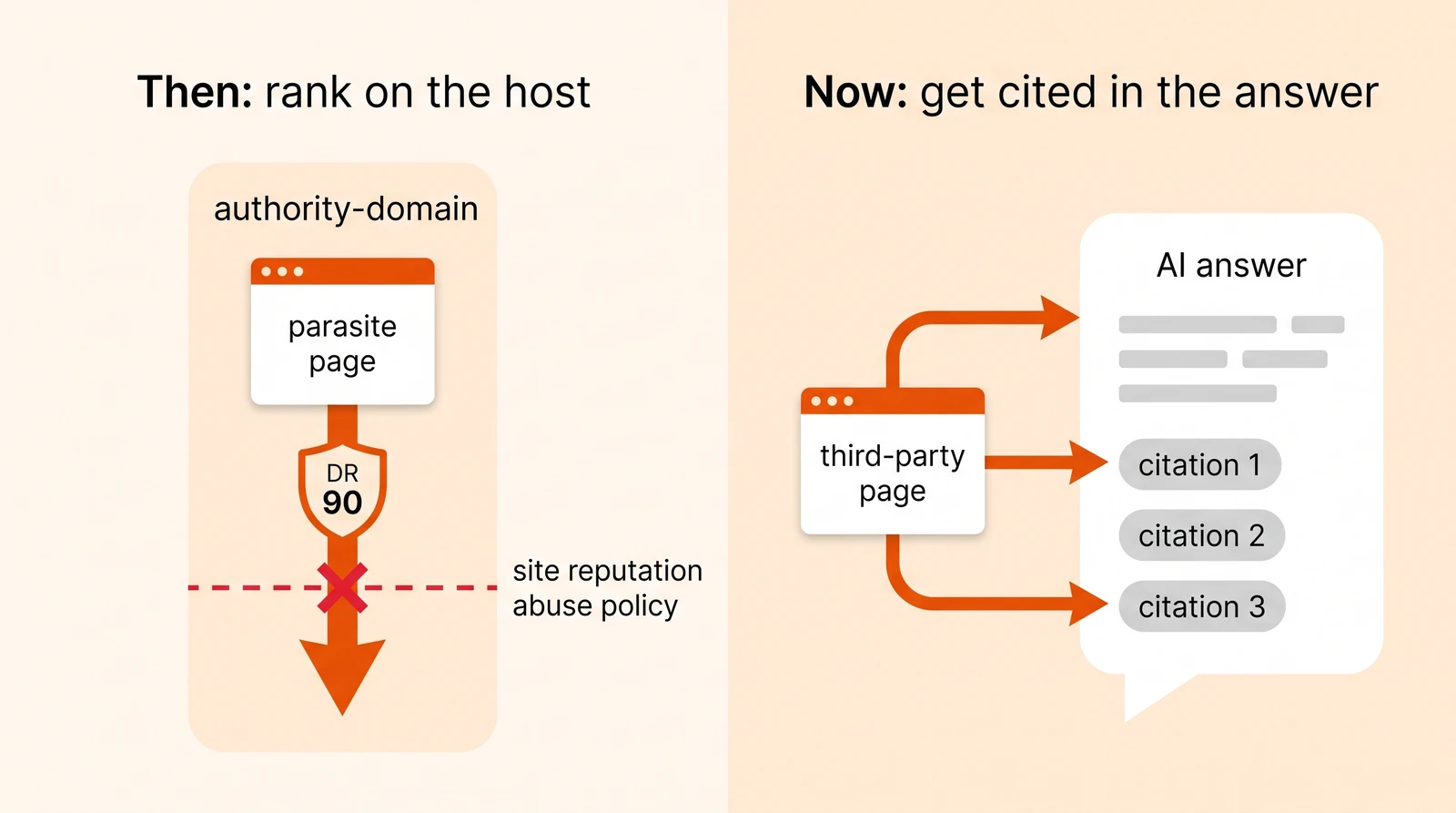
This is a genuinely different game, and calling it “parasite SEO” is nearly a category error:
| Classic parasite SEO | Third-party placement for AI search | |
|---|---|---|
| Goal | Hold a blue-link position | Be retrieved and cited in an answer |
| Winning surface | Google SERP | ChatGPT, Perplexity, Gemini, AI Overviews |
| What’s rewarded | Keyword targeting, host authority, tier-2 links | Comparative framing, specificity, consensus across sources |
| Failure mode | Deindexed by policy enforcement | Never retrieved — invisible rather than penalized |
| Measurement | Rank tracking | Citation and mention tracking |
The failure modes are the important row. Classic parasite SEO fails loudly — you get deindexed and you know. AI-oriented placement fails silently. Your content simply never enters the retrieval set, and nothing tells you.
Where placement still pays
Not all hosts survived the crackdown equally, and the split maps almost exactly onto which ones AI engines like.
Held up well — UGC and community platforms. Reddit, Quora, Stack Exchange, niche forums. Low Google-parasite value historically, high AI-citation value now. These are conversations, not placements, which is precisely why they’re hard to game and why models trust them.
Held up well — genuine editorial contribution. Industry publications with real review processes. Slower, harder to place, and the only category the policy explicitly protects.
Collapsed — paid news placement. The /sponsored/ subfolder economy took the direct hit. Expensive, increasingly ineffective in Google, and rarely cited by AI engines because the content is thin.
Mixed — Medium, Substack, LinkedIn articles. Modest Google value, meaningful AI-retrieval value, near-zero placement cost. The best risk-adjusted option for most B2B brands.
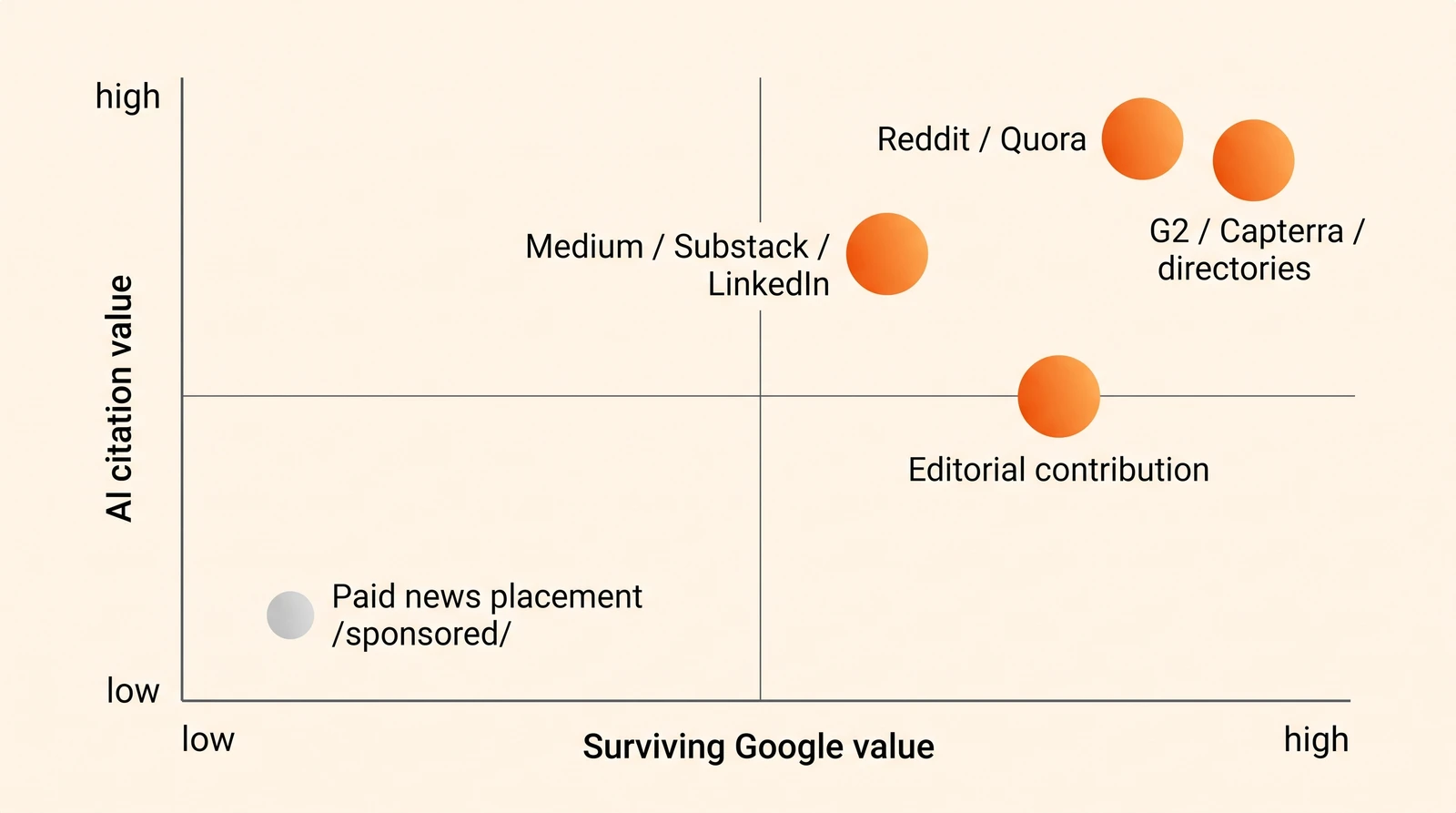
Barnacle assets — the quiet winner. G2, Capterra, Yelp, industry directories. These rank in Google and get cited constantly by AI engines answering comparison questions. Lowest risk of anything on this list, because you’re optimizing a listing you legitimately own.
If you’re deciding where to spend, the honest ranking for most brands in 2026 is: barnacle assets first, community participation second, editorial contribution third, paid placement last.
Doing it without getting burned
The guardrails that experienced practitioners converge on:
- Treat it as part of a content strategy, not a standalone hack. Placement amplifies owned content; it doesn’t substitute for it.
- Prioritize topical relevance. Irrelevant host-to-content pairing is the clearest site reputation abuse signal there is.
- Produce something the host is proud to publish — content that would survive a manual quality review.
- Disclose sponsorships and affiliate relationships clearly, per host and search engine policy.
- Avoid mass-scale cookie-cutter deployment. Fewer, better, editorially integrated assets.
- Keep building your own domain. Everything you gain through placement sits on infrastructure you don’t control.
That last one deserves emphasis. The entire risk profile of parasite SEO — platform dependency, policy volatility, brand exposure, impermanence — comes from building on rented land. Editors can de-optimize or delete your page tomorrow. Policies can reclassify your tactic overnight. Neither is hypothetical; both happened at scale between 2024 and 2026.
If you’ve already been hit
Site reputation abuse is enforced both algorithmically and through manual actions, which show up in Google Search Console under Security & Manual Actions. A manual action is in some ways the better outcome: it tells you exactly what happened, and there is a defined route back.
The recovery sequence:
- Find every affected URL. Manual actions can be sitewide or partial — identify whether it’s a whole subdirectory (
/sponsored/,/partners/,/deals/) or specific pages. - Remove or genuinely fix the content. Removing is faster; fixing means bringing the pages under real first-party editorial control, not just editing a byline.
- Correct the link attributes. Commercial and affiliate links need
rel="sponsored"; other third-party outbound links needrel="nofollow"where appropriate. - Fix the arrangement, not just the artifacts. If the underlying deal is still “publisher rents subfolder to a third party with no oversight,” resubmitting will fail.
- File a reconsideration request describing what was wrong, what you changed, and what prevents recurrence.
If you’re on the other side of it — the brand that placed the content rather than the host — assume the placement is gone and that anything pointing at it now leads nowhere. This is the platform dependency risk arriving in concrete form.
How to measure it now
Rank tracking alone stopped being sufficient the moment the payoff partly shifted from position to citation. Three things worth watching:
- Host page performance — its own ranking, traffic, and whether the host has quietly edited or removed it.
- Referral and assisted conversions — what actually flows from that page into your funnel.
- AI citation and mention share — whether answer engines cite that page, or mention your brand, when asked category questions.
The third is where most teams are flying blind. A Reddit thread can be feeding ChatGPT’s answer about your category while sending you essentially no clicks, and no analytics tool built for the blue-link era will tell you. This is the same measurement gap we covered in how to track brand mentions in AI search and zero-click search in the AI era.
Sanbi.ai tracks which sources each engine cites when answering prompts in your category — so you can see whether a placement actually entered the retrieval set, which competitors are being cited from the same surfaces, and which platforms are worth the effort for your specific category rather than in general. If you’re deciding where to place, that’s the data that makes it a decision rather than a guess.
Where this goes next
A few things look likely past 2026:
- Enforcement gets more precise. Google continues refining the line between abusive third-party content and legitimate editorial collaboration, rather than treating contributed content as uniformly suspect.
- AI accelerates production, humans gate quality. More AI-assisted content creation paired with editorial oversight, because the unreviewed version is exactly what the policy targets.
- Engagement becomes the durable moat. Placements that generate real interaction — comments, shares, discussion — survive both algorithmic scrutiny and model retrieval better than static articles.
- Platforms formalize. Some hosts tighten contributor access; others build official sponsored-content programs with proper disclosure.
The through-line: parasite SEO is shifting from a black-hat exploit toward regulated, partnership-driven authority leveraging. Less arbitrage, more relationship.
The bottom line
Classic parasite SEO — buy a slot on a big domain, inherit its authority, rank tomorrow — is largely finished in Google. The site reputation abuse policy did what it was designed to do.
But the underlying insight was never wrong. Third-party surfaces carry trust your own domain can’t manufacture. That’s still true; it’s just that the surfaces that matter changed, and the engines rewarding them are no longer only Google.
The teams doing this well in 2026 aren’t buying placements. They’re participating where their buyers already ask questions, contributing content good enough to survive editorial review, optimizing the listings they legitimately own — and measuring which of those actually shows up when an AI engine answers a question about their category.
That last step is the one that separates strategy from superstition.
Sources
Primary policy documentation:
- Google Search — Spam policies: site reputation abuse (the definition, with examples of abusive vs acceptable third-party content)
- Google Search Central — March 2024 core update and new spam policies (introduces the policy and its intent)
- Google Search Central — Updating our site reputation abuse policy (November 2024 clarifications)
- Google — Defending Search users from “parasite SEO” spam (November 2025; Google’s own framing, and its response to the EU investigation)
- Google — Annex 1: Site Reputation Abuse Policy, submission to the UK Competition and Markets Authority (formal description of the policy and enforcement approach)
Industry analysis:
- Search Engine Journal — Google Updates Site Reputation Abuse Policy Documentation (what the documentation update did and did not change)
- Search Engine Roundtable — Google Expands Site Reputation Abuse Policy Manual Actions Steps (manual actions and remediation)
Related reading: Answer Engine Optimization guide · GEO playbook for 2026 · AEO vs GEO · Query fan-out explained
Frequently Asked Questions
Parasite SEO is publishing search-optimized content on a high-authority third-party domain — a news site, Medium, Reddit, LinkedIn, a large industry blog — so it ranks faster than the same content could on your own site. Instead of spending years building domain authority, you borrow the host's existing trust and ranking signals to capture competitive queries quickly. The page lives on the host domain (often in a /sponsored/, /partners/ or user-content subfolder) while monetization happens through affiliate links, lead forms, or links back to your own properties.
For Google, the mass-produced version is largely dead. Google's 2024 site reputation abuse policy explicitly targets third-party pages published with little or no first-party oversight that exist mainly to exploit the host's ranking signals. After enforcement, many sponsored-post placements on news sites lost rankings or were deindexed entirely, and Google now works to separate host authority from low-quality third-party content. What is not dead: editorially integrated contributions with genuine oversight, and — increasingly — third-party placement aimed at AI answer engines rather than at Google's blue links.
Barnacle SEO optimizes an existing profile or listing you already control on a third-party platform — a Google Business listing, a Yelp profile, a G2 page, a marketplace listing — so it ranks for searches where your own site is weak. Parasite SEO means publishing net-new content on a host domain specifically engineered to rank for target keywords. Barnacle SEO is generally low risk because it works with the platform's intent; parasite SEO carries higher risk because it can cross into site reputation abuse.
It sits on a spectrum. White-hat implementations publish genuinely useful content relevant to the host's audience, disclose sponsorships and affiliate relationships, and involve real editorial review where the host retains control. Black-hat implementations mass-produce thin articles on unrelated topics, use expired or hacked high-authority domains with no thematic connection, hide sponsorships, over-optimize anchor text, and rely on automated link schemes. Google's site reputation abuse policy is aimed at the second group, but enforcement has caught borderline tactics too.
Introduced in 2024, it is a Google Search policy defining site reputation abuse as third-party pages published with little or no first-party oversight or involvement, intended primarily to manipulate search rankings by exploiting the host site's signals. In practice it decoupled host authority from contributed content: a page on a DR 90 news site no longer inherits that authority automatically. Google still distinguishes abusive placements from legitimate guest posts, press coverage, and editorially reviewed contributed articles.
The common categories are high-authority blogs and content platforms (Medium, Substack, HubPages), web 2.0 and site-builder properties (WordPress.com, Blogger, Google Sites, Wix and Weebly subdomains), UGC and community platforms (Reddit, Quora, Stack Exchange, niche forums), social and professional networks (LinkedIn articles, YouTube descriptions), directories and review platforms (Yelp, G2, industry directories), and news or PR distribution networks selling sponsored placements that read as editorial. Since the crackdown, the UGC and community group has held value far better than the paid-news group.
This is where the tactic has migrated. AI answer engines retrieve heavily from third-party and user-generated sources — Reddit, Quora, LinkedIn, YouTube, review platforms and industry publications — because those sources carry the comparative, experiential language models need to answer questions. So a well-placed third-party page can influence what ChatGPT, Perplexity or Gemini says about your category even when it earns little Google traffic. The mechanics differ from classic parasite SEO: you are optimizing to be retrieved and cited, not to hold a blue-link position.
Four main ones. Platform dependency: the content lives on someone else's domain, and editors can alter, de-optimize or delete it at any time, cutting traffic instantly. Policy volatility: search and platform policies change quickly, turning acceptable tactics into violations. Brand risk: poorly executed placements on irrelevant or low-quality sites damage perception, especially when readers perceive them as manipulative. Impermanence: rankings won through host authority are less durable than those built on owned properties, particularly as Google continues decoupling host signals from third-party content.
Rank tracking alone is no longer sufficient, because the payoff has partly shifted from position to citation. Track three things: the host page's own ranking and traffic; referral and assisted conversions flowing from it to your properties; and whether AI answer engines cite that page or mention your brand when asked category questions. The third is the one most teams miss — a Reddit thread or Medium post can be feeding ChatGPT's answer about your category while sending you almost no clicks.
As a complement, not a foundation. Expert guidance consistently positions it as a tactical accelerator: useful for launch windows, competitive niches with long sandbox periods, and occupying more of page one alongside your own site. It is a poor substitute for building authority on a domain you own, because everything you gain sits on infrastructure you do not control. The healthiest version treats third-party placement as amplification for owned content rather than a replacement for it.
Intent, mainly. Standard guest posting aims to contribute genuine editorial value on a relevant site, building brand authority and earning natural links. Parasite SEO guest posts are more transactional — written and placed primarily to exploit the host's authority for commercial queries. The line blurs in practice, and Google's enforcement effectively tries to judge which side of it a given page falls on by looking for real first-party editorial involvement.
Not by themselves. Google's clarified guidance is explicit that affiliate and freelance content is permitted when it isn't primarily manipulating rankings and carries the correct link attributes — rel="sponsored" for commercial and affiliate links, rel="nofollow" where appropriate. What triggers site reputation abuse is unrelated content placed on an established domain purely to borrow its ranking authority, with little or no first-party oversight. Proper link attribution is a concrete, checkable requirement that a surprising number of placements still get wrong.
It appears in Google Search Console under Security & Manual Actions, and can be sitewide or scoped to a directory such as /sponsored/ or /partners/. Recovery means identifying every affected URL, removing the content or bringing it under genuine first-party editorial control, correcting link attributes to rel="sponsored" or rel="nofollow", fixing the underlying arrangement rather than just the pages, and then filing a reconsideration request that explains what was wrong and what prevents recurrence. Resubmitting without changing the arrangement generally fails.
Yes. The European Commission has opened an investigation into Google's anti-spam enforcement, and Google has publicly called it misguided, arguing it risks harming users. Google has also filed a formal description of the policy and its enforcement with the UK Competition and Markets Authority. Publishers who lost a revenue line argue the policy amounts to Google dictating what they may publish on their own domains. The outcome matters for planning: if regulators force a softening, some of what stopped working in 2024 could return.
No. Syndication republishes content that already exists on your own site to third-party sites, usually with a canonical tag pointing back to the original. Parasite SEO involves net-new content originating on the third-party domain, without a canonical pointing to a site you own — the host page is the asset, not a copy of one.