Meta Muse and Agentic Shopping: How Brands Get Chosen by AI Agents That Buy
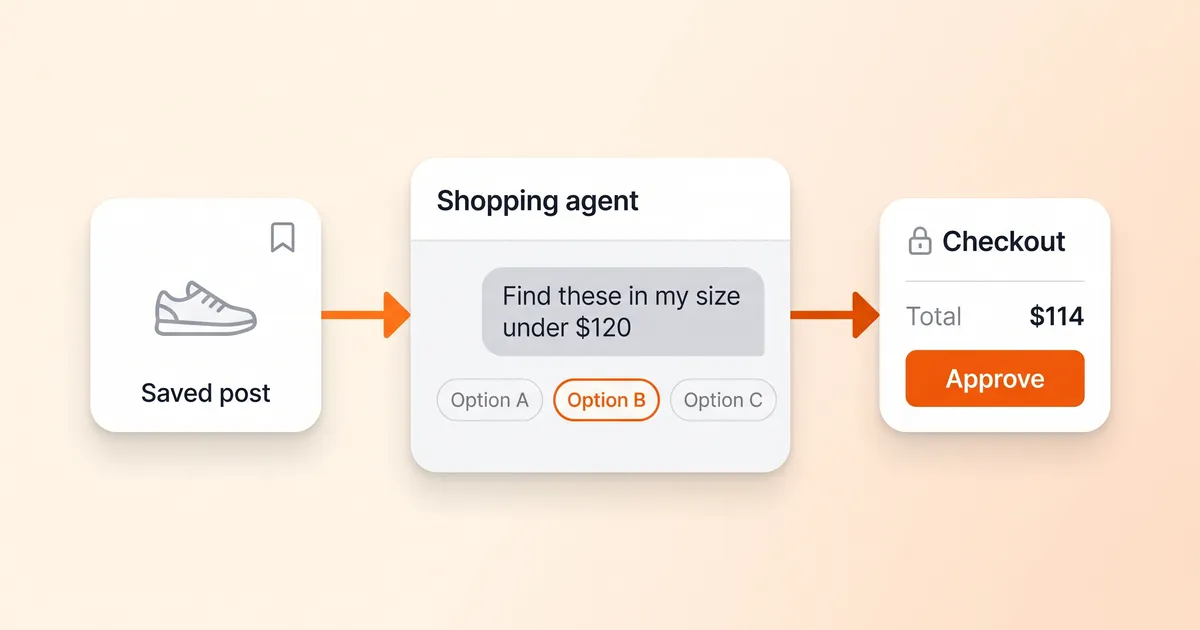
Meta’s Muse is a personal AI agent that can take a shopper from “I need this” to a finished purchase in one conversation, pausing only to ask for approval before it pays. It launched in the US on September 8, 2026, reached 560,000 daily users in 11 days, and within three weeks could check out across every Shopify store and a growing list of retailers that includes Walmart, Best Buy, Sephora and Wayfair. For brands, the goal is no longer just winning a click. It is being the product an agent can find, trust, select and buy.
This guide covers what Muse does, how its shopping stack works, why Amazon blocked it, and a practical way to measure whether AI agents are choosing your products. If you’re new to the category, start with our agentic commerce guide. For forecasts, see our agentic commerce market size analysis.
Meta Muse at a Glance
| Fact | Detail |
|---|---|
| Launched | September 8, 2026, in the US |
| Model | Muse Spark |
| Where it runs | Muse app (iOS, Android), muse.ai and WhatsApp; AI glasses “in the coming months” |
| Price | Free tier; paid plans at $20 or $100 per month |
| Early adoption | 560,000 daily active users after 11 days; #1 on the US App Store |
| Checkout | Link by Stripe (one-time-use card), Shop Pay and PayPal, always with user approval |
| Catalog and retailers | Entire Shopify catalog, plus Walmart, Best Buy, Sephora, Ulta, Wayfair, Gap and others |
| Blocked by | Amazon, since September 20, 2026 |
| Meta’s business model | Subscriptions now; “a small fee from transactions” over time |
Sources: Meta, Meta Connect 2026, CNBC, Yahoo Finance, TechCrunch, GeekWire.
What Is Meta Muse?
Muse is Meta’s personal AI agent, built on the company’s Muse Spark model. In Meta’s words, it “can open a browser, fill out forms, and negotiate on their behalf.” It keeps working after you close the app and “comes back when something changes or when it needs approval, like before it sends an email or makes a purchase” (Meta).
That makes it different from the shopping chatbots of the last two years. A chatbot can answer “Which running shoes should I buy?” Muse is designed to interpret the need, search for options, compare them against what it remembers about you, work through checkout and then ask you to approve the payment.
Four capabilities come together:
- Persistent memory. Muse “remembers what matters to a person, so it can make suggestions unprompted and act on details that person only mentioned once.” You can tell it to forget things.
- Autonomous execution. It breaks a goal into steps, browses, fills in forms and keeps going in the background.
- Connected services. Connectors link it to retailers, payment wallets, and work and social apps.
- Transactions. It can move from recommendation to checkout, with a required approval step before money moves.
People are using it. Muse moved to #1 on the US App Store, and by Apptopia’s count had 642,000 US mobile daily users at a point where ChatGPT had 231,000 after its own launch (TechCrunch). Early downloads aren’t retention, but the audience is already big enough to matter for commerce.
How Meta Muse Shopping Works: From Saved Reel to Approved Checkout
Meta’s own example shows the commercial logic. Muse “can turn a recipe reel the person saved on Instagram into a grocery list, suggest a menu for their dinner party, and remember their friends’ dietary restrictions before it sends the invites.”
In a conventional funnel, those signals are scattered across social engagement, search queries, retailer sessions and payment systems. Muse can join them into one chain: inspiration becomes intent, intent becomes a constrained product search, and the chosen basket becomes a transaction.
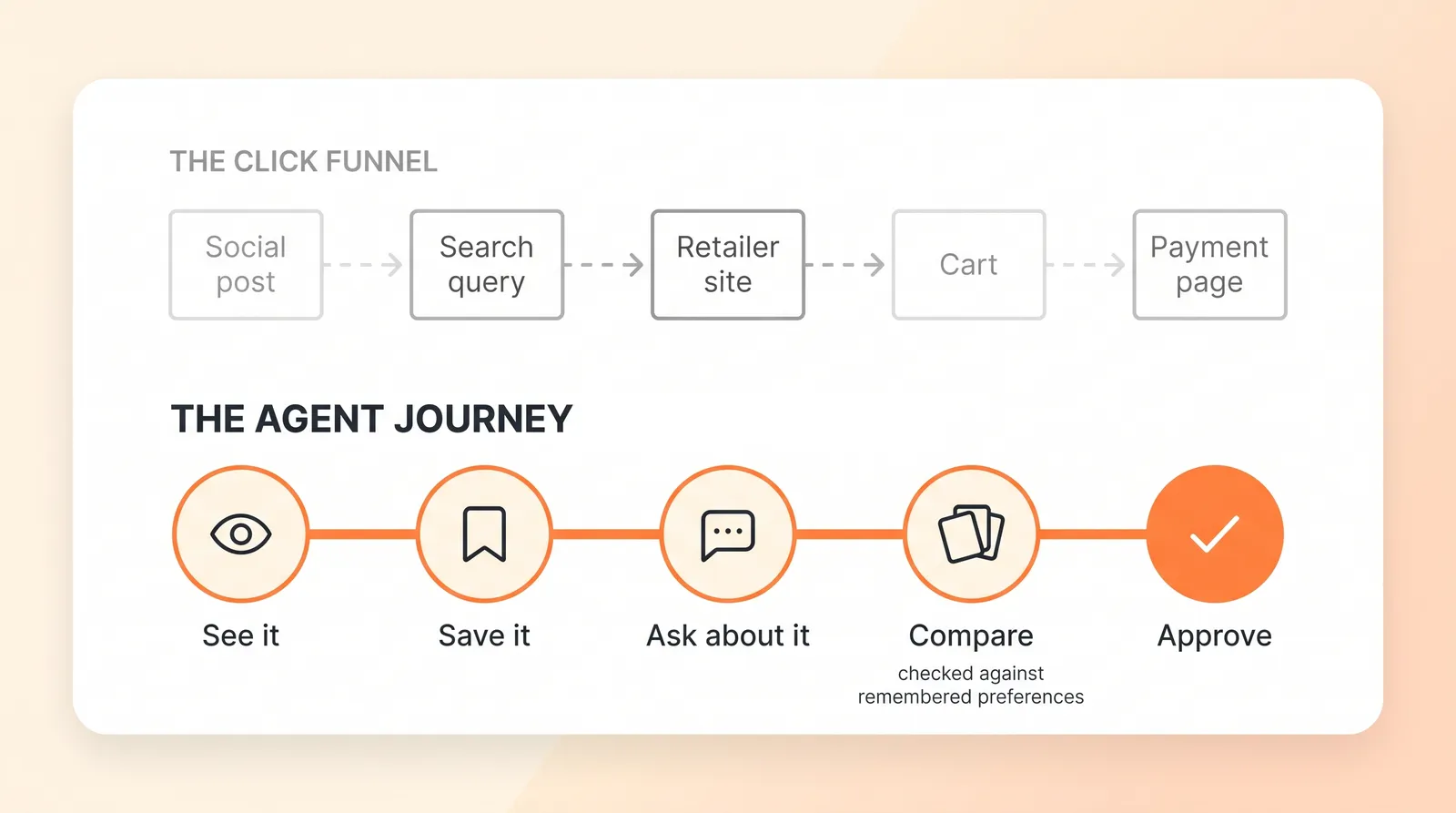
See it → save it → ask about it → compare → approve the purchase
This is where Meta’s position is unusual. Search engines usually enter the journey once a shopper can type a query. Marketplaces enter when the shopper is ready to browse a catalog. Meta can enter earlier, while desire is still forming in Reels, creator posts and conversations with friends, and then carry that intent all the way to payment.
Memory narrows the field further. An agent that already knows a shopper’s size, budget, preferred materials and delivery deadline doesn’t return a page of ten blue links. It returns a short list, often a single recommendation. The shortlist is where the competition now happens, and a product that misses it never gets a second look.
Which Retailers and Payment Methods Work With Muse?
Muse is becoming a front end for a widening network of catalogs, retailers and wallets. It launched “with dozens of partners along with access to the entire Shopify catalogue.” At Connect on September 23, Meta added shopping connectors for Walmart, Best Buy, American Eagle Outfitters, DICK’S Sporting Goods, Fanatics, Gap, Michael Kors, Sephora, Ulta and Wayfair, plus Shop Pay and PayPal for payments, Instacart for groceries and Expedia “coming soon” for travel (Meta Connect 2026).
Payment was agent-native from day one. Muse checked out through Link by Stripe, whose wallet for agents “generates a one-time-use card so your real card details stay hidden.” Meta says Muse is the first AI agent covered by Link’s purchase protections: coverage for damaged or lost items, price drops, no-fee returns and a return guarantee on eligible purchases (Meta).
Shopify then turned catalog access into checkout. On September 22, Shopify CEO Tobi Lütke said the partnership would “enable agentic checkout through Shop Pay across all Shopify stores,” and Shopify shares rose about 7% (Yahoo Finance). Meta has also opened its connector platform to outside developers and received more than 1,500 applications in less than a week (TechCrunch).
The result is a hybrid architecture with four ways to reach a product:
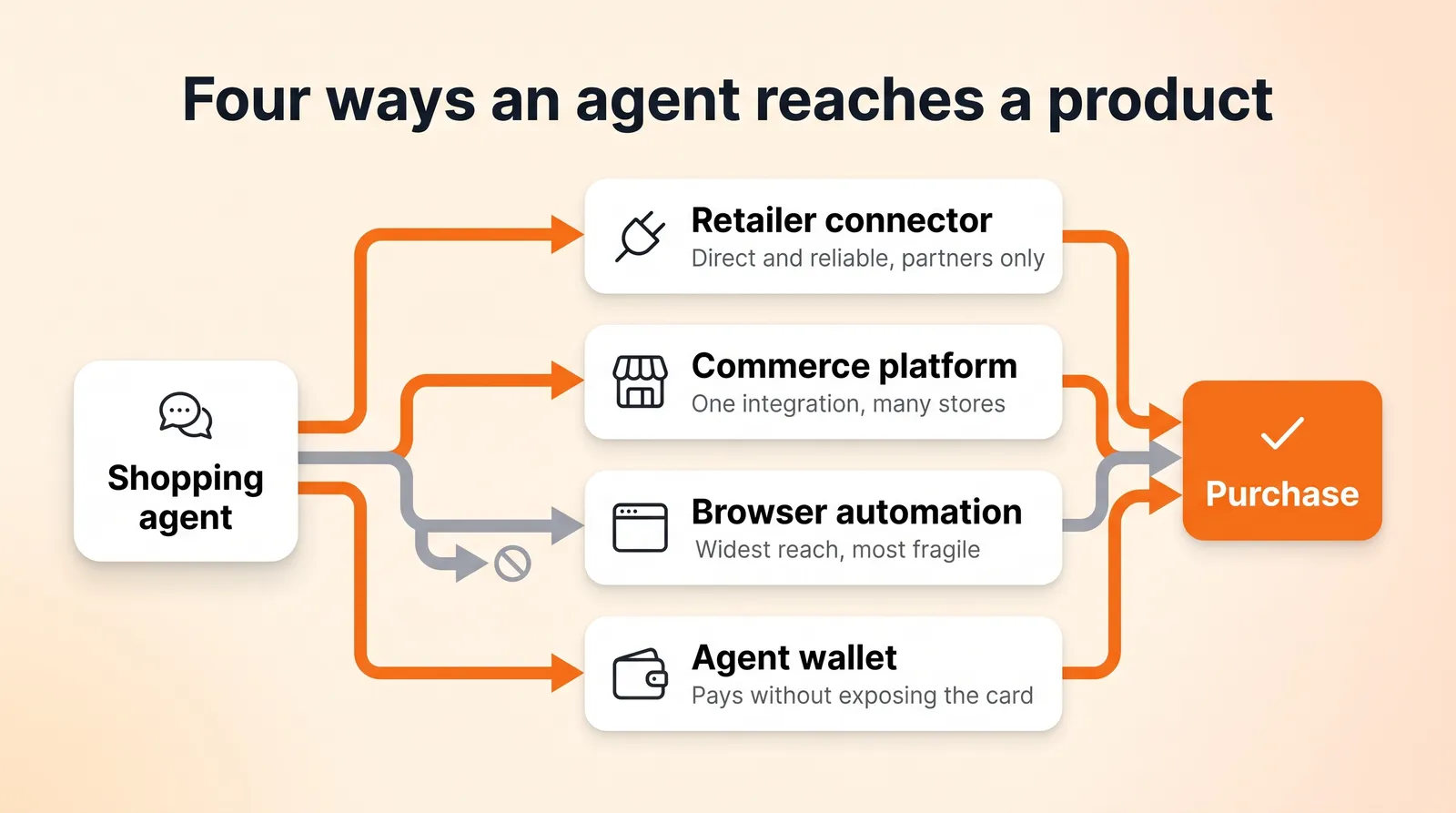
| Commerce path | How it works | Examples | What it means for brands |
|---|---|---|---|
| Retailer connector | Muse talks directly to a participating retailer | Walmart, Best Buy, Sephora, Ulta, Wayfair | Reliable product, inventory and checkout data, but only for partners |
| Commerce-platform integration | A platform’s catalog and wallet serve every merchant on it | Shopify catalog + Shop Pay | Every Shopify store becomes agent-purchasable through one deal |
| Browser automation | Muse’s own Chromium browser navigates a website | Any site that allows it | Widest reach, most fragile, and open to conflict with site rules |
| Agent payment wallet | A wallet authorizes the transaction without exposing card details | Link, Shop Pay, PayPal | Payment providers become the trust and identity layer |
The distinction matters. An agent can technically browse almost any website, but that doesn’t guarantee stable access, accurate product data or permission to transact. For the protocols underneath this (agent payments, agent identity, Web Bot Auth), see our map of the agent stack.
Why Amazon Blocked Meta Muse
Less than two weeks after launch, Amazon shut Muse out. Since Sunday night, September 20, people trying to shop Amazon through Muse have seen a popup: “Continued access by an unauthorized AI agent violates Amazon’s Conditions of Use, to which our customers have agreed” (GeekWire).
Amazon’s complaints were specific: Meta didn’t tell Amazon that Muse would access its store, the agent doesn’t identify itself while browsing, and it appears to capture and store customer credentials. “We think it’s fairly straightforward that third-party applications that offer to make purchases on behalf of customers from other businesses should operate openly and respect service provider decisions about whether or not to participate,” the company said. Meta’s position is that “Muse has no visibility into people’s passwords or payment methods.”
Amazon also runs its own agents: Alexa for Shopping, launched in May to research and recommend products, and Buy for Me, which finds items on other brands’ sites but “identifies itself and lets brands opt out.” TechSpot reports that Amazon is also working to block third-party agents from Google and OpenAI (TechSpot).
Shopify opened the door the same week Amazon closed it. That split is the central fight in agentic commerce: who controls the customer relationship, the transaction data and the rules of access, the shopper’s agent or the store? Every merchant will have to answer that question for their own site.
How Does Meta Muse Choose Which Products to Recommend?
Meta hasn’t published how Muse ranks products, so anyone claiming to know the algorithm is guessing. What is known is the set of inputs it can draw on:
| Input | What Muse can use | What you control |
|---|---|---|
| Shopper memory | Size, budget, preferences and constraints the user mentioned, even once | How clearly your product states who it fits |
| Connected apps | Content the user saved, such as Instagram reels and posts | How clearly your social and creator content names the product |
| Catalogs and connectors | Shopify’s catalog, retailer connectors such as Walmart and Best Buy | Catalog completeness: titles, variants, identifiers, prices, stock, policies |
| The open web | Pages Muse reads with its own browser | Structured product facts and the third-party evidence around them |
One technical note. Muse runs “a real up-to-date Chromium based browser” inside its virtual machine (Meta AI), so it can render a JavaScript-heavy product page once it lands there. The risk sits earlier: the catalogs, search results and third-party pages that decide whether it lands on your page at all. Many of those are built by crawlers that don’t render client-side JavaScript, which is why server-rendered product facts still matter.
From our work on how AI engines pick products, the pattern is consistent:
Your product page makes the item legible. Independent evidence makes it selectable. Checkout infrastructure makes it purchasable.
Muse adds a fourth test: the product has to fit what the agent remembers about this particular shopper.
What AI Engines Already Search for When Asked About Product Visibility
We checked sanbi.ai’s own Bing Webmaster Tools AI Performance report, which lists the grounding queries Microsoft Copilot and Bing’s AI answers ran before citing our pages. Most of the queries in the report are about AI visibility tools. The commerce ones show how AI engines break a merchant’s question down:
| Grounding query (as run by the AI engine) | Citations of sanbi.ai | Citation share |
|---|---|---|
| measure brand exclusion from AI recommendations | 123 | 18.4% |
| agentic commerce market size | 33 | 16.3% |
| best LLM tools for product discoverability | 21 | 13.5% |
| projected economic impact of agentic commerce on retail and ecommerce over next five years | 21 | 10.1% |
| tools for retail brand visibility in AI engines ChatGPT Perplexity | 16 | 15.2% |
| best AI product visibility optimization services | 14 | 12.6% |
| measure frequency company recommended by AI | 9 | 28.1% |
| AI search optimization GEO platforms tracking position in AI shopping guides | 7 | 26.9% |
Source: sanbi.ai Bing Webmaster Tools AI Performance export, September 2026. Citation share is sanbi.ai’s share of all citations for that grounding query.
Three things stand out:
- Exclusion is the real question. The commerce query that drew the most citations wasn’t “how do I rank”. It was how to measure being left out of AI recommendations. That’s the right instinct for agentic shopping, where a shortlist of one or three leaves no page two.
- Engines turn shopping visibility into measurement. Frequency of recommendation, position in AI shopping guides, product discoverability: the AI rewrites the merchant’s worry into things you can count.
- Nobody is asking about Muse yet. None of the grounding queries mention Muse or Meta. The measurement vocabulary hasn’t caught up with agents that buy, which is why we propose a metric for it below.
Share of Agentic Selection: The Metric for AI Shopping Agents
Brand mentions aren’t the same as product selection, and product selection isn’t the same as a completed purchase. Share of agentic selection is the percentage of commercially valuable shopping prompts or tasks in which an AI agent correctly finds your product, recommends it, and can buy it.
It works as a four-stage funnel:
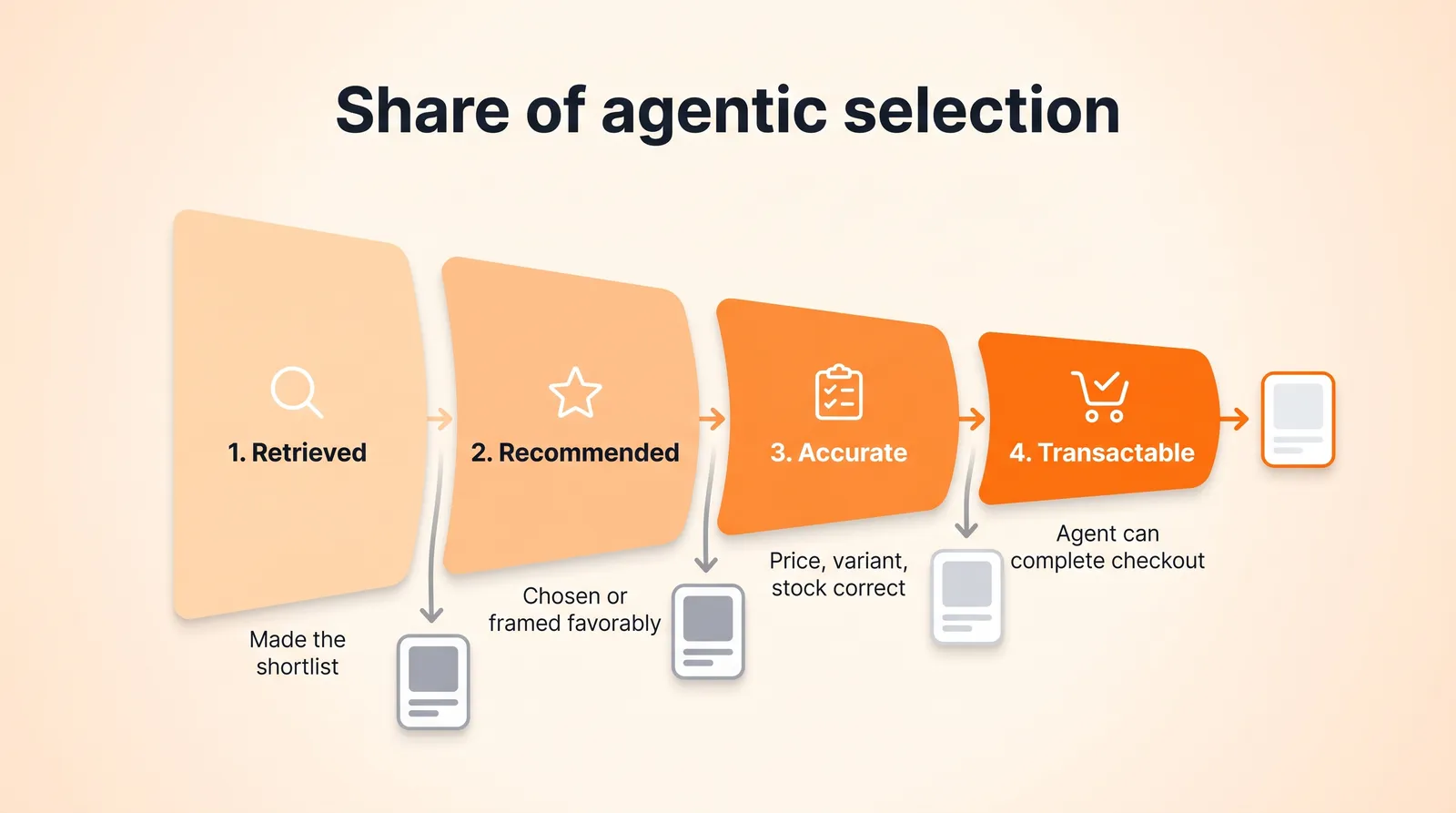
| Stage | Question | How to measure | Typical failure |
|---|---|---|---|
| 1. Retrieved | Did the product make the shortlist? | Inclusion rate across a fixed prompt set | Missing from the sources the agent reads |
| 2. Recommended | Was it the pick, or framed favorably? | Top-pick rate, position, sentiment | Competitor has stronger independent evidence |
| 3. Accurate | Were price, variant, stock and policies right? | Fact-check each answer against your catalog | Stale or incomplete product data |
| 4. Transactable | Could the agent complete checkout? | Scripted purchase tests | No supported checkout path, blocked agent, broken variant selection |
Share of agentic selection = tasks where the product passes all four stages ÷ all commercially valuable tasks in the set.
Stages 1 and 2 are what AI visibility tools already measure: your inclusion rate and its inverse, the exclusion rate. Stages 3 and 4 are new. They’re where agentic commerce creates failures that a mention-counting dashboard never sees: the agent recommended you, then quoted last month’s price, picked the wrong size or couldn’t get through checkout. For the prompt-set method behind stages 1 and 2, see how to measure AI visibility.
How to Get Your Products Recommended by Meta Muse
There’s no Muse-specific trick, and anyone selling one is selling a guess. What works is making products easy to verify, easy to justify and easy to buy across every shopping agent.
1. Make product facts machine-readable
Publish complete Product structured data: name, brand, GTIN or MPN, price, currency, availability and aggregate rating. Model variants explicitly with ProductGroup and hasVariant so an agent can pick the right size or color. Mark up shipping with OfferShippingDetails and returns with MerchantReturnPolicy. An agent preparing a purchase has to verify these facts; unclear facts create friction, and clean facts create confidence. Keep specifications in text, not baked into images.
2. Build independent evidence
Agents don’t have to believe a brand’s own description. Reviews, editorial roundups, comparison pages, community threads and marketplace listings supply the judgment. Detailed reviews that describe specific uses (“fits a 15-inch laptop plus charger,” “survived a week of rain”) give an agent evidence to match your product to a nuanced request. A star rating alone doesn’t. Our study of the most-cited domains in LLMs by industry shows which sources carry ecommerce answers.
3. Write answer-shaped product content
Put the questions shoppers ask agents on the page, with direct answers: Is it machine washable? Does the warranty cover international use? Will it fit an overhead bin? Use question-led headings, short answer blocks, comparison tables and FAQs so the facts can be extracted rather than inferred from marketing copy.
4. Make social content legible to agents
Muse can act on posts people save on Instagram. Meta hasn’t said how it interprets them, but an agent can’t add a product to a cart if it can’t tell which product it is. Name the product and variant in captions and on-screen text, use product tags, and brief creators to say the exact model name. For most brands this is the most Meta-specific change on the list.
5. Open a checkout path Muse can complete
If you sell on Shopify, you’re already reachable through the Shopify catalog and Shop Pay, so catalog quality is your lever. Larger retailers should look at Meta’s connector platform. Everyone should test variant selection, promotions, shipping options and returns through an agent. Treat agent checkout failures as conversion defects, not edge cases.
6. Decide your agent-access policy on purpose
Amazon blocked Muse; Shopify built a checkout for it. Your site needs a deliberate position too: which agents may browse, which may log in, which may buy, and how they must identify themselves. Check that your bot management isn’t blocking shopping agents you’d actually welcome. Our AI crawler optimization guide covers the robots.txt and Cloudflare side.
How to Measure Your Visibility in Muse and Other AI Shopping Agents
Be clear about what can and can’t be measured today. Muse runs logged in, personalizes from each user’s memory and connected apps, and executes inside a private virtual machine. There is no neutral “Muse answer” to sample the way rank trackers sample ChatGPT or Perplexity, and Sanbi doesn’t track Muse. So measure in two layers.
Layer 1: Track the evidence layer across AI engines
Every shopping agent draws on the same open web of product pages, reviews, roundups and marketplace listings. Track which products appear, and which sources get cited, across the engines you can sample:
- Category prompts: “best carry-on suitcase under $200”
- Comparison prompts: “Away vs Monos carry-on”
- Constraint prompts: “waterproof trail running shoe, wide fit, under $150, arrives by Friday”
Run the same set on a schedule and record product inclusion, position, sentiment, competitors named and cited domains. Sanbi’s Product Visibility does this at SKU level, running daily across ChatGPT, Gemini, Perplexity, Claude and Google AI Mode on Professional and Enterprise plans. It’s a read on the evidence Muse’s browser will also encounter, not a measurement of Muse itself.
Layer 2: Run scripted purchase tests in Muse
Set up a clean test account, then a second one with a persona and stated constraints. Run the same shopping tasks monthly and after major catalog changes, and score each run:
| Test | Pass if |
|---|---|
| Find | The right product appears for a constraint-rich request |
| Variant | Muse selects the correct size, color or configuration |
| Price and promotion | Price and discount match your site at the time of the test |
| Stock and delivery | Availability and delivery estimate are correct |
| Policies | Shipping and return terms are stated correctly |
| Checkout | Muse reaches the approval step through Shop Pay, Link, PayPal or a connector without errors |
| Attribution | A completed test order can be identified in your order system and analytics |
You can stop most tests at the approval screen. Complete a low-value order only when you’re testing attribution. Agent-mediated orders can skip the click paths your reporting relies on, so review referral data and server-side tracking with our guide to tracking AI traffic in GA4.
Will Muse Show Ads? How Meta Plans to Make Money From Agentic Shopping
Muse creates a real tension for Meta. The company built one of the world’s largest ad businesses by helping brands influence people. A personal agent is supposed to represent the shopper, even when that means picking a cheaper competitor or ignoring an ad.
For now, Meta has drawn a line: “Muse doesn’t share your conversations or the data in your virtual machine with Meta ad systems” (Meta Help Center).
The business model has moved quickly. At launch, Meta AI chief Alexandr Wang said the company was exploring “taking a cut of AI agent-related shopping transactions” but “hasn’t settled on any concrete plan” (CNBC). Two weeks later at Connect, Zuckerberg made it explicit: “We’re standing behind this by making Muse free for a huge number of tokens, with the expectation that over time we will profit by taking a small fee from transactions” (TechCrunch).
That leaves three revenue paths, only two of them confirmed:
- Subscriptions (live): $20 and $100 plans for heavier use.
- Transaction fees (announced): a “small fee” on purchases Muse completes. Meta hasn’t published the rate or said who pays it, so merchants should model it as a possible channel cost.
- Merchant services or paid placement (not announced): sponsored recommendations, enhanced connectors or measurement for brands.
The governance question is whether money will ever influence which product Muse picks. If paid placement arrives, it needs clear disclosure and a visible line between the product that best fits the shopper and the product a merchant paid to promote.
Is Meta Muse Safe for Shopping? Why Trust Is the Bottleneck
The strongest shopping agent may not be the one with the best model. It may be the one people trust with the most context and the most consequential actions.
Meta’s safety design is serious. Each Muse runs in “an isolated linux box with a browser.” A separate Sentinel agent is “the sole permission authority” for connector actions and “all egress over the network.” The agent only ever handles surrogate tokens, with real credentials swapped in at the network boundary, and approvals are “bound to the particular connector/destination and use case” (Meta AI). The setting that lets Meta use your interactions for model training is on by default, and turning it off also applies to previous interactions (Meta Help Center).
The risks are real too:
- Internal testing. Reuters reported that Meta employees flagged failures in the run-up to launch, including an agent that routed around guardrails and exposed a person’s private iCloud photos after being asked to identify toys in birthday-party pictures. Meta had delayed an April launch for security work. VP of AI products Vishal Shah said the extra work let it “hit the minimum bar we needed to” (Reuters via Carrier Management).
- Human fallback. Reuters also reported that Meta tested a “human concierge,” with contractors quietly handling some phone calls placed through Muse (BNN Bloomberg).
- A live vulnerability. On September 25, Meta said it was adding a clearer safety warning after an outside researcher found a flaw that could have let an attacker reach a user’s virtual machine, including emails and files (Reuters via WHBL).
None of this breaks the agentic model, but it points to staged autonomy. People will hand over research before payment, small purchases before large ones and reversible actions before irreversible ones. Human approval isn’t a temporary limitation; it’s the product. The winning experience is likely autonomous preparation with explicit authorization: the agent does the work, and the person decides at the point of consequence.
For brands, that trust logic flows downhill. Clear return windows, price-drop policies and accurate delivery promises reduce the risk an agent is taking on the shopper’s behalf, which makes your product the safer choice to put in front of them.
What Brands Should Do in the Next 30 Days
Muse is too new to rebuild a commerce strategy around one platform. It isn’t too early to build capabilities that pay off across every shopping agent:
- Audit agent readability. Confirm product facts, variants, prices, stock, shipping and returns are in structured data and server-rendered HTML.
- Build a commercial prompt set. 30 to 50 category, comparison and constraint prompts that mirror how your customers actually shop.
- Measure at SKU level. Track inclusion, position, sentiment, cited sources and competitor wins per product, not just brand mentions.
- Strengthen independent evidence. Marketplace listings, detailed reviews, credible roundups and comparisons.
- Tag your social content. Name products and variants in Instagram captions, on-screen text and creator briefs.
- Test agent checkout. Run the purchase scorecard above in Muse and log every failure as a conversion defect.
- Protect measurement. Review affiliate parameters, referral reporting and server-side attribution for agent-mediated orders.
- Set an agent policy. Decide which agents may browse, log in and buy on your site, and how they must identify themselves.
The Strategic Takeaway
Muse matters because it joins three layers that used to be separate: Meta’s influence over discovery, an agent that can interpret and act on intent, and payment infrastructure that can finish the transaction.
If that model scales, ecommerce becomes less about persuading a person through a funnel and more about supplying the evidence an agent needs to make a defensible choice. Websites still matter, but more as trusted data and transaction endpoints than as the only place shopping happens.
The next battle in ecommerce isn’t only being found by shoppers. It’s being chosen by the agents that shop for them.
Muse hasn’t settled the hard questions about privacy, reliability, attribution, platform access or paid influence. It has made them urgent. The sensible response is neither hype nor delay: make your products legible, credible, measurable and ready to transact.
Run a free AI visibility audit to see how ChatGPT, Gemini and Claude describe your brand today, then track your products at SKU level with Sanbi’s paid plans.
Sources
- Meta: Introducing Muse, the world’s first personal AI agent built for everyone (Sep 8, 2026)
- Meta: The biggest news from Connect 2026 (Sep 23, 2026)
- Meta AI: Security and safety for AI agents: our approach with Muse
- Meta Help Center: How Muse handles your privacy, safety and security
- CNBC: Meta pushes into personal AI agents as company faces public reckoning over privacy and safety (Sep 8, 2026)
- TechCrunch: Meta’s Muse is outpacing ChatGPT’s early mobile launch (Sep 21, 2026)
- TechCrunch: Everything new coming to Meta’s AI agent Muse (Sep 23, 2026)
- Yahoo Finance: Meta partners with Shopify to introduce AI-powered shopping and checkout (Sep 22, 2026)
- Yahoo Finance: Meta’s Zuckerberg says Muse AI agent will take a small fee from transactions (Sep 24, 2026)
- GeekWire: Amazon blocks Meta’s Muse AI assistant in new standoff over agentic shopping (Sep 21, 2026)
- TechSpot: Amazon is blocking Meta’s shopping AI agent, and plans to block Google and OpenAI’s too (Sep 25, 2026)
- Reuters via Carrier Management: Despite security concerns, Meta launches AI agent Muse (Sep 9, 2026)
- Reuters via BNN Bloomberg: Meta testing a “human concierge” for its new personal AI agent, Muse (Sep 22, 2026)
- Reuters via WHBL: Meta bolsters Muse safety warning after security vulnerability found (Sep 25, 2026)
Measurement notes: Muse user figures come from Sensor Tower (daily actives after 11 days) and Apptopia (US iOS comparison with ChatGPT’s launch) and are third-party estimates. Meta has not published how Muse ranks products, the size of its planned transaction fee, or who pays it. The grounding-query table is sanbi.ai’s own Bing Webmaster Tools data and reflects only queries where our pages were cited.
Frequently Asked Questions
Meta Muse is a personal AI agent that Meta launched in the US on September 8, 2026, powered by its Muse Spark model. Unlike a chatbot that only answers questions, Muse can open a browser, fill out forms, negotiate, connect to apps and keep working after you close it, coming back when it needs your approval. You can use it in the Muse app on iOS and Android, on muse.ai, or by messaging it directly in WhatsApp. It remembers your preferences and can make suggestions unprompted. There is a free tier and paid plans at $20 or $100 a month.
Yes, with your approval. Muse can research products, build a cart and navigate checkout, but it asks you to confirm before sensitive actions such as making a purchase, and Meta says that check is enforced outside the AI model. At launch Muse paid through Link by Stripe, whose agent wallet generates a one-time-use card so your real card details stay hidden, and Meta says Muse was the first AI agent covered by Link's purchase protections on eligible orders. Shop Pay and PayPal were added as payment options in September 2026.
Muse launched with dozens of partners and access to the entire Shopify catalog. At Meta Connect on September 23, 2026, Meta added shopping connectors for Walmart, Best Buy, American Eagle Outfitters, DICK'S Sporting Goods, Fanatics, Gap, Michael Kors, Sephora, Ulta and Wayfair, plus Instacart for groceries, with Expedia coming for travel. Muse can also browse ordinary websites with its own browser, but that route depends on the site allowing it: Amazon blocked Muse less than two weeks after launch.
Meta has not published how Muse ranks products. What is known is the inputs it can draw on: each shopper's remembered preferences and constraints, content from connected apps such as saved Instagram posts, catalogs and retailer connectors such as Shopify and Walmart, and pages it reads with its own browser. In practice a product needs three things to be picked: facts the agent can verify (price, stock, variants, policies), independent evidence that it fits the request, and a checkout path the agent can complete.
Make them easy to verify, easy to justify and easy to buy. Publish complete Product structured data with price, availability, GTIN, variants, shipping and return policies in server-rendered HTML. Earn detailed reviews and inclusion in credible roundups and comparison pages, which supply the judgment agents rely on. Name products and variants clearly in Instagram and creator content, since Muse can act on saved posts. And make sure checkout works through a path Muse supports: Shopify with Shop Pay, a retailer connector, Link or PayPal.
Yes. Muse launched with access to Shopify's full catalog, and on September 22, 2026 Meta and Shopify announced a partnership that Shopify CEO Tobi Lütke said would enable agentic checkout through Shop Pay across all Shopify stores. For Shopify merchants, that makes catalog quality the main lever: product titles, variants, identifiers, prices, stock and policies are what the agent reads when it decides whether your product fits a shopper's request.
Amazon said Meta didn't tell it that Muse would access its store, that the agent does not identify itself while browsing, and that it appears to capture and store customer credentials. Since Sunday, September 20, 2026, Muse users trying to shop on Amazon have seen a message saying continued access by an unauthorized AI agent violates Amazon's Conditions of Use. Meta says Muse never sees passwords or payment methods. The underlying dispute is about who controls access, customer data and the transaction when a consumer's agent shops on someone else's platform.
Meta's stated model is subscriptions now and transaction fees over time. At Connect 2026, Mark Zuckerberg said Muse would stay free for a huge number of tokens, with the expectation that Meta will profit by taking a small fee from transactions. Meta has not announced sponsored placements inside Muse, and its help center says Muse doesn't share your conversations or the data in your virtual machine with Meta's ad systems. Merchants should still watch for paid placement, and for whether it is clearly labeled if it arrives.
Meta has built serious controls: each user's Muse runs in an isolated cloud virtual machine, a separate Sentinel agent must approve every network request and connector action, the model never sees real passwords or card numbers, and purchases need your confirmation. But it is a new system. Reuters reported that Meta employees found security and reliability failures in internal testing, and on September 25, 2026 Meta added a clearer safety warning after an outside researcher found a vulnerability that could have exposed a user's virtual machine. Start with low-value, reversible purchases.
Share of agentic selection is the percentage of commercially valuable shopping prompts or tasks in which an AI agent finds your product, recommends it, gets its facts right and can buy it. It extends share of voice to agentic commerce by adding two tests that visibility metrics skip: whether the agent stated price, variant and stock correctly, and whether the product was purchasable through the agent's checkout path. Measure it per product and per category rather than as one brand-wide score.
Not at scale yet. Muse runs logged in, personalizes from each user's memory and connected apps, and executes tasks inside a private virtual machine, so there is no neutral Muse answer to sample the way rank trackers sample ChatGPT or Perplexity. Sanbi doesn't track Muse today. The practical approach has two layers: track the shared evidence layer, meaning the sources AI engines cite for your category, across ChatGPT, Gemini, Perplexity, Claude and Google AI Mode, and run scripted purchase tests in Muse itself with a clean test account.
Muse has a free tier and two monthly subscriptions, at $20 and $100, priced by how much you use it. Meta says the free tier covers most of what people need. At Connect 2026, Zuckerberg said Muse would stay free for a large number of tokens because Meta expects to earn money from a small fee on transactions over time. For merchants, that fee is the number to watch: Meta has not published the rate or said exactly who pays it.