Agentic Shopping Market Trends (2025–2033): The Growth Forecasts Reddit Is Debating
The agentic shopping space represents one of the most transformative shifts in retail commerce since the emergence of e-commerce itself. Autonomous AI agents—software systems that make purchasing decisions independently on behalf of consumers—are accelerating adoption at an unprecedented rate. This report breaks down the market size, regional dynamics, growth forecasts, and what it all means for brands competing for visibility in the age of AI.
Executive Summary
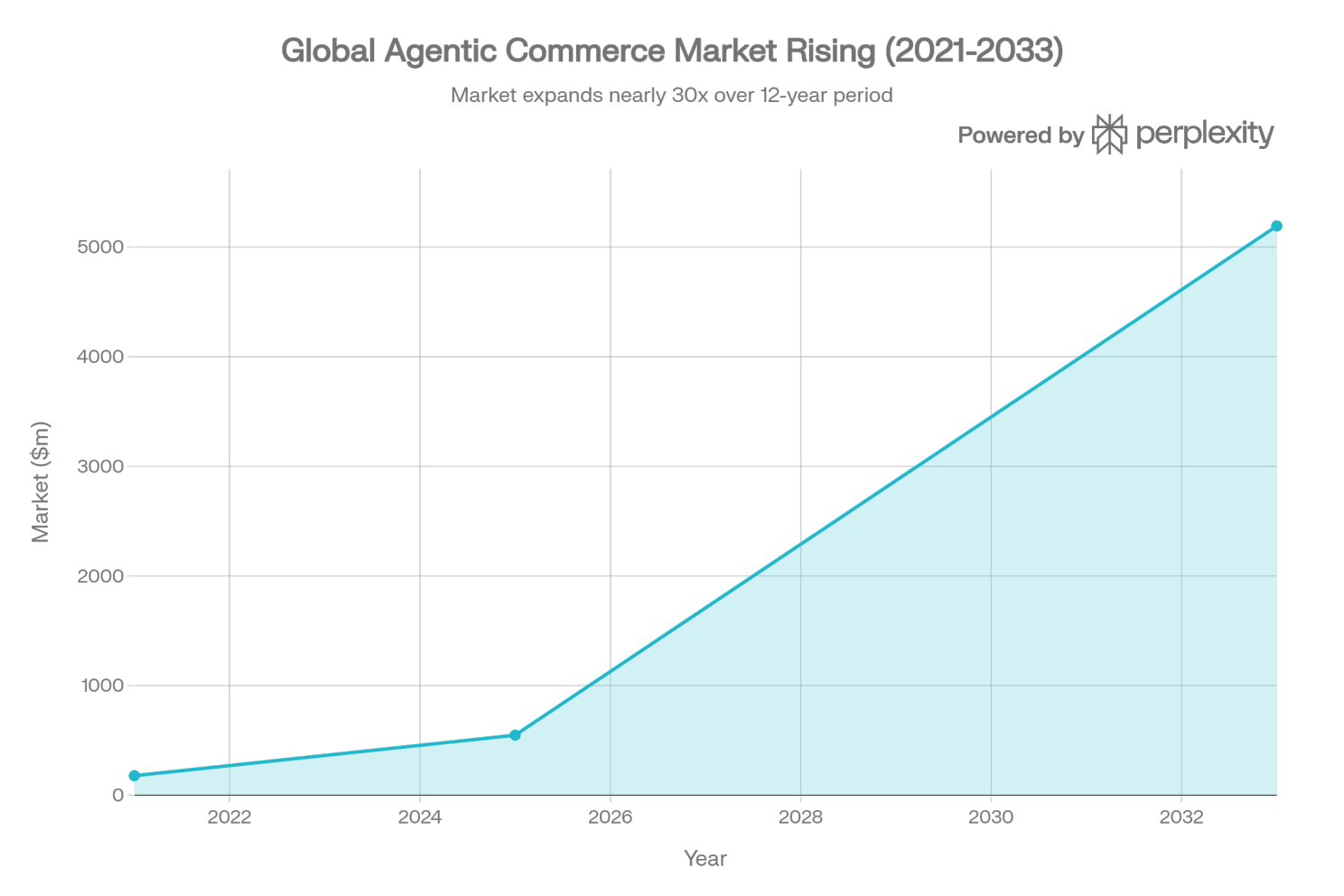
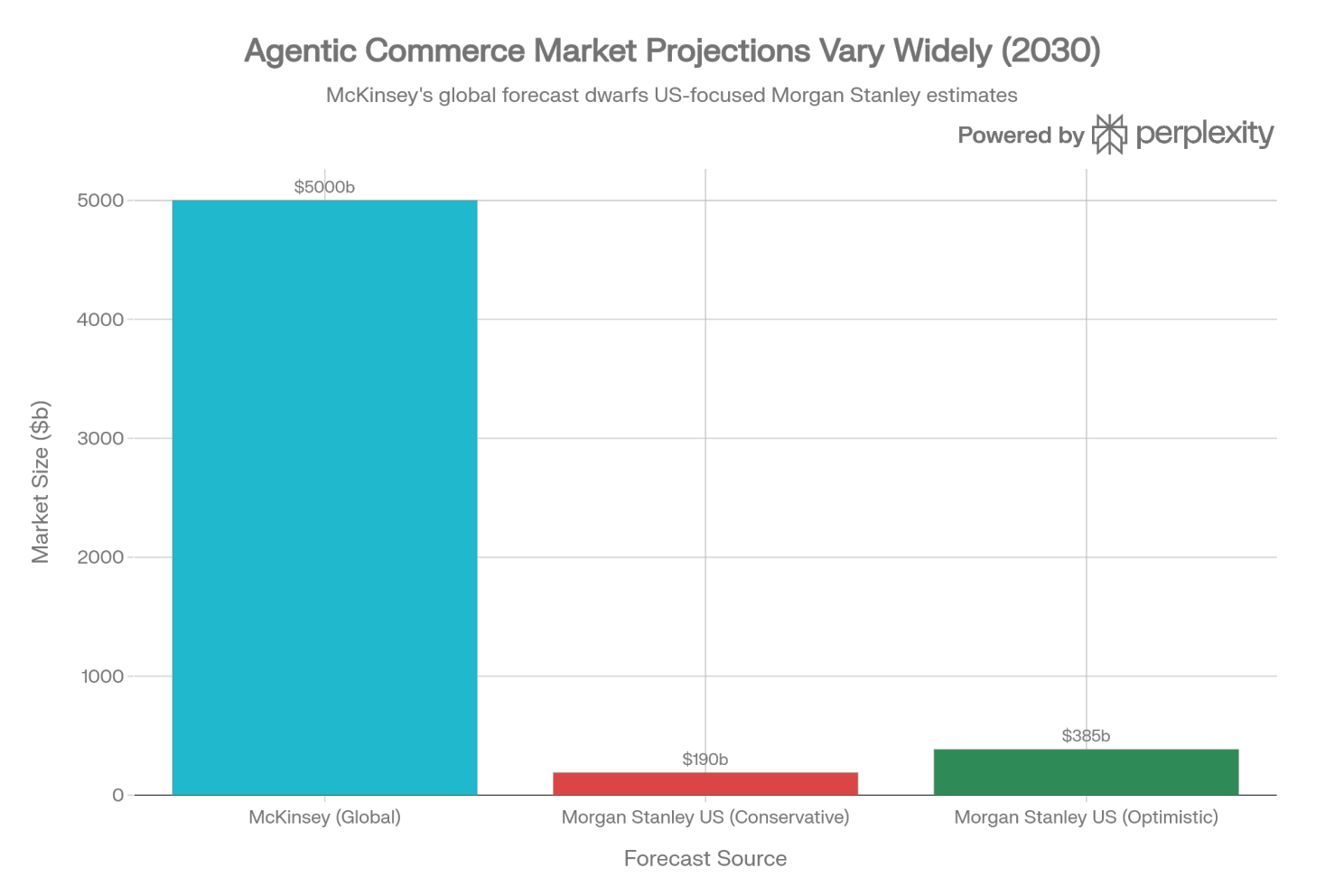
The global agentic commerce market, valued at $547.3 million in 2025, is projected to reach $5.2 billion by 2033, expanding at a compound annual growth rate of 32.5%. By 2030, leading research institutions forecast the market will reach between $3 trillion and $5 trillion globally, with the U.S. e-commerce segment alone capturing $190 billion to $385 billion in agentic-driven spending (10–20% market share).
This unprecedented growth is being driven by fundamental shifts in consumer behavior, aggressive platform investments from technology giants, and regulatory infrastructure emerging to standardize agent-to-retailer communication protocols. The implications extend far beyond consumer convenience—they represent a restructuring of how retailers compete, how brands maintain visibility, and how e-commerce economics function in a post-search paradigm.
Market Size and Growth Trajectory
Current Market Dimensions
The agentic shopping market entered mainstream visibility in 2024–2025, though its foundations were established earlier. The global agentic commerce market grew from $177.7 million in 2021 to $547.3 million by the end of 2025, demonstrating rapid acceleration.
Within the broader agentic AI ecosystem (which encompasses beyond-commerce applications), the global market reached $7.29 billion in 2025, with projections to expand to $9.14 billion in 2026 and $139.19 billion by 2034, representing a 40.5% CAGR.
The distinction between these two market segments matters: agentic commerce specifically refers to autonomous shopping and purchasing workflows, while agentic AI encompasses all autonomous agent applications across enterprise operations. Agentic commerce remains a subset, but it is the fastest-growing application area for enterprise AI spending in retail and e-commerce.
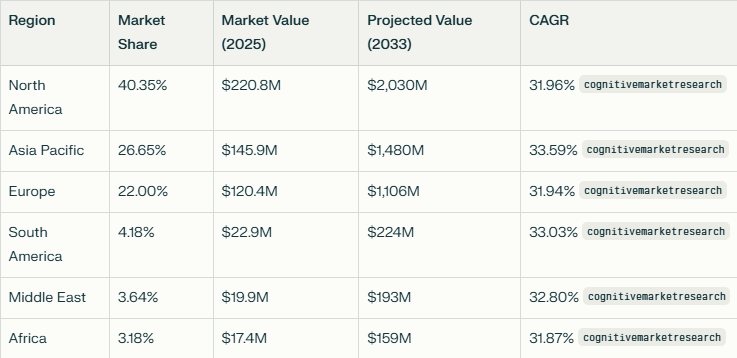
Regional Market Distribution (2025)
The agentic commerce market exhibits clear geographic concentration, with developed markets and large consumer populations leading adoption:
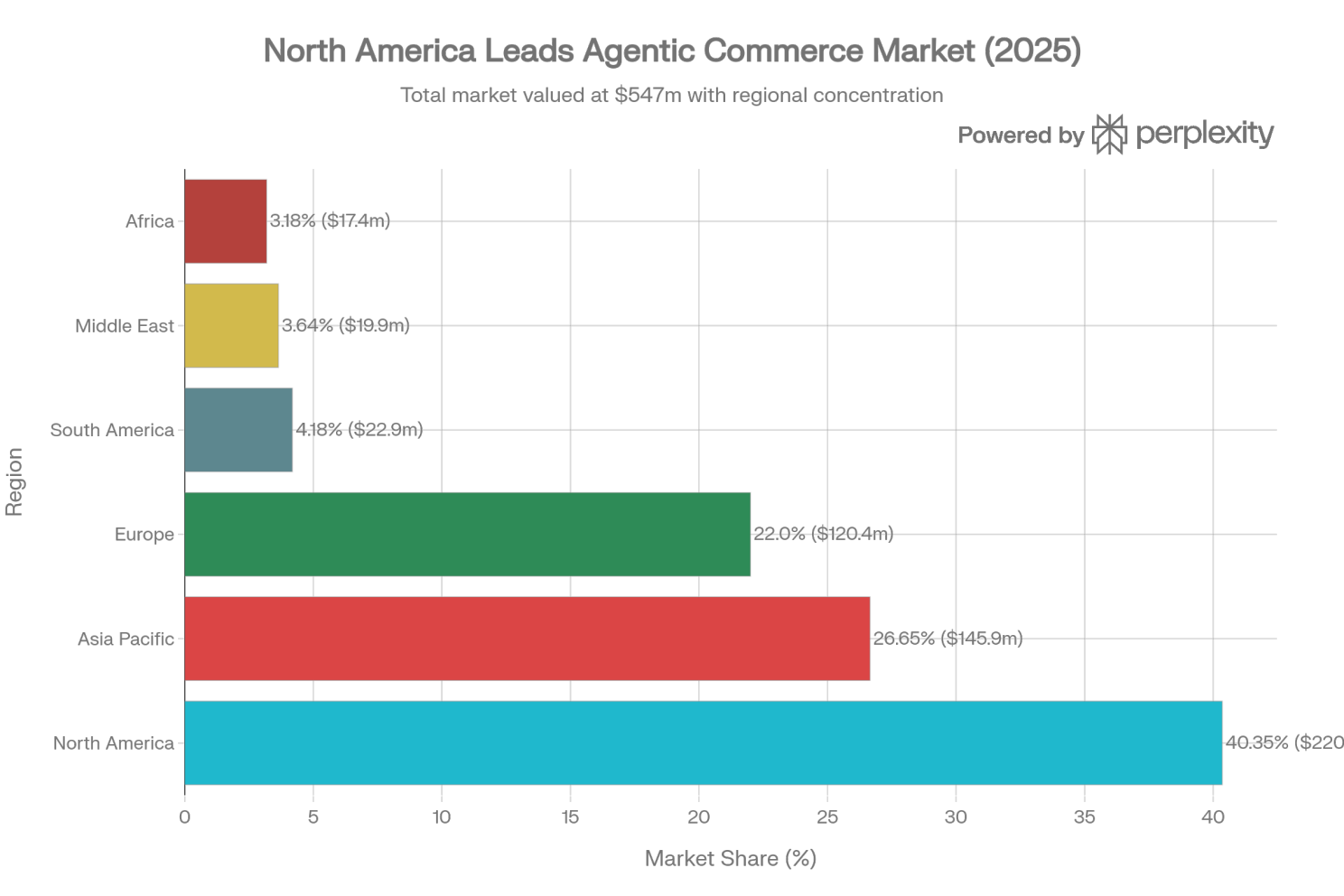
- North America: 38.2% — dominance reflects the concentration of early-adopter consumers, technology infrastructure, and venture capital investment. Within North America, the United States captures 83.26% of regional market value, positioning it as the global epicenter of agentic commerce innovation.
- Europe: 27.5% — driven by strong regulatory frameworks and enterprise adoption.
- Asia-Pacific: 23.1% — rapid growth fueled by mobile-first consumer behavior and massive e-commerce populations.
- Latin America: 6.8% — emerging adoption led by Brazil and Mexico.
- Middle East & Africa: 4.4% — early-stage but accelerating.
Long-Term Market Forecasts (2030)
Multiple research institutions have published divergent yet consistent forecasts for the agentic commerce market by 2030, indicating strong consensus around the market trajectory despite uncertainty in precise scale:
-
McKinsey projects the global agentic commerce market will reach $5 trillion by 2030, representing a significant portion of total e-commerce transaction volume. This figure reflects McKinsey’s assumption that agentic systems will handle approximately 15–25% of all e-commerce transactions within the U.S. alone.
-
Morgan Stanley Research provides a more granular forecast for the U.S. market specifically, estimating agentic shoppers could command $190 billion to $385 billion in U.S. e-commerce spending by 2030. This translates to 10–20% of total U.S. e-commerce market share.
-
Bain & Company aligns with this thesis, projecting 15–25% of e-commerce will flow through agentic channels by 2030, though the firm acknowledges this estimate depends heavily on resolution of trust, security, and regulatory issues.
These forecasts suggest a 2026–2030 compounded annual growth rate of approximately 45–65% for the agentic commerce segment, far exceeding historical e-commerce growth rates of 7–12%.
Current Market Dynamics (January 2026)
Traffic Migration and Platform Dominance
The most immediate market signal is the dramatic reallocation of traffic away from traditional search to AI-powered discovery channels:
- AI-sourced retail traffic surged 1,200% year-over-year, while traditional search traffic declined 10% YoY—the most significant traffic shift in retail since mobile overtook desktop browsing.
- On Shopify’s network (serving over 5 million brands), AI-driven traffic increased sevenfold, with AI-generated purchase volume increasing elevenfold.
- Approximately 6% of all internet searches now flow through AI-powered answer engines (ChatGPT, Gemini, Perplexity, Claude)—a shift that would have taken five years in the pre-AI era but occurred in just 18 months.
High-Intent Consumer Adoption
Shoppers arriving via AI agents exhibit substantially higher purchase intent and engagement than traditional visitors:
- According to Boston Consulting Group, customers arriving through AI agents are 10% more engaged than traditional website visitors, reaching retailers further down the sales funnel.
- 60% of U.S. consumers expect to use AI shopping agents within the next 12 months, with 75% already possessing familiarity with AI tools.
- During Cyber Week 2025, 20% of all global orders were influenced by AI agents or shopping assistants, according to Salesforce.
Multi-Million Merchant Adoption
Merchant adoption is accelerating rapidly: over 1 million Shopify merchants have already opted into OpenAI’s Instant Checkout feature, which enables auto-carting and autonomous purchasing directly within ChatGPT without leaving the conversation.
Major technology platforms announced expansive agentic commerce infrastructure in January 2026:
- Google unveiled a Universal Commerce Protocol in partnership with Walmart, enabling products to be discoverable and purchasable through Gemini, with image and voice recognition capabilities.
- Microsoft launched Brand Agents (turnkey solutions for brands) and personalized shopping agent templates, with integrated implementations at brands like Guess.
- OpenAI expanded Instant Checkout capabilities to support multi-item shopping carts within ChatGPT, with integration partnerships including Etsy, Shopify, and Walmart.
Structural Market Trends
Shift from SEO to Answer Engine Optimization (AEO)
Traditional SEO strategies emphasizing keyword density, backlinks, and page rankings are giving way to Answer Engine Optimization (AEO), which prioritizes machine-readable product information, structured data, and natural language content that AI agents can parse and reason about.
Retailers must now ensure their product data—materials, dimensions, pricing, inventory, return policies, sustainability metrics—is accessible to AI agents in standardized formats. Failure to achieve this visibility creates the risk of algorithmic invisibility, where competitors’ products are consistently recommended by agents while a retailer’s offerings remain unseen.
This is the defining challenge for brands in 2026: if your data isn’t machine-readable, you don’t exist in the agentic shopping funnel.
Real-Time Adaptive Merchandising
Rather than static pricing and inventory strategies, retailers in 2026 are implementing real-time adaptive systems where agentic AI continuously monitors competitor pricing, demand signals, weather patterns, local events, and inventory levels to optimize autonomously. Multi-agent systems deliver operational efficiencies including:
- 60% fewer errors in pricing and inventory management
- 40% faster execution on promotional changes
- 25% lower operating costs compared to manual processes
Compression of the Shopping Funnel
Traditional e-commerce journeys requiring multiple steps—discovery, comparison, decision-making, payment—are being compressed into single conversational interactions. The shopping journey that once took 20+ minutes of active browsing now occurs within a single AI agent interaction lasting seconds.
The fastest impact is occurring in planning-driven, repeatable purchase decisions: outfit curation, room design planning, gift selection, seasonal refreshes, and household replenishment. Higher-stakes purchases (health, finance, identity-linked categories) remain more resistant to full automation through 2026–2027.
Emergence of “Super Agents”
The competitive advantage accrues to “super agents”—comprehensive AI assistants like ChatGPT, Google Gemini, Klarna, and Instacart that aggregate data and transact across multiple retailers. These platforms control discovery, comparison, and transaction facilitation, creating a structural shift where individual retail brands lose direct customer relationships and must instead cultivate “algorithmic trust”—the preference shown by AI agents when making recommendations.
This mirrors historical retail disruptions but with accelerated intensity: just as Amazon’s aggregation diminished small retailers’ direct market access, agentic platforms are now intermediating the consumer-retailer relationship at an earlier stage—before consumers even consciously select a retailer.
Consumer Segmentation and Adoption Barriers
Research from Kearney identifies four distinct consumer cohorts driving agentic commerce adoption:
| Segment | Share | Motivation | Adoption Speed |
|---|---|---|---|
| Tech-Forward Early Adopters | 15% | Automation, time savings | Fastest |
| Price-Sensitive Pragmatists | 35% | Discounts, savings guarantees | Fast (if savings proven) |
| Privacy-Conscious Skeptics | 30% | Control, data transparency | Slow (requires trust) |
| Routine Loyalists | 20% | Brand loyalty, human interaction | Slowest |
Despite these distinctions, a consistent consumer desire exists to remain “smart shoppers”—requesting proof of savings, spending limits, and visible budget controls even when AI performs purchasing automation. Successful agentic commerce platforms will emphasize transparency and control mechanisms rather than complete delegation.
Trust remains the most significant barrier to acceleration. For categories where identity is central (fashion, home decor, luxury goods), consumers remain resistant to autonomous purchasing. Conversely, categories focused on correctness and optimization (groceries, supplies, commodities) show rapid agentic adoption.
Market Spending and Investment Trends
Enterprise IT Spending on Agentic AI
Retailers are dramatically increasing investment in agentic AI capabilities:
- According to Gartner, AI spending across retail will increase 36% in 2026, while specialized GenAI spending will increase 38%.
- 48% of retail respondents plan to deploy agentic AI in 2026, indicating mainstream adoption rather than niche experimentation.
- IDC projects agentic AI will represent 10–15% of total IT spending in 2026, expanding to 26% of budgets (~$1.3 trillion) by 2029.
By 2029, Gartner predicts single, semi-autonomous AI agents for discrete store inventory management tasks will become “a prerequisite for staying in business” rather than a competitive differentiator.
Migration of Retail Media Spending
Traditional retail media networks are experiencing funding pressure as marketing budgets migrate upstream to AI agent platforms where discovery originates. Instead of bidding for shelf placement or search keyword prominence, brands must now optimize product data, pricing, and availability to appeal to AI agent algorithms that select recommendations independently of human browsing behavior.
Emerging Standards and Infrastructure
In January 2026, two competing but compatible protocols emerged to standardize how AI agents interact with retailers:
- OpenAI’s Agentic Commerce Protocol (ACP): Enables shopping journeys through ChatGPT’s interface, with initial partnerships including Shopify, Etsy, and Walmart.
- Google’s Universal Commerce Protocol (UCP): Enables shopping journeys through Gemini, with significant retail partnerships including Walmart and Sam’s Club.
These protocols serve an essential infrastructure function: they eliminate the need for retailers to build custom integrations with each agentic platform individually. Standardized APIs and data formats allow a single retailer implementation to service multiple agent platforms simultaneously—analogous to how payment processors eliminated individual merchant integrations with each card issuer.
Growth Drivers and Acceleration Factors
-
Technology Maturation: Large language models (GPT-4, Gemini, Claude) have reached sufficient sophistication to understand complex preferences, negotiate pricing, and execute multi-step transactional workflows with minimal error rates.
-
Labor Market Pressure: Retail faces severe labor shortages and wage pressure. According to NRF data, at least 23 states have planned minimum wage increases for 2025, driving retailers toward automation.
-
Consumer Behavior Shift: Unlike previous retail technologies that required behavior change, agentic commerce aligns with existing consumer preferences for convenience, speed, and delegation.
-
Platform Consolidation: Amazon, Google, OpenAI, and Microsoft’s aggressive infrastructure investments create a “push” effect where agentic capabilities become embedded in platforms consumers already use daily.
-
Supply Chain Transparency: Machine-readable product data requirements have inadvertently created infrastructure that also enables supply chain transparency, authenticity verification, and sustainability tracking.
Market Constraints and Risks
Despite accelerating adoption, several factors could moderate growth:
- Regulatory Uncertainty: Nascent regulations around AI, automated purchasing, and data privacy remain unsettled. Stricter regulations in Europe (via AI Act provisions) could increase friction and compliance costs.
- Trust and Transparency Concerns: 30% of consumers remain resistant without visible decision-making transparency. Privacy breaches could trigger broader consumer skepticism.
- Retailer Resistance: Incumbent retailers with established DTC strategies view agentic intermediation as threatening to brand loyalty and margin control.
- Data Quality Requirements: Many smaller retailers lack the infrastructure to provide sufficiently rich machine-readable data, creating a competitive advantage for larger retailers with mature data governance.
Conclusion: The 2026–2027 Inflection Point
The agentic shopping space is transitioning from exploratory pilot phase to mainstream infrastructure deployment. The market’s explosive growth trajectory—from $547.3 million in 2025 to projected $5.2 billion by 2033, and ultimately to $3–5 trillion in annual transaction volume by 2030—reflects a fundamental restructuring of how commerce occurs.
The critical inflection point is 2026–2027, during which agentic commerce infrastructure becomes mature enough for mainstream adoption while consumer and regulatory frameworks are still malleable. Retailers and brands that optimize for agentic visibility and algorithmic preference in this window will capture disproportionate market share. Those that delay adaptation risk algorithmic invisibility as competitors’ products become the default recommendations in agent-driven discovery.
The transformation from search-based shopping to agent-orchestrated commerce represents the most significant disruption to retail economics since the emergence of e-commerce 25 years ago.
Is your brand ready for the agentic commerce era? Check your AI Visibility Score →
Report Date: January 23, 2026
Author: Aditya Sinha, Founder — Sanbi.ai
Key Sources
- McKinsey: Superagency in the Workplace — Empowering People to Unlock AI’s Full Potential
- Gartner: Top Technology Trends 2026
- eMarketer: Agentic Commerce Traffic & Consumer Adoption Metrics
- BCG: Maximizing the AI Opportunity in Retail
- Kearney: The Future of AI-Powered Shopping
- Bain & Company: Artificial Intelligence Insights
- SAP & NRF: Platform Announcements (January 2026)
Frequently Asked Questions
The global agentic commerce market was valued at $547.3 million in 2025, up from $177.7 million in 2021. It is projected to reach $5.2 billion by 2033, expanding at a compound annual growth rate (CAGR) of 32.5%.
Agentic shopping is when autonomous AI agents—like ChatGPT, Gemini, and Perplexity—make purchasing decisions independently on behalf of consumers. Instead of browsing websites, the agent discovers, compares, and buys products within a single conversational interaction.
Multiple research firms forecast 15–25% of all e-commerce will flow through agentic channels by 2030. Morgan Stanley estimates $190B–$385B in U.S. agentic spending alone, while McKinsey projects the global market could reach $3–5 trillion.
North America leads with 38.2% of the global agentic commerce market (2025), followed by Europe at 27.5% and Asia-Pacific at 23.1%. Within North America, the U.S. captures 83.26% of regional market value.
Brands must shift from SEO to Answer Engine Optimization (AEO), ensuring product data is machine-readable via structured data (JSON-LD). Retailers need to integrate with AI-first protocols like Google's Universal Commerce Protocol and OpenAI's Instant Checkout to avoid algorithmic invisibility.
Algorithmic invisibility occurs when a brand's products are never surfaced by AI shopping agents because the brand lacks machine-readable data, structured APIs, or integration with agentic commerce protocols. The consumer never 'fails to click'—the product simply never gets proposed.