GEO and AEO for Ecommerce: How to Get Your Products Into AI Answers in 2026
Ask ChatGPT for the best running shoes for flat feet under $140 and you get three or four product names, a sentence of reasoning each, and no grid to scroll.
That is the whole problem. There is no page two, no position six, no long tail of listings a determined shopper might reach. Either your product is in the short list the engine assembles, or it does not exist for that question.
Where product recommendations actually come from
The instinct is to optimize the product detail page. It is the page you control, so it is the page you improve.
For AI product recommendations it is rarely the deciding input.
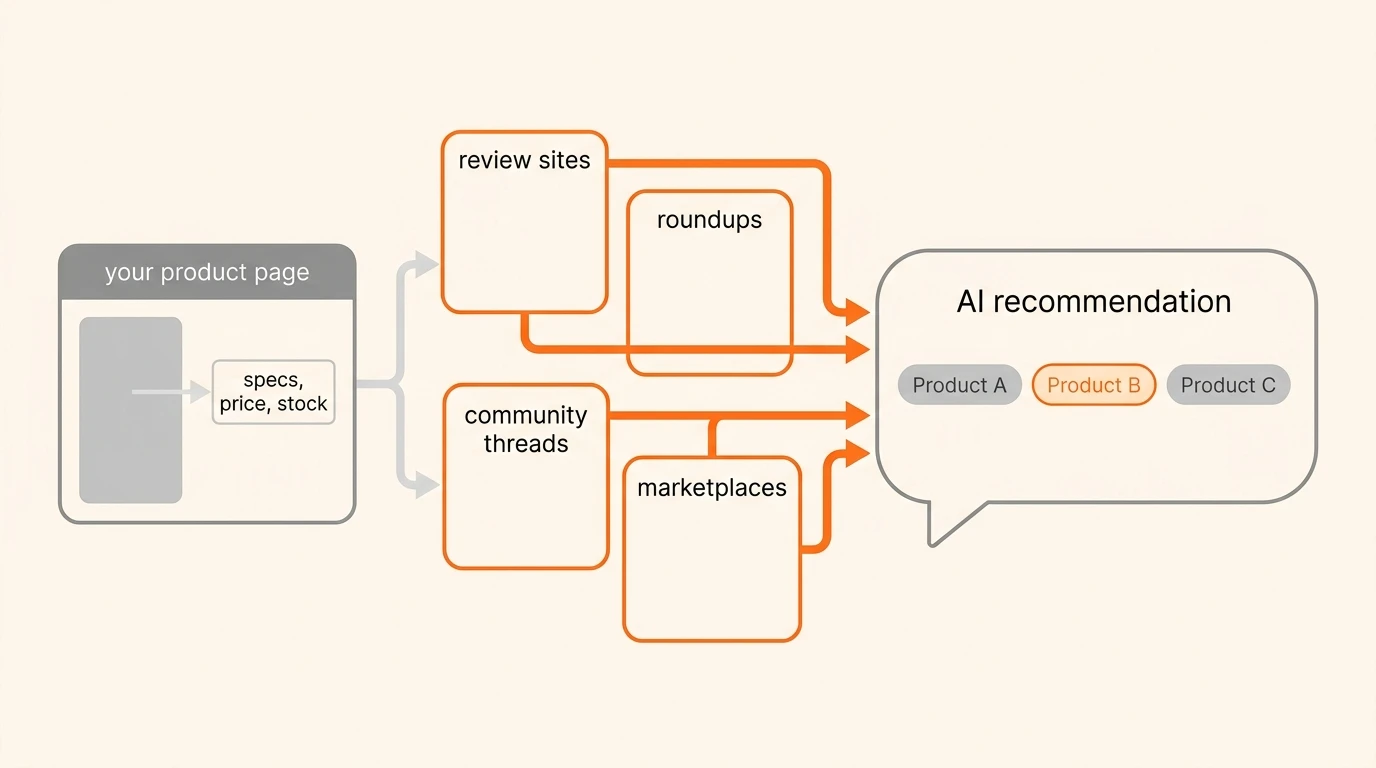
Engines assemble shopping answers mostly out of third-party consensus: review sites, editorial roundups, community threads, marketplace listings, comparison articles. Your PDP contributes facts — specifications, price, availability. It almost never contributes judgement, because a brand asserting its own product is best is exactly the claim a synthesizing model discounts hardest.
This produces the pattern ecommerce teams keep reporting: a well-built, fast, technically clean product page that AI engines never mention, while a competitor with a worse page is recommended constantly. The competitor is not winning on page quality. They are winning on being present in the sources the engine reads.
Which reframes the work:
| Job | Where it happens | What it needs |
|---|---|---|
| Supply verifiable facts | Your product page | Complete, current structured data |
| Supply judgement | Third-party sources | Reviews, roundups, comparisons |
| Supply situational language | Reviews and community | Specific, use-case-rich text |
| Supply availability | Feeds and marketplaces | Accurate real-time price and stock |
Only the first row is fully under your control. Most of the remaining effort is influence rather than authorship — which is uncomfortable, and is the actual job.
The product page still matters — for facts
Your PDP is not where judgement comes from, but it is where an engine verifies claims. Get these wrong and you get described vaguely, or skipped in favour of a retailer listing with cleaner data.
Complete Product schema. Price, currency, availability, GTIN or MPN, aggregate rating, review count. Engines repeat facts they can attribute confidently. Ambiguity produces hedging, and hedged descriptions lose to specific ones.
Specifications as text, not only images. Weight, dimensions, materials, compatibility, care requirements. A spec sheet rendered as a JPEG is invisible. This sounds obvious and remains extremely common.
Answer the situational questions on the page. “Is it machine washable?”, “does it fit a 15-inch laptop?”, “can I use it in salt water?” These are the questions buyers ask engines, and a page that answers them plainly is extractable. This is the answer engine optimization half of the work.
Server-render everything that matters. Most AI crawlers do not execute JavaScript. A price, spec table or review block injected client-side may simply not exist as far as the engine is concerned — even though it renders perfectly for you. Check by disabling JS and reading the page.
That last point is worth dwelling on, because it fails silently. Nothing errors. The page looks right in every browser. The content is just absent from what the crawler stored.
The part that actually moves recommendations
Everything above makes you eligible. This is what gets you named.
Get into the roundups. For most categories a small number of “best X” articles supply a large share of the recommendation set. Identify them by asking the engines directly and reading which sources they cite — the citation list is your target list, ranked by influence, generated for free.
Cultivate detailed reviews, not just ratings. Star averages give engines a quality signal. Review text gives them the language to explain why your product suits a situation. “Held up through a wet Scottish week” is worth more to an engine answering a situational query than a hundred five-star ratings with no words. Review prompts that ask about specific use cases produce far more usable text than “how did we do?”.
Be present where your category is discussed. Reddit and community platforms carry disproportionate weight in AI retrieval — our citation analysis found Perplexity in particular treats community sentiment as a direct input. Participation, not placement; the failure mode of astroturfing is well understood by both moderators and models. The same care applies here as in third-party placement generally.
Publish honest comparisons. Comparison and alternatives queries are a large share of AI shopping questions, and someone is going to write that content. If it is never you, your category’s comparison layer is authored entirely by competitors and affiliates. Comparisons that concede where a rival genuinely wins get cited more, because a model synthesizing across sources treats balance as credibility and marketing copy as noise.
Keep marketplace listings accurate. Amazon, Google Shopping and category marketplaces are heavily represented in retrieval. A stale or incomplete listing is a bad description of your product being read by an engine that cannot tell it is stale.
”AI search” on Shopify means two different things
Search the Shopify App Store for AI search and the top result is Boost AI Search & Filter — Boost Commerce’s on-site search and filtering app, rated 4.7 from roughly 1,900 reviews and priced from about $19–29 a month up to several hundred for large catalogues. It is a good product. It is also a different product from what this article is about, and merchants regularly conflate the two.
| On-site AI search app (Boost, Searchanise, Klevu, Algolia) | AI search visibility (ChatGPT, Perplexity, Gemini) | |
|---|---|---|
| Who is searching | A shopper already in your store | A buyer who has not found you yet |
| What it changes | Typo tolerance, filters, recommendations, bundles | Whether your product is in the engine’s shortlist |
| Where the answer comes from | Your own catalogue | Third-party sources plus your structured data |
| How you measure it | Search-to-purchase rate, zero-result rate | Prompt tracking, citation share, AI referrals |
Boost AI Search & Filter will not get you recommended in ChatGPT, and no AI visibility tool will fix a store where shoppers can’t find the blue one in size 9. Budget for both; just don’t expect one to do the other’s job.
One place they touch: some on-site search apps render collection and search-result pages client-side. If the only path to a product is a JavaScript-built results page, the crawler problem from the previous section applies — check that your product and collection URLs still return complete HTML without JS.
Which queries to compete on
Not all product queries are equally winnable, and the difference is stark.
Broad category terms — “best running shoes” — are dominated by entrenched consensus. Dozens of roundups already agree on an answer. Displacing that takes sustained work and rarely repays a small brand.
Specific, constrained queries — “best trail running shoes for wide feet under $130” — are far more winnable. Fewer sources address them, consensus is thin, and a product that genuinely fits can be placed confidently by the engine.
This inverts a familiar ecommerce instinct. Catalogue breadth is not the advantage in AI recommendation, because the engine only names three to five products regardless of how many you sell. A sharp position on a narrow need beats a wide catalogue with no clear claim on anything. Small catalogues often do better here, which is not true of classic ecommerce SEO.
Start where you genuinely win. Being recommended for a query you deserve builds the source consensus that eventually makes broader queries reachable.
Monitoring: track products, not just the brand
Brand-level monitoring answers “do engines know us?”. For ecommerce that is the less useful question — a brand can be well known while its specific products are absent from every recommendation set.
Track at the level decisions get made:
- Category prompts — “best [category] for [use case]”, across your main categories
- Comparison prompts — “[your product] vs [competitor]”, “[competitor] alternatives”
- Constraint prompts — the price, size and compatibility variants buyers actually ask
- Per prompt, record whether your product is named, which competitors appear, and which sources are cited
Run the same set on a schedule across ChatGPT, Perplexity, Gemini and Claude. The citation column is the one that drives action: it tells you which specific sources to influence next, in priority order. The method is the same as tracking brand mentions, applied at SKU and category granularity.
Sanbi.ai tracks product-level prompts across ChatGPT, Gemini, Perplexity, Claude and Google AI Mode with the citation sources attached, so you can see not just that a competitor is being recommended but which review site or thread is doing the recommending — which is the difference between knowing you have a problem and knowing where to go fix it.
Where this is heading
Recommendation is the current state. The direction of travel is agents that do more than suggest — assembling carts and completing purchases, which we covered in the agentic commerce guide.
The visibility requirement does not change: an agent can only buy from the shortlist it assembles, and that shortlist is built the same way today’s recommendations are. What gets added is a machine-readability requirement. An agent that cannot verify current price, confirm stock, or parse your checkout will route to a listing it can. Accurate structured data and clean feeds stop being an SEO nicety and become the difference between being purchasable and being skipped.
The work is the same either way, which is convenient: verifiable facts on pages that render without JavaScript, genuine presence in the sources that supply judgement, and monitoring granular enough to tell you which of the two is failing.
The bottom line
Product pages make you eligible. Third-party consensus gets you recommended.
Most ecommerce teams have the ratio backwards, pouring effort into pages they control and none into the review sites, roundups, comparisons and communities that actually supply the judgement engines synthesize. Fix the page-level facts once — schema, specs as text, server-rendered content — then spend the recurring effort where the recommendations are really made.
And measure at product level, because “our brand is visible” and “our products get recommended” turn out to be different things far more often than anyone expects.
Related reading: GEO playbook for 2026 · AEO vs GEO · Agentic commerce guide · Query fan-out explained
Frequently Asked Questions
Generative engine optimization for product search is the practice of making your products the ones AI engines name when someone asks a shopping question — 'best waterproof hiking boots under $150', 'alternatives to the Dyson V15'. It differs from classic ecommerce SEO because there is no results grid to rank in. The engine returns a short recommendation, usually three to five products, assembled from sources it trusts. GEO for product search is about being in that assembly: present in the sources engines read, described in language that matches how buyers phrase needs, and backed by review consensus.
Mostly from third-party consensus rather than from your product page. Engines synthesize review sites, editorial roundups, community discussion, marketplace listings and comparison content, then name products that multiple trusted sources agree on. Your own product detail page contributes specifications and availability, but it rarely supplies the judgement — a brand describing itself as 'the best' carries almost no weight, while three independent roundups saying so carries a lot. This is why catalogue-only optimization underperforms for product queries.
Yes, and it is one of the few areas where the classic SEO answer and the AI answer agree. Product schema with price, availability, currency, GTIN or MPN, and aggregate rating gives engines unambiguous facts to state, and unambiguous facts are the ones they are willing to repeat. Missing or stale structured data does not just cost you rich results — it makes an engine likelier to describe your product vaguely or fall back to a retailer's listing that does have clean data, which moves the citation and the click away from you.
Usually because the sources it reads recommend them. Engines lean on review sites, editorial roundups and community threads for product judgement, so a competitor that appears in more of those wins even with a weaker product page. The other common causes: your product is described in brand language rather than the words buyers use, your specifications are incomplete so the engine cannot verify a claim, or you are absent from the marketplace and comparison listings that dominate your category's retrieval set. Check which sources the engine cites — that list is your target list.
In practice they overlap heavily and the distinction is more useful as emphasis than as taxonomy. Answer engine optimization focuses on being the answer to a direct question — 'is the X waterproof?' — which rewards clear, extractable factual content on your own pages. Generative engine optimization focuses on being included when an engine generates a recommendation from many sources, which rewards third-party presence and consensus. Ecommerce needs both: AEO for specification and support questions, GEO for the discovery and comparison questions that drive new demand.
Track product-level prompts the way you would track keywords: a fixed set of category and comparison questions run on a schedule across ChatGPT, Perplexity, Gemini and Claude, recording whether your product is named, which competitors appear, and which sources are cited. Product monitoring differs from brand monitoring in granularity — you care about individual SKUs and categories, not just the brand name, because a brand can be well known while its specific products are absent from recommendation sets.
Often better than for large ones. Engines recommend a handful of products per answer, so breadth is not the advantage — being clearly the best answer to a specific, well-defined need is. A small catalogue with a sharp position ('the lightest three-season tent under two kilos') is easier for an engine to place confidently than a large undifferentiated one. The practical implication is to compete on narrow, specific queries where your product genuinely wins rather than broad category terms where consensus already favours incumbents.
Substantially, in two ways. Aggregate ratings in structured data give engines a citable quality signal. More importantly, the text of reviews — on your site, on marketplaces, and on third-party platforms — is the language engines draw on when explaining why a product suits a use case. Reviews that discuss specific situations ('held up through a wet Scottish week') are far more useful to an engine answering a situational question than five-star ratings with no text. Encouraging detailed reviews is a GEO tactic, not just a conversion tactic.
Yes, and it is one of the higher-return moves available. Comparison and alternatives queries are a large share of AI shopping questions, and engines need sources that actually compare things. If you never publish comparisons, the comparison content in your category is written entirely by competitors and affiliates with their own preferences. Honest comparisons that concede where a competitor genuinely wins tend to be cited more, because engines synthesize across sources and content that reads as balanced survives that synthesis better than marketing copy.
Recommendation is an AI naming products for a human to evaluate. Agentic commerce is an AI agent completing the transaction — selecting, adding to cart, sometimes purchasing on the buyer's behalf. The visibility problem is the same at the front end: an agent can only buy from the shortlist it assembles. The additional requirement is machine-readable commerce infrastructure — accurate structured data, real-time availability and pricing, clean checkout — because an agent that cannot verify a price or stock status will route around you to a listing it can parse.
No — it solves a different problem. Boost AI Search & Filter, Searchanise, Klevu and similar apps improve product discovery for shoppers who are already inside your store: better search relevance, typo tolerance, filter trees, recommendations. ChatGPT, Perplexity and Gemini never touch your store's search box; they assemble product shortlists from review sites, roundups, marketplaces and your structured data. So an on-site AI search app raises conversion for the traffic you have, while AI search visibility work determines whether the engines send you traffic at all. The one overlap to check: if the app renders collection or results pages with JavaScript, make sure your product URLs still serve complete HTML to crawlers.
In practice it means a structured, machine-readable layer of your catalogue that agents can query: complete Product schema on every page, a product feed with stable identifiers, accurate real-time price and stock, clean category taxonomies, and consistent facts across your site and marketplaces. Some retailers add an llms.txt and an API or agent-protocol endpoint. The goal is that when an assistant assembles a shopping answer it can verify your products without guessing, because agents route around listings they cannot parse.
Boost AI Search & Filter is a Shopify app from Boost Commerce that replaces the default store search with AI-powered search, typo tolerance, custom filter trees per collection, product recommendations and merchandising rules. It is one of the highest-rated apps in its category, with a 4.7 rating across roughly 1,900 reviews and tiered pricing from about 19 to 29 dollars a month for small catalogues up to several hundred for large ones. It improves discovery for shoppers already in your store.
Searchanise, Klevu, Algolia, Fast Simon, Doofinder and Shopify's own Search & Discovery app are the usual comparisons. Choose on catalogue size, filter complexity, merchandising controls, speed, and whether results pages are server-rendered or injected client-side, which matters for crawlers. None of them affects whether AI assistants recommend your products; budget that separately under AI search visibility.
Pricing is tiered by product count and Shopify plan: entry tiers around 19 dollars a month on standard Shopify plans and higher on Shopify Plus for catalogues up to about a thousand products, rising to several hundred dollars a month for catalogues in the tens of thousands, with a free trial. Confirm current tiers in the Shopify App Store, as the app has repackaged plans more than once.