Agentic Commerce in Q4 2026: Which AI Assistants Can Actually Check Out, and How to Prepare for the Holidays
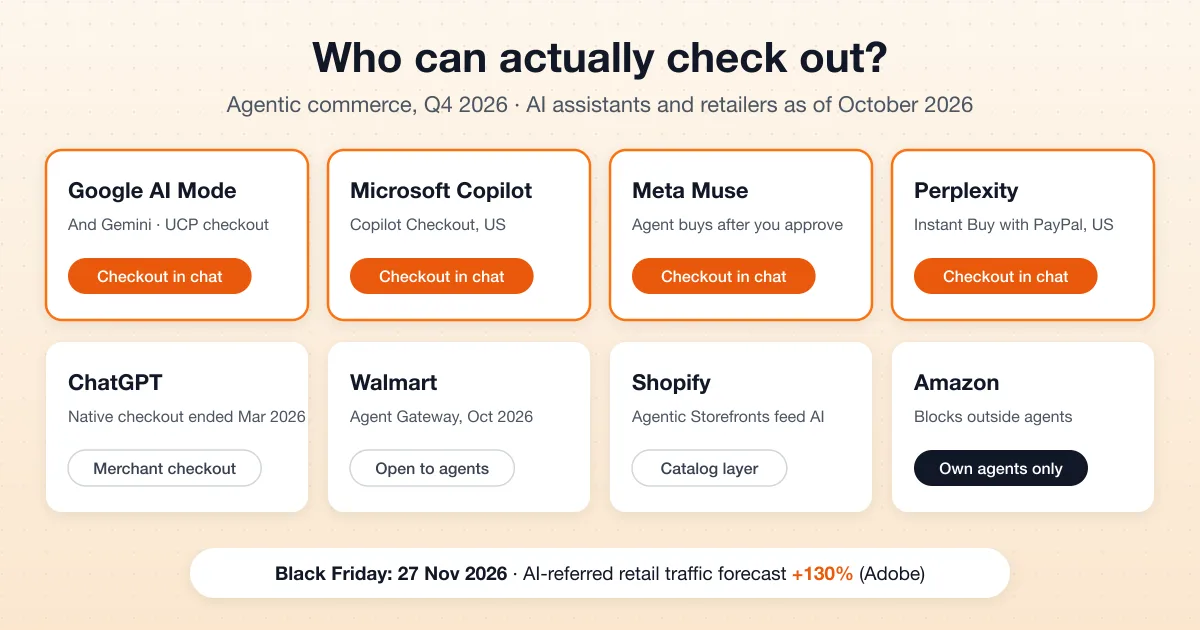
As of 23 October 2026, four AI assistants can complete a purchase inside the conversation: Google AI Mode and Gemini, Microsoft Copilot, Meta Muse and Perplexity. ChatGPT, the assistant most people associate with AI shopping, handed checkout back to merchants in March 2026. Amazon lets only its own agents buy on Amazon, while Walmart opened a dedicated gateway for everyone else’s agents two days ago.
The holiday data shows the same split. AI already shapes discovery: Adobe forecasts AI-referred traffic to US retail sites up 130% this season. Agents completing the purchase are still rare: 8% of AI users have bought entirely through an agent. This tracker covers who can check out, what changed between July and October, what the holiday forecasts measure, and what a merchant should do before Black Friday on 27 November. We will update it after Cyber Monday.
For the background, see our explainers on what agentic commerce is and its risks, the market-size forecasts to 2033 and the protocols underneath it.
Agentic Commerce at a Glance (October 2026)
| Question | Short answer |
|---|---|
| Who checks out inside the chat? | Google AI Mode and Gemini, Microsoft Copilot, Meta Muse, Perplexity (all US-first) |
| What happened to ChatGPT checkout? | Native Instant Checkout gave way to merchant checkout on 24 March 2026; ChatGPT now focuses on product discovery |
| Who blocks outside agents? | Amazon, which has blocked Meta Muse since 20 September 2026 |
| Who welcomes them? | Walmart, through the Walmart Agent Gateway and Agent Profiles announced on 21 October 2026 |
| Biggest Q4 launch | Google’s Universal Cart, live in the US across Search and Gemini since 15 October |
| Holiday traffic forecast | AI-referred US retail traffic +130% year on year in Nov–Dec 2026 (Adobe) |
| Purchases made by agents | 8% of AI users have bought entirely through an agent (L.E.K.); 10% of AI-assisted purchases closed inside the chatbot (Attentive) |
| Conversion | AI-referred visitors converted 48% better than other traffic in August 2026 (Adobe) |
Which AI Assistants Can Check Out Right Now
“Checkout” covers several different flows, so the table separates three things: whether the purchase completes inside the assistant, where it is live, and which rails carry it.
| Assistant or retailer | Can it check out in the chat? | Live since | Where | Rails | Watch for |
|---|---|---|---|---|---|
| Google AI Mode and Gemini | Yes: Google Pay checkout through UCP; Universal Cart can also move items to the merchant’s own cart | Agentic checkout 13 Nov 2025; UCP 11 Jan 2026; Universal Cart 15 Oct 2026 | US; Canada and Australia announced for early 2027, UK later | Universal Commerce Protocol (works with A2A, AP2 and MCP), Google Pay; the merchant stays merchant of record | Eligibility runs through Merchant Center |
| Microsoft Copilot | Yes: Copilot Checkout, “no redirect” | 8 Jan 2026 on Copilot.com; mobile app reported by Apr 2026 | US | PayPal, Shopify, Stripe; Microsoft cites the Agentic Commerce Protocol | ESW added a Copilot integration for its brands in July |
| Meta Muse | Yes: the agent checks out after the shopper approves the total in the chat | 8 Sep 2026 | US | Stripe Link wallet, with a single-use card where Link isn’t accepted; Shop Pay and PayPal added at Connect, 23 Sep | Amazon blocks it |
| Perplexity | Yes at launch: Instant Buy with PayPal | 25 Nov 2025 | US | PayPal; the retailer is merchant of record | No 2026 update found, so confirm the current scope |
| ChatGPT | No native checkout: purchases finish in the merchant’s checkout (in-app browser on mobile, new tab on desktop) | Instant Checkout 29 Sep 2025; changed 24 Mar 2026 | — | Agentic Commerce Protocol, now extended to product discovery | Walmart runs its own app inside ChatGPT with Walmart payments |
| Amazon | Only its own agents: Alexa for Shopping and Buy for Me | Alexa for Shopping (renamed from Rufus) 13 May 2026 | US | Amazon account | Blocks third-party agents |
| Walmart | A retailer, not an assistant: outside agents can buy through its gateway | Announced 21 Oct 2026; Agent Profiles “in the next month” | Not stated | Walmart Agent Gateway (an MCP server); agents never see card data | Spending limits per agent |
| Shopify | The catalog layer: Agentic Storefronts send merchant products to AI channels | 24 Mar 2026 | Global | Shopify Catalog and UCP | Shopify turned the channels on by default |
Google AI Mode and Gemini: the broadest native checkout
Google has the most complete flow in the US. Agentic checkout started rolling out to eligible US merchants on 13 November 2025. The Universal Commerce Protocol followed in January, “starting with native checkout”. By September, Google said UCP enabled direct checkout for “hundreds of thousands of brands”, with Australia and Canada to follow early next year. On 15 October it launched Universal Cart across Search and the Gemini app. Universal Cart holds items from several retailers, tracks price drops and lets the shopper either “securely check out with Google Pay” or “transfer your items directly to the merchant’s cart”. Merchant Center’s checkout documentation says the merchant remains merchant of record. Travel is split: hotels can be booked inside AI Mode in the US in English, while flights still go to the airline’s site.
Microsoft Copilot: checkout without a redirect
Microsoft announced Copilot Checkout on 8 January 2026, rolling out in the US on Copilot.com with PayPal, Shopify and Stripe. In April, Windows Central reported it working inside the Copilot mobile app in the US. In July, ESW launched agentic commerce for its brands with Copilot first. Microsoft’s September “super app” relaunch was about business agents and coding, not shopping.
Meta Muse: the agent buys after you approve
Muse launched on 8 September in the US. It can research products and complete the purchase itself; Stripe says shoppers “approve the transaction total directly in the chat”. At Connect on 23 September, Meta added retailers including Walmart and Best Buy, plus Shop Pay and PayPal. We cover how Muse chooses products in Meta Muse and agentic shopping, and the privacy questions in Is Meta Muse safe?.
ChatGPT: discovery first, checkout handed back
OpenAI launched Instant Checkout on 29 September 2025 for US users buying from US Etsy sellers, built on the Agentic Commerce Protocol with Stripe. On 24 March 2026 it changed course. It wrote that the first version “did not offer the level of flexibility” merchants needed, and that it was “allowing merchants to use their own checkout experiences while we focus our efforts on product discovery”. Shopify’s March update describes the result: on mobile, purchases complete in an in-app browser on the merchant’s store; on desktop, ChatGPT links out. CNBC and Forrester both covered the change. OpenAI’s Dots agents, launched on 29 September 2026, were announced with no shopping or payment features. If you read our January piece on the beginning of agentic shopping, this is the biggest change since.
Perplexity: Instant Buy, with a question mark
PayPal and Perplexity launched Instant Buy on 25 November 2025: US users check out in the chat and the retailer stays merchant of record. We found no 2026 primary update on its scope. Amazon’s lawsuit is about Perplexity’s Comet browser assistant, not Instant Buy, and the Ninth Circuit vacated the preliminary injunction on 4 August 2026.
Amazon and Walmart: one wall, one gateway
Amazon’s Alexa for Shopping (the renamed Rufus) can buy for you, and its Buy for Me feature “handles the entire purchase on your behalf” on other stores. Outside agents are a different matter. Amazon has blocked Muse since 20 September, telling TechCrunch that “continued access by an unauthorized AI agent violates Amazon’s Conditions of Use”.
Walmart went the other way on 21 October. Its announcement introduces Agent Profiles, the Walmart Agent Gateway and terms for AI agents. Each authorized agent gets its own profile in the customer’s account, with a spending limit and separate purchase history, and “agents don’t receive customers’ payment-card information”. TechCrunch describes the gateway as an MCP server. For brands, the practical difference is large: products sold on Walmart can be bought by any compliant agent, while products sold only on Amazon cannot.
What Changed Between July and October 2026
| Date | What happened | Why it matters |
|---|---|---|
| 2 Jul | Visa reported live agentic commerce transactions across Europe | Card networks moved from pilots to live agent payments |
| 14 Jul | Mastercard said its Proto agent sandbox would be live in the UK in August | A second network building agent rails in Europe |
| 21 Jul | ESW launched agentic commerce with Microsoft Copilot (US) | Cross-border brands got a Copilot checkout path |
| 4 Aug | Ninth Circuit vacated the injunction in Amazon v. Perplexity | Agent access to retail sites remains legally open |
| 17 Aug | Synchrony and OpenAI announced a ChatGPT plugin for offers and financing, “soon” | Financing, not checkout, is the next ChatGPT commerce layer |
| 27 Aug | Google launched hotel booking in AI Mode with Google Pay (US, English) | Agentic checkout spread from retail to travel |
| 8 Sep | Meta launched Muse with agent checkout through Stripe Link (US) | The first mass-market social agent that buys |
| 16 Sep | Google: UCP direct checkout for “hundreds of thousands of brands” | Scale on Google’s side ahead of the holidays |
| 20 Sep | Amazon began blocking Muse | The largest US retailer closed its doors to outside agents |
| 23 Sep | At Connect, Muse added retailers including Walmart and Best Buy, plus Shop Pay and PayPal | Agent checkout reached mainstream merchants and wallets |
| 29 Sep | OpenAI launched Dots, always-on agents, with no shopping features announced | ChatGPT’s agent push is not a commerce push, yet |
| 15 Oct | Google launched Universal Cart across Search and Gemini (US) | A multi-retailer cart with native checkout |
| 21 Oct | Walmart announced the Agent Gateway and Agent Profiles; Azoma raised an $11.2M Series A to help brands sell through AI shopping agents | Retailers and investors are building for agent buyers |
| 22 Oct | Skyfire and Forter partnered on agent verification at checkout; the companies said agentic orders on Forter’s network grew more than fourfold since August | Agent orders are growing from a small, undisclosed base |
Two caveats. OpenAI’s change was a refocus, not a shutdown: Forrester, citing The Information, reported that OpenAI called the pullback temporary, but nothing had been restored by 23 October. And on 15 October Google also put more inline links in AI Mode and AI Overviews, which matters for brands that rely on clicks from AI answers.
The First Agentic Holiday Season: What the Forecasts Measure
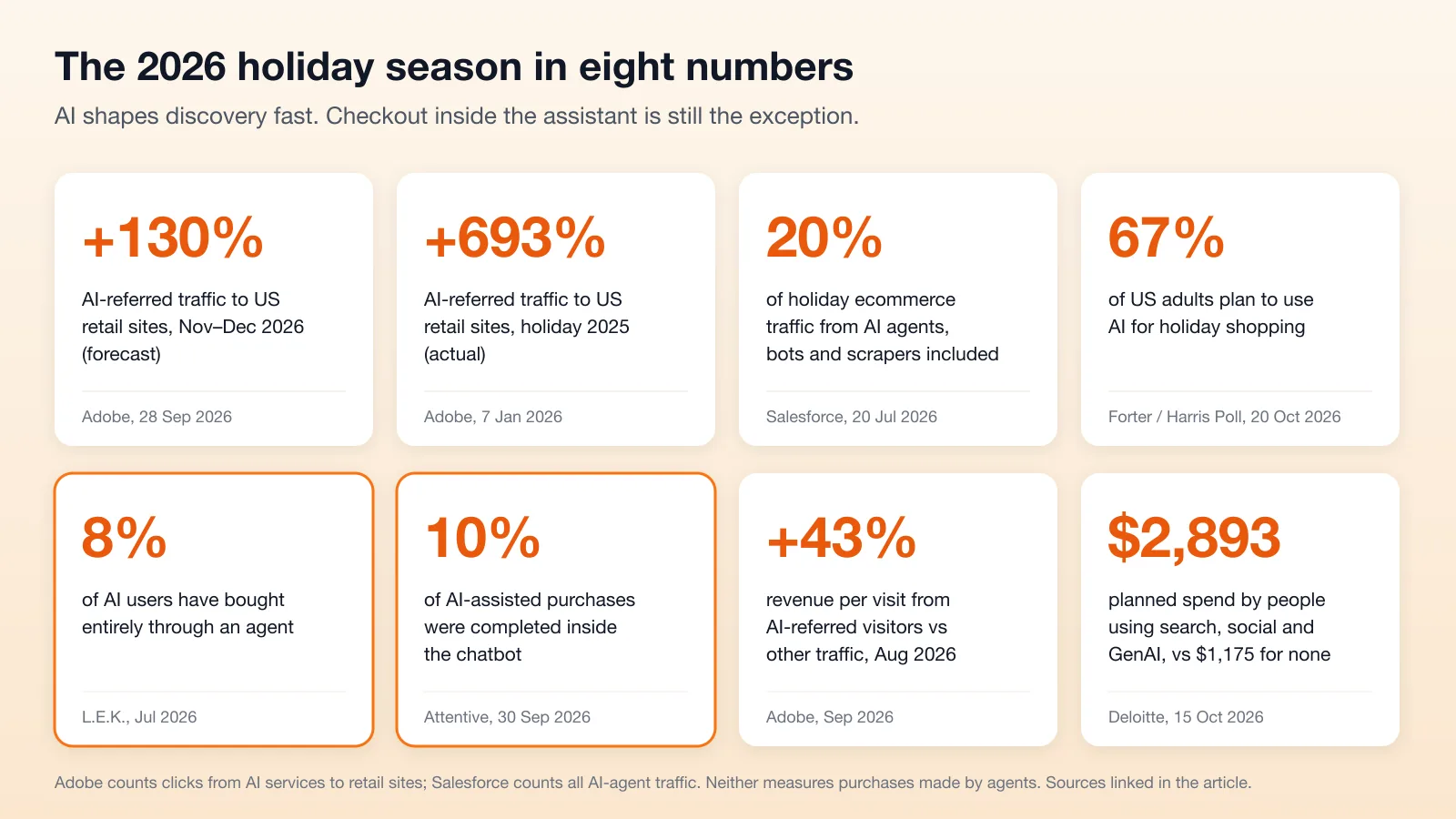
Every headline number measures something different. Read the “what it measures” column before quoting any of them.
| Source (date) | Forecast | What it measures |
|---|---|---|
| Adobe (28 Sep 2026) | US online spend $275.1B, +6.7%; AI-referred traffic +130% year on year, Nov–Dec; Thanksgiving AI traffic +141% | Shoppers clicking from AI services to retail sites. Not purchases inside AI. Adobe’s press release gives 159% for Thanksgiving; the report page says 141% |
| Salesforce (20 Jul 2026) | 20% of holiday ecommerce traffic from AI chat agents; 1 in 3 ecommerce sites with a site-specific shopper agent by Cyber Week | All agent traffic, including back-end agents and competitor scrapers. Not shoppers, not orders |
| Deloitte (15 Oct 2026) | Average planned spend $1,654, +4%; $2,893 for shoppers using search, social and GenAI vs $1,175 for those using none | Planned spending by 4,000 US consumers. An association, not proof that AI raises spend |
| NRF (15 Oct 2026) | Nov–Dec retail sales $1.013 trillion, +4.2% | Total retail excluding autos, gas and restaurants. No AI split |
| EMARKETER (7 Apr 2026) | $20.57B, 1.5% of US retail ecommerce, through AI platforms in 2026 | Full year, not holiday, from a December 2025 forecast |
The baseline is last season. Adobe’s holiday 2025 results recorded $257.8 billion online (+6.8%) and AI-referred retail traffic up 693.4%, with Cyber Monday up 670%. Adobe added that “the base of users remains modest”. Growth rates in the hundreds of percent come from a small base. The forecasts above do not predict how many orders agents will place.
What Shoppers Actually Do With AI
Four measures get blurred in most coverage: purchases AI influenced, clicks referred from AI, transactions completed inside an assistant, and purchases an agent executed on its own. The 2026 surveys show a steep drop at each step.
| Measure | Finding | Source |
|---|---|---|
| Used AI to inform a purchase | About 30% of US consumers | L.E.K., Apr 2026 survey of 2,650 |
| Used a chatbot for a shopping task in the past three months | 68% of recent US shoppers | Attentive, Aug 2026 survey of 3,054 |
| Plan to use AI for holiday shopping | 67% of US adults; 83% of 18–34s vs 40% of over-65s | Forter / The Harris Poll, Sep 2026, 2,017 adults |
| Bought a different product or brand because of AI | 62% of AI-assisted shoppers | Attentive |
| Looked for proof outside the AI before buying | 93% of AI-assisted shoppers; 94% of AI users validate AI output | Attentive; L.E.K. |
| Purchase completed inside the chatbot | 10% of AI-assisted purchases | Attentive |
| Bought entirely through an AI agent, without visiting a retailer site | 8% of AI users | L.E.K. |
| Prefer to finish the purchase on the seller’s site or app | 60%, vs 17% who prefer the chatbot | Attentive |
The visits that do arrive are valuable. In Adobe’s August 2026 data, from its holiday forecast deck, AI-referred visitors converted at a rate 48% higher than non-AI traffic, generated 43% more revenue per visit and added to cart 32% more often. In the UK, Adobe found that AI-referred traffic overtook traditional web search on conversion rate in May 2026, with a 20% lead over non-AI traffic by August. The volume is still small: L.E.K. puts AI referrals at under 0.5% of inbound traffic, growing at a 176% compound annual rate. For most merchants this holiday season, AI matters more for discovery than for checkout.
Merchant readiness lags. PayPal’s April 2026 merchant survey found only about one in five merchants had 80% or more of their catalog available as structured, machine-readable data. The report’s stated sample size does not match its segment counts, so treat the exact percentages as directional.
What AI Agents Ask About Agentic Commerce: Our Bing Data
The buyers researching agentic commerce are increasingly machines. Our own Bing Webmaster Tools export shows it.
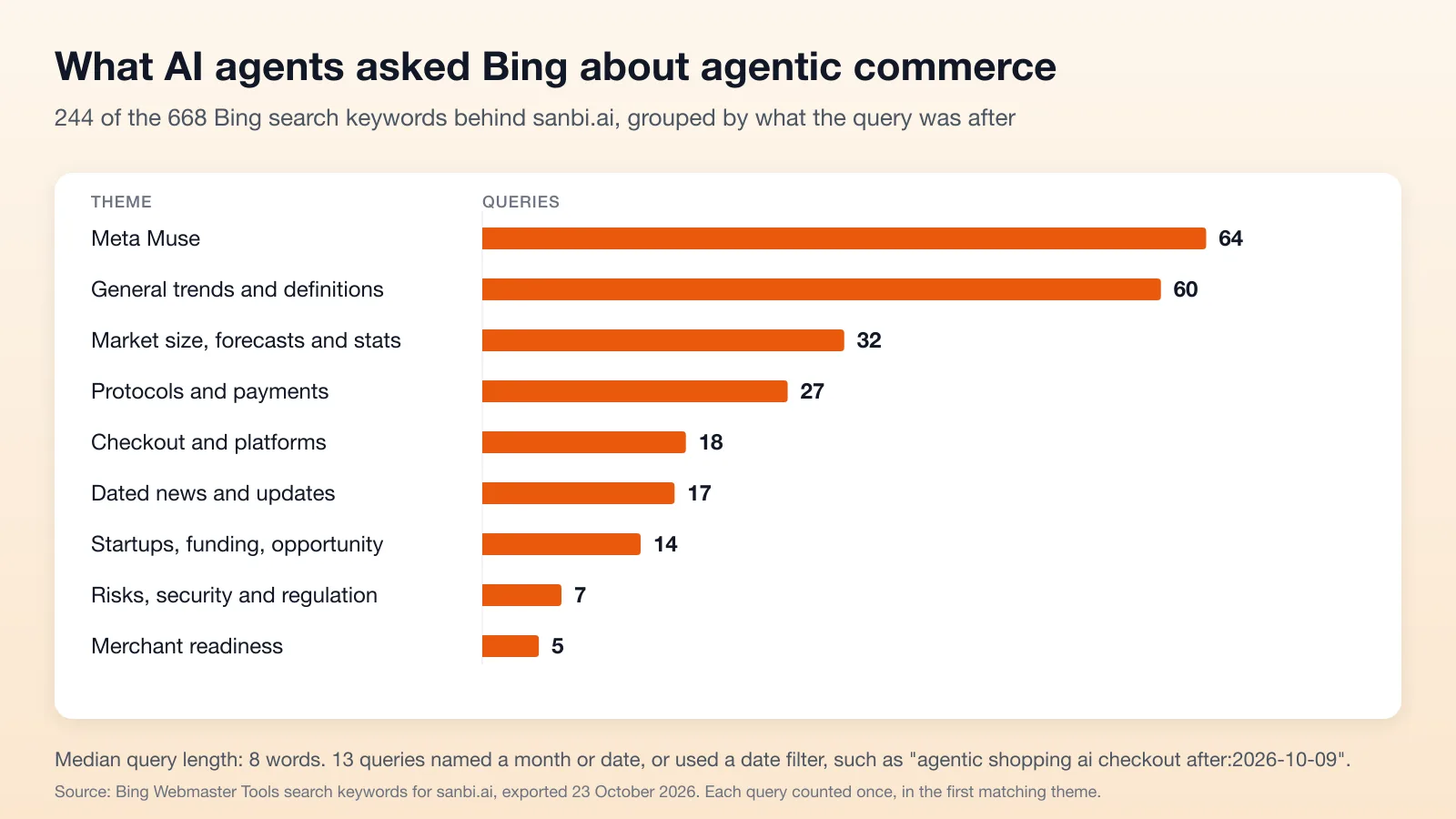
- 244 of the 668 Bing search keywords behind sanbi.ai (37%) are about agentic commerce, AI checkout, agent payments or Meta Muse. They produced 303 of 1,333 impressions and 9 of the 16 Bing clicks in the export.
- They read like retrieval strings, not questions. The median query is eight words long, for example “agentic commerce ai shopping agent 2026 forecast openai instant checkout mckinsey”.
- They ask for fresh, dated facts. Thirteen named a month or a date or used a date filter: “agentic shopping ai checkout after:2026-10-09”, and “‘october 9, 2026’ or ‘october 10, 2026’ agentic commerce retailer ai checkout announcement”.
- Bing’s AI cites the same theme. In Bing’s AI Performance report, “agentic commerce market size” earned 33 citations for sanbi.ai at a 16.3% citation share, and “projected economic impact of agentic commerce on retail and ecommerce over next five years” earned 21.
- Google sees it too. Two machine-written queries about agentic commerce risks, one ending “late 2025 early 2026”, produced 34,962 impressions and one click in our Search Console between April and October 2026.
The lesson for anyone publishing about this market: agents fan out to find the newest dated source, then lift tables and single-sentence answers. That is why this page carries an “as of” date in its first sentence, dates every row and keeps an update log. We explain the mechanics in AI search intelligence and Bing’s grounding queries.
Holiday Readiness Checklist for Merchants (Before 27 November)
Pages and feeds need time to be recrawled, so ship these in the first half of November.
| # | Action | Why it matters now |
|---|---|---|
| 1 | Fix product data first: GTINs, live prices, stock, shipping cost and speed, return terms, in the feed and on the page | Only about one in five merchants have most of their catalog machine-readable (PayPal), and Google’s checkout eligibility runs through Merchant Center |
| 2 | Check which AI channels your platform already feeds | Shopify’s Agentic Storefronts are on by default for ChatGPT, Copilot, AI Mode and Gemini; Copilot Checkout runs through PayPal, Shopify and Stripe; Muse pays through Stripe Link |
| 3 | Test your own checkout from inside the assistants | ChatGPT now sends buyers to your checkout in a mobile in-app browser; test guest checkout, wallets and promo codes there |
| 4 | Set an agent-access policy on purpose | Amazon blocks outside agents and Walmart verifies them; Salesforce’s 20% “AI agent traffic” includes scrapers. See our guide to robots.txt, Cloudflare and AI crawlers and the agent identity layer |
| 5 | Publish holiday facts agents can lift | State shipping cut-off dates, return windows, gift receipts and price-match terms in plain sentences and in structured data (OfferShippingDetails, MerchantReturnPolicy) |
| 6 | Earn the third-party evidence engines cite | Azoma’s analysis of 38 million citations found editorial content is 51.9% of what Gemini cites for shopping, and affiliate content 39.6% of what Alexa for Shopping cites. Gift guides and reviews carry weight |
| 7 | Segment AI referrals in analytics before the peak | You cannot compare holiday weeks you didn’t segment. Our GA4 guide shows the setup |
| 8 | Track the gift prompts you want to win | ”Best gift for a runner under $100” is decided in the answer before any checkout happens |
For the product-page side of items 1, 5 and 6, see GEO and AEO for ecommerce product pages.
How to Measure Whether Agents Pick Your Products
Agentic commerce has two layers, and no single tool sees both.
The evidence layer is whether AI engines recommend your product when a shopper asks. You can measure it from the outside: run the prompts your buyers use on each engine every day, and record whether your product appears, its position, the sentiment and the sources the engine cited. In the Muse post we called the result share of agentic selection. Sanbi.ai runs these prompt sets daily across ChatGPT, Gemini, Perplexity, Claude and Google AI Mode. Product visibility tracking is on the Professional and Enterprise plans.
The transaction layer is what happens after the recommendation: in-chat orders in Google’s checkout, Copilot Checkout or Muse, and AI-referred sessions on your own site. Only the platforms and your own analytics see these. Use Merchant Center, your payment provider and an AI-referral segment in GA4. No outside tracker sees purchases inside Muse or Copilot unless the platform reports them.
Holiday 2026 is the first season where both layers are measurable at once, so set up the baseline now. Our free audit checks how ChatGPT, Gemini and Claude describe your brand today: Run a free AI visibility audit.
Update Log
- 23 October 2026: first edition, with status checked against company announcements published up to 22 October 2026.
- Next update: after Cyber Monday (30 November 2026), with Adobe’s and Salesforce’s holiday results and any checkout changes from the platforms above.
Sources
- Google: agentic checkout (13 Nov 2025); NRF 2026 remarks on UCP (11 Jan 2026); Marketing Live shopping updates (20 May 2026); booking travel in AI Mode (27 Aug 2026); holiday shopping updates (16 Sep 2026); Universal Cart (15 Oct 2026); more links in AI Mode and AI Overviews (15 Oct 2026); Merchant Center checkout help
- Microsoft: Copilot Checkout and Brand Agents (8 Jan 2026); Windows Central on mobile checkout (22 Apr 2026); ESW agentic commerce with Copilot (21 Jul 2026)
- OpenAI and ChatGPT: Buy it in ChatGPT (29 Sep 2025); Powering product discovery in ChatGPT (24 Mar 2026); Introducing Dots (29 Sep 2026); CNBC; Forrester; Shopify, agentic commerce momentum (24 Mar 2026)
- Meta and Stripe: Introducing Muse (8 Sep 2026); Stripe on Muse and Link (8 Sep 2026); Connect 2026 (24 Sep 2026)
- Perplexity: PayPal and Perplexity launch Instant Buy (25 Nov 2025); Ninth Circuit opinion, No. 26-1444 (4 Aug 2026)
- Amazon and Walmart: Alexa for Shopping (13 May 2026); TechCrunch on Amazon blocking Muse (21 Sep 2026); Walmart on agents (21 Oct 2026); TechCrunch on Walmart (21 Oct 2026)
- Forecasts and surveys: Adobe 2026 holiday forecast; Adobe holiday 2025 results; Adobe UK, August 2026; Salesforce; Deloitte; NRF; EMARKETER; L.E.K.; Attentive; Forter / The Harris Poll; PayPal merchant pulse
- Payments and funding: Visa (2 Jul 2026); Mastercard (14 Jul 2026); Synchrony and OpenAI (17 Aug 2026); Azoma Series A (21 Oct 2026); Skyfire and Forter (22 Oct 2026)
Frequently Asked Questions
Four can complete a purchase without sending the shopper to the merchant's website: Google AI Mode and the Gemini app (checkout with Google Pay through the Universal Commerce Protocol), Microsoft Copilot (Copilot Checkout with PayPal, Shopify and Stripe), Meta Muse (the agent checks out with Stripe Link after the shopper approves the total) and Perplexity (Instant Buy with PayPal, launched in November 2025). All four started in the US. ChatGPT is the notable exception: OpenAI handed checkout back to merchants in March 2026.
Not natively. OpenAI launched Instant Checkout on 29 September 2025 and said on 24 March 2026 that the first version did not offer the flexibility merchants needed, so merchants now use their own checkout while OpenAI focuses on product discovery. On mobile, Shopify purchases open the merchant's store in an in-app browser; on desktop, ChatGPT links out. Walmart runs its own app inside ChatGPT. The Agentic Commerce Protocol continues and now covers product discovery as well.
Universal Cart is Google's shopping cart for Search and the Gemini app, launched in the US on 15 October 2026. It holds items from several retailers in one place, tracks price drops, surfaces promo codes and suggests payment methods. Shoppers can check out with Google Pay inside the cart, through the Universal Commerce Protocol, or move the items into the merchant's own cart and finish on the merchant's site.
Yes. Microsoft introduced Copilot Checkout on 8 January 2026, rolling out in the US on Copilot.com with PayPal, Shopify and Stripe, and described it as checkout with no redirect. Coverage in April 2026 reported it working inside the Copilot mobile app in the US. Microsoft says it is adopting open standards such as the Agentic Commerce Protocol.
Perplexity launched Instant Buy with PayPal on 25 November 2025 for US users, with checkout in the chat and the retailer as merchant of record. We found no 2026 update from Perplexity or PayPal on its scope, so check current availability before you rely on it. The Amazon lawsuit concerns Perplexity's Comet browser assistant, not Instant Buy; the Ninth Circuit vacated the preliminary injunction on 4 August 2026.
Only Amazon's own. Amazon's Alexa for Shopping (the renamed Rufus) and its Buy for Me feature can complete purchases, but Amazon blocks third-party agents and has blocked Meta Muse since 20 September 2026, saying continued access by an unauthorized AI agent violates its Conditions of Use. Brands that sell mainly on Amazon will not be bought by outside agents there.
The Walmart Agent Gateway is the interface Walmart announced on 21 October 2026 for AI agents to shop Walmart and Sam's Club directly instead of clicking through pages built for people. It comes with Agent Profiles, launching within a month of the announcement, which give each authorized agent its own profile inside the customer's account, a spending limit and a separate purchase history. Walmart says agents do not receive customers' payment-card information.
Forecasts measure different things. Adobe expects AI-referred traffic to US retail sites, meaning shoppers clicking through from AI services, to rise 130% year on year in November and December 2026, against total online spend of $275.1 billion. Salesforce expects 20% of holiday ecommerce traffic to come from AI agents, a figure that includes back-end agents and competitor scrapers. Forter and The Harris Poll found that 67% of US adults plan to use AI for holiday shopping.
Few, so far. An April 2026 L.E.K. survey of 2,650 US consumers found that 8% of AI users had completed a purchase entirely through an AI agent without visiting a brand or retailer site. Attentive's August 2026 survey found that 10% of AI-assisted purchases were completed inside the chatbot, and 60% of AI-assisted shoppers prefer to buy on the seller's own website or app.
In Adobe's data, yes. In August 2026, AI-referred visitors to US retail sites converted at a rate 48% higher than non-AI traffic, generated 43% more revenue per visit and added to cart 32% more often. In the UK, Adobe found AI-referred traffic converted better than traditional search from May 2026. The volume is still small: L.E.K. puts AI referrals at under 0.5% of inbound traffic.
Fix product data first, then check which AI channels your platform already feeds, test your own checkout from mobile in-app browsers, set an agent-access policy on purpose, publish shipping cut-offs and return windows as plain text and structured data, segment AI referrals in analytics and track the gift prompts you want to win. Black Friday is 27 November 2026, so changes that need to be crawled should ship in early November.
Discovery through AI is mainstream; purchases executed by agents are not. About 30% of US consumers have used AI to inform a purchase and 68% of recent shoppers in Attentive's survey used a chatbot for a shopping task, but only 8% of AI users have bought entirely through an agent, and 94% still check the AI's output before buying.
Meta launched Muse with agent checkout through Stripe Link (8 September), Amazon began blocking it (20 September), Google launched hotel booking in AI Mode (27 August) and Universal Cart (15 October), Walmart opened an Agent Gateway for outside agents (21 October), and Visa and Mastercard took agent payments live in Europe and the UK. OpenAI's Dots agents (29 September) did not add shopping.
Track the gift and comparison prompts that decide a purchase before any checkout happens: 'best gift for a runner under $100', 'best noise-cancelling headphones for travel', '[your product] vs [competitor]', plus prompts that ask about shipping cut-offs and returns. Run them daily on each engine through November and December and record whether your product appears, where it ranks and which sources were cited. Sanbi.ai runs prompt sets daily across ChatGPT, Gemini, Perplexity, Claude and Google AI Mode, with product visibility tracking on the Professional and Enterprise plans.