
Best AI Search Optimization Agencies 2026 — How to Choose the Right One
Two years ago, a traditional SEO agency could credibly claim to cover everything a brand needed for search visibility. That’s no longer true.
AI search optimization — improving brand visibility inside ChatGPT, Gemini, Perplexity, and Claude — requires different skills, different content strategies, different measurement tools, and different authority-building playbooks than traditional search. The best AI search optimization agencies in 2026 have rebuilt their entire delivery model around this reality.
This guide is for marketing leaders trying to evaluate whether they need an AI search optimization agency, what the best ones actually deliver, and how to avoid paying for a rebrand of traditional SEO work with “AI” attached to the name.
1. What AI Search Optimization Agencies Actually Do
The term gets used loosely. Before evaluating any AI SEO agency, get clarity on what the engagement actually delivers.
The Core Deliverables of a Qualified AI Search Agency
Best AI search optimization agencies deliver work across four layers:
- Measurement and baselining — establishing your current AI brand visibility: citation frequency per engine, competitive share of voice, sentiment, and source URL analysis
- Content strategy and production — creating answer-first pages, comparison content, FAQ-format articles, and technical documentation targeting the specific prompts where you’re absent
- Technical implementation — structured data (FAQ schema, Organization schema, Product schema), llms.txt, AI bot crawl permissions, and site health signals that affect AI model readiness
- Authority building — earning coverage on the specific third-party sources (industry publications, review platforms, analyst reports) that AI models cite when recommending brands in your category
Agencies that only deliver layer 2 — content production without measurement, without technical implementation, and without authority building — are not running a genuine AI search optimization program. They’re publishing content and calling it GEO.
What Separates AI Search Agencies from Traditional SEO Agencies
Traditional SEO agencies optimize for Google. AI search strategy agencies optimize for AI citation. The mechanisms are different:
| Traditional SEO Agency | AI Search Optimization Agency |
|---|---|
| Tracks keyword rank positions | Tracks citation frequency per AI engine |
| Optimizes for Google crawlers | Optimizes for AI model extraction |
| Builds backlinks for PageRank | Builds authority on AI-cited source domains |
| Measures organic traffic | Measures citation rate and share of voice |
| Delivers page-level optimization | Delivers entity-level and content-structure optimization |
Why this matters for brands: An agency that measures success in organic traffic improvements is optimizing for a channel that is declining as a share of total research activity. The best generative AI search engine optimization agencies measure success in citation frequency — the metric that maps directly to AI-first buyer behavior.
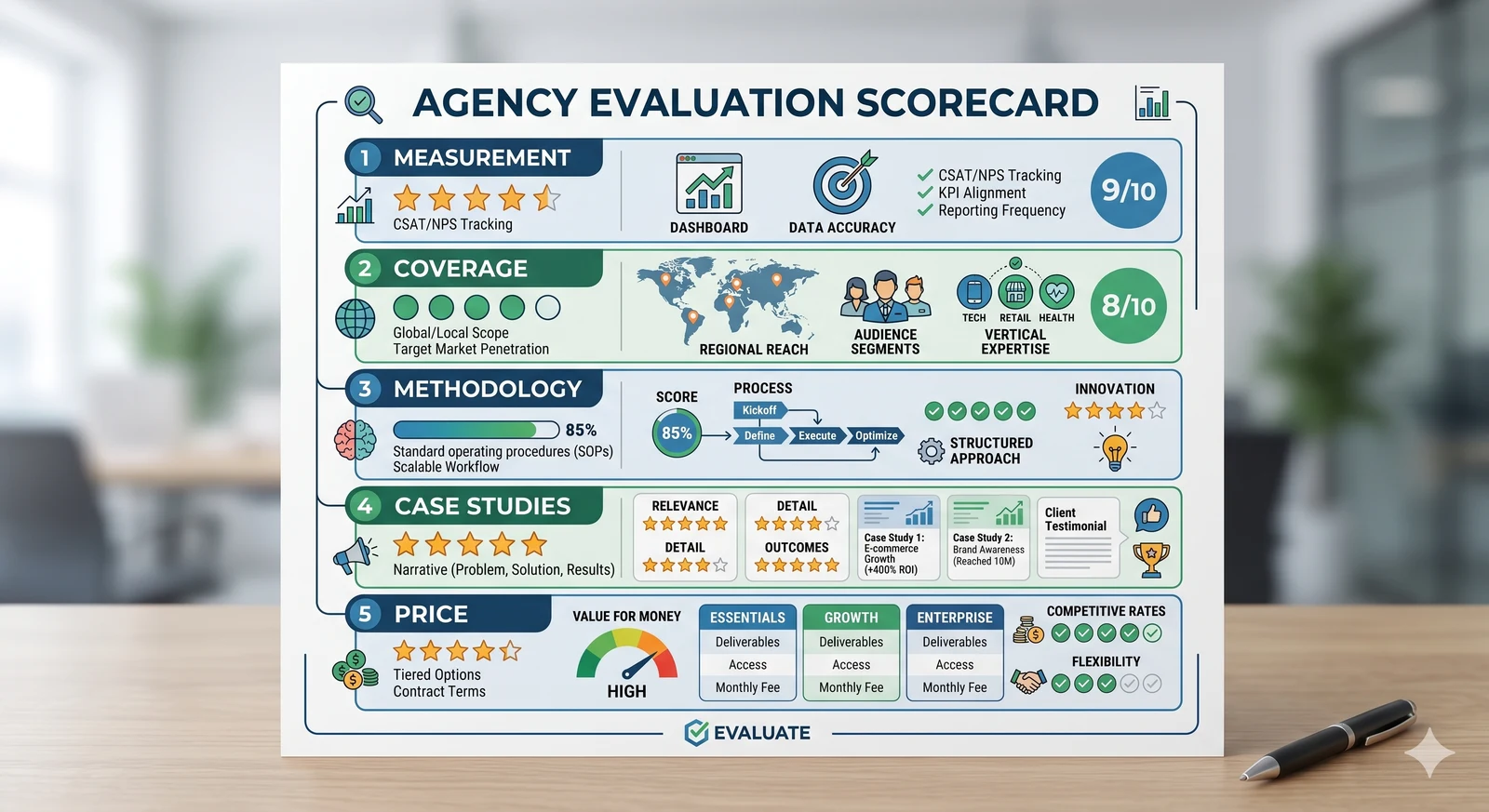
SEO Services With LLM Visibility: What the Package Should Include
Most SEO proposals in 2026 mention “LLM visibility” somewhere. The test is whether it is a separately measured workstream or a line on the proposal. SEO services with LLM visibility have to cover two surfaces that share some plumbing but keep different scoreboards: Google’s AI Overviews and AI Mode are grounded in Google’s ordinary index, while ChatGPT, Perplexity and Claude each retrieve through their own crawlers and search partners (the engine-by-engine detail is in our AI crawler guide). An expert package for Google and AI search engines should spell out each part:
| Component | What it should include | Proof to ask for |
|---|---|---|
| Classic SEO | Technical health, rankings and organic clicks for the pages that matter | Search Console data, not tool estimates |
| LLM visibility baseline | A fixed set of buyer prompts run across ChatGPT, Gemini, Perplexity, Claude and Google AI Mode, several runs per prompt | The prompt list, the run dates and the raw answers |
| Share-of-voice target | Your share of brand mentions on those prompts against three to five named competitors, per engine | A starting number and a dated target |
| Source plan | The third-party domains each engine cites in your category, and which ones the agency will earn coverage on | A citation-source map |
| AI workflow services | Automated prompt runs, alerts, content briefs and schema deployment, with a named editor approving anything published | Who reviews machine output before it ships |
| Reporting | Monthly trend per engine, plus Search Console’s AI-feature impressions and AI referral sessions in GA4 | A sample report |
Share-of-voice packages are how many agencies now price AI search work: a fixed number of prompts and competitors tracked, a share-of-voice target, and an allowance of content and outreach to move it. Buy the definition before the package. If the provider cannot say how often each prompt runs, how a mention is counted and how the competitors were chosen, the number will not be comparable from one month to the next, and neither will the providers you are comparing.
AI workflow services, where an agency builds automations in tools like n8n or Zapier for prompt tracking, brief writing or reporting, earn their fee when they remove manual measurement work. They are a red flag when the workflow mass-produces pages. Google’s spam policies define scaled content abuse as many pages “generated for the primary purpose of manipulating search rankings and not helping users”, “no matter how it’s created”, and AI engines have no reason to cite thin pages either.
2. How to Evaluate AI Search Optimization Agencies
Not every agency that claims AI search expertise has actually built the capability. Here’s the evaluation framework.
The Measurement Framework Test
Ask every agency you evaluate: “What platform do you use to track citation frequency across AI models, and can you show me a sample report?”
A qualified AI LLM SEO agency uses a purpose-built AI visibility tracking platform — like Sanbi.ai — that runs automated prompt sets against AI model APIs, tracks brand mentions, and produces share-of-voice benchmarks. An agency relying on manual checks (running queries in a chat interface and taking screenshots) is not capable of delivering consistent, comparable data at scale.
The Case Study Test
Ask for before/after citation frequency data for a client in your category. Not “we increased organic traffic by 40%” — that’s a traditional SEO metric. Ask specifically: “What was the client’s citation frequency in ChatGPT before the engagement, and what was it after 90 days?”
Agencies that can’t produce this data either weren’t measuring it (a serious capability gap) or weren’t producing citation improvements (a results gap).
The Multi-Model Coverage Test
Ask which AI platforms the agency tracks and optimizes for. Best AI search agencies cover the full model mix: ChatGPT, Gemini, Perplexity, Claude and Google AI Mode, plus DeepSeek and Qwen for brands that sell into China. An agency that only tracks ChatGPT is operating with a significant blind spot — buyers use multiple AI tools, and a brand visible in ChatGPT but absent in Perplexity is losing a meaningful share of AI-driven research traffic.
The Content Methodology Test
Ask to see a sample of the content they’d produce. Best AI search optimization agencies produce answer-first content that leads with a direct answer to the buyer’s question, uses FAQ schema, makes citable factual claims, and is structured for AI extraction — not just for human readability. Content that reads like standard SEO blog posts without these structural characteristics will not perform in AI citation environments.
The Experiment Log Test
AI-native AEO agencies run their work as experiments, and the good ones can show you the log. Ask: “Show me three AEO experiments you ran this year: the hypothesis, the prompts, the pages you changed, the control pages you left alone, and the result.” A credible answer reads like a lab notebook. Twenty prompts re-run weekly for a month, one set of pages rewritten answer-first, an untouched control set, and a measured difference between the two.
Then ask how they set OKRs. A sound AEO objective is a share-of-voice or citation target on a named prompt set, per engine, with a date: “raise our share of voice on 40 comparison prompts in ChatGPT and Perplexity from 12% to 25% by the end of Q2.” “Publish twelve blog posts” is an output, not a key result. Agencies that publish their experiments on their own blog make this test easy, because you can check whether their claims held up before you sign.
3. Agency vs. Platform — Which Do You Actually Need?
Before hiring an AI search optimization agency, establish whether you actually need full-service delivery or whether a platform gives you what you need.
When to Use an AI Visibility Platform Directly
If your team has in-house content and SEO capability — writers who can produce AEO-format content, a technical SEO resource who can implement schema, and a marketing strategist who can prioritize gaps — then a platform like Sanbi.ai gives you everything you need:
- Automated citation tracking across all major AI models
- Competitive share-of-voice benchmarking
- Content gap identification and Recommended Tasks
- Technical health auditing
- AI content engine for producing optimized drafts
Cost: $37–$275/month depending on plan. This is the right model for teams that have execution capability and just need measurement and direction.
When to Hire an AI Search Optimization Agency
Hire an AI search agency when:
- You don’t have in-house capacity to produce AEO-optimized content at the volume and cadence the gap analysis requires
- You need full-stack delivery: strategy + content + technical + authority building in one engagement
- You’re in a highly competitive category where falling further behind while building internal capability is too costly
- You need faster results than an internal ramp-up allows
The right answer for many brands is a hybrid: Sanbi.ai as the measurement and intelligence layer, plus an agency or specialist freelancers for content execution.
The third option: an in-house AI search (GEO) analyst
Between “buy a platform” and “hire an agency” sits a role that barely existed eighteen months ago: the AI search analyst — also advertised as GEO analyst, AEO specialist or LLM visibility manager, which is why AEO hiring searches mostly surface agencies and tools rather than job specs. The job is the measurement half of the GEO audit checklist: own the buyer prompt set, keep per-engine baselines for ChatGPT, Gemini, Perplexity and Claude, trace which third-party sources the engines cite instead of you, and ship one prioritised fix a week to the content and dev teams. Good candidates come from technical SEO, content strategy or marketing analytics; the differentiator is comfort with sampling and variance, because AI answers change between runs and a naive analyst will chase noise.
When it beats an agency: you already have writers and a developer, and what’s missing is someone to point them at the right gaps. When it doesn’t: you have no production capacity, in which case an analyst produces excellent lists nobody executes. Most mid-market teams end up with the analyst on the platform and an agency or freelancers for volume.
4. What the Best AI Search Optimization Agencies Charge — and What You Get
AI search optimization agency pricing in 2026 varies significantly based on scope, market, and agency tier.
Entry-Level Engagements
One-time AI visibility audits: $2,000–5,000. This delivers a baseline citation report, competitive share-of-voice analysis, content gap mapping, and technical recommendations. Useful for understanding your starting position — but not an optimization program.
Ongoing SMB Retainers
$3,000–6,000/month typically covers: weekly citation tracking, 4–8 content pieces per month (AEO-format pages, comparison articles, FAQ content), technical implementation, and monthly reporting. At this tier, look for agencies that include the tracking platform cost in the retainer and show you a shared dashboard.
Enterprise GEO Retainers
$10,000–25,000/month for brands in competitive categories needing high-volume content production (15–30 pieces/month), geographic segmentation tracking across multiple regions, authority-building campaigns targeting AI-cited publications, and dedicated strategic account management.
Why this matters for brands: The ROI math for AI search optimization is compelling at almost any price point given the conversion rates from AI-cited traffic (10–16% for Perplexity, 15.9% for ChatGPT). A single incremental enterprise deal from improved AI visibility often exceeds an entire annual agency retainer.
AI Search Optimization Services for Small Businesses
For a small business in the US, the first AI search work is usually local, and much of it does not need a retainer. Answers to “best [service] near me” and “[service] in [city]” questions lean on Google Business Profiles, review sites and local directories rather than on company websites (the domains that win for local services are listed in the most-cited domains by industry), and the answers change from one city to the next (why AI answers differ by location). A small-business package worth paying for covers:
- A complete, verified Google Business Profile and Bing Places listing, with categories, services, hours and photos kept current
- The same name, address and phone number across the directories and review sites your category uses
- Location and service pages built around geotargeted keywords (“emergency plumber in Austin”), each opening with a direct answer
- LocalBusiness and Service structured data that matches the visible text
- A steady flow of fresh reviews on the platforms AI answers cite for your category
- A monthly check of 10 to 20 local prompts in ChatGPT, Gemini and Google AI Mode
That scope sits at or below the entry-level prices above. If a provider quotes an enterprise retainer for it, or cannot show you the prompt checks, keep looking. A free AI visibility audit gives you the baseline before any provider does.
5. Red Flags When Evaluating AI Search Optimization Agencies
Watch for these warning signs that an ai search optimization agency isn’t as capable as they claim:
- No measurement framework — they describe their service entirely in terms of content production, with no mention of citation tracking or share-of-voice benchmarking
- Only track ChatGPT — AI search optimization that ignores Gemini, Perplexity, Claude and Google AI Mode is missing much of the AI search landscape
- Promise first-page results — AI citation isn’t ranked like a list; any agency promising “rank 1 in ChatGPT” doesn’t understand how AI model outputs work
- Traditional SEO metrics only — reporting on organic traffic and keyword rankings but not citation frequency means they’re not actually measuring AI search outcomes
- No category-specific experience — AI citation patterns vary significantly by industry; an agency without experience in your category is running generic playbooks against a very specific set of buyer prompts
6. How to Work With an AI Search Optimization Agency Effectively
Even the best top ai optimization agency can’t deliver results without the right client-side inputs.
What you need to provide:
- Access to Sanbi.ai (or your AI visibility tracking platform) so the agency has live data
- Documented buyer prompt set — the actual questions your customers ask AI tools when researching your category
- Competitor shortlist — the 3–5 brands your AI citations should benchmark against
- Content approval workflow — AEO content needs faster approval cycles than traditional content to keep pace with the AI search landscape changes
- A shared definition of success: citation frequency targets and share-of-voice goals, not just traffic or ranking metrics
Find Your AI Visibility Baseline Before Hiring an Agency
Before you engage any agency, you need a baseline. An agency without data on where you stand today is guessing where to start.
Run your AI visibility audit with Sanbi.ai →
Sanbi.ai produces the baseline citation frequency report, competitive share-of-voice benchmark, and content gap analysis that any qualified AI search optimization agency will need as their starting point — and that you’ll use to hold them accountable for results.
Sanbi.ai is the AI search visibility platform used by brands and agencies to track citations across ChatGPT, Gemini, Perplexity, Claude and Google AI Mode — providing the measurement foundation that separates genuine AI search optimization programs from rebranded traditional SEO.
Frequently Asked Questions
An AI search optimization agency helps brands improve how they appear inside AI-generated answers across ChatGPT, Gemini, Perplexity, Claude, and other AI-powered search surfaces. Services typically include: AI brand visibility audits (establishing baseline citation frequency and share of voice), content strategy for AEO and GEO (answer-first pages, FAQ schema, comparison content), technical implementation (structured data, llms.txt, AI bot crawl permissions), authority building (earning coverage on the sources AI models cite), and ongoing tracking to measure improvement. The best AI search optimization agencies deliver full-stack execution — not just audits and recommendations.
The best AI search optimization agency in 2026 combines deep expertise in AEO and GEO content strategy, multi-model citation tracking capability, and evidence of measurable citation improvement for past clients. Evaluation criteria: Do they use a purpose-built AI visibility platform to measure results (not just manual checks)? Can they show before/after citation frequency data for clients? Do they track share of voice against competitors, not just absolute mention counts? Do they have experience with your specific AI model mix — ChatGPT-heavy, Gemini-heavy, or multi-model? The best generative AI search engine optimization agency for your business is the one with a proven measurement framework and results in your category.
To find a good AI SEO agency: (1) ask for their AI visibility measurement methodology — what platform do they use to track citation frequency, and how do they baseline before/after?; (2) ask for case study data showing citation frequency improvement (not just 'we published content' — actual before/after metrics); (3) ask which AI platforms they optimize for — an agency that only tracks ChatGPT is missing half the picture; (4) ask how they identify content gaps — through buyer prompt research, competitor share-of-voice analysis, or just keyword tools?; (5) check whether they use a tool like Sanbi.ai for continuous tracking or rely on manual spot-checks. Agencies without a structured measurement framework are guessing.
A generative engine optimization agency specializes in improving brand visibility inside AI-generated answers — the kind produced by ChatGPT, Gemini, Perplexity, and Claude. A traditional SEO agency focuses on improving page rankings in Google's organic results. The core difference: SEO agencies optimize for position in a list; GEO agencies optimize for citation in a generated answer. The skills are related but not identical — GEO agencies need deep expertise in answer-first content structure, AI model behavior, structured data for AI extraction, and the authority signals that influence AI citation decisions (which differ from the backlink signals that drive Google rankings). The best generative AI search engine optimization agency combines both disciplines.
AI search optimization agency pricing in 2026 varies widely by scope. Entry-level AI visibility audits run $2,000–5,000 as a one-time engagement. Ongoing AI SEO retainers for SMBs typically start at $3,000–6,000 per month, covering tracking, content production, and technical implementation. Enterprise GEO agency retainers for brands in competitive categories with multi-engine, multi-region requirements run $10,000–25,000 per month. An important note on cost: a platform like Sanbi.ai ($37–$275/mo) plus a skilled freelance content strategist often outperforms a full-service agency retainer for companies with in-house execution capability — the agency adds value when you need full-stack delivery, not just the platform.
When evaluating an AI LLM SEO agency, look for: multi-model expertise (not just ChatGPT — do they track and optimize for Gemini, Perplexity, Claude and Google AI Mode, plus DeepSeek and Qwen if you sell into China?); a structured measurement framework (they should be using an AI visibility tracking platform, not manual checks); content strategy expertise in AEO and GEO (answer-first structure, FAQ schema, citable claims, structured data); technical SEO implementation for AI readiness (llms.txt, bot crawl permissions, schema); and evidence of results (citation frequency data, share-of-voice improvements for past clients). Avoid agencies that describe their AI SEO service primarily in terms of publishing blog posts — content volume without citation measurement is not an AI SEO program.
Yes. Ranking in Google AI Overviews and AI Mode is a core deliverable for qualified AI search optimization agencies. The optimization signals for AI Overviews overlap significantly with broader GEO and AEO best practices: answer-first content structure, FAQ schema, E-E-A-T authority signals, strong structured data implementation, and presence in the high-authority sources Google's AI Overview algorithm draws from. An AI search optimization agency should be able to audit your current AI Overview appearance, identify the content and authority gaps preventing your pages from being cited, and produce the content and technical changes needed to improve citation frequency.
UK-based AI SEO and GEO agencies are an emerging category — most were traditional SEO agencies that have added AI search optimization capabilities over the past 12–18 months. When evaluating UK AI search agencies: apply the same criteria as global agencies (measurement framework, multi-model coverage, case study evidence) but also check for experience with UK-specific AI search patterns, which can differ from US patterns in prompt behavior and preferred source domains. For UK brands with international exposure, an agency that can run geographic segmentation tracking — UK citations versus US citations — is valuable, as AI models sometimes return different brand recommendations per region.
An AI citation optimization agency specializes in the specific challenge of getting your brand cited in AI-generated answers. Their deliverables typically include: (1) citation gap analysis — identifying the exact prompts where competitors are cited but your brand isn't; (2) source authority mapping — identifying which third-party sites AI models pull from for your category; (3) content production — creating the answer-first pages, comparison content, and FAQ-format articles most likely to be cited; (4) structured data implementation — ensuring your content is machine-readable and attributable; (5) authority building — earning coverage on the high-authority sources that drive AI citations. The best AI citation optimization agencies measure success in citation frequency improvement, not in content pieces published.
In the first 90 days, a qualified AI search strategy agency should deliver: (1) baseline AI brand visibility audit — your citation frequency per engine, share of voice versus 3 competitors, sentiment analysis, and source URL mapping; (2) prompt research — a documented set of 30–50 buyer prompts mapped to citation gaps; (3) technical audit — llms.txt status, bot crawl permissions, schema implementation health; (4) content roadmap — 8–12 prioritized content pieces targeting the highest-value citation gaps; (5) first content deliverables — at least 3–4 published pages with citation tracking in place. Agencies that take longer than 90 days to produce measurable baseline data are not moving fast enough relative to how quickly the AI search landscape shifts.
The top generative engine optimization companies in 2026 fall into three categories: (1) full-service GEO agencies that combine strategy, content, and technical implementation; (2) hybrid SEO/GEO agencies that added AI search capabilities to established SEO practices; (3) AI-native consultancies that grew out of AI research or LLM-specific expertise. When comparing top GEO agencies: evaluate their measurement platform (are they using Sanbi.ai or a comparable tool for citation tracking?), their content methodology (answer-first AEO structure, not just standard SEO content), and their track record in your specific category. The best generative engine optimization company is the one that can show you a citation frequency improvement curve for a client in a comparable business to yours.
Hire an AI search optimization agency when you need full-stack execution — strategy, content production, technical implementation, and ongoing optimization — and don't have the in-house team to deliver it. Use an AI visibility platform like Sanbi.ai directly when you have in-house content and SEO capability and need the measurement, tracking, and recommendations layer to direct your team's work. The platform-only approach costs $37–275/mo and works for teams with strong content execution. The agency approach costs $3,000–25,000/mo and makes sense when you lack in-house execution capacity or need faster results than internal teams can deliver. Most enterprise brands end up with both: a platform for measurement and a specialist agency for execution.
Hire an AI search (GEO) analyst in-house when you already have content and development capacity and the missing piece is direction: someone who owns the buyer prompt set, keeps per-engine visibility baselines, analyses which sources ChatGPT, Gemini and Perplexity cite instead of you, and hands the team one prioritised fix a week. Titles vary — GEO analyst, AEO specialist, AI search analyst, LLM visibility manager — and the talent pool is still small, so expect to train a technical SEO or analytics hire into the role. Choose an agency when you lack production capacity, because an analyst without writers produces lists nobody executes. The common end state for mid-market brands is an in-house analyst working from a platform like Sanbi.ai, with an agency or freelancers for content volume.
Shortlist agencies that can show measured results, not just a method: a baseline of how often AI engines mentioned a client before the work, the same measurement afterwards, and the prompts and engines used. Ask which tool they measure with, how they choose prompts, what they will publish or change in the first 90 days and how they report. Be wary of guaranteed positions in AI answers, which no one can promise.
Most specialist AEO and GEO agencies now score visibility by running a fixed set of prompts across AI engines and reporting the share of answers that mention the client. Ask to see the prompt list, the engines, how often the prompts run and which platform does the measuring. Startups on a small budget can often do the measuring themselves: Sanbi.ai's Starter plan costs $50 a month ($37.25 billed annually), and Professional tracks up to five domains for agencies with several clients.
Usually four workstreams: an audit of how AI engines describe the brand today and which sources they cite; content that answers buyer questions directly; third-party evidence such as reviews, comparisons and press, which engines rely on; and technical work so AI crawlers can read the site. Good providers measure each with a prompt-based tracker and report changes in citations and share of voice, not just activity.
AEO hiring covers the new roles built around answer-engine visibility: AI search or GEO analysts, AEO specialists, LLM visibility managers, and increasingly a marketing engineer who can wire up crawler analytics, schema and tracking. Job titles are unstable, which is why searches for these roles surface agencies and tools more than job specs. Most companies start by adding AEO responsibilities to an existing SEO or content lead, then hire a dedicated analyst once prompt tracking becomes a weekly operation.
Technical SEO fundamentals, comfort reading server logs and structured data, prompt design and query-intent analysis, enough statistics to reason about sampling and variance in AI answers, spreadsheet or SQL fluency, and the writing skill to turn citation-gap analysis into briefs a content team can act on. Familiarity with at least one AI visibility platform and with GA4 and Search Console is expected. Curiosity about how retrieval works matters more than any certification.
Because the title is new there is no reliable dedicated benchmark; compensation currently tracks senior SEO analyst and marketing analytics roles in the same market, with a premium where the role includes technical work. Use technical SEO analyst and marketing analyst ranges from job boards for your city as the baseline and expect to pay toward the top of them for candidates who have already run prompt tracking programs. Agencies bill the same skill set at three to five times the loaded salary.
A GEO analyst owns the measurement side of AI search: defines the buyer prompt set, maintains per-engine visibility baselines for ChatGPT, Gemini, Perplexity, Copilot and Google's AI surfaces, analyses which third-party sources engines cite instead of the brand, monitors sentiment and accuracy, and turns the findings into a weekly prioritised list for content and engineering. Backgrounds are usually technical SEO, content strategy or marketing analytics; the distinguishing skill is comfort with sampling and variance.
A credible package treats Google and the AI answer engines as separate, measured workstreams. It covers classic SEO (technical health, rankings and clicks), an LLM visibility baseline built from a fixed set of buyer prompts run several times across ChatGPT, Gemini, Perplexity, Claude and Google AI Mode, a share-of-voice target against named competitors, a source plan for the third-party domains each engine cites in your category, and monthly reporting that adds Search Console's AI-feature impressions and AI referral traffic from GA4. If the LLM part has no prompt list, no run cadence and no baseline, it is a line item, not a service.
It is a common way agencies price AI search work in 2026: they track a fixed number of buyer prompts and competitors across AI engines, set a target for your share of brand mentions on those prompts, and include an allowance of content and outreach to move it. Before buying one, ask how many times each prompt is run, how a mention is counted, how the competitors were chosen and which engines are included. Without those definitions the share-of-voice number cannot be compared month to month, or between providers.
Mostly local basics: a complete Google Business Profile and Bing Places listing, the same name, address and phone number across directories, location and service pages written around geotargeted keywords, LocalBusiness schema that matches the visible page, a steady flow of reviews, and a monthly check of 10 to 20 local prompts in ChatGPT, Gemini and Google AI Mode. That scope fits entry-level pricing, or an in-house owner with a tracking platform. It rarely justifies an enterprise retainer.
Ask for three AEO experiments they ran this year, with the hypothesis, the prompts, the pages changed, the control pages left alone and the result. Ask how they set OKRs: a good key result is a share-of-voice or citation target on a named prompt set, per engine, with a date, not a number of posts. Ask which engines they measure and how often each prompt runs, which third-party sources they would target in your category, and who edits AI-assisted content before it is published. Agencies that publish their own experiments are the easiest to check.