AEO and GEO News, November 2026: 10 Changes That Matter and What to Do About Each
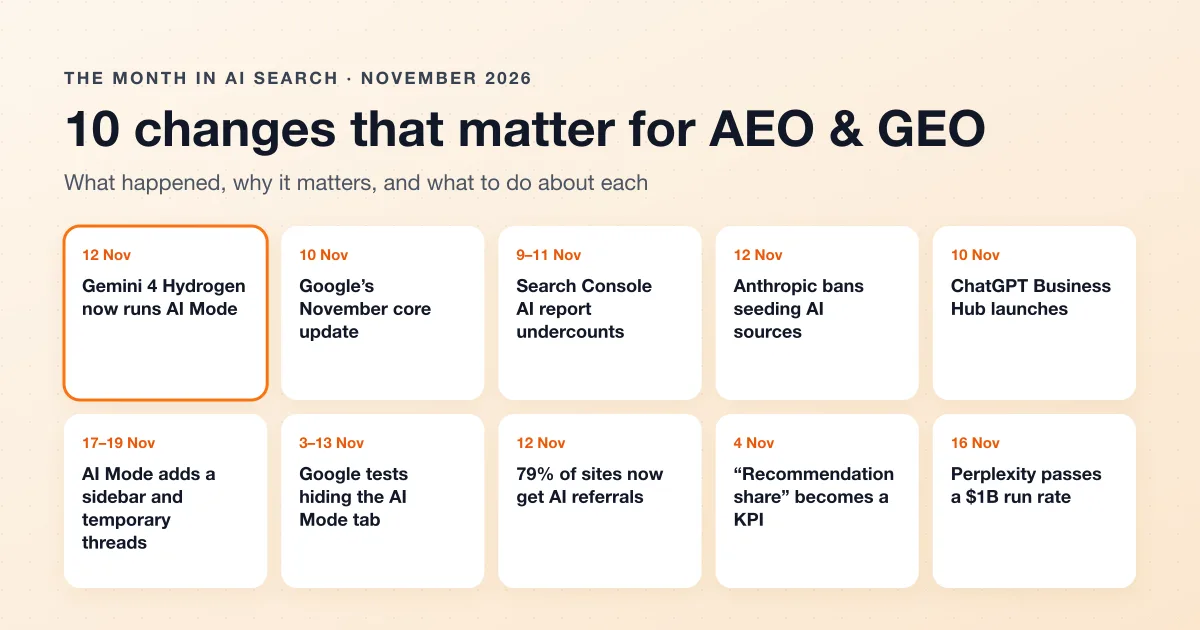
In the first three weeks of November 2026, answer engine optimization (AEO) and generative engine optimization (GEO) changed on several fronts at once. Google swapped the model behind AI Mode on 12 November, in the middle of a core update that began on 10 November, while a Search Console bug undercounted AI impressions for three days. Anthropic began banning the use of Claude to seed the sources AI engines cite. ChatGPT got its own analytics dashboard, and a study of 28,500 sites found 79.2% now get AI referrals.
Some of these changes move your AI visibility, some only move your reports, and a few are tests that may never ship. Below is each one, what it means for brands trying to get cited in AI answers, and what to do about it, followed by the dates to annotate in your reports and a short checklist for the rest of the month.
November 2026 in AEO and GEO at a Glance
| # | Date (2026) | What happened | Who it affects | What to do |
|---|---|---|---|---|
| 1 | 12 Nov | Gemini 4 Hydrogen becomes the default model in Google AI Mode and answers the hardest AI Overviews | Everyone visible in Google’s AI features | Re-baseline AI Mode citations from 12 Nov |
| 2 | 10 Nov | Google’s November 2026 core update begins (up to two weeks) | All sites in Google Search | Wait a full week after it finishes before judging |
| 3 | 9–11 Nov | Search Console’s Generative AI report undercounts impressions | Anyone reading Search Console’s AI report | Exclude those days from comparisons |
| 4 | 12 Nov | Anthropic’s usage policy bans using Claude to seed AI answer sources | GEO agencies and in-house teams using Claude | Audit off-site tactics for undisclosed or fake sources |
| 5 | 10 Nov | OpenAI launches ChatGPT Business Hub (beta) | Every business ChatGPT mentions | Claim and verify your business |
| 6 | 17–19 Nov | AI Mode gets temporary threads and a desktop homepage sidebar | Brands researched in multi-step journeys | Track follow-up prompts, not just first questions |
| 7 | 3–19 Nov | Google tests hiding the AI Mode tab and the “Ask anything” box | Google AI traffic forecasts | Watch, don’t react; Google hasn’t commented |
| 8 | 12 Nov | SE Ranking: 79.2% of 28,500 sites get AI referrals | Every site measuring AI traffic | Benchmark your AI-to-organic ratio |
| 9 | 4 Nov | Conductor launches a “Recommendation Share” KPI | Teams choosing AEO metrics | Check what each tool’s metric counts |
| 10 | 16 Nov | Perplexity passes a $1B revenue run rate and ships a Monitor API | Brands deciding which engines to track | Keep Perplexity in your engine set |
1. Gemini 4 Hydrogen Became the Default Model in Google AI Mode
On 12 November, Google rolled out Gemini 4 Hydrogen in Search. “Hydrogen is now available globally in Google Search for all users,” wrote Robby Stein, Google’s VP of Product for Search. In a thread on X, Stein said Hydrogen is now AI Mode’s default model and is also “being used for your hardest questions in AI Overviews.” As Search Engine Journal noted, neither Google nor Stein has said which questions count as the hardest.
For AEO, the key line in Google’s post is about links. Google says Hydrogen’s reasoning improves query fan-out, the technique of running many related searches at once, and that this connects people to “a broader range of helpful links than before,” including sites they “previously might not have discovered.” Google gave no figures. The post also says AI Mode now follows complex, multi-part requests more precisely and uses more images, tables and custom tools in its answers.
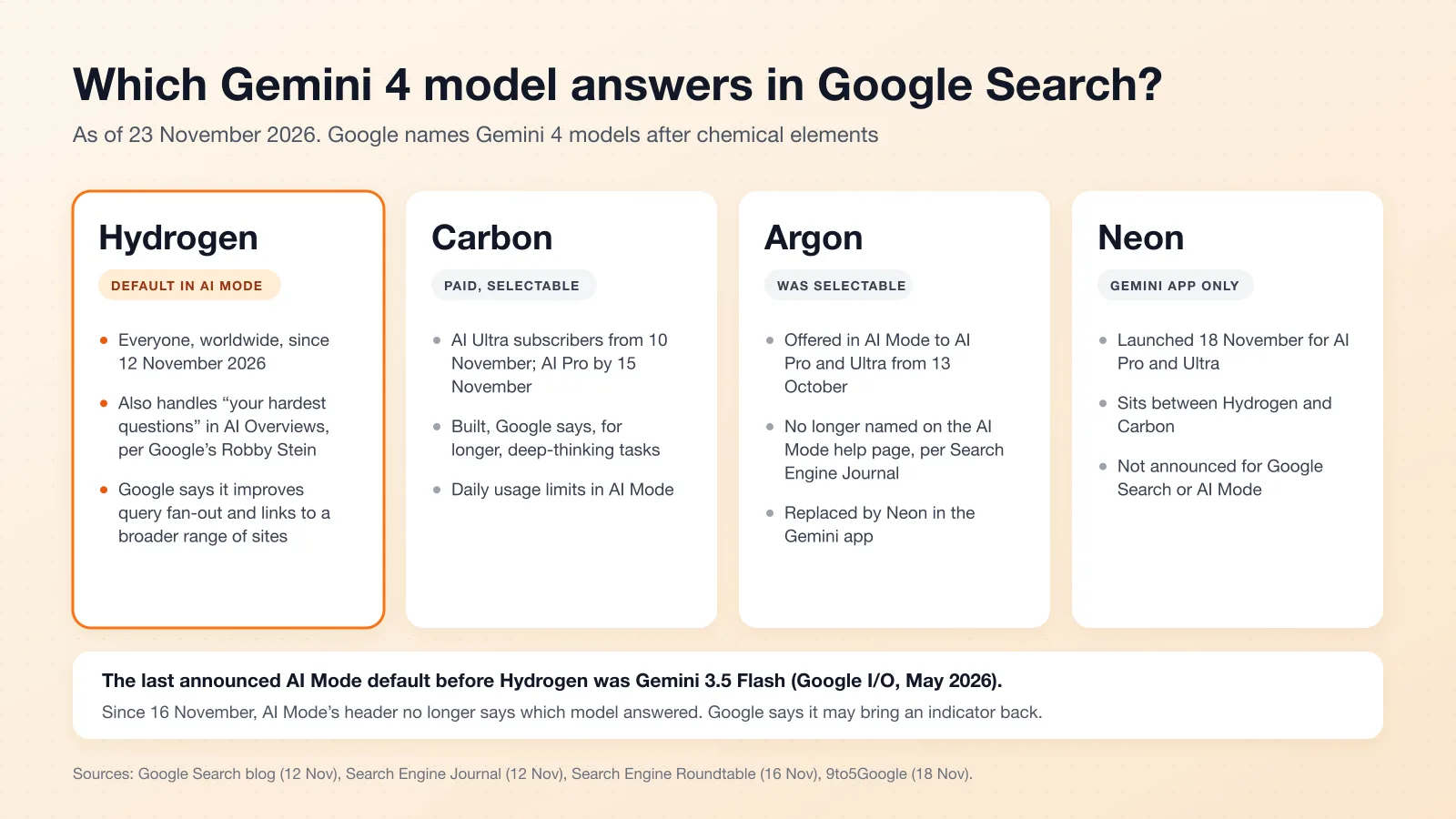
Hydrogen is one of four Gemini 4 models, all named after chemical elements, and Search uses them differently:
| Model | Role in Google Search | Who gets it |
|---|---|---|
| Hydrogen | Default in AI Mode; also the hardest AI Overviews | Everyone, worldwide, from 12 Nov |
| Carbon | Selectable in AI Mode, with daily limits; built, Google says, for longer, deep-thinking tasks | AI Ultra from 10 Nov; AI Pro by 15 Nov |
| Argon | Selectable in AI Mode from 13 Oct; no longer named on the AI Mode help page | AI Pro and Ultra |
| Neon | Launched 18 Nov in the Gemini app; not announced for Search | AI Pro and Ultra (Gemini app) |
Google didn’t say which model Hydrogen replaced; the last announced AI Mode default was Gemini 3.5 Flash, from Google I/O in May 2026. There is a wrinkle for anyone auditing AI Mode by hand. On 16 November, Search Engine Roundtable spotted that AI Mode’s header no longer names the model. Google’s Rajan Patel called it “Intended, but we’re thinking through the right way to bring back an indicator for your selected model.” A screenshot can no longer tell you which model answered.
What to do:
- Re-baseline from 12 November. AI Mode answers before and after that date came from different models. Treat the two periods as separate series rather than one trend line.
- Cover the sub-questions. If fan-out now runs more, or different, related searches, pages that answer the follow-up questions around a topic gain more ways in. Our guide to ranking in Google AI Mode covers how to map them.
- Track AI Mode separately from AI Overviews. Hydrogen runs all of AI Mode but only some AI Overviews, so the two surfaces may now move differently. See our guides to AI Mode tracking tools and AI Overviews trackers.
2. Google’s November 2026 Core Update Is Rolling Out
Google released the November 2026 core update on the morning of 10 November, Pacific time. It “applies globally and to all languages,” and Google says the rollout “may take up to 2 weeks to complete.” As of 23 November, Google hadn’t posted a completion notice. It is the third core update of 2026, after March and May, and Google hasn’t said what it targets.
Core updates matter for AEO because Google’s AI features are built on Google Search. Google’s AI features documentation says a page “must be indexed and eligible to be shown in Google Search with a snippet” to be a supporting link, and that both features may use query fan-out to find supporting pages. Google hasn’t said whether this update changed AI Overviews or AI Mode citations, but pages that lose rankings have fewer chances to be picked.
This November’s problem is overlap. A core update started on 10 November, the AI Mode model changed on 12 November, and Search Console’s AI report undercounted impressions from 9 to 11 November. Any change you see in Google AI citations this month could come from any of the three.
What to do: follow Google’s own core update guidance: “We recommend waiting at least a full week after a core update completes before analyzing your site in Search Console.” Then compare a full week after completion with the week before the rollout began. Look at AI citations from a tracker for the same window. If organic rankings held but AI Mode citations moved, the model change is the more likely cause.
3. Search Console’s AI Report Undercounted Impressions on 9–11 November
Google’s data anomalies page confirms that “A logging error caused a decrease in impressions on the Generative AI performance report in Search” for data from 9 to 11 November 2026. It is a reporting bug: your actual visibility in AI Overviews and AI Mode wasn’t affected, as Search Engine Roundtable noted.
It’s the second time. The same logging error hit 13 to 17 August 2026, and on 21 August Google restored the data: “Missing data for this period has been restored.” As of 23 November, the anomalies page doesn’t say whether the November data will be restored.
The Generative AI performance report is still the only first-party view of Google AI impressions, and it shows impressions only, without clicks or queries. Our GA4 and Search Console guide covers how to pair it with GA4, whose default channel grouping now includes an “AI Assistant” channel for ChatGPT, Gemini, DeepSeek, Copilot and Grok referrals. That channel doesn’t capture AI Overviews or AI Mode clicks, which arrive as Google organic traffic.
What to do: annotate 9–11 November in every dashboard that uses this report, and leave those days out of week-on-week comparisons until Google says the data is restored.
4. Anthropic Banned Using Claude to Seed AI Answer Sources
Anthropic’s updated usage policy, published on 8 October, took effect on 12 November 2026. A new section, “Do Not Engage in Deceptive Campaigns or Artificial Activity,” prohibits using Claude to:
“Manipulate the sources from which search engines or AI systems draw answers”
The policy defines that as seeding sources “with content that misrepresents its origin, authorship, or independence.” Its example is “networks of sites posing as unaffiliated sources corroborating the same claims.” The same section bans fake personas, sockpuppets, astroturfing, fake reviews and hidden sponsorship. It also bans building tools for these campaigns or selling them as a service.
Anthropic already banned fake-account networks and fake news sites, but those rules were spread across other sections. What’s new is naming the sources AI answers are drawn from. Search Engine Journal reported that Anthropic’s September threat intelligence report described about 70 sites posing as independent local news outlets, linked to a France-based ad agency. They published at least 8,913 articles in about 20 languages, “specifically designed to boost their site’s authority rankings on search engines.” Anthropic banned the organization.
Two details keep this in proportion. First, the rule targets deception, not optimization. Publishing under your own name, earning real reviews, pitching journalists and disclosing paid placements are all outside it. Second, the same update removed automated content publishing from Anthropic’s high-risk list, so publishing content Claude helped write is not the problem. Hiding where that content came from is.
What to do:
- Audit your off-site tactics. List every source you’ve seeded in the last year: forum posts, reviews, “best of” listicles and guest posts. Flag anything that hides your involvement.
- Ask your GEO agency how they produce third-party mentions, in writing. A vendor that builds “independent” review sites with Claude now breaks Anthropic’s terms, and the account can be lost.
- Read it as a signal. Google already penalizes much of this, as our parasite SEO guide covers. Expect other AI companies to tighten their rules and detection in the same direction.
5. ChatGPT Got Its Own Analytics: Business Hub
On 10 November, OpenAI launched Businesses in ChatGPT in beta. Its Business Hub lets a company claim and verify its business, then see mentions, profile views, website clicks and discovery topics in ChatGPT, over 7-day or 28-day views. We covered it in full in ChatGPT Business Hub, explained.
Two details matter for AEO measurement. An OpenAI spokesperson told Digiday that a “mention” only counts when ChatGPT references your website or shows your location; “Just naming the brand doesn’t count.” And Business Hub shows no prompts, no share of voice and no competitors. It’s useful first-party data, but it covers one engine and can’t tell you why your numbers moved.
What to do: claim and verify your business now, so the data starts accruing. Keep using a ChatGPT rank tracker for prompts, competitors and the other engines.
6. AI Mode Became a Workspace: a Homepage Sidebar and Temporary Threads
Two interface changes this month push AI Mode from single searches towards ongoing research sessions:
- Temporary threads (17 November). Google began rolling out temporary threads in AI Mode worldwide. Started from an icon at the top right, they don’t “save to your history or impact future recs”.
- A homepage sidebar (19 November). “New on the Google desktop homepage globally: a collapsible sidebar to easily find & jump back into your recent AI searches,” Stein posted, calling it “A much simpler way to pick up where you left off.”
A sidebar of saved conversations makes it easier for people to come back to a thread days later and keep asking follow-ups. Each follow-up can trigger fresh searches, so a brand can lose a buyer at the third question even after appearing in the first answer. Temporary threads add a quieter effect: they start without the user’s past AI Mode context, one more reason why the same prompt gives different answers to different people.
What to do: add follow-up prompts to your tracking, such as “which of these is cheapest?”, “what do reviewers complain about?” and “is it worth it for a small team?”. Track them as well as the opening question.
7. Google Is Testing Less AI Mode in Search
While AI Mode gained features, Google also tested showing it less:
| Date | Test (reported, not confirmed by Google) |
|---|---|
| 3 Nov | The AI Mode button disappeared for some users in Chrome and incognito sessions |
| 13 Nov | Glenn Gabe shared results with no AI Mode tab and no “Ask anything” box inside AI Overviews |
| 19 Nov | Some users reported seeing no AI Overviews at all on searches that normally show one |
Google hasn’t commented. Some observers link the tests to money: Alphabet’s own executives said in October that AI Mode monetizes at a lower rate than classic search, a factor in the $500 billion stock drop we covered. Others think Google is folding AI Mode into the main results rather than keeping it as a separate tab.
What to do: nothing drastic. These are small tests, and the sidebar launched worldwide the same week. If your AI Overviews or AI Mode impressions dip without a ranking change, though, a test cohort is one possible explanation.
8. AI Referrals Now Reach Four in Five Websites
On 12 November, SE Ranking’s AI tracker SE Visible published a study of 28,500 websites that received organic search traffic every month from January 2025 to September 2026. Its headline: 79.2% of the sites received at least one AI referral in September 2026, up from 39.7% in January 2025.
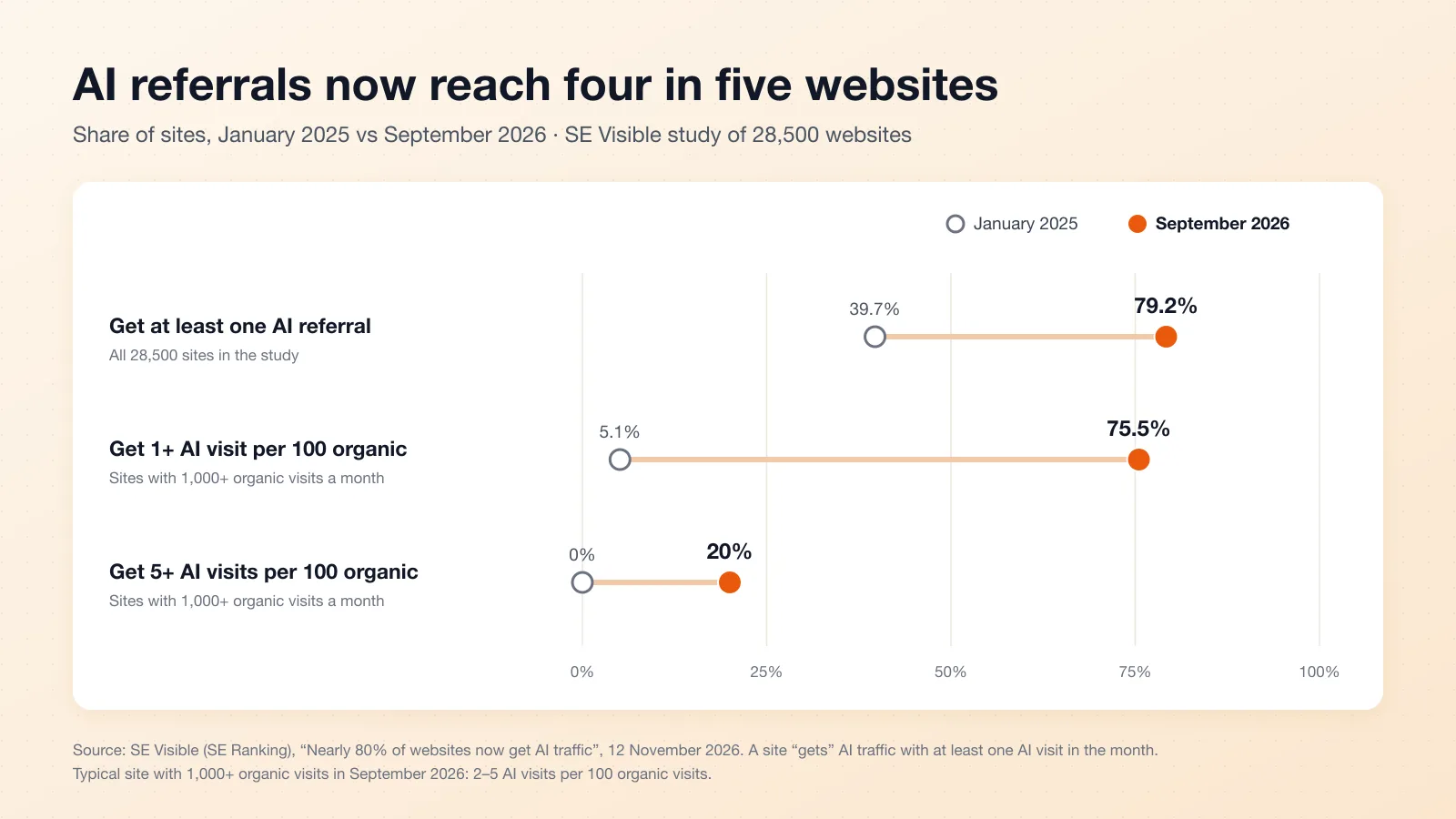
Growth came in a burst. The share of sites with AI traffic hovered between 54.3% and 59.2% from June 2025 to May 2026, then jumped from 58.4% in May to 73.1% in June 2026. Among sites with at least 1,000 organic visits a month:
| Metric (sites with 1,000+ organic visits/month) | Jan 2025 | Sep 2026 |
|---|---|---|
| Got any AI traffic | n/a | 99.7% |
| Got at least 1 AI visit per 100 organic visits | 5.1% | 75.5% |
| Got 2–5 AI visits per 100 organic visits | 1.2% | 34.2% |
| Got 5+ AI visits per 100 organic visits | 0% | 20% |
So for a site of that size, 2 to 5 AI visits for every 100 organic visits is now typical. The study doesn’t split referrals by platform, but an earlier SE Ranking study it cites found ChatGPT sent about three in four AI referrals worldwide from January to April 2026.
What to do: work out your own ratio, AI-referred sessions divided by organic search sessions, times 100. Below 1 puts you in the bottom quarter of sites your size, which usually means AI engines rarely cite you. Above 5 puts you in the top fifth. Remember that AI Overviews and AI Mode clicks count as organic in GA4, so this ratio understates Google’s AI share.
9. “Recommendation Share” Joined the AEO Metrics Fight
On 4 November, at its C3 conference in New York, Conductor unveiled its next-generation AEO platform. It’s built around a new KPI, Recommendation Share, which measures how strongly AI recommends a brand over its competitors. “The brands that win will be the ones AI recommends when customers are ready to make a decision,” said CEO Wei Zheng.
AEO now has more metrics than agreed definitions. Gartner calls the category “answer engine visibility tools” in its first Market Guide for it (March 2026), and each vendor counts something slightly different:
| Metric | What it counts | Where you’ll see it |
|---|---|---|
| Mention | Your brand named in an AI answer | Most AI visibility trackers |
| Citation | Your page linked as a source | Trackers, Bing AI Performance, Search Console (impressions only) |
| Business Hub “mention” | ChatGPT references your website or shows your location; brand name alone doesn’t count | ChatGPT Business Hub |
| Share of voice | Your mentions or citations as a share of all brands in the answers. In Sanbi, it’s citation share: how often the engines cite your own site | Most trackers, defined differently by each |
| Recommendation share | How strongly AI recommends you over competitors | Conductor |
What to do: before comparing numbers across AI search visibility tools, or putting one in a board deck, check whether it counts names, links or recommendations. A brand can be named often and cited rarely; our study of our own brand found the same gap between branded and unbranded prompts.
10. Perplexity Passed a $1 Billion Revenue Run Rate
On 16 November, Perplexity CEO Aravind Srinivas said on stage at a Semafor event that the company had crossed a $1 billion annual revenue run rate. That is an annualized pace, not booked revenue. The Information had reported Perplexity under $250 million at the start of the year and over $750 million by August.
Perplexity also shipped a Monitor API: “Watch a topic or page and get a webhook when something relevant changes.” That’s a reminder that monitoring the web is becoming a commodity developers can buy by the call. What a commodity API won’t give you is a fixed set of prompts, competitors and engines measured the same way every day, which is what trend lines need.
What to do: if Perplexity has dropped out of your engine set, add it back. It is growing fast and shows its sources on every answer. Our Perplexity rank tracking playbook covers how to track it.
Coming Next: Black Friday Is the First Big Test
Black Friday falls on 27 November and Cyber Monday on 30 November. Adobe forecasts AI-referred traffic to US retail sites up about 130% year on year across November and December. Online retailers will be the first to see what a new AI Mode model, a fresh core update and peak demand do to AI referrals all at once. Our agentic commerce holiday tracker covers which assistants can check out and what to prepare. We’ll update it after Cyber Monday.
The Dates to Annotate in Your AI Visibility Reports
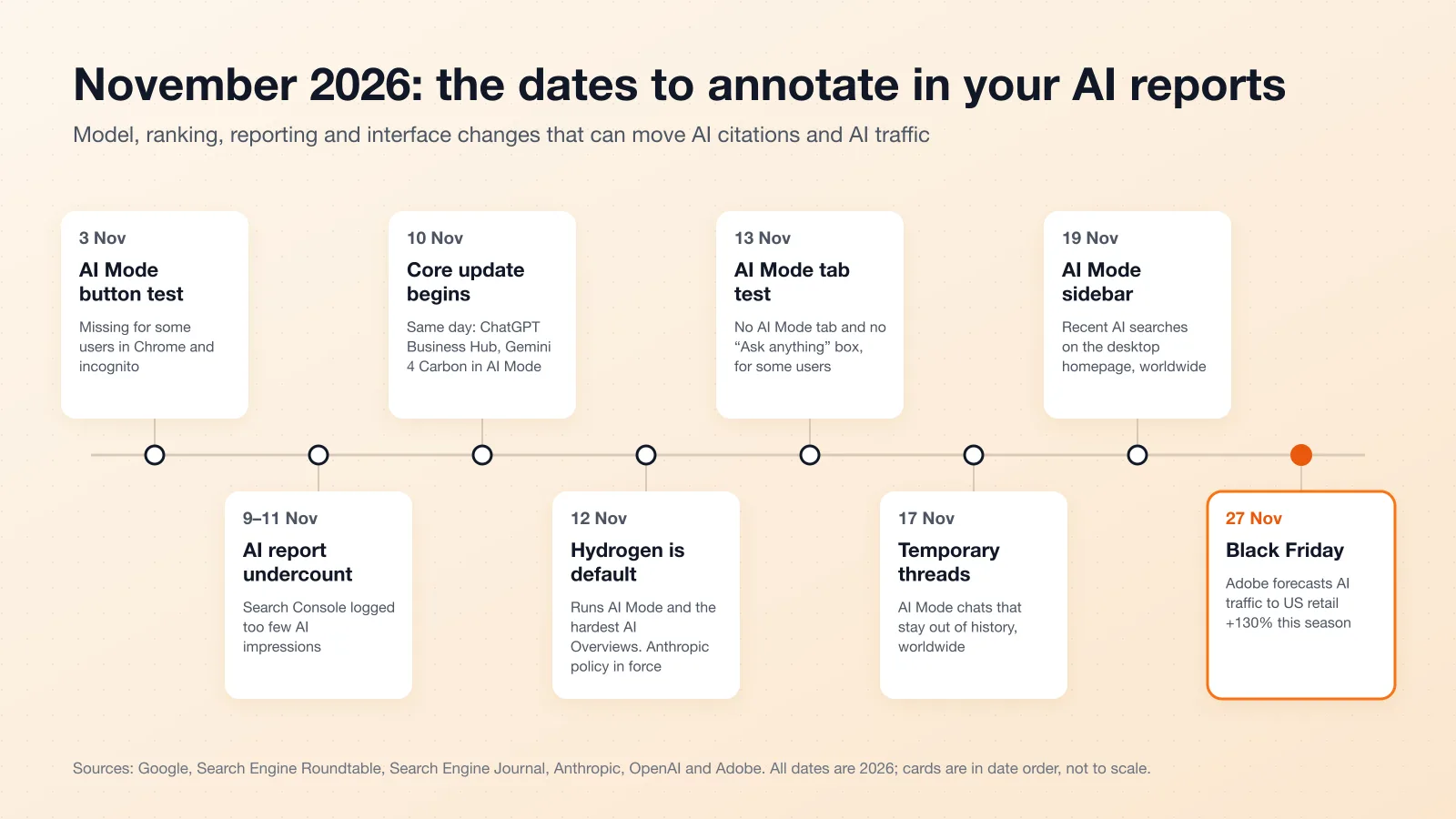
If a chart of AI citations or AI traffic moves this month, check it against these dates before you change any content:
| Date (2026) | Event | Affects |
|---|---|---|
| 3 Nov | AI Mode button test begins for some users | Google AI impressions (test cohorts) |
| 4 Nov | Conductor launches Recommendation Share | Metric definitions |
| 9–11 Nov | Search Console Generative AI report undercounts impressions | Search Console AI report only |
| 10 Nov | November core update begins; ChatGPT Business Hub launches; Gemini 4 Carbon in AI Mode (Ultra) | Google rankings; ChatGPT reporting |
| 12 Nov | Hydrogen becomes AI Mode default; Anthropic policy in force | Google AI citations; Claude users |
| 13 Nov | Test: no AI Mode tab, no “Ask anything” box | Google AI impressions (test cohorts) |
| 16 Nov | AI Mode header stops naming the model | Manual AI Mode audits |
| 17 Nov | AI Mode temporary threads, worldwide | AI Mode personalization |
| 19 Nov | AI Mode sidebar on the desktop homepage, worldwide | Multi-turn AI Mode usage |
| ~24 Nov | End of the core update’s two-week window (check Google’s dashboard) | Google rankings |
| 27 and 30 Nov | Black Friday and Cyber Monday | Retail AI referrals |
What Didn’t Change in November
With this much news, it’s worth noting what stayed put. Google’s AI features guidance still says: “There are no additional requirements to appear in AI Overviews or AI Mode, nor other special optimizations necessary.” It also says “You don’t need to create new machine readable files, AI text files, or markup to appear in these features.” An llms.txt file remains optional, not a ranking lever.
The fundamentals in our AEO vs GEO guide haven’t changed either. Engines still cite pages that answer the question directly, carry specific facts and are corroborated by sources the brand doesn’t control. November changed how answers are generated and measured, not what earns a citation.
Your AEO and GEO Checklist for the Rest of November
- Annotate the dates above in GA4, Looker Studio and your AI visibility tracker.
- Split AI Mode data at 12 November and compare the two periods instead of reading one trend.
- Wait out the core update. Don’t change content in response to Google moves until a full week after Google marks it complete.
- Exclude 9–11 November from Search Console AI report comparisons.
- Claim your business in ChatGPT Business Hub, then keep a tracker for prompts and competitors.
- Audit off-site GEO tactics against Anthropic’s new rule, and get your agency’s methods in writing.
- Add follow-up prompts to the prompt set you track, now that AI Mode keeps conversations going.
- Benchmark your AI-to-organic ratio against SE Ranking’s 2–5 per 100 for sites of your size.
Track the Changes Instead of Guessing
A month like this is why AI visibility needs daily measurement on a fixed prompt set: when a model switch, a core update and a reporting bug land in the same week, a weekly spot check can’t separate them. Sanbi.ai’s paid plans track up to five engines daily, including ChatGPT, Perplexity and Google AI Mode, so a step change like 12 November shows up in the trend line on the day it happens. For the full workflow, see how to track your visibility in AI search.
Run a free AI visibility audit to see where ChatGPT, Gemini and Claude mention your brand today, before the holiday rush.
Sources
- Google: Gemini 4 Hydrogen in Search (12 Nov 2026); Search Status Dashboard, November 2026 core update; core updates guidance; AI features and your website; Search Console data anomalies; Generative AI performance report
- Search Engine Journal: Hydrogen as AI Mode default (12 Nov 2026); Claude’s new rules on fake sources (9 Oct 2026)
- Search Engine Roundtable: November core update; Generative AI report bug; Gemini 4 Carbon in AI Mode; AI Mode drops the Gemini label; temporary threads; AI Mode sidebar; AI Mode button test; AI Mode tab test
- 9to5Google: Gemini 4 Neon announcement (18 Nov 2026)
- Anthropic: Usage Policy (effective 12 Nov 2026)
- OpenAI: ChatGPT Business Hub
- SE Visible (SE Ranking): Nearly 80% of websites now get AI traffic (12 Nov 2026)
- DestinationCRM: Conductor’s next-generation AEO platform (4 Nov 2026)
- Semrush: Gartner Market Guide for Answer Engine Visibility Tools
- Latent Space: Perplexity hits a $1B revenue run rate (16 Nov 2026)
- Adobe: 2026 holiday shopping forecast
Frequently Asked Questions
Ten changes stand out. Gemini 4 Hydrogen became the default model in Google AI Mode on 12 November and now handles the hardest AI Overviews questions. Google's November 2026 core update began on 10 November. Search Console's Generative AI report undercounted impressions from 9 to 11 November. Anthropic's usage policy, in force from 12 November, bans using Claude to seed the sources AI systems draw answers from. OpenAI launched ChatGPT Business Hub on 10 November. AI Mode added a homepage sidebar and temporary threads, while Google tested hiding the AI Mode tab. An SE Ranking study found 79.2% of websites now get AI referrals. Conductor launched a 'Recommendation Share' metric, and Perplexity passed a $1 billion revenue run rate.
Gemini 4 Hydrogen is the fast, efficient model in Google's Gemini 4 family. On 12 November 2026 it became the default model in AI Mode for all users worldwide. Google didn't say which model it replaced; the last announced default was Gemini 3.5 Flash, from Google I/O in May 2026. Google's Robby Stein said Hydrogen is also used for 'your hardest questions in AI Overviews', though Google hasn't defined which questions count. Google says Hydrogen follows instructions more precisely, handles long multi-part questions and typos better, and improves query fan-out.
They are Gemini 4 models, named after chemical elements. In Google Search, Hydrogen is the default in AI Mode for everyone. Carbon, which Google describes as built for longer, deep-thinking tasks, is a selectable option in AI Mode for Google AI Ultra subscribers from 10 November 2026 and AI Pro subscribers from about 15 November, with daily limits. Argon was selectable in AI Mode for AI Pro and Ultra from 13 October, but the AI Mode help page no longer names it. Neon launched on 18 November in the Gemini app, sits between Hydrogen and Carbon, and hasn't been announced for Search.
Probably, but nobody has measured it yet. Google says Hydrogen improves query fan-out, the technique of running many related searches at once, and that this connects people to 'a broader range of helpful links than before', including sites they might not have found otherwise. Google gave no numbers. Because the switch landed inside the November core update, compare AI Mode citations from before 12 November with the weeks after, using the same prompts, before you credit or blame any content change.
Google hasn't said. AI Overviews and AI Mode only link to pages that are indexed and eligible to show in Google Search with a snippet, and they build answers from related searches through query fan-out, so ranking changes can plausibly move AI citations too. The update began on 10 November 2026, applies globally to all languages and may take up to two weeks. Google recommends waiting at least a full week after it completes before analyzing Search Console data.
Because of a reporting bug, not lost visibility. Google's data anomalies page says a logging error caused a decrease in impressions on the Generative AI performance report in Search for data from 9 to 11 November 2026. It affects reporting only. When the same error hit 13 to 17 August 2026, Google restored the missing data on 21 August; as of 23 November it hadn't said whether the November data will be restored. Annotate those three days and leave them out of before-and-after comparisons.
Anthropic's usage policy, in force from 12 November 2026, prohibits using Claude to 'manipulate the sources from which search engines or AI systems draw answers' by seeding them with content that misrepresents its origin, authorship or independence. Its example is networks of sites posing as unaffiliated sources that corroborate the same claims. It doesn't ban GEO as such: publishing under your own name, earning genuine reviews and disclosing sponsorship fall outside it. The same update removed automated content publishing from Anthropic's list of high-risk uses.
AI source seeding means planting content in the places AI engines retrieve answers from, such as forums, review sites, listicles and networks of look-alike sites, so that the engines repeat a claim. It becomes deceptive when the content hides who wrote or paid for it, or poses as independent. Anthropic's usage policy has banned that deceptive form when done with Claude since 12 November 2026. Its September 2026 threat report described about 70 fake local news sites that published at least 8,913 articles in about 20 languages.
It is a collapsible panel on the Google desktop homepage that lists your recent AI Mode searches so you can jump back into them. Google's Robby Stein announced the worldwide rollout on 19 November 2026, calling it 'a much simpler way to pick up where you left off.' It had been in testing since late October. It turns AI Mode from one-off searches into ongoing conversations, which makes follow-up questions a bigger part of how people research.
Temporary threads are AI Mode conversations that don't save to your search history or affect future recommendations. Google began rolling them out worldwide on 17 November 2026. You start one from an icon at the top right of AI Mode. For brands, they are one more reason why AI answers vary between users: a temporary thread starts without the user's past AI Mode context.
Not as of 23 November 2026, but it is testing less of it. On 3 November some users reported the AI Mode button missing in Chrome and incognito sessions. On 13 November Glenn Gabe shared screenshots of results with no AI Mode tab and no 'Ask anything' box inside AI Overviews, and on 19 November some users reported seeing no AI Overviews at all. Google hasn't commented. At the same time it rolled out an AI Mode sidebar and temporary threads worldwide, so AI Mode is moving rather than disappearing.
About four in five, by one large measure. SE Ranking's SE Visible study of 28,500 websites, published on 12 November 2026, found that 79.2% received at least one AI referral in September 2026, up from 39.7% in January 2025. The share sat between 54.3% and 59.2% from June 2025 to May 2026, then jumped to 73.1% in June 2026. Among sites with 1,000 or more organic visits a month, 99.7% got some AI traffic.
For a site with at least 1,000 organic visits a month, 2 to 5 AI visits for every 100 organic visits was typical in September 2026, according to SE Ranking's SE Visible study. In that group, 75.5% of sites got at least 1 AI visit per 100 organic visits, up from 5.1% in January 2025, and 20% got 5 or more. If your ratio is below 1, your AI visibility is probably lagging your organic search performance.
Recommendation share is a metric Conductor launched at its C3 conference on 4 November 2026. It measures how strongly AI engines recommend a brand over its competitors. It belongs to a crowded family of AEO metrics that count different things: a mention is your brand named in an answer, a citation is your page linked as a source, ChatGPT Business Hub counts a mention only when ChatGPT references your website or shows your location, and share of voice usually compares your mentions or citations with competitors'. Always check which one a tool reports.
It reached a $1 billion annual revenue run rate, not $1 billion of booked revenue. CEO Aravind Srinivas announced it on 16 November 2026 at a Semafor event. The Information had reported Perplexity under $250 million at the start of 2026 and over $750 million by August. The same week Perplexity launched a Monitor API, which watches a topic or page and sends a webhook when something relevant changes.
At minimum: 9 to 11 November (Search Console AI report undercount), 10 November (core update begins, ChatGPT Business Hub launches), 12 November (Gemini 4 Hydrogen becomes AI Mode's default; Anthropic's policy takes effect), 17 November (AI Mode temporary threads), 19 November (AI Mode sidebar) and the end of the core update rollout once Google posts it. Add 27 November (Black Friday) and 30 November (Cyber Monday) if you sell online, because seasonal demand will move AI referrals too.