ChatGPT Now Has Its Own Analytics: Business Hub, the “ChatGPT Search Console”, Explained
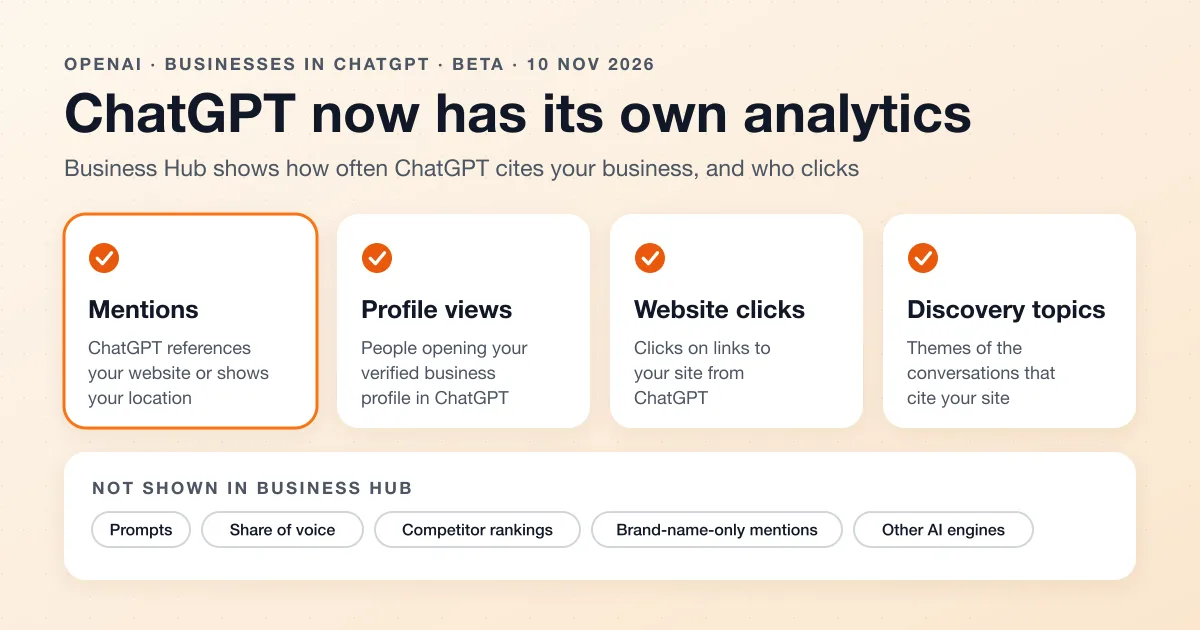
On 10 November 2026, OpenAI launched Businesses in ChatGPT in beta. Its Business Hub lets a company claim and verify its business, then see how often ChatGPT mentions it, how many people view its ChatGPT profile, how many click through to its website and which conversation topics it turns up in. It is the first time ChatGPT has given brands their own numbers about how they appear in its answers.
TechCrunch said the insights call Google Analytics to mind. SEOs, who saw a leaked version four days earlier, nicknamed it the “ChatGPT Search Console.” Both comparisons are only half right. Business Hub counts what happens inside ChatGPT, not what visitors do on your site, and it leaves out the prompts, competitors and rankings that would explain its numbers. ChatGPT’s GA4-style tracker already exists, but on the paid side: the ads pixel and Conversions API.
Below we cover what launched, what each metric counts, how it compares with GA4 and Search Console, how to claim your business, and how to fill the gaps it leaves.
ChatGPT Business Hub at a Glance
| Question | Answer |
|---|---|
| What launched? | Businesses in ChatGPT (beta): Business Hub and Business Agents |
| When? | 10 November 2026. A leak surfaced on 6 November |
| Who can claim a business? | “Any eligible business located where ChatGPT is available,” per OpenAI |
| How do you verify? | Not fully published. Launch-day testers were offered a text, a phone call or DNS verification; Shopify merchants can connect their store |
| What does it show? | Mentions, profile views, website clicks and discovery topics, over 7-day or 28-day views |
| What doesn’t it show? | Prompts, chats, share of voice, competitor rankings and brand names mentioned without your website |
| What does it cost? | Free for now; OpenAI hasn’t ruled out a paid model |
| Business Agents | Eligible US ecommerce and online service businesses only, at launch |
| Does claiming improve visibility? | OpenAI says it “should not have an impact on how frequently it appears” |
What OpenAI Launched on 10 November 2026
OpenAI’s announcement covers three pieces, all found in Business Hub:
- A claimable business profile. Once verified, a company can “update key details and add self-service product feeds with pricing and availability.” Verified profiles get a blue check, and people can open the profile when a business appears in an answer. TechCrunch noted that the profiles greatly resemble the ones Google and other search engines already offer.
- Insights. “Business Hub provides aggregated insights into how people engage with a business in ChatGPT,” OpenAI says, including “the number of mentions and website clicks a business receives,” plus discovery topics.
- Business Agents. Eligible businesses can “build, test, and launch a Business Agent” that answers questions about their products in a separate, labeled conversation. They are live for eligible ecommerce and online service businesses in the US.
OpenAI pitched it at scale: Businesses in ChatGPT gives companies “a new way to connect with the 1.2 billion people who use ChatGPT each week.”
The analytics didn’t come out of nowhere. Juozas Kaziukėnas, founder of Marketplace Pulse, posted a screenshot of a “Claim your business in ChatGPT” banner on 6 November and wrote that he “saw its first steps as early as August.” Search Engine Roundtable and PPC Land covered the leak the same day, and Digiday reported on 9 November that a dashboard was being tested. OpenAI declined to comment then and announced the product the next day.
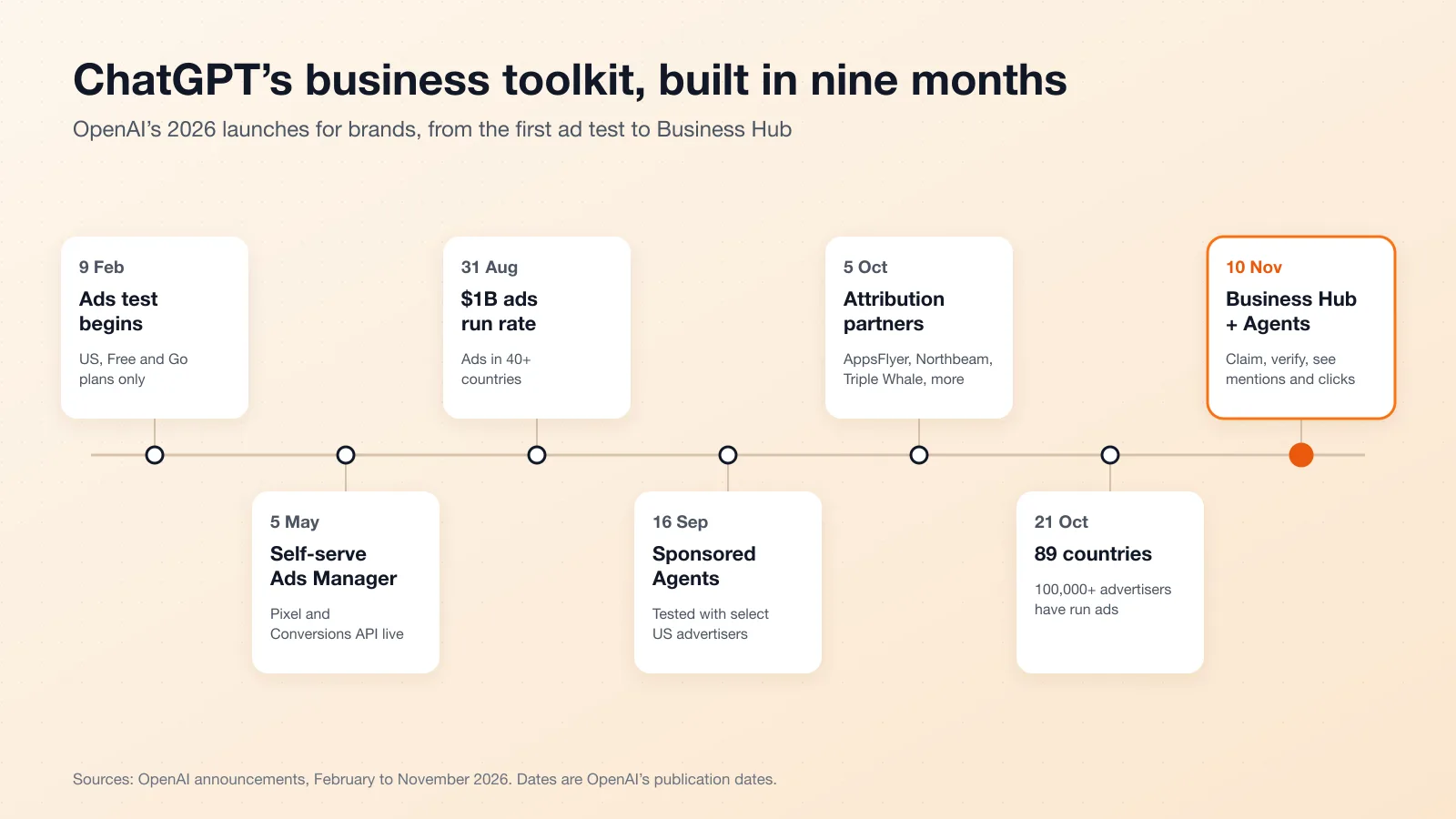
Business Hub is the organic half of a business platform OpenAI has been building all year:
| Date (2026) | What OpenAI launched for businesses |
|---|---|
| 9 February | Ads test begins in the US, on the Free and Go plans |
| 5 May | Beta self-serve Ads Manager and cost-per-click bidding; OpenAI says it “recently launched Conversions API and pixel-based measurement” |
| 31 August | ChatGPT Ads passes a $1 billion annualized revenue run rate, “in less than 200 days,” in over 40 countries |
| 16 September | Sponsored Agents tested with select US advertisers |
| 5 October | Attribution partners including AppsFlyer, Triple Whale, Adjust, Northbeam and Branch |
| 21 October | Ads in 89 countries; “over 100,000 advertisers have run campaigns” |
| 10 November | Businesses in ChatGPT: Business Hub and Business Agents (beta) |
What Business Hub Tracks: Mentions, Clicks and Discovery Topics
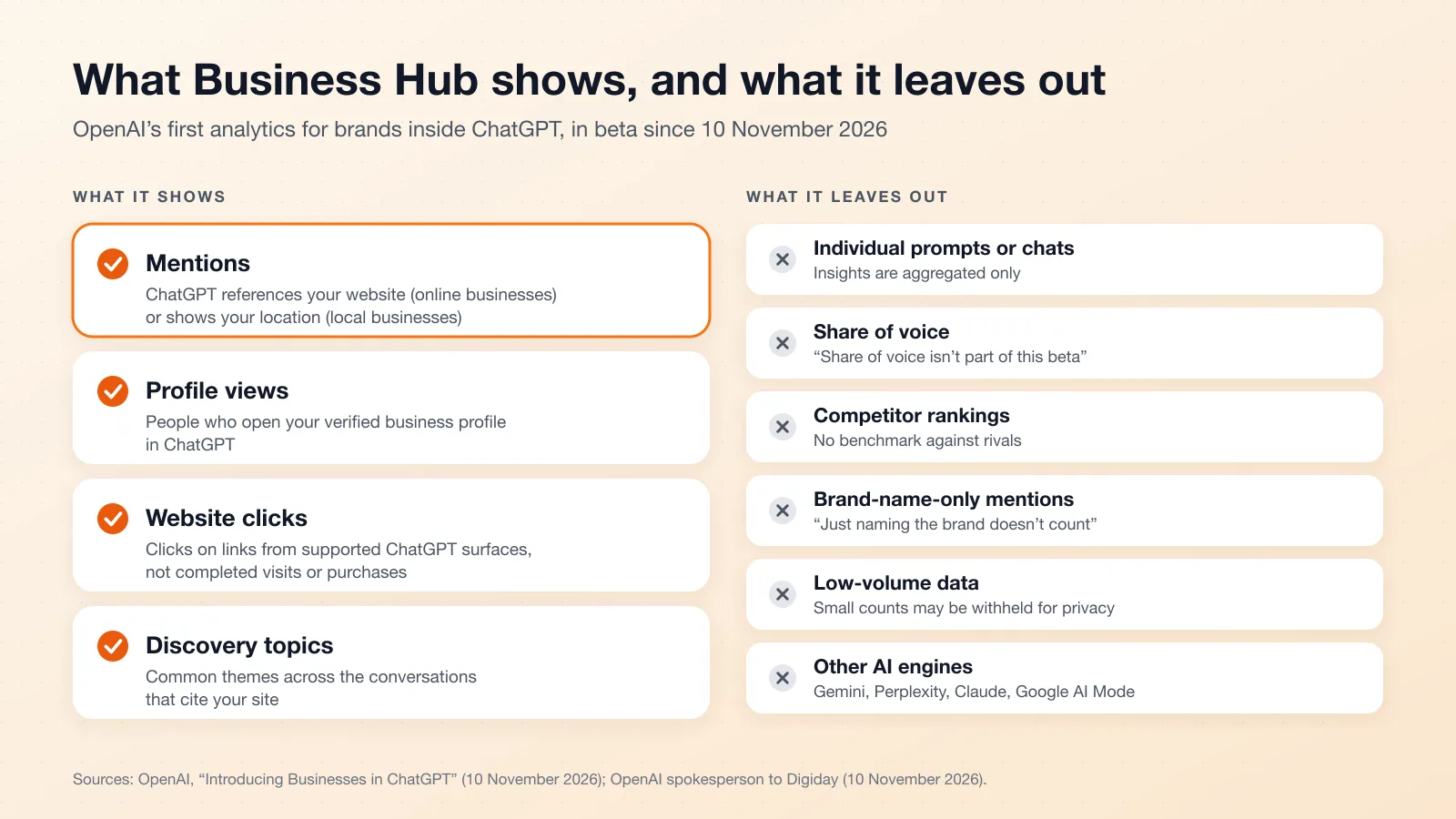
OpenAI’s launch screenshot shows a dashboard with “Brand insights” and “Agent insights” tabs, a 7D/28D switch, totals for mentions, profile views and website clicks, a mentions chart and a table of the top five discovery topics. Here is what each metric means, based on OpenAI’s announcement and what an OpenAI spokesperson told Digiday:
| Metric | What it counts | Watch out for |
|---|---|---|
| Mentions | For an online business, answers in which ChatGPT references your website; for a local business, answers that show a result for your location | “Just naming the brand doesn’t count” |
| Profile views | People who open your ChatGPT business profile | Only exists once your business has a profile |
| Website clicks | “Clicks on links from supported ChatGPT surfaces” | “Not completed visits or purchases” |
| Discovery topics | “Common themes across conversations where their website is cited” | Themes, not the actual prompts |
Two rules apply to all of them. The data is aggregated, and it is “only available when there are enough conversations or interactions to meet certain thresholds.” A small business may see little or nothing until volumes build up.
A Business Hub “mention” is not a brand mention
This is the detail most coverage has missed. In most AI visibility tools, a mention means the answer names your brand. In Business Hub, a mention for an online business means ChatGPT referenced your website. If ChatGPT recommends you by name but doesn’t cite your site, as often happens when it answers from what the model already knows rather than from a web search, that recommendation won’t show up.
So Business Hub mentions behave more like citations, closer to the citation counts in Bing’s AI Performance report than to a brand’s share of voice. A brand that ChatGPT talks about often but rarely links to could see low numbers and still be well known to ChatGPT. To earn more of the counted kind, give ChatGPT pages worth citing; our guide to where ChatGPT gets its information covers how its search and crawlers find them.
What Business Hub leaves out
Kaziukėnas put the main limitation plainly when he first saw the tool: “it doesn’t show prompts, user data, or any kind of competition benchmark or ranking. So it won’t help understanding why mentions/clicks are increasing or decreasing.” At launch that still holds:
- No prompts. Businesses “don’t see individual prompts or chats.” Discovery topics group conversations into themes, which tells you the territory but not the question.
- No share of voice or competitors. “Share of voice isn’t part of this beta.” You can’t see who ChatGPT recommended instead of you.
- No position or answer text. You won’t know whether you were the first suggestion or the fifth, or whether ChatGPT described you accurately.
- No other engines. It covers ChatGPT only, not Gemini, Perplexity, Claude or Google AI Mode.
- No long history, yet. OpenAI declined to say how long mentions are tracked; an ad executive with access told Digiday the chart shows the past seven or 28 days. OpenAI hasn’t mentioned an export or API.
Is Business Hub a GA4 for ChatGPT? Business Hub vs GA4 vs Search Console
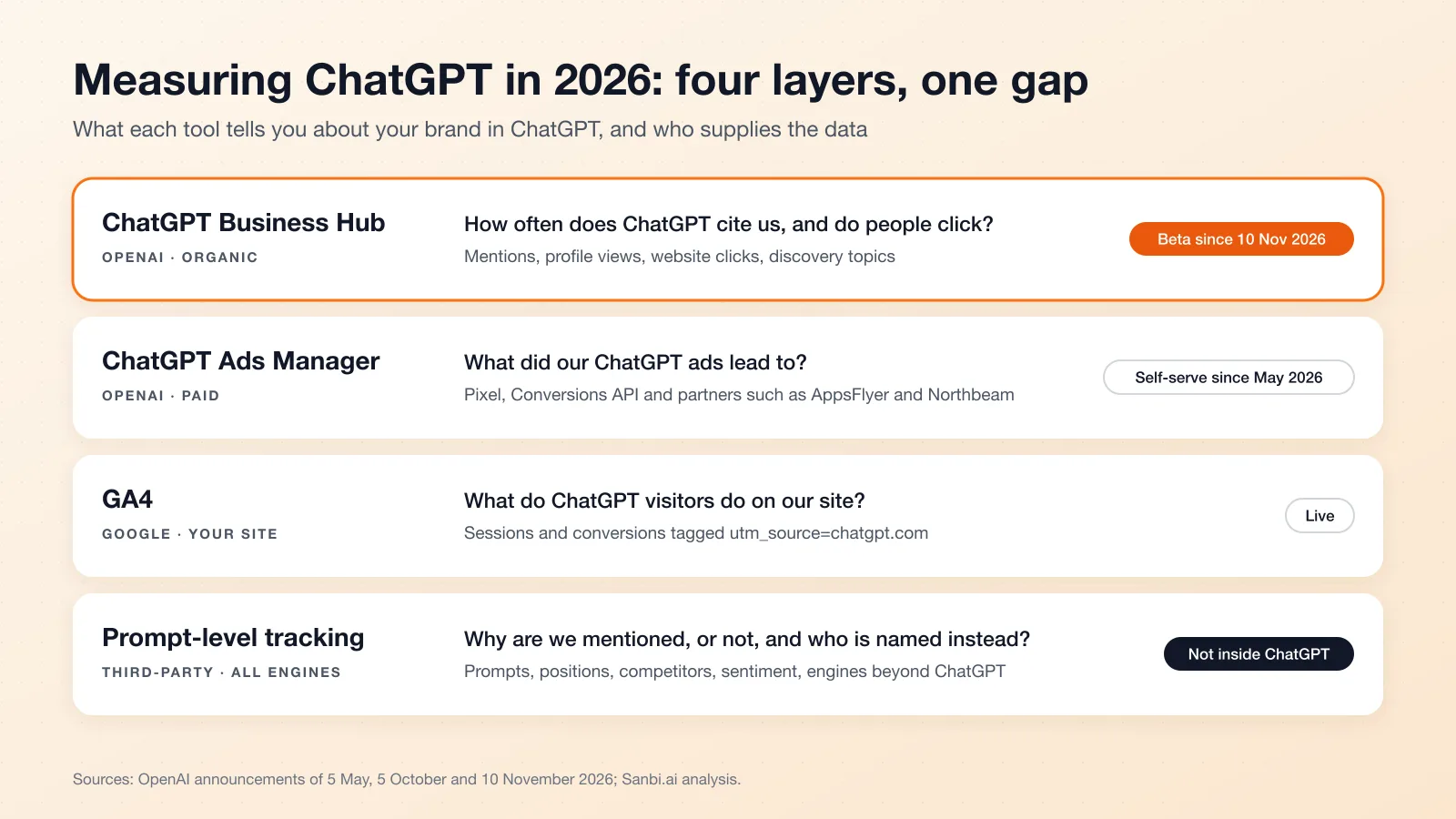
Each of these tools answers a different question, and Business Hub only covers part of what GA4 and Search Console do:
| ChatGPT Business Hub | Google Search Console | GA4 | Bing AI Performance | |
|---|---|---|---|---|
| Run by | OpenAI | Microsoft | ||
| Measures | Your presence inside ChatGPT | Your presence in Google Search | Visitors on your site | Your citations in Copilot and Bing AI answers |
| Main metrics | Mentions, profile views, website clicks, discovery topics | Impressions, clicks, CTR, average position | Sessions, users, events, conversions | Citations, cited pages, grounding queries |
| Shows the queries? | No, only themes | Yes | No | Yes, grounding queries |
| Shows your position? | No | Yes | No | No |
| Shows competitors? | No | No | No | No |
| Access | Claim and verify your business | Verify your domain | Install the tag | Verify your site |
| Cost | Free for now | Free | Free | Free |
The verdict: Business Hub is a cut-down Search Console for ChatGPT, combined with a Google Business Profile. It is not a GA4. It stops at the click, and OpenAI is explicit that a website click is not a completed visit.
ChatGPT’s real GA4-style tracker is on the ads side
The closest thing to GA4 inside ChatGPT is built for advertisers. OpenAI’s ChatGPT Ads Measurement Pixel is “a browser SDK for measuring website events,” and its Conversions API “sends conversion events directly from your server to OpenAI.” OpenAI said in May that it had “recently launched” both, and in August that they had “become important foundations for measurement.” Ads reporting covers impressions, clicks, spend, conversions, cost per action and return on ad spend, with country and device breakdowns, attribution windows and up to 365 days of history. In October OpenAI added attribution partners such as AppsFlyer, Triple Whale and Northbeam. None of it shows the prompts behind an ad view.
Business Hub now gives the organic side its first numbers. Digiday spelled out the business logic: “Once ChatGPT visibility shows up as a daily number, marketers will want that number to climb,” and the lever OpenAI sells is a sponsored placement. Businesses can already sponsor their Business Agent as the destination for ChatGPT Ads. Google ran the same play with Business Profiles, Search Console and Ads, and is now doing it again by adding ads to AI Mode.
ChatGPT Sites already counts visitors
A smaller tracker lives in ChatGPT Sites, which lets people build and host a website from a ChatGPT conversation. OpenAI’s documentation says “Sites records traffic automatically, without an analytics SDK,” and shows unique visitors and page views over time. It only covers sites hosted on ChatGPT, and isn’t available for sites owned by an Enterprise workspace.
GA4 still measures what happens after the click
For organic visits to your own site, GA4 is still the tool. ChatGPT appends utm_source=chatgpt.com to most links, and GA4’s default channel group now has an “AI Assistant” channel for visits “from sources like ChatGPT, Gemini, Deepseek, Copilot, or Grok” (it excludes Google’s AI Overviews and AI Mode). The tag isn’t guaranteed. In October 2026, after the GPT-6 release, ChatGPT links briefly stopped carrying it and opened without a referrer, until Adobe’s Cedric Huesler reported that “it was a bug” and the tags were back. Visits with neither can show up as Direct. Our guide shows how to track ChatGPT traffic in GA4 and check that your channel setup catches it.
How to Claim Your Business in ChatGPT
- Open Business Hub at chatgpt.com/business-hub and choose to claim your business. OpenAI says any eligible business located where ChatGPT is available can claim.
- Verify that you represent the business. OpenAI hasn’t listed its methods and says they vary by business type and market. When Barry Schwartz of Search Engine Roundtable claimed his business on launch day, he was offered a text or call to the main business number, or DNS verification. Shopify merchants can connect their store from Business Hub or the Shopify admin. OpenAI Enterprise customers and advertisers can go through their OpenAI representative.
- Wait for review. Claims go into a queue (“We’re reviewing your claim”) and OpenAI emails a decision.
- Complete the profile. Update your key details and add a product feed with pricing and availability. Eligible Shopify products are already in ChatGPT through Shopify Catalog.
- Consider a Business Agent. Eligible US ecommerce and online service businesses can build one from their own information. You can’t plug in your own agent, and your profile still gives people the option to visit your website instead of chatting.
- Check your insights. Expect empty or partial numbers until you pass OpenAI’s privacy thresholds.
Claiming is free and OpenAI says it doesn’t change how often you appear, so there is little reason to wait. The bigger risk is leaving a profile unclaimed while ChatGPT shows out-of-date details.
What Business Hub Means for AI Visibility Tracking
Business Hub fixes the biggest weakness of third-party AI visibility data: it is OpenAI’s own count. For the first time you can see whether ChatGPT’s citations of your site and its clicks to your site are going up. As Kaziukėnas put it, “combined with external tools that track prompts it will show accurate first-party data if GEO/AEO strategies are working.”
What it can’t tell you is why. If mentions fall 30% in a month, Business Hub won’t show which questions you dropped out of, which competitor replaced you or whether ChatGPT started describing you wrongly. That is still the job of prompt-level tracking:
| Question | Business Hub | Prompt tracker |
|---|---|---|
| Are ChatGPT’s citations of us going up? | Yes, first-party | Estimated from sampled prompts |
| Which questions mention us? | No, themes only | Yes |
| Who is recommended instead of us? | No | Yes |
| Where do we rank in the answer? | No | Yes |
| What does ChatGPT say about us? | No | Yes |
| Gemini, Perplexity, Claude and AI Mode? | No | Yes, depending on the tool |
Use discovery topics to choose which prompts to track. If ChatGPT cites you in conversations about “standing desks for small apartments,” that theme deserves a set of tracked prompts. Our ChatGPT rank tracking guide explains how to build that set and how often to run it, and our guide to measuring brand visibility in ChatGPT and other engines covers the metrics worth reporting.
Sanbi.ai runs those prompts every day across up to five engines (ChatGPT, Gemini, Perplexity, Claude and Google AI Mode) and records whether you’re named, where you rank, what the answer says and which sources it cites. Business Hub then lets you check the ChatGPT trend against OpenAI’s own numbers.
What to Do Next: A Business Hub Checklist
- Claim and verify your business in Business Hub. It’s free, and an unclaimed profile is out of your control.
- Fix your details and add a product feed. Accurate prices and availability are what Business Agents and shopping answers draw on. Our agentic commerce tracker covers how ChatGPT shopping changed this year.
- Record a baseline. Note mentions, profile views, website clicks and top discovery topics every week. With a 7-day or 28-day window and no documented export, your own log is the only history you’ll have.
- Reconcile with GA4. Business Hub clicks and GA4 sessions from chatgpt.com won’t match, because clicks are not visits. Track the ratio, not the gap, and check GA4’s AI Assistant channel alongside Direct in case the utm tag drops again.
- Turn discovery topics into tracked prompts so you can see who wins the conversations where you’re cited, and the ones where you’re not.
- Make your site easy to cite. Allow OAI-SearchBot in robots.txt and publish pages with specific, dated facts. Business Hub only counts answers that reference your website.
Want to see how ChatGPT, Gemini and Claude describe your brand today? Run a free AI visibility audit. It takes no card. To track ChatGPT and Google AI Mode alongside Gemini, Perplexity and Claude every day, see our plans.
Sources
- OpenAI: Introducing Businesses in ChatGPT (10 November 2026); ChatGPT ads announcements: Testing ads in ChatGPT (9 February 2026), New ways to buy ChatGPT ads (5 May 2026), A milestone in expanding access to AI (31 August 2026), Reimagining advertising with AI (16 September 2026), Building advertising for the way people use AI (5 October 2026) and ChatGPT Ads expands to 26 new countries (21 October 2026)
- Measurement documentation (accessed 10 November 2026): OpenAI’s ChatGPT Ads Measurement Pixel, Conversions API, Ads reporting and Managing a ChatGPT Site; Google’s GA4 default channel group; Search Engine Roundtable on ChatGPT’s missing UTM parameters (14 October 2026, updated 15 October)
- The leak: Juozas Kaziukėnas on LinkedIn (6 November 2026); Search Engine Roundtable (6 November 2026); PPC Land (6 November 2026); Digiday (9 November 2026)
- The launch: Digiday on Business Agents and metric definitions (10 November 2026); Search Engine Roundtable’s hands-on claim (10 November 2026); TechCrunch (10 November 2026); The Verge (10 November 2026); The Next Web (10 November 2026)
Frequently Asked Questions
Business Hub is OpenAI's new home for businesses inside ChatGPT, launched in beta on 10 November 2026 as part of Businesses in ChatGPT. A company can claim and verify its business, update its details, add a product feed with prices and availability, and see aggregated insights: how often ChatGPT mentions it, how many people view its ChatGPT profile, how many click through to its website and which discovery topics it appears in. Eligible US businesses can also build a Business Agent there.
OpenAI announced Businesses in ChatGPT, Business Hub and Business Agents in beta on Tuesday, 10 November 2026. Marketplace Pulse founder Juozas Kaziukėnas had spotted a 'Claim your business in ChatGPT' banner and posted about it on 6 November, and said he first saw early versions of the analytics in August 2026.
Four things, according to OpenAI and its launch screenshots: mentions, profile views, website clicks and discovery topics. Discovery topics are common themes across the conversations in which ChatGPT cites a business's website. The data is aggregated, shown over 7-day or 28-day views, and only appears once there are enough conversations to meet OpenAI's privacy thresholds.
Not every time ChatGPT names you. An OpenAI spokesperson told Digiday that for an online business a mention counts when ChatGPT references the business's website, and for a local business when ChatGPT shows a result for that location. 'Just naming the brand doesn't count.' That makes Business Hub mentions closer to a citation count than to the brand-mention counts most AI visibility tools report.
No. OpenAI says it doesn't share users' conversations with businesses, and a spokesperson said businesses 'don't see individual prompts or chats' and that 'share of voice isn't part of this beta.' There is no competitor benchmark or ranking either. The closest thing to query data is discovery topics, which group conversations into themes.
Partly. Like Google Search Console it reports how often you appear and how many people click, and it is free to verified owners. Unlike Search Console it shows no queries, no average position and no click-through rate by query, and it covers only ChatGPT. Think of it as a mix of a cut-down Search Console and a Google Business Profile.
Not really. GA4 measures what visitors do on your website after they arrive. Business Hub measures what happens inside ChatGPT before the visit, and OpenAI says its website clicks are 'not completed visits or purchases.' The GA4-like tracker in ChatGPT is on the paid side: ChatGPT Ads has offered a pixel and a Conversions API since spring 2026. For organic visits you still need GA4, where ChatGPT traffic arrives tagged utm_source=chatgpt.com.
Go to Business Hub at chatgpt.com/business-hub, choose to claim your business and verify that you're authorized to represent it. Any eligible business located where ChatGPT is available can claim. Shopify merchants can connect their store to speed up verification, and OpenAI Enterprise customers and advertisers can claim through their OpenAI representative. Once approved, you can update your details and add a product feed.
OpenAI hasn't published its verification methods and says it uses different ones for different businesses and markets. When Search Engine Roundtable's Barry Schwartz claimed his business on launch day, he was offered a text or call to the main business number, or DNS verification; he used DNS. The claim then goes into a review queue, and OpenAI emails a decision.
Yes, for now. OpenAI's VP of monetization, Benji Shomair, told Digiday that Business Hub and Business Agents are free but didn't rule out a paid model later. Businesses can separately pay to sponsor their Business Agent as the destination for ChatGPT Ads.
A Business Agent is a chat assistant that a verified business builds in Business Hub from its own information and product feed. When ChatGPT shows the business, people can open its profile and start a separate, clearly labeled conversation with the agent to ask follow-up questions. At launch, Business Agents are available to eligible ecommerce and online service businesses in the United States, and businesses can't bring their own agents.
OpenAI says it shouldn't. Benji Shomair said claiming a business 'should not have an impact on how frequently it appears,' because ChatGPT's answers need to stay objective. Accurate, current business information may still help ChatGPT match you to more relevant conversations, but a claimed profile is not a ranking boost.
Because they measure different events. Business Hub counts clicks on links from supported ChatGPT surfaces, not completed visits, and may withhold low counts for privacy. GA4 counts sessions that load your tag, so ad blockers, consent banners and visitors who leave before the tag fires all create gaps. ChatGPT's utm_source tag can also go missing: a bug in October 2026 briefly stripped it, and those visits could land in Direct. Expect GA4 sessions from chatgpt.com to be lower than Business Hub clicks.
Yes, for advertisers. The ChatGPT Ads Measurement Pixel is a browser script that records actions on your site, such as purchases, leads and sign-ups, and attributes them to ads in ChatGPT. The Conversions API sends the same events from your server. OpenAI said in May 2026 that it had recently launched both. There is no pixel for organic ChatGPT traffic; for that, use GA4, whose default AI Assistant channel groups visits from ChatGPT and other assistants.
If you want to know why your numbers move, yes. Business Hub gives first-party counts for ChatGPT only, with no prompts, positions, competitors or answer text. A prompt tracker shows which questions mention you, who is named instead, what the answer says and how Gemini, Perplexity, Claude and Google AI Mode compare. Use Business Hub as the ground truth for ChatGPT outcomes and a tracker to explain them.