Google Lost $500 Billion in One Day, and Its Own Executives Pointed to AI Search
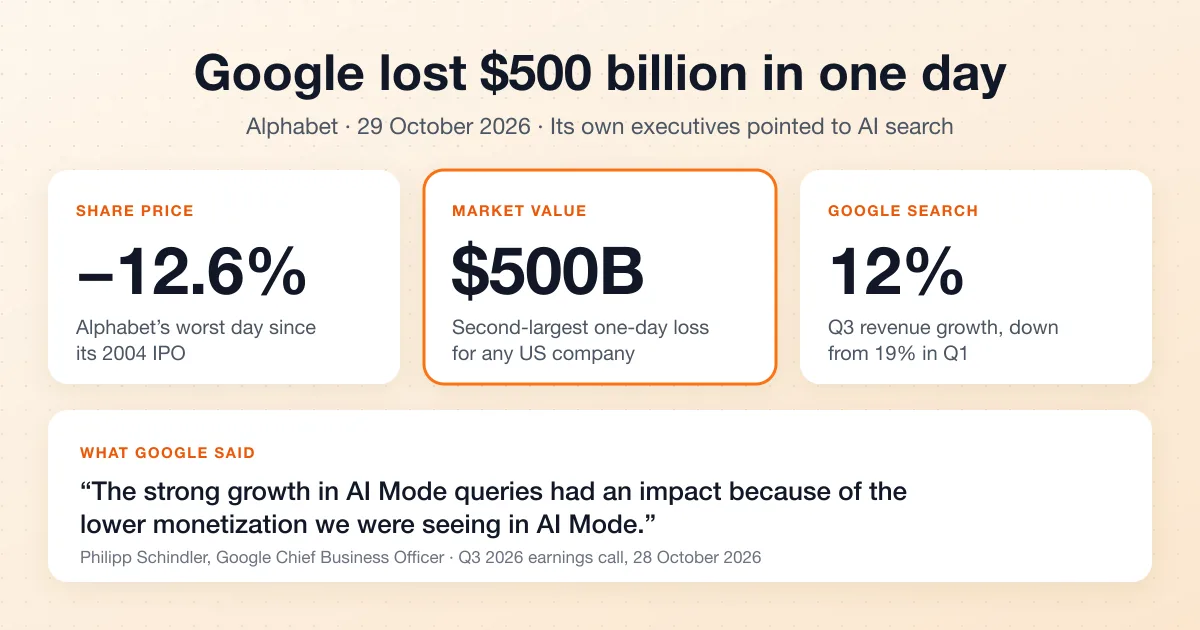
On Thursday, 29 October 2026, Alphabet shares fell 12.6% and erased about $500 billion in market value, the worst day in the company’s history. The evening before, Google’s chief business officer, Philipp Schindler, told analysts that “the strong growth in AI Mode queries had an impact because of the lower monetization we were seeing in AI Mode.” Put simply, people are using Google’s AI search more than ever, and it earns Google less per search than the results page it is replacing.
AI Mode wasn’t the only cause. Google named currency swings as the biggest single reason search growth slowed, and investors were at least as rattled by $51 billion of AI spending in one quarter and a second straight quarter of negative free cash flow. Of all the causes, though, AI search is the only one that is new, structural and of Google’s own making. Google also chose to push further into it: on the same day it took ads in AI Mode to ten more countries and started showing ads on follow-up questions in the US.
Below we go through every cause, look at the numbers behind the one Google named, and explain why this makes AI search harder, not easier, for brands to ignore. If you’re new to the product at the center of the story, start with our Google AI Mode explainer.
The $500 Billion Day at a Glance
| Question | Answer |
|---|---|
| What happened? | Alphabet’s Class A shares (GOOGL) closed down 12.64% at $283.82 on 29 October 2026 |
| How much value was lost? | About $500 billion. The Wall Street Journal estimated $499.8 billion; Yahoo Finance’s calculation was $475 billion |
| Is that a record? | It was Alphabet’s worst day since its 2004 IPO. Only Nvidia ($589 billion, January 2025) has lost more value in one day |
| What triggered it? | Q3 2026 results, released on 28 October: revenue, earnings, Search and YouTube all missed forecasts, and free cash flow was −$9.1 billion |
| How did Search do? | $63.35 billion, up 12%, down from 19% growth in Q1 and 17% in Q2. It missed estimates for the second quarter in a row |
| What did Google blame? | Currency first, then one-off effects in two ad categories, then “lower monetization” in AI Mode |
| Were people searching less? | No. Query growth was the highest in five years |
| What did Google do next? | Scaled AI Mode ads to 10 more countries, with Brazil, Mexico and the UK planned for Q4, and launched ads on follow-up questions in the US |
| What happened next? | The shares slid again on Friday, 30 October. October was Alphabet’s worst month since its IPO: down nearly 19%, about $758 billion of market value (Yahoo Finance) |
Why Google Stock Dropped on 29 October 2026
Alphabet reported third-quarter results after the market closed on Wednesday, 28 October. The headline numbers looked strong. Revenue rose 25% to $127.6 billion, Google Cloud more than doubled to $30.7 billion, and Sundar Pichai said the company was “now on a half-trillion dollar revenue run rate.”
Wall Street read the detail differently. Revenue and earnings both came in below LSEG consensus, the first time in nearly four years that Alphabet had missed on both, according to CNBC. Search & other revenue was $63.35 billion against about $64.9 billion expected (UBS). Google Services brought in $96.3 billion against $98.4 billion expected (Bloomberg), and YouTube ads missed too. Earnings per share were $2.12 against an estimate of $2.99, dragged down by an $8.2 billion non-operating loss, mostly from marking down Alphabet’s SpaceX stake.
The shares were down almost 11% before Thursday’s open and kept falling. GOOGL closed 12.64% lower at $283.82. CNBC called it the stock’s worst day ever, beating the record of 11.63% set in March 2020. The roughly $500 billion lost was almost double Alphabet’s previous one-day record, about $275 billion in July, according to Forbes data cited by Fox Business. NBC News reported it as the second-largest one-day loss of value in US market history, after Nvidia’s $589 billion drop in January 2025. Alphabet was still worth $3.47 trillion at Thursday’s close.
The selling didn’t stop there. On Friday, 30 October, the shares slid again as the sell-off spread across Big Tech. By Yahoo Finance’s calculations, Alphabet lost $468 billion over the week, its worst week ever, and about $758 billion over October. The stock fell nearly 19% in the month, its worst since the 2004 IPO, beating the 18.5% drop of November 2008.
A fall in market value is not a cash loss. Alphabet still earned $26.2 billion in the quarter and held $265.1 billion in cash and marketable securities. What fell was investors’ estimate of what Google’s future profits are worth, and the reasons for that are what matter to anyone who markets through Google.
Who’s to Blame? Lining Up the Suspects
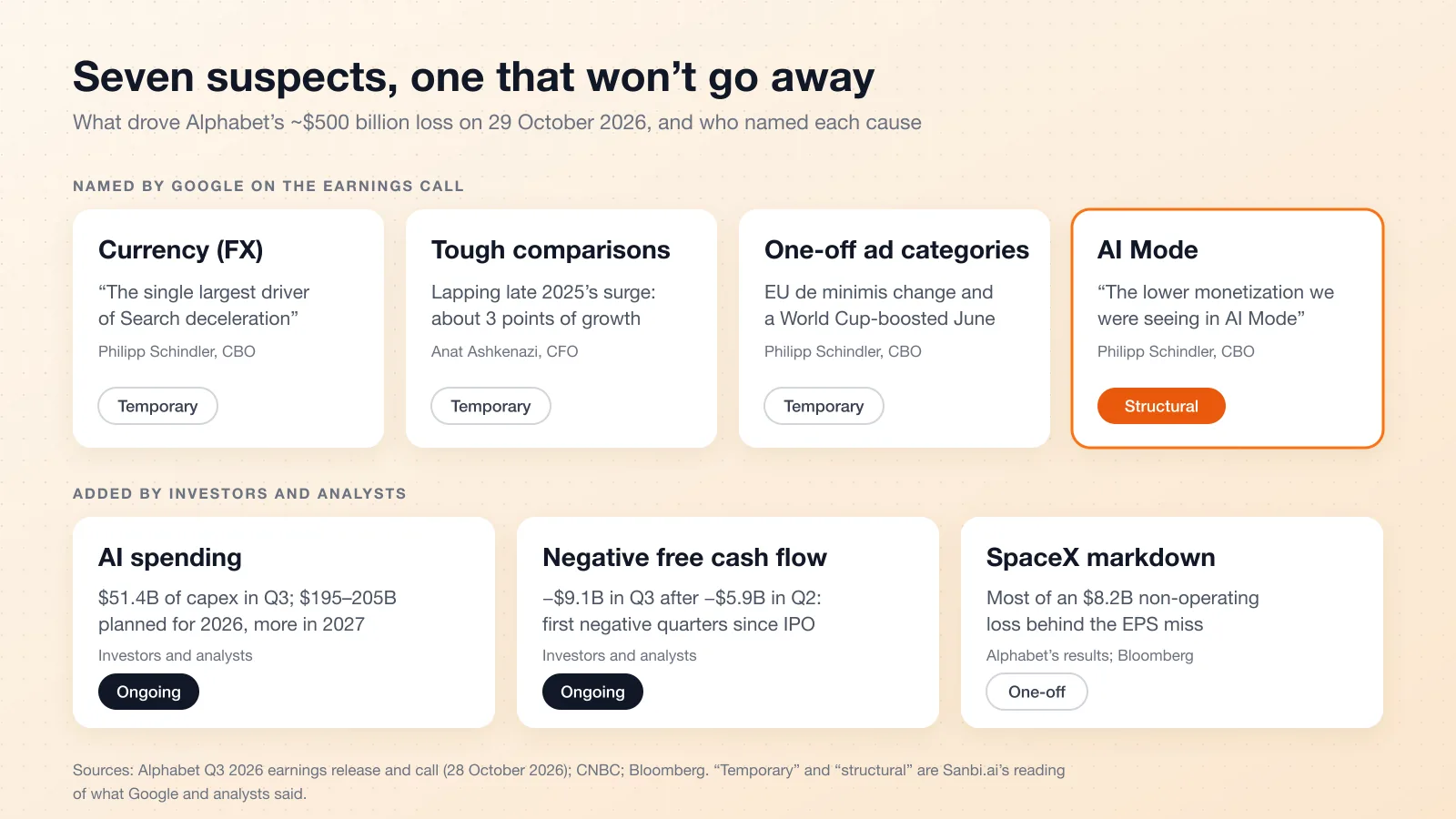
Google gave its own explanation on the earnings call. JPMorgan’s Doug Anmuth asked why search revenue was slowing while queries grew at a five-year high, and whether the answer was simply that Google was showing fewer ads in AI Overviews and AI Mode. Schindler listed three causes. The CFO and Wall Street added the rest.
| Suspect | The evidence | Who named it | Will it last? |
|---|---|---|---|
| Currency (FX) | “It was the single largest driver of Search deceleration relative to Q2” | Philipp Schindler, chief business officer | Temporary, though the CFO expects a slightly larger currency headwind in Q4 |
| Tough comparisons | Search growth sped up in late 2025, so 2026 is measured against a high bar: about three points of growth in Q3 and a couple more in Q4 | Anat Ashkenazi, CFO | Temporary. Bank of America expects tough comparisons through Q2 2027 |
| One-off ad categories | Asia-Pacific retail advertisers hit by the EU ending its de minimis exemption; media spending falling back after a World Cup-boosted June | Schindler | Temporary |
| AI Mode | “The strong growth in AI Mode queries had an impact because of the lower monetization we were seeing in AI Mode” | Schindler | Structural until AI Mode ads catch up |
| AI spending | $51.4 billion of capital spending in Q3, a 2026 forecast of $195 billion to $205 billion that will “increase significantly in 2027”, and more than $1 trillion in future commitments | Investors and analysts | Ongoing |
| Free cash flow | −$9.1 billion, after −$5.9 billion in Q2: the first two negative quarters since Alphabet went public | Investors and analysts | Depends on capital spending |
| SpaceX markdown | Most of the $8.2 billion non-operating loss behind the earnings miss | Bloomberg | A one-off accounting item |
Three suspects are temporary by Google’s own account. Three are about spending and accounting, not search. Only one is about search, is structural, and was named by Google itself: AI Mode.
On Google’s own account, currency did the most damage to this quarter’s search growth. But currency headwinds come and go every few years, and they don’t explain the worst day in Alphabet’s history. Investors hadn’t heard Google say on the record before that its own AI search earns less per query than the results page it is replacing. That is how analysts read it:
- UBS said the results were “going to bring Search cannibalization fears right back to the forefront.”
- Deutsche Bank wrote that “AI Mode is currently dilutive to monetization”, while keeping its Buy rating.
- Citizens downgraded the stock: “While query growth reached a five-year high, monetization appears to be challenged while search faces difficult comps.”
- D.A. Davidson’s Gil Luria said investors “will now worry” that the misses were “an indication that AI has finally come for Google”. He added that he “would not rush to conclusions based on one quarter”.
- Investing.com’s Thomas Monteiro told Bloomberg that until Google can charge for AI the way it once charged for search ads, every capital spending forecast will “read less like ambition and more like a bill.”
The Culprit Google Named: AI Mode
Two numbers from the same quarter show the problem:
- Search queries grew at their fastest year-over-year rate in five years, according to Pichai.
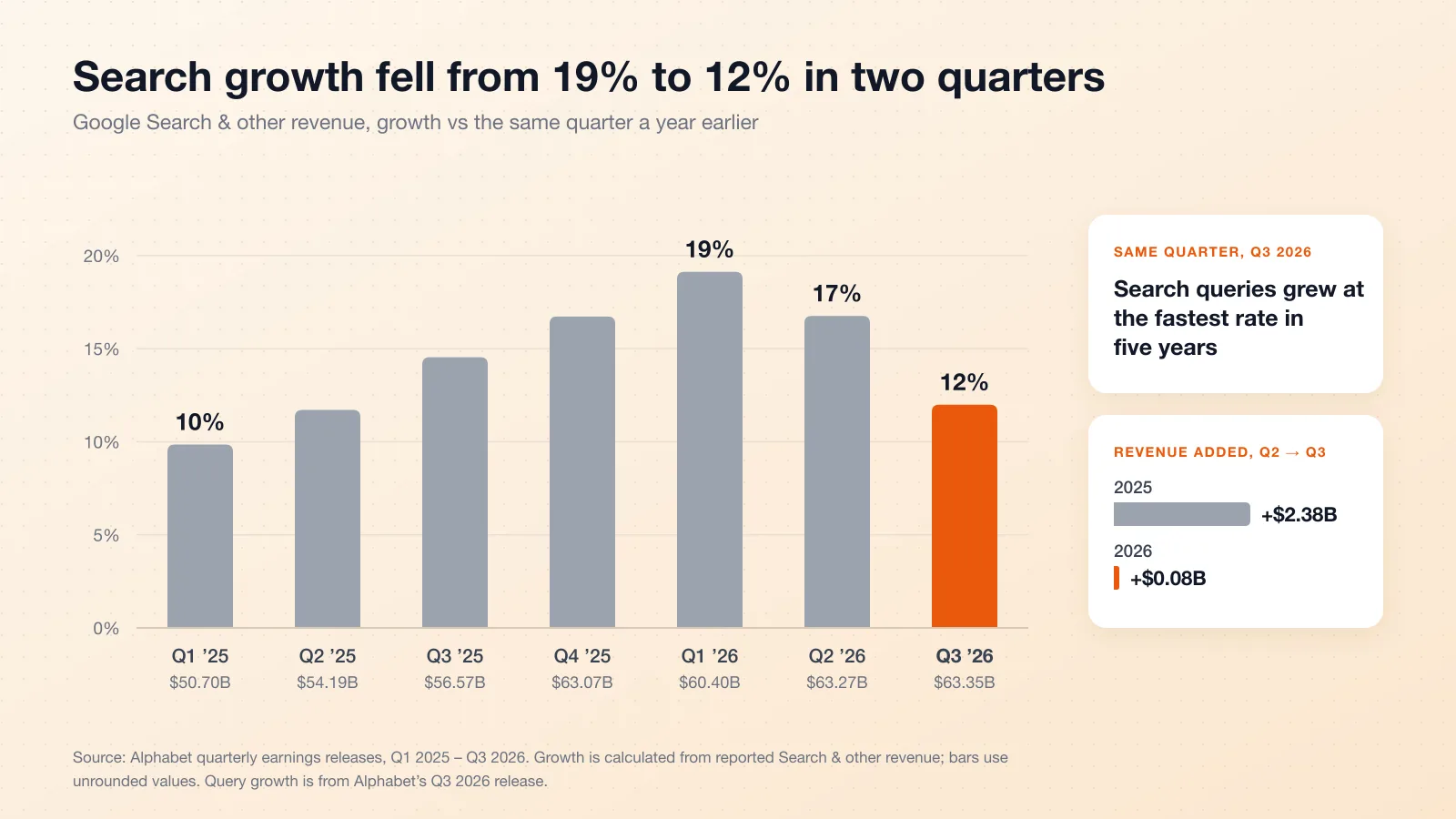
- Search revenue grew by $79 million from Q2 to Q3 2026. Between the same two quarters of 2025, it grew by $2.38 billion.
Google Search revenue growth by quarter
| Quarter | Google Search & other revenue | Growth vs a year earlier |
|---|---|---|
| Q1 2025 | $50.70 billion | 10% |
| Q2 2025 | $54.19 billion | 12% |
| Q3 2025 | $56.57 billion | 15% |
| Q4 2025 | $63.07 billion | 17% |
| Q1 2026 | $60.40 billion | 19% |
| Q2 2026 | $63.27 billion | 17% |
| Q3 2026 | $63.35 billion | 12% |
Source: Alphabet’s quarterly earnings releases. Growth is calculated from reported revenue.
Why AI Mode makes less money than classic Search
So people searched more and Google’s search revenue barely moved. Currency explains part of that gap, but the part Google can’t wait out is AI Mode, for three reasons:
- AI Mode is big. Google said at I/O in May 2026 that AI Mode had passed 1 billion monthly users within a year of launch, and called it “our biggest upgrade to Search ever.”
- It is a different kind of search. Pichai said AI Mode queries are “on average three times longer than traditional searches,” and one in five uses voice, images or documents. These are conversations, not keywords.
- Its ads have lagged behind its usage. Schindler described the 28 October rollout of AI Mode ads to ten more countries as “taking our monetization footprint global for the first time.” Google also says “the majority of AI Mode queries are incremental,” meaning people wouldn’t have typed them into classic search at all. That’s good for usage, but a new query with no ad on it adds nothing to revenue.
Bank of America saw the same thing in AI Overviews. Google, it wrote, “indicated traffic transition to Overviews was a small headwind in the Q, and likely bigger in Intl markets where ad loads are just starting to ramp.”
Google is choosing to cannibalize itself
Google could have protected the old results page. It is doing the opposite on purpose. On the call, Pichai said: “Just like our shift to mobile over a decade ago, we are focused on building the best Search user experience, followed by monetization.” In other words, Google ships the AI search experience first and makes money from it later. Quilter Cheviot’s Ben Barringer described it to CNBC as an “innovator’s dilemma”: Google “doesn’t know whether to protect its core business or look to join the disruption.” Google’s own actions answer that question: it is joining the disruption, and a $500 billion day didn’t change its mind.
Not the First Time AI Has Cost Google Billions
Investors have been punishing Alphabet over AI for nearly four years. What they feared has changed each time.
| Date | What happened | Market reaction |
|---|---|---|
| 8 February 2023 | Google’s launch ad for Bard wrongly said the James Webb Space Telescope took the first pictures of a planet outside our solar system | Shares fell as much as 9% during the day; about $100 billion in market value lost (NPR) |
| 7 May 2025 | Apple’s Eddy Cue testified that Safari searches fell in April for the first time, which he put down to people using AI, and said AI search engines would eventually replace standard ones | Shares down more than 7% (CNBC) |
| 29 October 2026 | Google’s own AI Mode grew faster than its ads, alongside record AI spending and negative free cash flow | Down 12.6%, Alphabet’s worst day ever; about $500 billion lost |
In 2023 the fear was that Google was behind in AI. In 2025 it was that AI chatbots would take searches away from Google. Google answered both: it shipped Gemini, and after Cue’s testimony it told investors that “we continue to see overall query growth in Search.” In 2026 the fear is that Google’s own AI search is winning users before it can earn from them. Every one of these fears has been about AI changing search, and each sell-off has been bigger than the last.
Why AI Search Is Still the Future
When a new product earns less than the one it replaces, the obvious move is to slow it down. Google did the opposite. On the day of the results, it:
- Scaled ads in AI Mode in Australia, Canada, India, Kenya, Malaysia, New Zealand, Nigeria, Pakistan, the Philippines and Singapore, with Brazil, Mexico and the UK planned for Q4 2026.
- Launched multiturn ads in the US, which show ads on answers to follow-up questions, labeled “Sponsored.”
- Told advertisers that “click-through rates are already similar between sponsored and organic product list items within AI Mode.”
- Reaffirmed where Search is going: “one seamless experience across AI Overviews, AI Mode, and traditional Search,” with agents that book reservations and fill in forms acting as “a unifying layer across our products.” Pichai said Google will bring agentic features to consumers later in 2026, starting with the Gemini app.
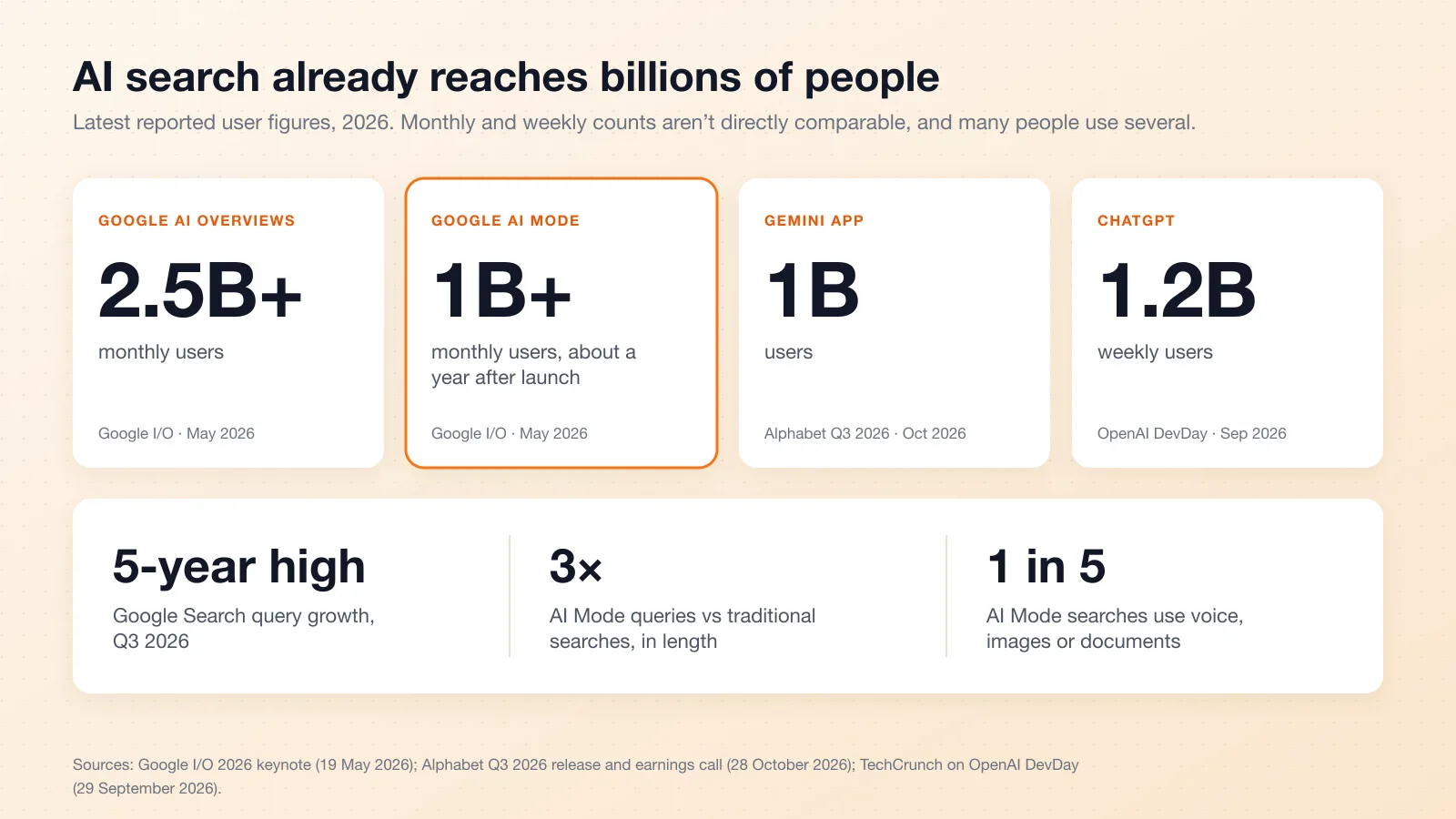
Users are already moving, whatever happens to the share price:
| AI search signal | Latest figure | Source and date |
|---|---|---|
| Google AI Overviews | More than 2.5 billion monthly users | Google I/O, 19 May 2026 |
| Google AI Mode | More than 1 billion monthly users, about a year after launch | Google I/O, 19 May 2026 |
| Gemini app | 1 billion users | Alphabet Q3 2026 results, 28 October 2026 |
| ChatGPT | 1.2 billion weekly users | OpenAI at DevDay, 29 September 2026 (TechCrunch) |
| Google Search queries | Fastest year-over-year growth in five years | Alphabet Q3 2026 results |
| AI Mode queries | Three times longer than traditional searches; one in five uses voice, images or documents | Pichai, Q3 2026 earnings call |
Monthly and weekly figures aren’t directly comparable, and many people use more than one of these products.
For traffic and adoption trends beyond Google, see our roundup of AI search statistics for 2026.
Not everyone on Wall Street thinks the damage will last. Rosenblatt’s Scott Devitt told CNBC, “I don’t think it’s a sea change,” and argued that “Alphabet, with its 4 billion search customers that become AI customers, is in an enviable position.” JPMorgan called the headwinds “more navigable than permanently structural.” Bank of America sees “potential for a growth uptick as early as 1Q” as international ads in AI Overviews launch.
Bulls and bears disagree about when Google will make AI search pay, not about whether search is becoming AI search. That’s the real lesson of the $500 billion day: Google, its investors and its rivals all accept where search is going, and they’re arguing about who earns from it, and how soon. For your business the question is simpler: does it show up in AI search at all?
What Google’s $500 Billion Day Means for Your Brand
Google’s numbers describe your customers too. Here’s how to future-proof your SEO strategy for answer engines.
-
The searches didn’t disappear. They moved into the answer. Queries are growing faster than at any time in five years, but more of them end inside an AI Overview or an AI Mode answer that names a few brands and cites a few sources. Pew Research found that users clicked a traditional result in 8% of visits when an AI summary appeared, against 15% without one. A first-place ranking is worth less if the answer above it recommends your competitor. Our guide to zero-click search in the AI era covers what still earns the click.
-
Organic AI visibility is cheaper now than it will be later. Google is adding ad slots to AI Mode country by country and to follow-up questions in the US. By Google’s own data, sponsored and organic product listings in AI Mode already get similar click-through rates, so an organic product placement there is worth about as much as a paid one, and today it costs nothing per click. As ads spread through 2027, organic space in each answer will be more contested. Start with how to rank in Google AI Mode.
-
Write for questions three times longer. AI Mode answers long questions by running many smaller searches behind the scenes. Pages that answer specific, multi-part questions with numbers, comparisons and dates get picked up by those searches. We explain the mechanics in query fan-out explained.
-
Get your product data ready for AI shopping. Google’s agentic checkout and Universal Cart run through Merchant Center and the Universal Commerce Protocol. Our Q4 2026 agentic commerce tracker shows which assistants can check out and what to fix before Black Friday.
-
Measure the answers, not just the clicks. Your analytics show the visits that arrive, not the answers that never sent one. Track the prompts your buyers ask and record whether your brand appears, where it ranks, what the answer says about you and which sources the engine cited. Sanbi.ai runs these prompts every day across up to five engines (ChatGPT, Gemini, Perplexity, Claude and Google AI Mode), and every paid plan includes AI Mode. For the click side, set up an AI-referral segment with our GA4 guide, and see how to track Google AI Mode for the measurement options.
-
Start your baseline now. AI answers change from one run to the next and from month to month, so you need history to see a trend. A brand that only starts measuring after ads fill its category’s AI Mode answers has no “before” to compare against.
The Verdict: Who’s to Blame?
On the numbers, currency did the most damage to this quarter’s search growth, and AI spending did the most damage to investors’ confidence. But AI search is the cause that Google itself named and the only one that won’t fix itself: AI Mode, which people use more every quarter and which earns less per search than the results page it replaces.
Google’s answer to its worst day ever was more AI search, now with ads, in more countries. That settles which way search is heading. The brands that do well in it will be the ones already named in the answer when the ads arrive.
See how ChatGPT, Gemini and Claude describe your brand today: run a free AI visibility audit. It takes no card. To track Google AI Mode alongside them every day, see our plans.
Sources
- Alphabet: Q3 2026 earnings release (28 October 2026); Q3 2026 earnings call: remarks from our CEO (28 October 2026); earnings call webcast and full call transcript; earlier releases for Q2 2026, Q1 2026, Q4 2025 and Q3 2025, which also give the 2024 and 2025 comparisons used in the growth table
- Google: Ads in AI Mode expand to new markets (Shashi Thakur, 28 October 2026); Sundar Pichai’s I/O 2026 keynote (19 May 2026); Q2 2026 earnings call remarks (22 July 2026)
- Market coverage: CNBC on Alphabet’s worst day, AI taking a bite out of search and what analysts say (29 October 2026); Bloomberg via Business Standard; NBC News; Fox Business; Yahoo Finance on Alphabet’s worst week and month (30 October 2026); 9to5Google
- Earlier sell-offs: NPR on Bard (9 February 2023); CNBC on Eddy Cue’s testimony (7 May 2025); Fortune (9 May 2025)
- AI search adoption and behavior: TechCrunch on ChatGPT’s 1.2 billion weekly users (29 September 2026); Pew Research Center on clicks with AI summaries (22 July 2025)
Frequently Asked Questions
Alphabet fell 12.6% after its third-quarter 2026 results missed Wall Street forecasts for revenue, earnings, Search and YouTube, and showed negative free cash flow of $9.1 billion on $51.4 billion of capital spending in the quarter. Search revenue grew 12%, down from 19% in the first quarter and 17% in the second, even though search queries grew at the fastest rate in five years. Google's chief business officer said lower monetization in AI Mode was one of the causes.
In market value, yes. Alphabet's Class A shares closed down 12.64% at $283.82 on 29 October 2026, which The Wall Street Journal estimated erased about $499.8 billion of market capitalization; Yahoo Finance's calculation was $475 billion. It was not a cash loss: Alphabet earned $26.2 billion in the quarter and held $265.1 billion in cash and marketable securities. Only one US company has lost more value in a single day: Nvidia, which lost $589 billion in January 2025.
Partly. Google named currency moves as the single largest driver of its Search slowdown, alongside tough comparisons with a strong late 2025 and one-off effects in two ad categories, and investors were just as worried about $51.4 billion of capital spending in one quarter and negative free cash flow. AI search is the one cause that is structural and of Google's own making: its chief business officer said 'the strong growth in AI Mode queries had an impact because of the lower monetization we were seeing in AI Mode.' That will last until AI Mode's ads catch up with its usage.
Three things, in this order. Chief business officer Philipp Schindler called currency moves 'the single largest driver of Search deceleration relative to Q2'. Next he cited one-off effects in two ad categories: the EU ending its de minimis exemption, which hit Asia-Pacific retail advertisers, and media spending falling back after a World Cup-boosted June. Third, he said 'the strong growth in AI Mode queries had an impact because of the lower monetization we were seeing in AI Mode.' The CFO added that Search was up against an unusually strong late 2025, which cost about three points of growth.
Mainly because it shows fewer ads. A classic results page has several ad slots, while AI Mode answers in a conversation, and Google only began scaling AI Mode ads outside the US on 28 October 2026. As AI Mode passed 1 billion monthly users, a growing share of searches landed on a surface with little ad inventory. Google says most AI Mode queries are incremental and that its ad tests have shown promising results, so it is now adding ads in more countries and on follow-up questions.
Not in usage. Google says its year-over-year query growth in Q3 2026 was the highest in five years, AI Overviews reach more than 2.5 billion people a month and AI Mode has passed 1 billion monthly users. What AI is changing is how search makes money. Search revenue growth slowed from 19% to 12% in two quarters while queries grew faster, because more searches now happen inside AI answers, which carry fewer ads and send fewer clicks to websites.
Yes. CNBC reported it as Alphabet's biggest percentage drop since Google's 2004 IPO, worse than the 11.63% fall of March 2020, and Bloomberg called it the company's biggest-ever loss of market value. Alphabet's previous one-day record was about $275 billion, set in July 2026, according to Forbes data cited by Fox Business. The shares slid again the next day, and October 2026 became Alphabet's worst month since its IPO: down nearly 19%, or about $758 billion of market value, according to Yahoo Finance.
Besides the US, Google said on 28 October 2026 that it is scaling AI Mode ads in Australia, Canada, India, Kenya, Malaysia, New Zealand, Nigeria, Pakistan, the Philippines and Singapore. It plans to add Brazil, Mexico and the United Kingdom in the fourth quarter of 2026. The ads are labeled 'Sponsored'.
Multiturn ads appear on Google's answers to follow-up questions as a user goes back and forth with AI Mode, not only on the first query. Google launched them in the US on 28 October 2026. Google also says sponsored and organic product listings in AI Mode already get similar click-through rates.
More slowly each quarter. Google Search & other revenue grew 19% year over year in Q1 2026 ($60.4 billion), 17% in Q2 ($63.27 billion) and 12% in Q3 ($63.35 billion). It grew by just $79 million from Q2 to Q3 2026, against $2.38 billion between the same quarters of 2025. For Q4, Alphabet expects tougher comparisons and a slightly larger currency headwind.
Twice in widely reported cases. On 8 February 2023, a Bard ad wrongly credited the James Webb Space Telescope with the first pictures of a planet outside our solar system, and Alphabet lost about $100 billion in market value that day. On 7 May 2025, Apple's Eddy Cue testified that Safari searches had fallen for the first time and that AI search engines would eventually replace standard ones, and Alphabet fell more than 7%. October 2026 is different because the damage came from Google's own AI search becoming popular with users before its ads caught up.
Being visible inside AI answers now matters as much as ranking. Searches are growing, but more of them end inside AI Overviews and AI Mode, which mention a few brands and link to a few sources. Pew Research found that users clicked a traditional result in 8% of visits when an AI summary appeared, against 15% without one. Brands should measure whether AI answers mention them, write for longer conversational questions and get product data ready for AI shopping before AI Mode's ad slots fill up.
Yes. The sell-off was about how fast Google can earn from AI search, not about whether people use it: Google's query growth hit a five-year high and AI Mode has passed 1 billion monthly users. Google's response was to add AI Mode ads in more countries and on follow-up questions, so organic space in each answer will be more contested from here. An organic placement costs nothing per click today, and Google says sponsored and organic product listings in AI Mode already get similar click-through rates. Start with a baseline: which prompts mention you, which competitors appear and which sources the engines cite.