Meta Muse in 2030: User Forecast, Predictions and What It Means for Brands
Meta Muse could reach about 1.3 billion monthly users by 2030 in our base case, with a plausible range of 611 million to 2 billion. The reason is distribution: Meta can put its new personal agent inside apps that 3.6 billion people already open every day, and it has done this before, doubling Meta AI from about 500 million to more than a billion monthly users in roughly a year. If it works, the main way people use Meta shifts from scrolling a feed to giving an agent instructions, and brands will compete to be the option that agent picks.
This post covers the 2030 view: our user scenario model, how Muse could spread across WhatsApp, Instagram, desktop and AI glasses, six predictions, and what brands should build now. For what Muse does today, how its shopping and checkout work, and why Amazon blocked it, read our Meta Muse and agentic shopping guide.
Meta Muse 2030 at a Glance
| Question | Answer |
|---|---|
| What is Muse? | Meta’s personal AI agent, running on the Muse Spark model; launched in the US in September 2026, Canada on September 18 |
| Where does it run today? | iOS and Android apps, muse.ai, WhatsApp and a Mac app; AI glasses announced |
| Meta’s audience | 3.60 billion daily active people across its apps (June 2026) |
| Precedent | Meta AI doubled from about 500 million to more than 1 billion monthly users between September 2024 and October 2025 |
| Our 2030 base case | ~1.3 billion monthly Muse users (range 611 million to 1.99 billion) |
| Agent share of US ecommerce in 2030 | 10% to 20% (Morgan Stanley) or 15% to 25% (Bain) |
| Biggest brake | Trust: 27% of consumers trust no one to run a shopping agent for them (Checkout.com) |
| What brands compete for | Recommendation share: a place on the agent’s shortlist |
Sources: Meta, Meta Connect 2026, Meta Q2 2026 results, Morgan Stanley, Bain via Digital Commerce 360, Checkout.com. The 2030 user figures are our scenario model, not Meta guidance.
Muse vs Muse Spark: The Muse Product Stack
Muse is the consumer-facing agent. Muse Spark is the model underneath it, built for agentic work. Around them sit Muse Image for image generation, Muse Code for software development (now also on Windows), Muse Voice Transcribe, the open-weights Muse Glimmer model, and the Muse Connector Platform, through which outside services expose actions the agent can take (Meta for Developers).
The difference between a model and an agent is the whole story. A model reasons and generates. An agent combines that intelligence with memory, tools, permissions, a browser and the ability to act. Meta says Muse keeps working on longer jobs after you close the app, coming back when something changes or when it needs permission for a sensitive action (Meta).
| Layer | What it does | Strategic role |
|---|---|---|
| Muse | Plans and carries out personal tasks | Owns the user relationship and their intent |
| Muse Spark | Reasons, plans and handles multi-step workflows | Supplies the intelligence |
| Secure VM | Houses the agent, its browser, data and credentials | Draws the execution and trust boundary |
| Connectors | Give Muse approved access to outside services | Expand what it can get done |
| Meta apps and devices | Put Muse inside familiar interfaces | Remove adoption friction |
| Payments | Authorize and complete transactions | Turn recommendations into revenue |
Why Meta Has a Distribution Advantage No AI Lab Can Copy
Meta’s apps averaged 3.60 billion daily active people in June 2026 (Meta Q2 2026 results). A standalone AI company has to win every user through a new app. Meta can place an agent inside products people already use daily.
It has already shown how fast that works. Meta AI, the assistant built into Meta’s apps, grew like this:
| Date | Meta AI monthly users | Source |
|---|---|---|
| September 2024 | Nearly 500 million | TechCrunch |
| December 2024 | Nearly 600 million | Meta |
| March 2025 | More than 700 million | Meta |
| April 2025 | Almost 1 billion | Meta Q1 2025 earnings call |
| October 2025 | More than 1 billion | Meta |
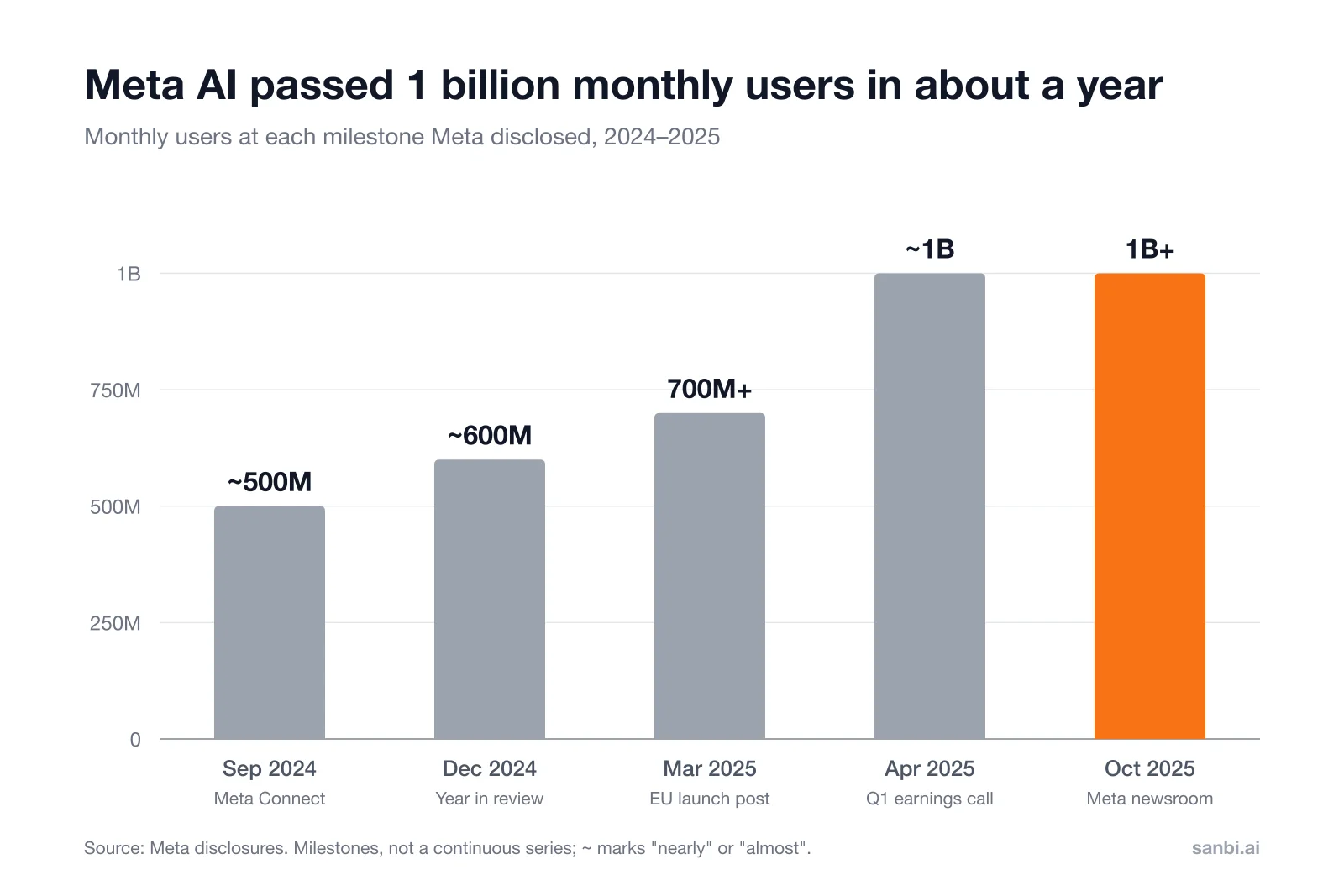
Each bar is a milestone Meta disclosed; Meta doesn’t publish a continuous monthly series.
Muse also has access to context no search engine or chatbot has in one place. A saved Instagram recipe can become a grocery list. A WhatsApp thread can become a calendar booking. A product seen through AI glasses can become a researched purchase. The advantage isn’t just more data. It’s the ability to connect social signals, stated intent, what the user is looking at, merchant inventory and execution in one workflow.
How Muse Could Spread Across Every Meta Product by 2030
Muse is more likely to become connective tissue across Meta’s apps than to replace any of them. Each surface contributes a different signal or action. Some of this is live today; much of it is our projection, so the table marks which is which.
| Surface | Muse’s likely role by 2030 | Status (September 2026) | What changes for brands |
|---|---|---|---|
| Main command line for delegating tasks | Live: message Muse in WhatsApp | Business messaging becomes agent-to-agent selling | |
| Inspiration and preference signal | Live: Muse can act on saved posts | Products in Reels and creator posts must be identifiable | |
| Community and local knowledge | Not announced | Local businesses compete for agent inclusion, not feed reach | |
| Messenger | Service and transaction channel | Business Agent live; Muse not announced | Consumer agents meet merchant agents |
| Threads | Real-time interest signal | Not announced | Authority on live topics has to be machine-readable |
| Muse app and muse.ai | Console for goals, files, permissions and audit trails | Live | Users can review what the agent did and why it chose you |
| Mac and desktop | Execution across installed apps | Live on Mac | Software and web apps get operated by agents, not only people |
| AI glasses | Hands-free, visual interface | Announced for “the coming months" | "What I see” becomes a search or a purchase |
| Muse Charm | A pocket device for the agent | Announced at Connect 2026 | The agent gets hardware of its own |
| VR glasses | Spatial assistant | Meta VR Glasses (spring 2027) build “your Meta AI agent” into the operating system | The agent follows the user into immersive devices |
Sources: Meta, Meta Connect 2026, Ray-Ban Meta Audio, Meta VR Glasses, Meta Business Agent.
Meta Muse User Forecast: 611 Million to 2 Billion by 2030
Meta doesn’t publish Muse user guidance, and a credible forecast shouldn’t pretend otherwise. So we built a simple scenario model with every assumption visible:
- Start with Meta’s 3.60 billion daily active people in June 2026.
- Grow that audience 1.5% a year, reaching about 3.82 billion in 2030.
- Apply three adoption paths for the share of that audience using Muse each month.
| Year | Meta audience | Conservative | Base | High adoption |
|---|---|---|---|---|
| 2027 | 3.65B | 110M (3%) | 219M (6%) | 365M (10%) |
| 2028 | 3.71B | 260M (7%) | 519M (14%) | 816M (22%) |
| 2029 | 3.76B | 414M (11%) | 904M (24%) | 1,355M (36%) |
| 2030 | 3.82B | 611M (16%) | 1,299M (34%) | 1,987M (52%) |
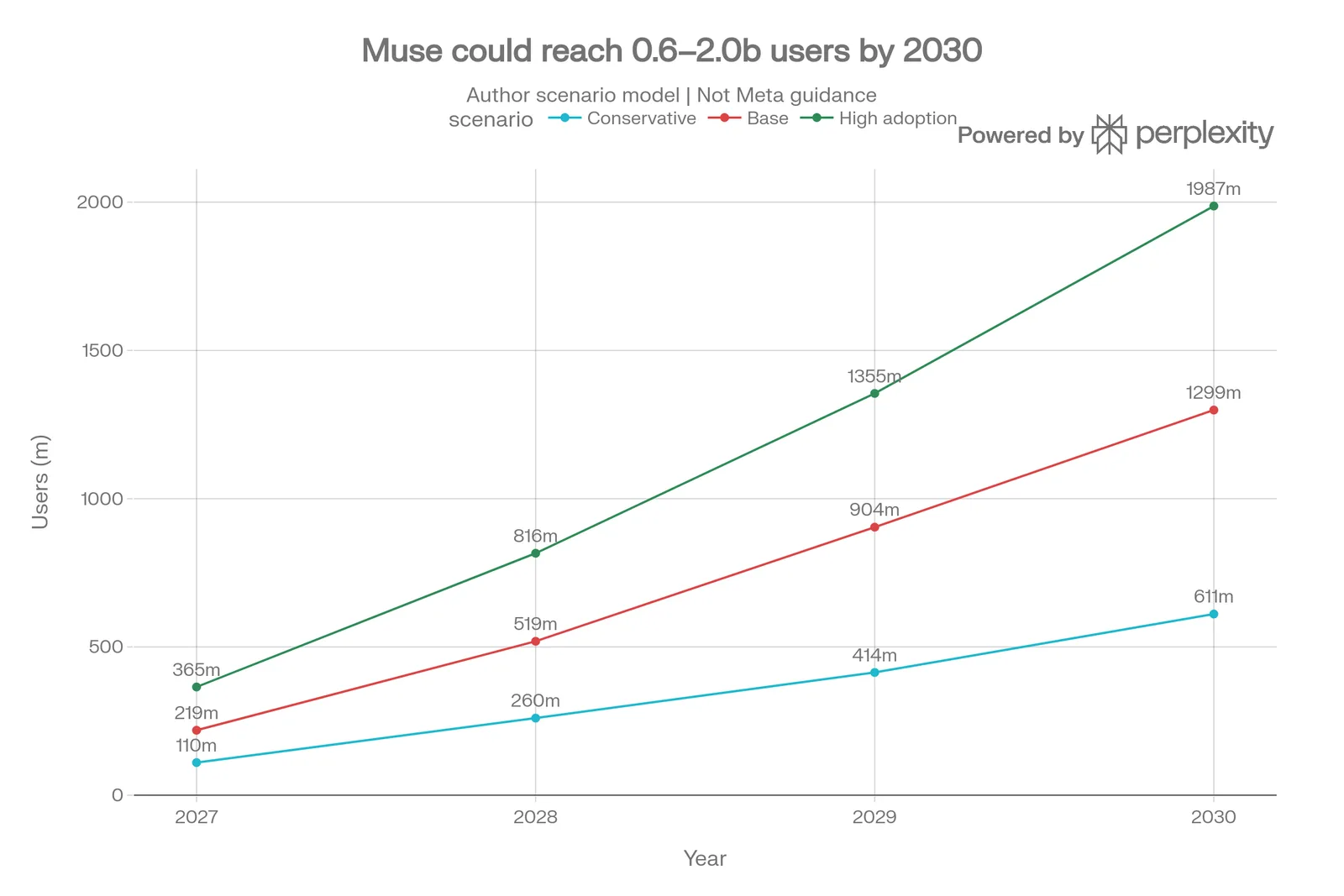
What has to be true for each path:
| Scenario | Conditions required |
|---|---|
| Conservative (611M) | Trust stays weak, rollout stays geographically limited, and Muse is used mostly for research and advice rather than for doing things |
| Base (1.3B) | Muse reaches WhatsApp users globally, connectors improve, and routine shopping and planning catch on |
| High adoption (1.99B) | Muse becomes the default layer across Meta’s apps and glasses, and people trust its permissions and payments |
Why the base case is plausible. Meta AI crossed a billion monthly users through in-app placement alone. Muse gets the same distribution.
Why it may be too high. Muse asks for far more trust than a chatbot. It may read connected accounts, keep a memory, operate a browser and start sensitive actions. In its second week, Apptopia counted about 642,000 US mobile daily users (TechCrunch), and Muse is available only in the US and, since September 18, Canada (iPhone in Canada). Reaching the 2027 base case of 219 million needs launches in WhatsApp’s largest markets.
Three variables decide which line Muse follows: international availability, the share of Meta users who switch the agent on, and monthly use after the novelty fades. One caveat on the method: we apply adoption rates to daily Meta users to estimate monthly Muse users. Meta’s monthly reach is larger than its daily base, so the audience figure is conservative, but the adoption rates are where almost all the uncertainty sits.
Agentic Shopping by 2030: From Browsing to Delegation
Muse’s most consequential near-term use is commerce. It launched with the entire Shopify catalog and Stripe’s Link checkout. Meta is now adding Shop Pay and PayPal for payments and connectors for retailers including Walmart, Best Buy, Sephora and Wayfair; Instacart is live and Expedia is coming soon (Meta Connect 2026).
The 2030 shift is in how shopping starts. A conventional funnel asks a person to discover, compare, click, browse, add to cart and check out. Muse compresses it into one instruction: “Find a carry-on under $250 that meets airline size limits, has reliable reviews and arrives by Friday.” The agent searches, compares, checks the constraints, assembles the order and asks for approval.
Forecasters think this becomes a material share of retail by 2030:
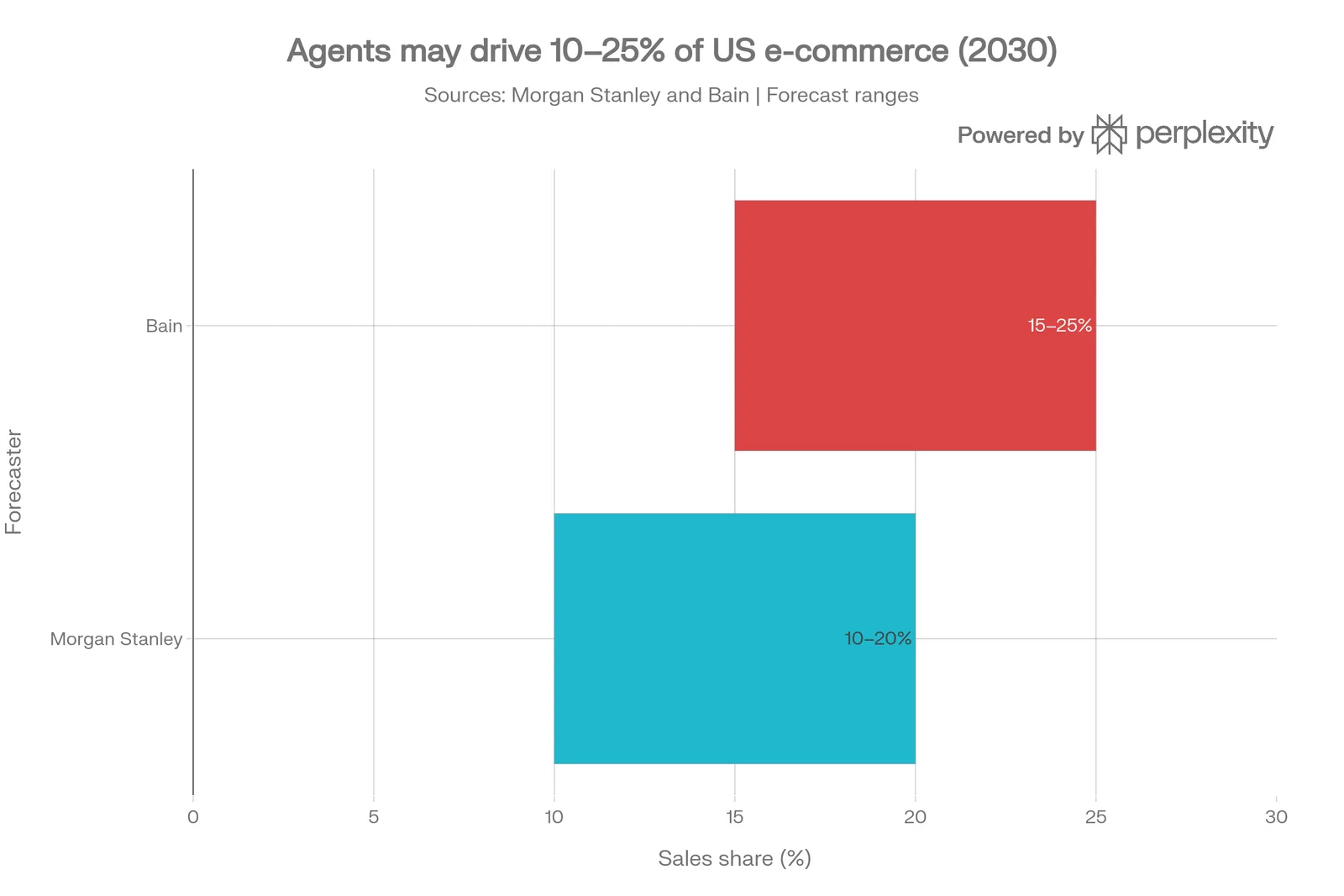
| Forecaster | Agents’ share of US ecommerce, 2030 | Spending |
|---|---|---|
| Morgan Stanley | 10% to 20% | $190B to $385B |
| Bain | 15% to 25% | $300B to $500B |
The ranges differ because “agentic commerce” can mean purchases an agent influences, starts or completes. The useful conclusion isn’t a single dollar figure. It’s that a meaningful share of online demand may be filtered by software before a shopper ever reaches a retailer. For the wider market-size picture, see our agentic commerce market forecast.
By 2030, shopping may also become policy-based. Instead of approving each purchase, people set rules once (budgets, preferred brands, delivery windows, sustainability requirements, approval thresholds) and let Muse apply them repeatedly. A brand that fits a shopper’s standing rules gets chosen again and again without ever being compared.
How Muse Changes Everyday Behavior by 2030
The deepest shift is from apps to outcomes. People will care less about which service performs each step and more about whether Muse got the goal right.
- Search becomes orchestration. The agent doesn’t return links; it gathers evidence, compares options and starts the task.
- Feeds become memory. Likes, saves, follows, conversations and viewed products help the agent infer preferences and timing.
- Messaging becomes a command line. WhatsApp turns from a place to talk into a place to instruct an agent and approve its work.
- The camera becomes a query. On AI glasses, a shelf, poster, menu or appliance can trigger identification, comparison, booking or purchase (Meta Connect 2026).
- Agents negotiate with agents. A personal Muse increasingly deals with merchant-side business agents to check stock, qualify options and close a sale.
Six Predictions for Meta Muse by 2030
| Prediction | Evidence today | Our confidence |
|---|---|---|
| 1. Muse becomes one identity across Meta | Mac app live; glasses, email, voice, avatars and the Muse Charm device announced | High |
| 2. WhatsApp becomes the default surface | Muse already works in WhatsApp | High |
| 3. Glasses create ambient commerce | Glasses shopping AI (product ID, prices, reviews, alerts, voice purchase) announced | Medium |
| 4. Discovery shifts to machine eligibility | Agents already shortlist products from structured data and reviews | High |
| 5. Business agents meet personal agents | Over 1 million businesses on Meta Business Agent | Medium |
| 6. The feed loses its monopoly on commercial intent | Muse already acts on saved Instagram posts | Medium |
1. Muse becomes a Meta-wide identity
Your agent is likely to persist across WhatsApp, the Muse app, desktop, glasses and eventually spatial devices. The interface changes; your goals, permissions, memory and preferences follow you. Meta’s announced expansion to Mac, AI glasses, email, custom voices, real-time avatars and a pocket device, Muse Charm, already points that way (Meta Connect 2026). Even its new audio glasses are sold on their “connection to your Muse personal AI agent” (Meta).
2. WhatsApp becomes the default surface
Conversation is already WhatsApp’s native interaction, so delegating to Muse can feel like messaging a capable contact rather than learning a new app. That matters most outside North America, where WhatsApp is the default way people message and where Muse hasn’t launched yet. If Muse goes global through WhatsApp, the base case is conservative. If it doesn’t, the conservative case is optimistic.
3. Glasses create ambient commerce
AI glasses turn offline attention into digital action. Look at a product, ask for reviews and alternatives, compare online prices, set a price alert or approve a purchase by voice. Meta has already announced shopping AI for its glasses that “identifies products, prices, and reviews so you can set alerts or buy with your voice,” and Muse is coming to the same glasses (Meta Connect 2026). The implication for brands is physical: packaging, shelf presence and product imagery need to match your catalog closely enough for an agent to recognize the item.
4. Discovery shifts to machine eligibility
Brands will optimize for agent comprehension, not only human attention. Structured product data, current availability, clear return policies, verifiable claims, strong reviews, accessible APIs and consistent entity information will decide whether Muse can confidently recommend an offer. This is the same work that decides how AI engines pick products today; Muse raises the stakes because an agent that acts leaves no page two.
5. Business agents meet personal agents
Consumer Muse and Meta Business Agent could form a two-sided agentic marketplace. More than one million businesses already use Meta Business Agent across WhatsApp and Messenger, and Meta says more than a billion active business threads happen every day across WhatsApp, Messenger and Instagram (Meta). The platform already connects to Shopify, Zendesk and Shopee. A user’s agent sends intent and constraints; a business agent returns inventory, terms or appointment slots; payment and messaging close the loop. Meta would then control not just discovery but the negotiation between demand and supply. For the protocols that make agent-to-agent commerce work, see our map of the agent stack.
6. The feed loses its monopoly on commercial intent
Feeds will stay important for entertainment and inspiration, but they’ll no longer be Meta’s only route to purchase intent. Muse turns what people watch and save into explicit goals and actions. Meta’s key metric shifts from time spent scrolling toward useful outcomes completed.
The Advertising Reset: From Impressions to Recommendation Share
Muse could strengthen Meta’s ad business or disrupt the mechanics that built it. Since December 2025, Meta has used interactions with its AI features to personalize the content and ads people see, in most regions (Meta). Muse is walled off more tightly: Meta says Muse conversations and virtual-machine data aren’t shared with its ad systems (Meta).
That creates a tension. The more private Muse is, the easier it is to trust. The more commercial context Meta extracts, the easier it is to monetize. Zuckerberg has already said Meta expects to earn a small fee on transactions (see how Meta plans to make money from Muse). By 2030, a third model is plausible: merchants paying for sponsored eligibility, meaning discoverability or offers inside the agent, with ranking still constrained by relevance and disclosed rules.
For marketers, the critical change is that impressions lose value relative to recommendation share: how often your brand makes the agent’s shortlist for relevant requests. A product can have excellent creative and huge social reach and still be invisible if its price, availability, specifications, reviews, policies and ordering options are hard for an agent to retrieve or trust. We break recommendation share into a four-stage funnel (retrieved, recommended, accurate, transactable) in our share of agentic selection framework.
Why Trust Will Decide Muse’s Adoption
Meta has built serious controls into Muse: an isolated secure virtual machine, a separate Sentinel agent that approves outbound actions, no access to real passwords or card numbers, approval before sensitive actions, and an audit trail (Meta). Consumers are still hesitant:
- 27% of consumers Checkout.com surveyed across six markets trust no organization to operate a shopping agent for them, and 24% say they would never delegate purchases. Their top asks: spending caps (30%), instant revocation (29%) and easy cancellation (28%) (Checkout.com).
- About three-quarters of online adults in the US, UK and Canada, surveyed in April 2026, are uncomfortable letting an agent complete and pay for a purchase on its own, even with spending limits (Forrester).
So adoption will climb a risk ladder, one rung at a time:
| Rung | What the agent does | What unlocks it |
|---|---|---|
| 1. Recommend | Researches and compares | Accurate, well-sourced answers |
| 2. Replenish | Reorders groceries and household staples | Saved preferences, sensible substitutions |
| 3. Build the cart | Assembles the order for human approval | Clear, explainable approval screens |
| 4. Buy small | Completes low-value purchases within set limits | Spending caps, instant revocation |
| 5. Buy big | Books travel and makes high-value purchases | Insurance, audit trails, clear liability |
Muse’s future depends less on whether the model can click “buy” than on whether people believe mistakes can be understood, stopped and reversed. For the security incidents and safeguards reported since launch, see Is Meta Muse safe for shopping?
What Brands Should Build Now for 2030
Muse’s scale is years away, but the work compounds, and most of it pays off across every AI agent, not just Meta’s.
| Horizon | Priority | Why it matters |
|---|---|---|
| Now (2026–2027) | Make product data agent-readable: attributes, variants, stock, prices, delivery dates, warranties and return rules in structured data and server-rendered HTML | Every agent, Muse included, reads the same evidence |
| Measure recommendation share on the engines you can track today | You can’t improve a shortlist you can’t see | |
| Name products and variants clearly in Instagram and creator content | Muse can act on saved posts only if it can tell which product it is | |
| Next (2027–2028) | Expose actions, not just pages: APIs or connectors for search, quotes, booking, purchase, tracking, cancellation and returns | Agents complete tasks where actions are available |
| Train your business agent on accurate catalog and service data, with clear rules for handing off to a human | Agent-to-agent selling in WhatsApp and Messenger | |
| Later (2029–2030) | Make products visually recognizable: packaging and imagery that match your catalog | Glasses turn physical products into queries |
| Keep paid influence separate from evidence | Sponsored reach won’t hold if the agent can’t justify the pick |
A word on measurement. There’s no neutral “Muse answer” to sample: it runs logged in, personalizes from each user’s memory and connected apps, and acts inside a private virtual machine. Sanbi doesn’t track Muse. What you can track is the shared evidence layer every agent draws on: which brands and products appear, in what position, and which sources get cited across ChatGPT, Gemini, Perplexity, Claude and Google AI Mode. Run the same intent prompts across categories and locations on a schedule instead of relying on one-off screenshots. Our guide to measuring AI visibility covers the method, and the Muse purchase-test scorecard covers testing inside Muse itself.
What to Watch: Five Signals Muse Is on Track
| Signal | Points toward the conservative case | Points toward the high-adoption case |
|---|---|---|
| International expansion | Muse stays in the US and Canada through 2027 | Launches in WhatsApp’s biggest markets |
| WhatsApp activation | A launch spike, then weak monthly retention | Steady monthly use among WhatsApp users |
| Connector density | Mostly US retail partners | Travel, finance, productivity and local services at scale |
| Task completion quality | Frequent reversals, refunds and abandoned tasks | High success rates and retention after errors |
| Glasses adoption | Occasional novelty use | Daily hands-free habit |
The Takeaway: From Owning Attention to Owning Intent
Meta is trying to move from owning attention to owning delegated intent. If Muse reaches the base case, it will sit between more than a billion people and the services they use.
By 2030, the question for brands may no longer be “How do we reach people on Meta?” but “How do we become the option their Meta agent chooses?”
Nobody can answer that for Muse yet, but you can answer it for the AI engines that shape the same evidence today. Run a free AI visibility audit to see how ChatGPT, Gemini and Claude describe your brand, then track recommendation share over time with Sanbi’s paid plans.
Sources
- Meta: Introducing Muse, the world’s first personal AI agent built for everyone (Sep 2026)
- Meta for Developers: Meta Connect 2026: the end-to-end recap
- Meta: Everything we announced at Meta Connect 2026
- Meta: Introducing Ray-Ban Meta Audio and our deepest lineup of AI glasses
- Meta: Introducing Meta VR Glasses (Sep 2026)
- Meta: Meta Reports Second Quarter 2026 Results (Jul 2026)
- Meta: Be there for every customer with Meta Business Agent (Jun 2026)
- Meta: Improving your recommendations on our apps with AI at Meta (Oct 2025)
- Meta: Europe, meet your newest assistant: Meta AI (Mar 2025)
- Meta: Our year in review: Meta’s 2024 highlights (Dec 2024)
- Meta: Q1 2025 earnings call transcript (Apr 2025)
- TechCrunch: Mark Zuckerberg says Meta AI has nearly 500 million users (Sep 2024)
- TechCrunch: Meta’s Muse is outpacing ChatGPT’s early mobile launch (Sep 2026)
- iPhone in Canada: Meta’s Muse AI agent is now available in Canada (Sep 2026)
- Morgan Stanley: Agentic commerce impact could reach $385 billion by 2030 (Dec 2025)
- Bain & Company via Digital Commerce 360: Bain: agentic AI could drive 15% to 25% of US ecommerce sales by 2030 (Dec 2025)
- Checkout.com: Consumer demand for AI shopping is forming fast, but trust for agentic commerce is still catching up (Jun 2026)
- Forrester: Consumers aren’t ready to delegate payments to AI agents (Jun 2026)
Method notes: the 2030 Muse user scenarios are sanbi.ai’s own model (Meta’s June 2026 daily active people, grown 1.5% a year, times the adoption rates shown). They are not Meta guidance. Meta AI user figures are Meta’s disclosed milestones, not a continuous series. Status labels in the integration table reflect Meta’s announcements as of September 27, 2026; everything marked “not announced” is our projection.
Frequently Asked Questions
Meta hasn't published any Muse user guidance, so any 2030 number is a scenario, not a forecast from Meta. Our model starts from the 3.60 billion people who used a Meta app daily in June 2026, grows that audience 1.5% a year, and applies three adoption paths. It lands at about 611 million monthly Muse users in a conservative case (16% adoption), 1.3 billion in the base case (34%) and 1.99 billion in a high-adoption case (52%). The base case assumes Muse reaches WhatsApp users well beyond the US.
Muse is the consumer agent people talk to. Muse Spark is the model underneath it, built for agentic work such as planning, using a browser and taking multi-step actions. The wider Muse family also includes Muse Image for image generation, Muse Code for software development, and the Muse Connector Platform, which lets outside companies give Muse approved access to their services. In short: Spark does the reasoning, Muse adds memory, tools, permissions and the ability to act.
Muse launched in the US in September 2026 on iOS, Android and muse.ai, and inside WhatsApp, where you can message it like a contact. It reached Canada on September 18. Meta then added a Mac app that, with your permission, can operate any app on your Mac, and announced Muse for its AI glasses in the coming months, along with its own email address, custom voices, real-time avatars and a pocket device called Muse Charm. Expect the same agent, with the same memory and permissions, to follow you across all of them.
Meta says Muse is coming to its AI glasses in the coming months for hands-free use, and its new Ray-Ban Meta Audio glasses are built to connect to your Muse agent. Separately, Meta announced shopping AI for its glasses that identifies products, prices and reviews so you can set alerts or buy with your voice. Put together, that makes glasses the surface where a product on a shelf, a poster or a menu can turn directly into a search, a comparison or a purchase without typing anything.
You can message Muse directly inside WhatsApp and delegate tasks the same way you would text a capable friend: plan a trip, compare products, book something or build a shopping list, with Muse asking for approval before sensitive actions. WhatsApp is likely to become Muse's most important surface because conversation is already how its users interact, and because WhatsApp's biggest audiences are outside the US and Canada, the only two countries where Muse is available so far.
Meta Business Agent is Meta's AI for businesses: it answers customers, sells and handles service across WhatsApp and Messenger, and Meta says more than one million businesses use it. Its platform connects to systems such as Shopify, Zendesk and Shopee. If consumer Muse and business agents both scale, a shopper's agent could send intent and constraints, the merchant's agent could reply with inventory, prices or appointment slots, and payment and messaging would close the loop inside Meta's apps.
Probably not. Feeds will stay central for entertainment and inspiration. What changes is that the feed loses its monopoly on commercial intent: a saved Reel, a post or a group discussion can become an instruction to Muse, which then researches, compares and acts. For Meta, the metric shifts from time spent scrolling toward useful outcomes completed. For brands, being admired in the feed matters less if the agent can't identify and verify the product afterwards.
Trust is the main brake. Muse can read connected accounts, remember preferences, operate a browser and start sensitive actions, which asks for far more trust than a chatbot. Surveys show the gap: Checkout.com found 27% of consumers trust no organization to run a shopping agent for them, and Forrester found about three-quarters of online adults in the US, UK and Canada uncomfortable letting an agent complete and pay for a purchase on its own. International availability and whether people keep using Muse after the novelty fades are the other two swing factors.
It shifts the goal from impressions to recommendation share: how often your brand makes the agent's shortlist when someone delegates a relevant task. A product can have strong creative and wide social reach and still be invisible if its price, availability, specifications, reviews, policies and ordering options are hard for an agent to retrieve or trust. Brands that win will treat structured product data, independent evidence and agent-ready checkout as marketing, not just operations.
No. Meta AI is Meta's assistant built into WhatsApp, Instagram, Facebook and Messenger, and it passed one billion monthly users in 2025. Muse, launched in September 2026, is a personal agent rather than an assistant: it runs in its own secure virtual machine, keeps working on longer tasks after you close the app, uses a browser and connected services, and asks for approval before sensitive actions. Meta AI's growth matters for Muse mainly as proof of how fast Meta can distribute AI inside its apps.