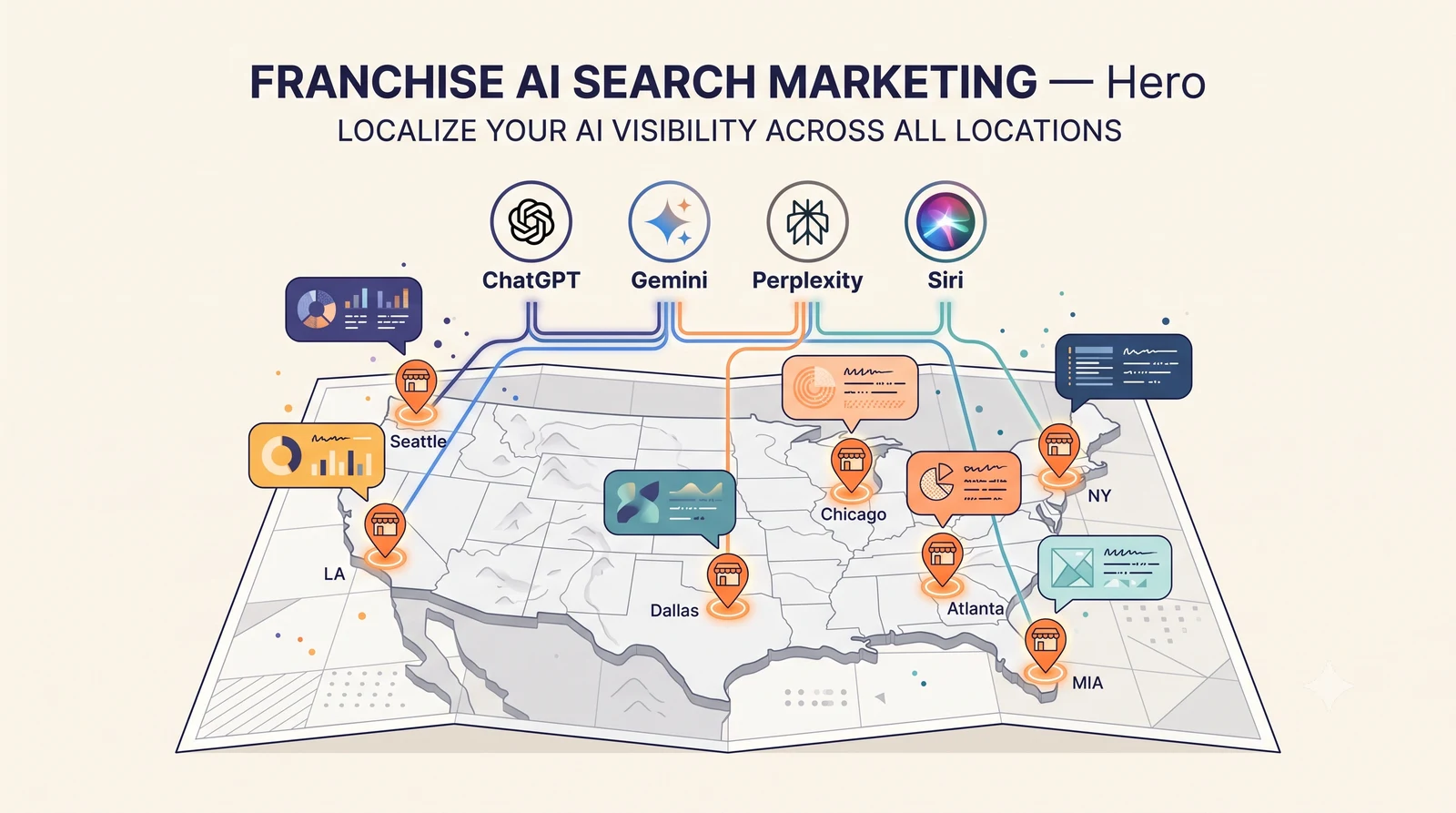
AI Search Marketing for Franchise & Multi-Unit Brands (2026 Playbook Reddit Is Sharing)
Franchise marketing was hard when the discovery surface was ten blue links and a local pack. In 2026, the discovery surface is a synthesized AI answer — and the same prompt returns a different answer for every location, drawn from different data sources, weighted by different sentiment signals.
That means your Ohio unit and your California unit may be describing themselves in AI answers using completely different data, sourced from completely different platforms, with completely different sentiment scores — and the brand marketing team back at HQ has no visibility into any of it.
The same fragmentation appears across borders and languages, not just state lines — AI search in the UAE and Middle East covers the bilingual version of this problem.
Here’s the 2026 playbook for franchise and multi-unit marketing in the AI search era: which AI engine pulls from which data source, why sentiment can quietly poison an entire brand, and the Local AEO + schema stack that fixes it.
The Franchise Paradox: Same Prompt, Different Answer, Every Location
Ask ChatGPT “best pizza in Austin” and it returns a list. Ask the exact same question about Portland and you get a completely different list. The kicker: even if your national brand is present in both results, the model may describe your Austin unit as “a reliable chain option with fast service” and your Portland unit as “often crowded with mixed reviews on order accuracy” — from the same prompt template, in the same session, two seconds apart.
That’s not a bug. It’s the architecture:
- Location-scoped retrieval — AI models filter their source data by the location signal inferred from the prompt (city name, IP, prior context)
- Per-location review corpora — every unit has its own Yelp, Google Business Profile, and Apple Business Connect footprint, with different review volumes and sentiment
- Different last-crawled timestamps per location — data freshness varies unit by unit
- Sentiment inheritance — a cluster of negative reviews at underperforming units can shape how the model describes brand-generic queries too
Our team at Sanbi documented this pattern in depth in research on how AI answers change by location. For franchise brands the implication is direct: a national AI visibility score is meaningless. You need per-location tracking, per-location sentiment monitoring, and per-location competitive share of voice.
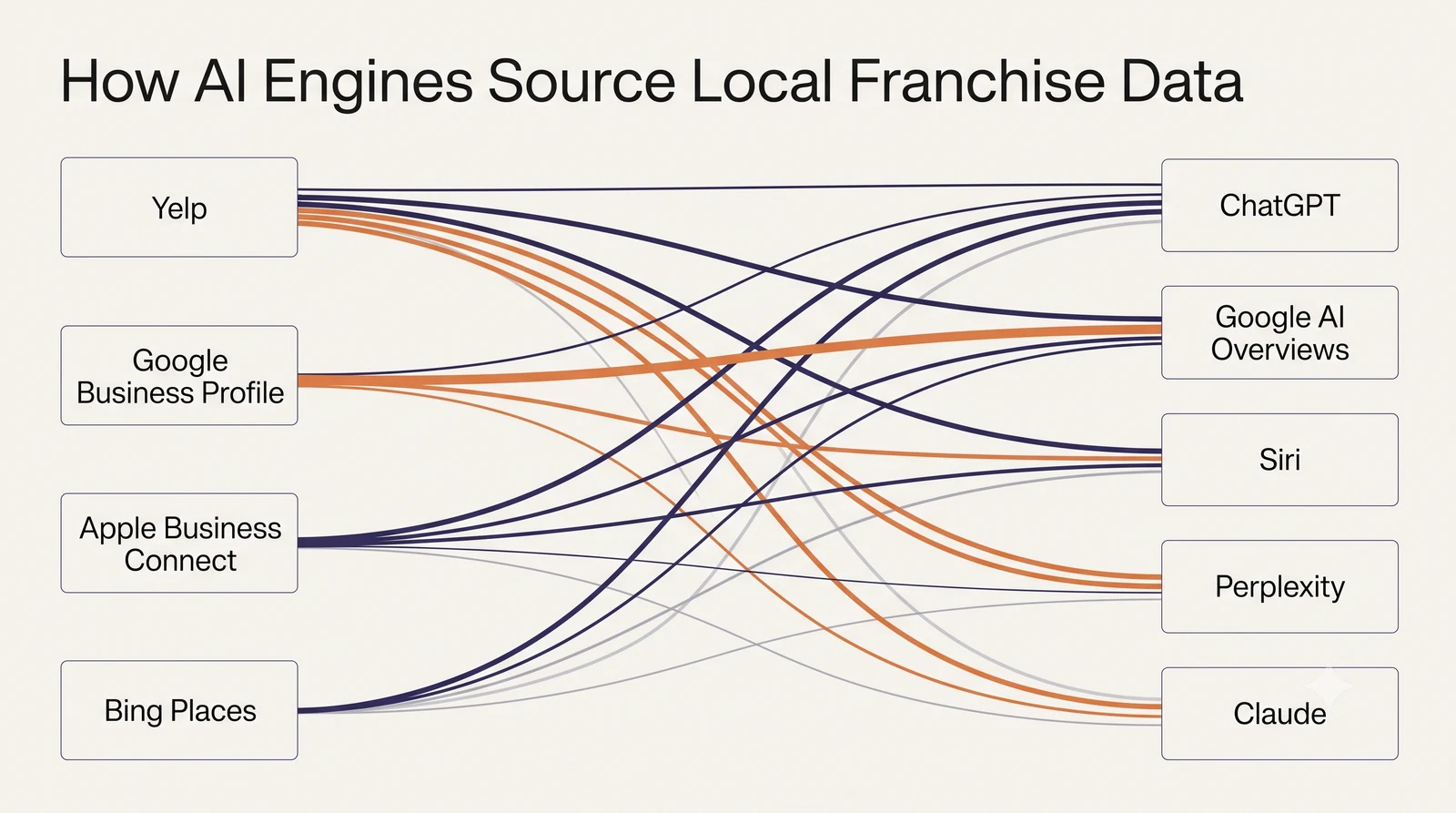
Which AI Engines Get Their Local Data From Where
The most critical unlock for franchise marketers in 2026 is understanding the data supply chain — which upstream source feeds which AI engine’s local answer. That’s what determines where you invest.
ChatGPT ← Yelp + Bing Local
OpenAI has a documented integration with Yelp that pipes per-location business data — hours, ratings, aggregate review sentiment, category tags, price band — into ChatGPT’s answer surface for local queries. For franchise categories like:
- Restaurants and QSR
- Salons, barbershops, med-spas
- Gyms and fitness studios
- Home services (HVAC, plumbing, cleaning)
- Auto dealerships and service centers
- Hotels and lodging
…Yelp’s per-location listing is now feeding ChatGPT. A franchise unit with a weak Yelp presence — no photos, low review count, unclaimed listing, outdated hours — gets systematically deprioritized in the AI answer even if the unit is operationally excellent.
ChatGPT also pulls from Bing’s local index (via the Bing web search that backs ChatGPT’s browsing). That means Bing Places accuracy quietly matters again in 2026 — not because Bing Search itself moves volume, but because the Bing local index feeds a large share of ChatGPT answers.
Google AI Overviews + Gemini ← Google Business Profile + Google Maps
Google AI Overviews (the AI answer at the top of Google Search results) is generated by Gemini models running on top of the Google local ecosystem:
- Google Business Profile completeness — hours, categories, attributes, services list
- Google Maps reviews — recency-weighted, keyword-analyzed for sentiment
- Google local index — location page content, structured data, backlink signals
- Merchant Center data — for franchise categories with products (auto parts, retail)
For any franchise brand that has ever thought “we can deprioritize Google Business Profile” — that’s now impossible. GBP is the single largest input to Google’s AI answers about your locations. If your GBP is incomplete for even 15% of units, that’s 15% of your locations dark inside Google’s AI answer surface.
Siri + Apple Intelligence ← ChatGPT + Apple Maps
Siri in 2026 runs on Apple Intelligence, which routes complex queries out to third-party models. The ChatGPT integration is the live default for extended reasoning — meaning voice queries to Siri that need synthesis often traverse ChatGPT’s answer surface (with Apple Maps and Apple Business Connect providing the local overlay).
There has been ongoing reporting about a Siri × Gemini partnership giving Siri access to Gemini for certain query types — we’ve tracked that story in our Siri × Gemini deal breakdown. Regardless of which model Siri routes to for a given query, the local data surface is the same: Apple Business Connect listings plus Apple Maps data, layered on top of the model’s own retrieval.
Franchise marketers who have never claimed their Apple Business Connect listings are already losing Siri voice queries in 2026. That’s a hard number for QSR, retail, and services franchises where voice search share is now double-digit.
Perplexity ← Web index + heavy citation
Perplexity blends its own web crawl with structured local data and cites every source visibly. For franchise queries this means:
- Your location pages need to be crawlable, structured, and cite-worthy
- Yelp and TripAdvisor pages for each unit surface as citations
- Local news mentions of the franchise get weighted heavily
- Blog reviews and comparison content citing specific units become source authority
Because Perplexity cites visibly, there’s an unusual upside for franchises: a well-optimized location page can become the cited source — driving actual referral traffic on top of the brand exposure. That’s rare in AI search; most citations are invisible.
Claude ← Web search via Brave and providers
Claude uses web search via multiple providers, with Brave documented as a source in citation footers. Claude tends to be more conservative on local recommendations than ChatGPT or Gemini — it will often list several franchise options with disclaimers rather than picking one — but when it does surface a specific location, it draws from:
- Structured location page content
- Review snapshots (with disclaimers about recency)
- Third-party comparison content
- The franchise’s own owned content if well-structured
Claude’s smaller local search share doesn’t make it optional. For research-heavy franchise categories — financial services, healthcare, legal, education — Claude’s usage skews high among decision-makers who spend on longer-consideration purchases.
The Sentiment Problem: How One Bad Location Poisons a Whole Brand
Here’s the failure mode that catches franchise brand teams off guard.
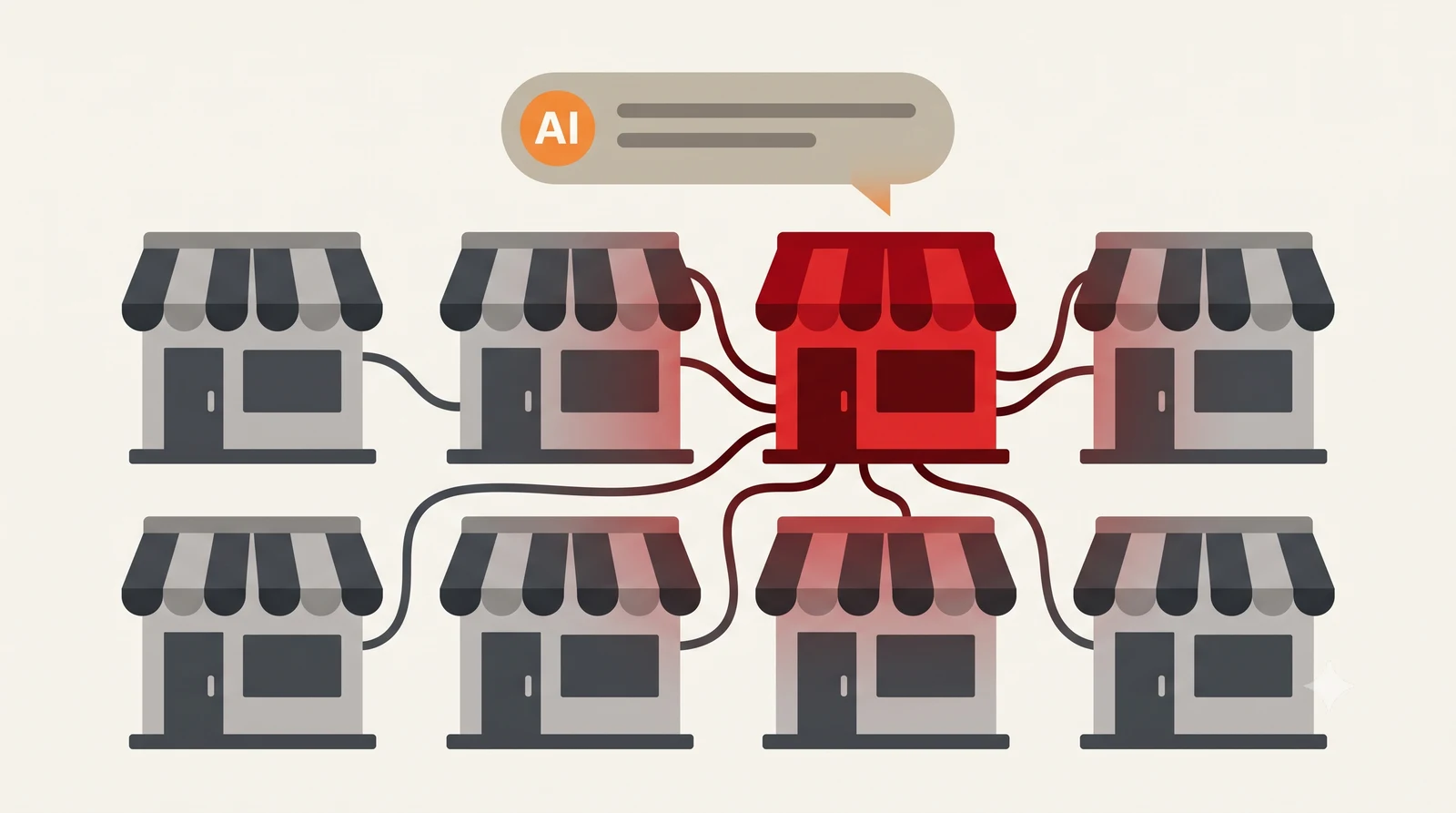
AI models don’t cleanly separate location-specific sentiment from brand-level sentiment. When a user asks “is [franchise brand] worth going to?” — a brand-generic prompt with no location — the AI engine pulls sentiment signals from across all units. A cluster of persistent negative reviews at three underperforming units can materially shape the answer the model returns for every user, in every city, for the entire brand.
This is the sentiment inheritance problem, and it has three levers:
Lever 1 — Per-location sentiment tracking. You cannot fix what you cannot see. Franchise brands need per-location AI-visibility monitoring that scores sentiment separately for each unit and for the brand-generic prompt set. When you spot brand-generic sentiment drifting negative faster than any single unit’s sentiment, you know the underperformer cluster is bleeding through. See our prompt monitoring deep-dive for the measurement stack.
Lever 2 — Location-specific structured content. The more distinct content each location page has — real photos, unit-specific FAQs, staff profiles, in-store services, upcoming events, community involvement — the more the AI model has to pull location-specific context rather than falling back on brand-generic summaries. Thin, templated location pages force the model back to the review aggregate. Rich location pages give the model an alternative narrative.
Lever 3 — Review-recency governance. Every major AI answer surface weights recent reviews heavily. A coordinated effort to generate fresh, honest, positive reviews at underperforming units — via post-service email/SMS nudges, in-unit QR flows, and staff training — will dilute old negative sentiment faster than any content or schema play. The half-life of a bad review’s AI-sentiment impact in 2026 is roughly 90 days if newer reviews are added; roughly forever if they’re not.
The Local AEO Stack for Franchise Brands
Answer Engine Optimization is the practice of structuring content so answer engines surface your brand as the answer. For franchises, Local AEO extends this to every location. The stack has seven pieces.
1. LocalBusiness Schema Per Location
Every location page needs LocalBusiness schema (or a more specific subtype: Restaurant, AutoRepair, HomeAndConstructionBusiness, HealthAndBeautyBusiness, LodgingBusiness, FinancialService). The required fields:
name— brand + location identifier (“Sanbi Pizza — Downtown Austin”)address— fullstreetAddress,addressLocality,addressRegion,postalCode,addressCountrytelephonegeo—latitude,longitudeopeningHoursSpecification— day-by-daypriceRangeimage— at least one location-specific photo URLurl— canonical location page URLsameAs— array linking to the unit’s Yelp, Google Business Profile, Facebook, Apple Business Connect, TripAdvisor, and any other authoritative profileaggregateRating— withratingValueandreviewCountfrom your review platform- A
reviewarray of the most recent 3–10 dated reviews withauthoranddatePublished
AI models parse this structured data directly. A missing or incomplete LocalBusiness block is the single biggest reason franchise units get skipped in AI answers.
2. FAQ Schema on Every Location Page
FAQPage schema for the top 5–8 real questions asked about that location:
- Hours (especially holiday hours)
- Parking / accessibility
- Reservations / appointments
- Popular services or menu items
- Location-specific policies
Direct-answer format. AI engines extract these near-verbatim.
3. Complete GBP + Yelp + Apple Business Connect
For each unit:
- Google Business Profile — verified, complete, current photos, up-to-date hours, services list, attributes
- Yelp — claimed, complete, current photos, category tags accurate
- Apple Business Connect — claimed, complete, current
- Bing Places — claimed, at minimum
Every one of these feeds a different AI engine (see the data supply chain above). Skipping any of them dark-holes a piece of your AI answer surface.
4. NAP Consistency Across Every Data Source
Name, address, phone — identical spelling, identical formatting, across every location page, every third-party profile, every directory citation. Inconsistency confuses the retrieval layer of every AI engine. Automated NAP monitoring is now standard for any franchise brand over 25 units.
5. Review Governance
- Automated post-service review generation flow at every unit
- Response protocol for negative reviews within 48 hours
- Per-unit review sentiment monitoring
- Flag units where sentiment drops below a threshold for operations intervention
6. Direct-Answer Content in Location-Page Copy
Each location page should lead with direct-answer paragraphs matching real buyer question phrasing. “What time does [brand] on [street] open on Sundays?” should be answered in a scannable, extractable paragraph — not buried behind a hours widget the AI can’t parse.
7. Citable Location-Specific Statistics
If your Austin unit has served 40,000 customers since opening, or your Portland unit has won three local best-of awards, put those numbers on the page with the source cited. AI models cite statistics disproportionately. Location-specific stats become AI-cited signals.
Our full AEO 2026 guide covers the underlying tactical framework in more depth; this section is the franchise-specific layer.
Multi-Unit Content Strategy: Templated but Not Thin
The classic franchise mistake: 400 location pages that are 95% identical, with only the address swapped. AI models detect this pattern and collapse them into a brand-generic answer, losing per-location distinctiveness.
The 2026 template-but-not-thin approach:
- Global brand section — 30% of the page, consistent across every location
- Location-specific section — 70% of the page, unique per unit:
- Real photos of that unit (not stock)
- Staff intro (manager, chef, key roles)
- Location-specific services, menu items, packages
- Community involvement (sponsorships, local events)
- Location-specific FAQ (parking, closest transit, accessibility)
- Recent reviews with
datePublished - Unit-specific stats and awards
- Neighborhood context (what’s nearby, why this location exists)
That structural distinctiveness is what makes AI engines confidently cite the unit rather than falling back to the brand-generic summary.
How Franchise Marketers Should Measure AI Visibility Per Location
You cannot manage what you cannot measure. The measurement stack for franchise AI visibility:
Per-location prompt sets. For each unit, build a fixed 15–25 prompt set combining:
- Location-generic (“best pizza in Austin”)
- Location + brand (“is [brand] on Congress worth it”)
- Voice-query phrasing (“hey Siri, what time does [brand] downtown close”)
- Comparison (“[brand] vs [local competitor]”)
- Service-specific (“[brand] gluten free options in [neighborhood]”)
Scheduled multi-engine tracking. Run the prompt set weekly against ChatGPT, Gemini, Perplexity, Claude, and Google AI Overviews. Record:
- Citation frequency per unit
- Share of voice vs local competitors
- Sentiment per unit
- Sources cited (which of Yelp, GBP, your own page, etc.)
Per-location dashboards. Aggregate to a map view so brand marketing can see at a glance which units win in AI search and which lose. Sanbi.ai’s Geographic Dominance feature (Professional plan) is purpose-built for this — per-location AI citation tracking with a map view across US, EU, APAC, and China/Taiwan. Full mechanics in how to measure AI visibility.
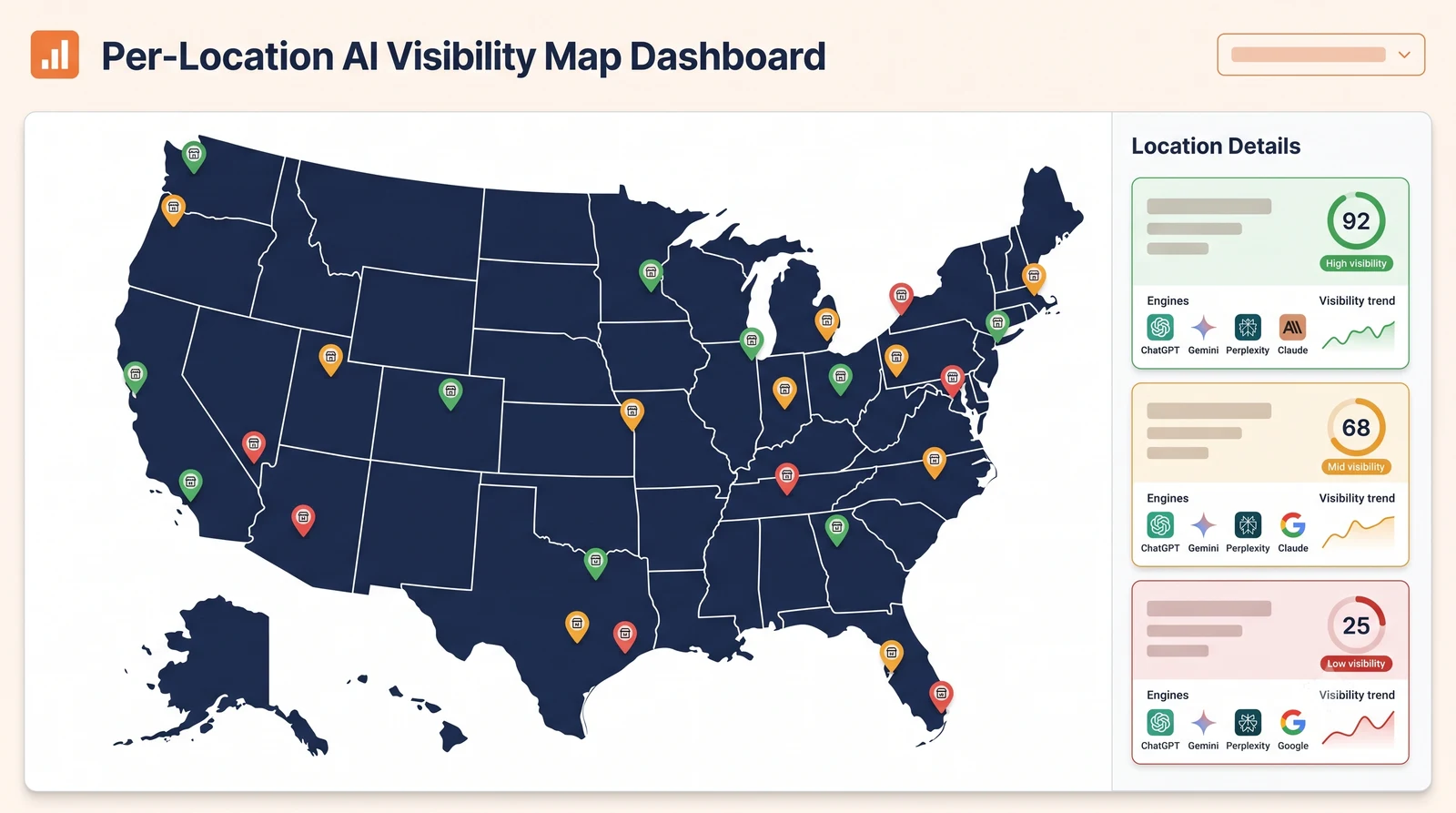
Alert on exceptions. At scale (500+ units) you don’t hand-review each unit. Set thresholds and alert only when a unit’s citation frequency drops >20%, sentiment turns negative, or a local competitor’s SoV crosses your unit’s SoV.
Reddit Is a Franchise AI Search Signal (Track It Both Ways)
Reddit deserves its own section because it plays two roles in franchise AI search that most brand marketing teams underweight in 2026.
Role 1 — Reddit Is a Top-Cited Source for Franchise Recommendation Queries
When users ask ChatGPT, Perplexity, Google AI Overviews, or Claude a recommendation or evaluation prompt about a franchise category, Reddit threads are one of the top source domains being cited. Prompts like:
- “best breakfast chain for kids in [city]”
- “is [franchise] worth going to”
- “which [franchise category] location has the best service in [neighborhood]”
- “[brand A] vs [brand B] — which is actually better?”
…pull heavily from Reddit consensus. A r/food, r/AskCulinary, r/nyc, or r/localbusiness thread with 40 comments discussing your franchise unit becomes source material for the AI’s answer — sometimes visibly cited (Perplexity, Google AI Overviews), sometimes woven in without attribution (ChatGPT).
Practical implication: Reddit sentiment about your franchise brand is now marketing infrastructure, not community management. Monitor it, engage authentically where subreddit rules permit, and address the operational root causes of negative threads rather than trying to suppress them (which resists Reddit’s culture and usually backfires).
Role 2 — Reddit Is the Best Public Source for Real Buyer Prompts
The prompts your buyers actually ask AI models about franchise categories aren’t in a keyword planner. They’re in Reddit threads — with the natural, conversational, modifier-heavy phrasing real buyers use.
The four-step Reddit prompt-mining process for franchise brands:
- Search
site:reddit.com [category] recommendationsandsite:reddit.com best [category] in [city]for your category - Extract the exact question phrasings, including modifiers (“good service”, “not overpriced”, “worth it”, “compared to X”, “with kids”, “late night”)
- Load the top 20–30 phrasings into your prompt monitoring platform to track weekly across ChatGPT, Gemini, Perplexity, Claude, and Google AI Overviews
- Re-mine monthly to catch emerging query patterns before competitors do
Our prompt monitoring guide covers the mechanics of turning mined Reddit prompts into a running per-location AI visibility program — that pattern applied per-franchise-unit is the core of a serious 2026 program.
Subreddits Franchise Marketers Should Monitor Weekly
Universal (all franchise categories):
- r/marketing, r/BigSEO, r/SEO, r/LocalSEO, r/smallbusiness, r/franchise, r/entrepreneur
Category-specific examples:
- QSR / restaurants — r/food, r/AskCulinary, r/restaurantowners, r/KitchenConfidential
- Home services — r/homeowners, r/HomeImprovement, r/Plumbing, r/HVAC
- Fitness — r/fitness, r/xxfitness, r/orangetheory (brand-specific)
- Beauty / salon — r/beauty, r/SkincareAddiction, r/curlyhair
- Auto — r/cars, r/MechanicAdvice, r/AskCarSales
- Location subs — r/nyc, r/LosAngeles, r/austin, r/chicago, r/toronto, r/melbourne
Location subreddits especially are gold — they surface the exact “best [category] in [city]” questions AI models get asked and cite Reddit answers for. Franchise brand teams that aren’t monitoring their top 10 city subs are flying blind on a signal their competitors’ AI answers are being built from.
The 30-Day Franchise AI Search Rollout
Week 1 — Audit.
- Baseline every unit’s Google Business Profile, Yelp, and Apple Business Connect completeness
- Baseline every location page for LocalBusiness schema, FAQ schema, and unique content ratio
- Run the initial per-location AI visibility scan across ChatGPT, Gemini, Perplexity, Claude, and Google AI Overviews
- Mine Reddit for the top 30 real-buyer prompts in your category and top 10 city subs — this is your prompt set for weekly tracking
Week 2 — Fix the foundation.
- Complete all missing GBP / Yelp / Apple Business Connect listings
- Deploy LocalBusiness schema to every location page (via a single templated schema block sourced from a canonical location database)
- Deploy FAQ schema to every location page with unit-specific questions
Week 3 — Fix the content.
- Add real location-specific photos, staff, and content to every unit page
- Deploy the direct-answer copy pattern to every location page hero
- Kick off the review-generation flow at underperforming units
Week 4 — Wire the measurement loop.
- Set up scheduled per-location tracking across all five AI engines
- Deploy the exception-alert thresholds for sentiment, citation frequency, and competitive SoV
- Brief the franchisee network on the dashboards they’ll be accountable for
Repeat monthly. First AI-answer improvements typically show in 6–10 weeks.
The Bottom Line for Franchise Marketers
The AI search era rewards franchise brands that treat every unit as its own AI visibility target, not as a variant of the national brand. The winners:
- Fund the boring foundation — GBP, Yelp, Apple Business Connect, LocalBusiness schema — at 100% coverage
- Track sentiment and citations per unit, not just at the brand level
- Give AI engines rich, unit-specific content to cite so the brand-generic summary doesn’t dominate
- Alert on outliers so the brand team fixes underperformers before they poison the whole brand’s AI-answer surface
- Measure AI visibility on the same cadence they measure blue-link SEO — because AI is now the discovery layer
Start your per-location AI visibility baseline this week with Sanbi.ai — run location-aware prompts across ChatGPT, Gemini, Perplexity, Claude, and Google AI Overviews, see exactly which of your franchise units win in AI search today, and get the prioritized playbook to fix the ones that don’t.
Frequently Asked Questions
AI search engines return different answers for each franchise location because they pull local data from different sources — ChatGPT pulls heavily from Yelp and Bing local, Google AI Overviews and Gemini pull from Google Business Profile and Google Maps, Perplexity blends web-index results with structured local data, and Claude uses web search via Brave and other providers. Each source has its own review corpus, its own NAP (name/address/phone) data, and its own last-crawled timestamp per location — so the same prompt asked in two different cities returns two different franchise units, with different sentiment and different citations. For franchise and multi-unit brands, that means a national AI visibility score is meaningless — you need per-location tracking.
Yes. OpenAI has an integration with Yelp that lets ChatGPT surface local business data — hours, ratings, review sentiment, and category information — when users ask for local recommendations. That means for franchise categories like restaurants, salons, gyms, home services, and dealerships, Yelp's per-location rating and review corpus directly shapes the answer ChatGPT gives. A single franchise unit with a bad Yelp rating gets excluded; a unit with strong Yelp presence gets recommended by name. This is why franchise brand teams cannot ignore Yelp even in 2026 — it's now feeding ChatGPT, not just serving as a review destination.
Google AI Overviews (the AI-generated summaries at the top of Google Search) and Google Search generally run on Gemini as the underlying model. Local Google AI answers pull heavily from Google Business Profile, Google Maps reviews, and the Google local index. Siri, as of 2026, integrates with Apple Intelligence, which routes complex queries out to third-party models — the ChatGPT integration is the live default, and there have been ongoing reports about a Siri × Gemini partnership giving Siri access to Gemini for certain query types. For franchise marketers the practical takeaway is the same: strong Google Business Profile completeness plus consistent NAP data across the Google ecosystem now powers both Google AI Overviews and, indirectly through Apple's model routing, the answers Siri returns.
Perplexity handles local business queries by blending its own web-index retrieval with third-party structured local data and heavy source citation — every claim in a Perplexity answer typically includes the source URL. For franchise queries, that means Perplexity leans on your location pages, Yelp/TripAdvisor listings, local news mentions, and blog reviews. Two implications: (1) each franchise unit's location page needs to be crawlable, cite-worthy, and structured with LocalBusiness schema; (2) unlike ChatGPT where the citation is hidden, Perplexity's visible citations mean the source domain matters — a well-optimized location page can become the cited source, driving referral traffic on top of the brand exposure.
Claude uses web search via multiple providers (Brave search is a documented source in Claude's citation footer) to answer local business queries. Claude tends to be more conservative than ChatGPT or Gemini on local recommendations — it will often decline to pick a single best option in a category and instead list several with disclaimers — but when it does cite specific franchise locations, it pulls from web content, structured data, and review snapshots. For franchises, the same fundamentals apply: cleanly structured location pages with LocalBusiness schema, review data surfaced in a machine-readable way, and consistent NAP across the crawlable web.
The sentiment problem is: one franchise unit with a cluster of bad reviews can poison the way AI engines describe the entire brand. When ChatGPT, Gemini, or Perplexity summarize a franchise, they don't always separate location-specific sentiment from brand sentiment — a persistent complaint pattern at three underperforming units can show up in a generic 'is X franchise worth visiting' answer that reflects on all 400 units. This is why franchise AI visibility programs need per-location sentiment tracking, not just brand-level tracking, and why review governance for underperforming units is now a marketing priority, not just an operations one.
Local AEO (Answer Engine Optimization) is the discipline of structuring every franchise location's web presence so answer engines — ChatGPT, Gemini, Perplexity, Claude, Google AI Overviews, Siri — surface that specific location as the answer to local buyer queries. The Local AEO stack includes: LocalBusiness schema markup per location, FAQ schema on every location page, complete Google Business Profile + Yelp + Apple Business Connect listings, NAP consistency across every data source, review governance, direct-answer content matching voice-query phrasing, and citable statistics tied to the location. Franchise brands need Local AEO in 2026 because AI answer surfaces have overtaken 10-blue-links as the discovery layer for local search — see our [complete AEO guide](/blog/answer-engine-optimization-aeo-guide-2026) for the underlying framework.
Every franchise location page needs LocalBusiness (or a more specific subtype like Restaurant, HomeAndConstructionBusiness, AutoRepair, HealthAndBeautyBusiness) schema markup with: name (brand + location), address (streetAddress, addressLocality, addressRegion, postalCode, addressCountry), telephone, geo (latitude, longitude), openingHoursSpecification, priceRange, image, url, sameAs (linking to that location's Yelp, Google Business Profile, Facebook, Apple Business Connect, TripAdvisor), aggregateRating (rating + reviewCount pulled from your review platform), and — critically — a review array with dated reviews. Add FAQ schema for the top 5–8 questions asked about that location (hours, parking, reservations, accessibility). AI models parse this structured data directly.
You measure AI visibility per franchise location by running location-aware prompts — 'best pizza in [city]', 'is [brand] [location] worth visiting', '[brand] hours in [neighborhood]' — against ChatGPT, Gemini, Perplexity, Claude, and Google AI Overviews on a scheduled cadence, then scoring per-location citation frequency, sentiment, and share of voice against local competitors. Sanbi.ai's Geographic Dominance feature (Professional plan) plots this per-location on a map view so franchise brand teams can see at a glance which units win in AI search, which lose, and which competitors are being surfaced instead. Full mechanics in our [location-based AI visibility research](/blog/ai-answers-change-by-location-geographic-dominance).
Franchise brands prevent one bad location from poisoning brand-level AI answers with three tactics: (1) per-location sentiment monitoring — track the sentiment AI models attach to each unit separately, so you catch a poisoned unit before it bleeds into brand-generic prompts; (2) location-specific structured content — make each unit's page rich enough that AI models pull location-specific context rather than falling back to brand-generic summaries; (3) review-recency governance — the AI engines weight recent reviews heavily, so a coordinated effort to generate fresh positive reviews at underperforming units diluts old negative sentiment fastest. Combine with per-location citation tracking to close the loop.
Traditional franchise local SEO optimized for ranking in Google's local pack, Google Maps, and organic blue links per location. Franchise Local AEO extends that discipline to also win the AI-generated answer inside ChatGPT, Gemini, Perplexity, Claude, Google AI Overviews, and voice assistants. The technical foundation overlaps (LocalBusiness schema, NAP consistency, review management, location page structure) but the winning content format shifts toward direct-answer prose, FAQ schema, and citable location-specific statistics. Most franchise brands need both layers in 2026 — SEO for blue-link discovery, AEO for AI-answer discovery — on the same location pages.
For franchise categories the priority order in 2026 is: (1) Google AI Overviews + Google Business Profile — still the largest local discovery surface for restaurants, home services, auto, and health/beauty; (2) ChatGPT — via its Yelp integration, dominant for restaurants, salons, and consumer-facing franchises; (3) Siri via Apple Intelligence — dominant for driving directions, hours, and 'call me the nearest' voice queries; (4) Perplexity — growing fast for research-heavy franchise categories (financial services, healthcare, legal); (5) Claude — smaller local share but strong for detailed comparison and multi-location research. A serious franchise AI visibility program tracks all five.
The foundations don't change — every location still needs LocalBusiness schema, complete Google Business Profile, Yelp presence, NAP consistency, and per-location tracking. What changes is the operating model: at 50 units a small brand marketing team can hand-audit each location's AI visibility monthly; at 500+ units you need automation — templated location pages generated from a single source of truth, bulk schema deployment, and a per-location AI visibility platform that surfaces exceptions rather than requiring manual per-unit review; at 2,000+ units the operating model shifts again to franchisee self-service dashboards, alerting only on outlier sentiment or citation loss, and centralized brand-consistency guardrails on the AI-answer surface.
Reddit matters twice over for franchise AI visibility. First, Reddit threads are one of the most heavily-cited source domains for ChatGPT, Perplexity, and Google AI Overviews when users ask recommendation prompts — 'best breakfast chain', 'is [franchise] worth going to', 'which [category] location has good service in [city]'. When a Reddit thread mentions a franchise unit positively or negatively, that sentiment often ends up quoted directly in the AI answer. Second, Reddit is the richest public source of the exact prompts real buyers ask AI models — mining r/AskReddit, r/personalfinance, r/LosAngeles, r/food, and franchise-specific subs gives franchise brand teams a prompt set grounded in real language rather than modeled keyword lists.
The subreddits franchise marketers should monitor depend on the franchise category. Universal picks: r/marketing, r/smallbusiness, r/franchise, r/localSEO, r/entrepreneur, r/SEO, r/BigSEO — where operators discuss AI visibility tactics. Category-specific: r/food, r/AskCulinary, r/restaurantowners (QSR/restaurants); r/homeowners, r/HomeImprovement (home services); r/fitness (gyms and fitness); r/beauty, r/SkincareAddiction (salons/beauty). Location subs (r/nyc, r/LosAngeles, r/austin, r/chicago) are gold for local-recommendation intent because they surface the exact 'best [category] in [city]' questions AI models get asked and cite Reddit answers for. Mine these weekly for the real prompts your buyers use.
The four-step process to mine Reddit for franchise-relevant AI prompts: (1) search 'site:reddit.com [your franchise category] recommendations' and 'site:reddit.com best [category] in [city]' to find the recommendation threads — these are near-verbatim what buyers ask ChatGPT and Google AI Overviews; (2) note the exact question phrasings, including modifiers like 'good service', 'not overpriced', 'worth it', 'compared to X'; (3) copy the top 20–30 phrasings into your prompt monitoring platform to track weekly across ChatGPT, Gemini, Perplexity, and Claude; (4) rerun the search monthly to catch emerging query patterns. Reddit is the leading edge — questions asked there today become the prompts AI models get asked at scale next quarter.
Yes — heavily. ChatGPT (and Perplexity, Google AI Overviews, and increasingly Claude) cite Reddit as one of their top source domains for recommendation and evaluation queries about local businesses and franchises. The behavior is most pronounced for prompts framed as opinions or comparisons: 'is [franchise] worth it', 'which [category] location has the best [feature]', '[brand A] vs [brand B] which is better'. When Reddit threads have visible consensus about a franchise unit, that consensus often shows up in the AI answer, sometimes with the Reddit thread visibly cited (Perplexity, Google AI Overviews) and sometimes woven in without attribution (ChatGPT). For franchise brand teams this makes Reddit sentiment monitoring a first-order marketing responsibility.
The correct response to a Reddit thread hurting your franchise AI visibility is not to try to remove it — Reddit resists removal requests and moderation attempts often backfire into new threads about the attempted removal. Instead: (1) address the underlying operational issue at the unit(s) named, so future reviews and threads reflect the fix; (2) engage authentically in the thread through official brand accounts where subreddit rules allow — a real, non-defensive response often shifts the sentiment of the thread and gets cited by AI models alongside the complaint; (3) generate genuine positive Reddit signal at the same units through customer-experience improvements that customers naturally share; (4) publish owned content — location pages, blog posts, comparison content — that gives AI models a well-structured alternative narrative to cite alongside the Reddit thread. AI models weight recency and multi-source consensus — a fresh, positive multi-source narrative dilutes a single Reddit thread over 60–90 days.
The most useful Reddit threads for franchise marketers learning AI search in 2026 sit across r/SEO, r/BigSEO, r/marketing, r/LocalSEO, r/artificial, and category-specific business subs. Search for threads with keywords: 'AI Overviews traffic drop', 'ChatGPT local recommendations', 'Yelp ChatGPT integration', 'Perplexity local search', 'franchise SEO 2026', 'multi-location AI visibility', 'AEO local business', 'geographic dominance AI search'. Sort by 'top of past year' for foundational context, then 'top of past month' for the current state of tactics. The Sanbi blog network (linked throughout this article) also curates the strongest patterns emerging from these threads into structured playbooks — see our [prompt monitoring guide](/blog/prompt-volume-llm-prompt-monitoring-reddit) and [AI visibility tools roundup](/blog/best-ai-visibility-tools-2026) for the current syntheses.