Going into 2026, You Are Marketing to AI, Not Humans
I was grabbing lunch with a colleague yesterday, and we were debating where to go.
Usually, this is the part where one of us pulls out Google Maps or Yelp and scrolls through a list of nearby spots.
But he didn’t do that.
He opened ChatGPT on his phone and spoke into it: “Find me a quiet spot for Italian food within a 10-minute walk that has good vegetarian options.”
In two seconds, the app didn’t just give him a list of links. It gave him a direct answer. It provided a specific recommendation, a summary of the reviews explaining why the vegetarian lasagna was good, and a map snippet.
We went there. The transaction was over before a search engine result page ever loaded.
The New Reality of Discovery
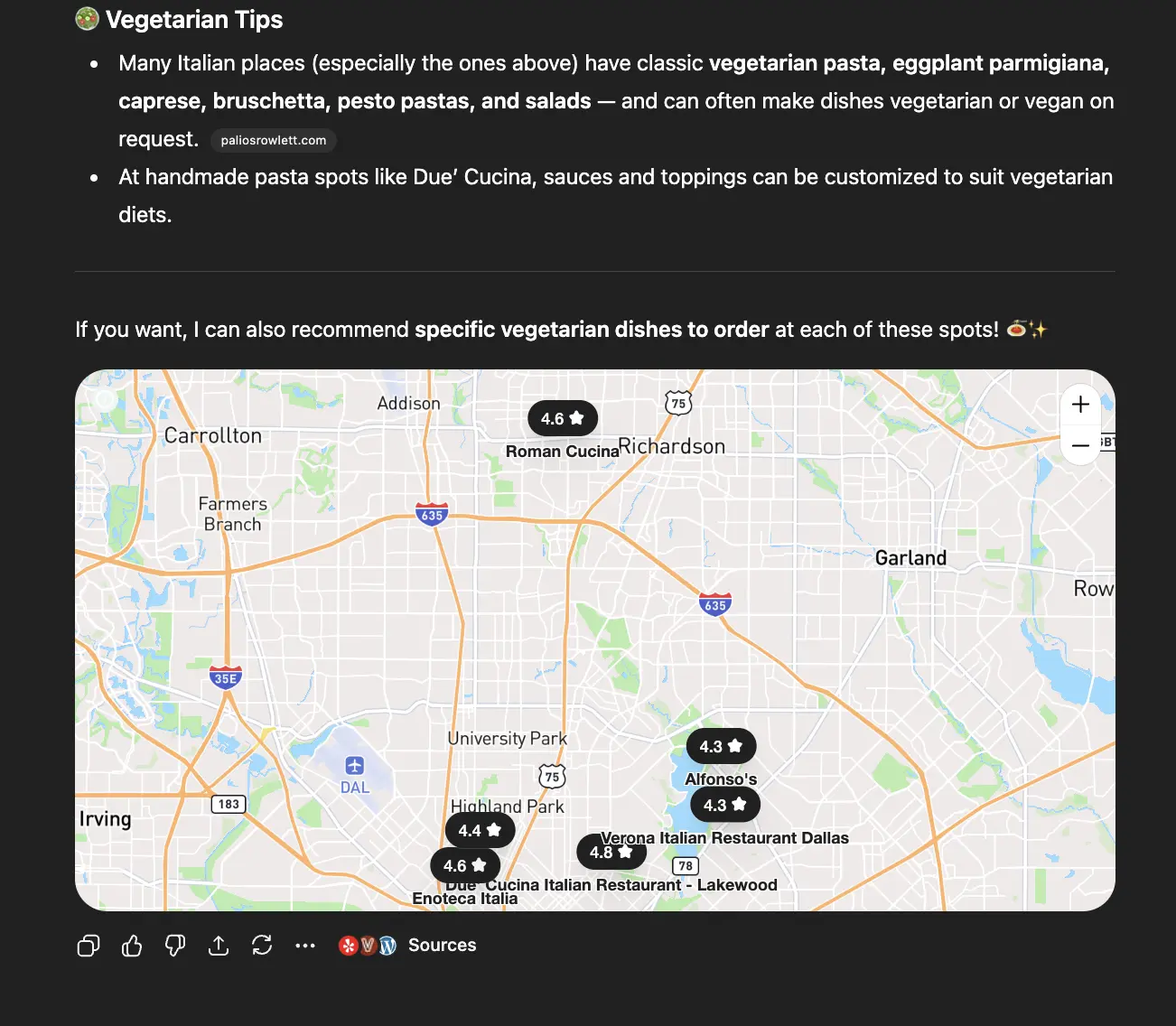
That restaurant didn’t just win a customer because they had good food. They won because the AI knew who they were, understood their menu, and trusted their reviews enough to synthesize that information into a recommendation.
This isn’t just happening with lunch. It is happening with B2B software, contractor services, and consultancy firms.
We are entering 2026 with a new reality: The “discovery layer” has shifted.
The Old Way: Optimizing for the Index
For the last 15 years, the gatekeeper was an algorithm that counted links and keywords. You optimized your content to be one of ten blue links on a page. You had to convince the algorithm you deserved to be on the list.
The New Way: Optimizing for the Inference
Today, the gatekeeper is a Large Language Model (LLM). It doesn’t just list options; it synthesizes answers. You have to convince the LLM that you are part of the answer.
If the AI doesn’t know who you are, what you do, and why you are trustworthy, it won’t cite you. You aren’t just ranked lower—you are invisible.
Entity Authority vs. Keyword Ranking
The human is still the buyer, but the AI is the new curator.
To survive this shift, you need to stop thinking about “ranking” and start thinking about Entity Authority.
- Keywords are strings of text you put on a page.
- Entities are concepts (People, Places, Organizations) that AI models understand as distinct objects with relationships.
If an AI cannot confidently explain what your business does (Entity), it will not recommend you (Authority). It requires “machine-readable” confidence to vouch for your brand in a generated response.
Don’t Be Excluded from the Conversation
If your brand hasn’t established this authority in the eyes of the Large Language Model, you are effectively opting out of the modern economy.
The companies that wait will be building “visibility debt,” spending years trying to teach AI models who they are, while early movers are already being cited as the default, authoritative answer.
It is time to start auditing how these models perceive your brand.
Get Your Free AI Visibility Check
Frequently Asked Questions
Traditional SEO optimizes for a list of blue links. AI optimization focuses on being the single, synthesized answer provided by models like ChatGPT and Gemini.
AI models rely on 'Entity Authority.' They need to understand who you are, what you offer, and see consistent validation across the web to confidently cite you in a conversational response.
A search engine indexes pages and retrieves links. An inference engine (AI) synthesizes vast amounts of data to generate a direct, conversational answer to a user's problem.
Entity Authority is the AI model's confidence that your business is a distinct, verified entity with defined attributes (services, location, expertise). Without it, the AI cannot confidently recommend you—you aren't ranked lower, you're completely invisible in generated responses.
Run unbranded queries on ChatGPT, Gemini, and Perplexity (e.g., 'Best [your service] in [your city]'). If you don't appear, your business likely lacks sufficient Entity Authority, structured data, or third-party validation for the AI to confidently cite you.
Visibility debt is the accumulated disadvantage businesses face by delaying AI optimization. While early movers build Entity Authority and become default AI recommendations, late adopters must spend years teaching AI models who they are—a gap that widens as competitors cement their positions.