
Your Brand Is Being Discussed in AI Right Now — Here's How to Track Every Mention
Right now, while you’re reading this, someone is asking ChatGPT whether your brand is worth evaluating. Someone else is asking Perplexity to compare you against your top three competitors. Another buyer is asking Claude to summarize what your product actually does.
In all three conversations, AI is constructing an answer about your brand — accurate or not, favorable or not, from a vendor citation or not.
Do you know what those answers say?
For most brands, the answer is no. And that gap — between what AI says about your brand and what you know about it — is the brand monitoring blind spot that matters most in 2026.
1. What AI Brand Mention Monitoring Actually Is
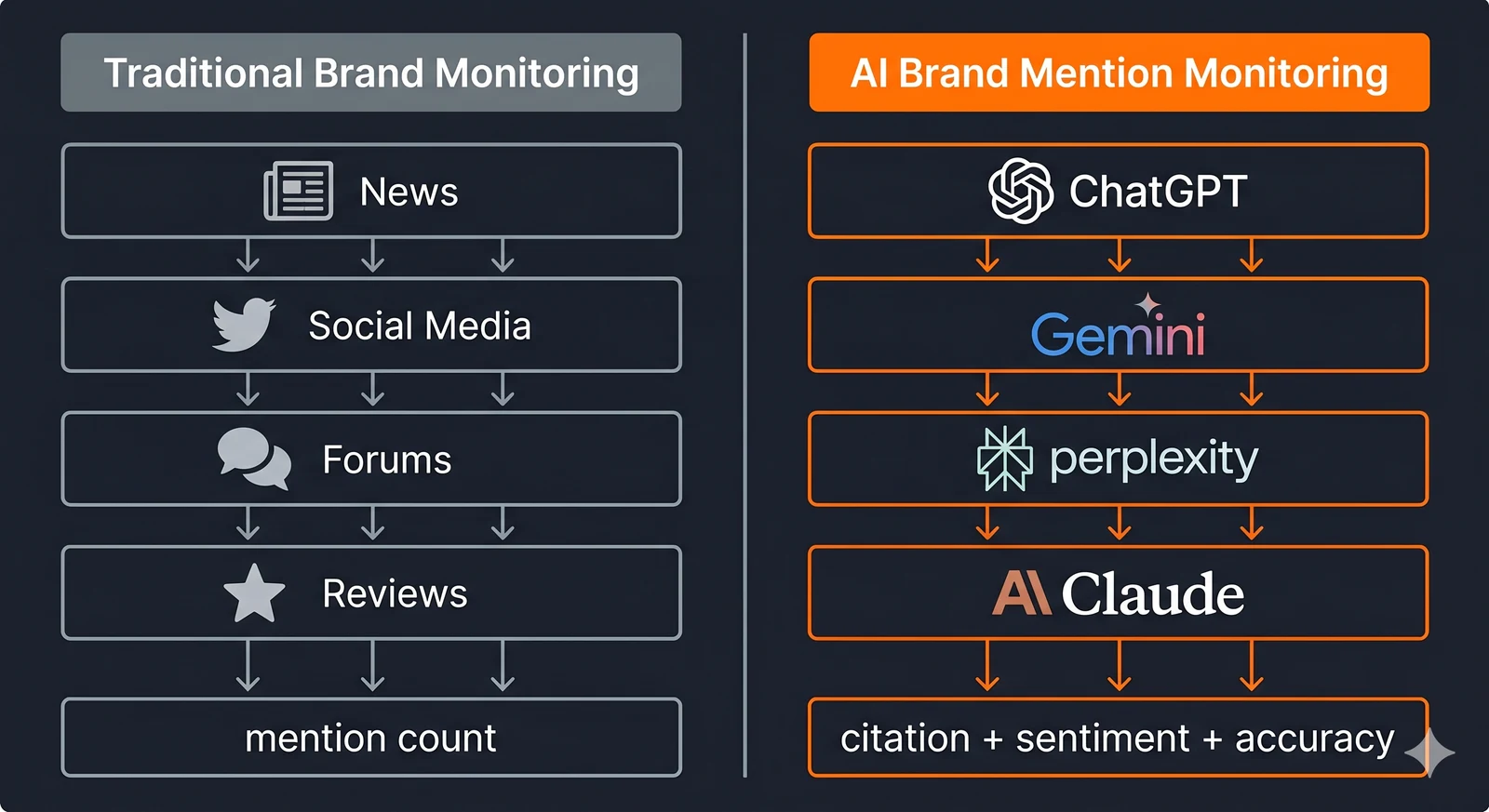
The gap between traditional and AI brand monitoring
Traditional brand monitoring tracks your brand across the published web: news articles, social media posts, Reddit threads, review platforms, forum discussions. These tools tell you where your brand has been mentioned and what was said.
AI brand mention monitoring is a different discipline. It tracks what AI models say about your brand when buyers ask — which is derived from published content but filtered through each model’s training, retrieval, and synthesis process. The AI version of your brand may diverge significantly from the published record: emphasizing outdated product features, conflating your pricing with a competitor’s, missing a recent product launch, or accurately synthesizing positive characteristics that have never received press coverage.
Both types of brand monitoring are necessary. They’re not interchangeable.
Why AI mentions matter more than traditional mentions for purchase decisions
When a buyer reads a news article mentioning your brand, they know it’s one journalist’s perspective. When a buyer asks ChatGPT “is Brand X worth evaluating,” the AI’s response carries the implicit authority of an aggregated, neutral synthesis. Buyers increasingly treat AI-generated characterizations of brands as more objective than any single piece of coverage.
This changes the stakes of brand mention monitoring. A negative characterization in one article is one data point. A negative characterization in ChatGPT’s response to “best tools for [your category]” is the default position for every buyer who asks that question.
Is it possible to monitor brand mentions in AI search?
Yes — and it’s no longer experimental. AI brand mention monitoring tools now run automated query sets against major AI platform APIs, parse responses for brand references, and track results over time. The infrastructure exists; the gap is awareness. Most brands haven’t set up AI brand monitoring because they don’t know it’s possible, not because the tools aren’t there.
Why this matters for brands: Measuring brand visibility in AI search is the brand safety and competitive intelligence infrastructure of the AI era. Just as brands learned to monitor social media when it became purchase-influential, they need to monitor AI models now.
2. What to Monitor: The Full AI Brand Tracking Framework
The five dimensions of AI brand visibility
A comprehensive AI brand monitoring program tracks five distinct dimensions:
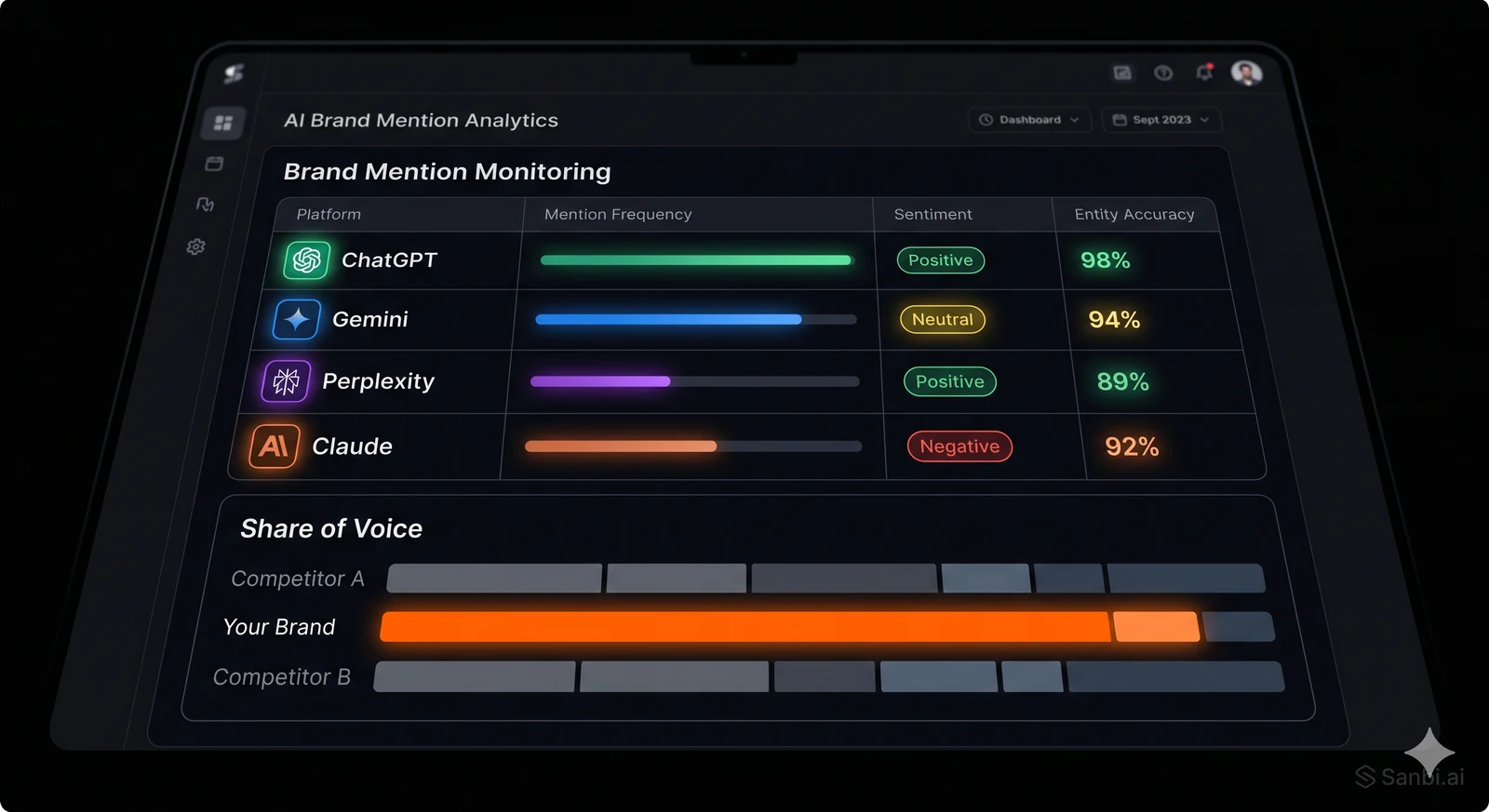
1. Mention frequency — How often does your brand appear in AI responses across your tracked query set? This is the headline metric. High mention frequency means AI models consistently surface your brand when buyers are researching your category.
2. Citation rate — How often is your domain URL explicitly cited as a source (vs. just named in text)? For platforms like Perplexity that show source panels, citation rate is the stronger signal — it means your content is being actively retrieved and used, not just recalled from training data.
3. Brand sentiment in AI — When AI models mention your brand, do they frame it positively (“a leading platform for X”), neutrally (“one option for X”), or negatively (“some users report issues with X”)? Sentiment is the dimension most brands neglect and most need to watch.
4. Entity accuracy — Are the facts AI models state about your brand correct? Incorrect pricing, outdated feature sets, wrong founding date, conflation with a competitor — entity inaccuracy in AI responses is a brand risk that traditional monitoring won’t surface.
5. Competitive share of voice — How does your mention frequency compare to competitors for the same query set? Share of voice is what converts mention frequency into a competitive signal.
Brand tracking metrics by platform
| Platform | Primary Citation Signal | Key Brand Metric |
|---|---|---|
| ChatGPT | Training data recall + browsing | Mention frequency in recommendations |
| Perplexity | Live URL citation | Citation rate + source position |
| Gemini | Google index integration | AIO citation + assistant mention |
| Claude | Training data recall | Category association accuracy |
| DeepSeek | Technical/APAC source mix | Mention in technical queries |
| Copilot | Bing index + Microsoft 365 | Enterprise research mentions |
Predictive AI alerts for brand mentions
The most advanced AI brand monitoring systems don’t just report current state — they alert you to early signals of change. Predictive AI alerts for brand mentions detect: a shift in sentiment before it appears in citation frequency data, a new competitor appearing in comparison citations alongside you, a change in which pages on your site are being cited, or a decline in mention rate for a specific query cluster. Early detection is what converts monitoring from a reporting function to a risk management function.
Why this matters for brands: AI brand tracking metrics are the new brand health KPIs. A brand that tracks sentiment, entity accuracy, and share of voice across AI platforms alongside traditional metrics has a complete picture of its brand position. One that only tracks traditional metrics is missing the layer that increasingly shapes buyer decisions.
3. Brand Mention Tracking Tools and Software
What AI brand mention tracking software actually does
The best AI brand mention tracking software does four things:
- Runs your query set automatically across multiple AI platforms on a defined cadence (daily or weekly)
- Parses responses for brand signals — name mentions, product references, domain citations, and competitor comparisons
- Applies sentiment analysis to the surrounding text when your brand is mentioned
- Stores results historically so you can track trends, not just snapshots
Brand mention software that only does one or two of these is a monitor, not a tracking system. The distinction matters: a monitor tells you what’s happening now; a tracking system tells you how things are changing and gives you the data to act.
The best AI brand visibility trackers in 2026
The best AI brand visibility trackers in 2026 combine multi-engine coverage, sentiment analysis, entity accuracy checking, and competitive benchmarking in a single platform. When evaluating brand mention monitoring tools:
- Multi-platform coverage: Does it track ChatGPT, Gemini, Perplexity, and Claude simultaneously, or only one?
- Query customization: Can you define the specific queries your buyers use, not just generic brand-name searches?
- Sentiment granularity: Does it score sentiment at the response level, or only flag positive/negative at a binary level?
- Competitive tracking: Can you run the same queries for competitor brands and compare?
- Alert configuration: Can you set up alerts when citation frequency or sentiment drops below a threshold?
- Reporting format: Can you generate shareable brand tracking reports for stakeholders?
ChatGPT brand monitoring software: what’s different
ChatGPT brand monitoring software faces a specific challenge: ChatGPT’s responses are non-deterministic (the same query can produce different responses on different runs) and, without browsing enabled, rely heavily on training data that has a knowledge cutoff. The best ChatGPT brand monitoring tools account for this by running each query multiple times, averaging results, and distinguishing between training-data-based responses and browsing-enabled responses. ChatGPT brand visibility tracking methods that treat every response as equally reliable without accounting for these factors produce noisy data.
Brand mention monitoring for Perplexity
Monitoring brand mentions in Perplexity has a structural advantage over ChatGPT monitoring: Perplexity shows its sources explicitly. A Perplexity brand mention monitor can track both whether your brand appears in the answer text AND whether your domain appears in the numbered citation panel — two separate and independently valuable signals. Track website mentions in Perplexity at the URL level to see which specific pages are driving citations, not just whether your domain appears.
Free brand monitoring tools for AI search
Free brand monitoring tools that cover AI search are limited in scope. Most free options offer either traditional brand monitoring (social/news) without AI coverage, or AI monitoring with very limited query caps. For initial AI brand visibility auditing without ongoing cost, a free AI visibility snapshot — like the audit available at sanbi.ai — provides a one-time baseline across the major AI platforms. Ongoing free AI brand monitoring at meaningful scale is not currently available from any major platform; the API costs of running queries across multiple AI engines create an inherent cost floor.
Why this matters for brands: The best AI brand visibility tracking tool for your team is the one that covers the platforms your specific buyers use and provides the competitive context to make the data actionable. Tracking brand mentions without competitive benchmarking produces interesting data; tracking them in competitive context produces decisions.
4. Monitoring Brand Mentions Across Every AI Platform
How to monitor brand mentions in ChatGPT
Monitoring brand mentions in ChatGPT requires a query set that covers three tiers:
- Brand-name queries: Direct questions about your brand (“What is [Brand X]?”, “Is [Brand X] good?”, “What do users say about [Brand X]?”)
- Category queries: Questions where your brand might or might not be recommended (“What are the best tools for [your category]?”, “What should I use for [specific problem]?”)
- Competitor comparison queries: Queries that put you in context (“[Brand X] vs. [Competitor Y]”, “[Competitor Y] alternatives”, “best [category] tools besides [Competitor Z]”)
All three tiers are needed. Brand-name query results tell you about entity accuracy and sentiment. Category query results tell you about category association and share of voice. Competitor comparison results tell you about relative positioning.
How to track brand mentions on Perplexity
To track brand mentions on Perplexity effectively, your monitoring approach needs to handle Perplexity’s live retrieval model: results can differ between runs because Perplexity is fetching current web content, not drawing from a static training corpus. Best practice is to run each tracked query multiple times per period and treat the aggregate as the signal, not any single run. Track both in-text brand mentions AND source panel citations — they represent different citation mechanisms and have different implications for content optimization.
How to analyse brand mentions in AI across platforms
How to analyse brand mentions in AI requires a cross-platform comparison framework. Running the same query set across ChatGPT, Gemini, Perplexity, and Claude and comparing results often reveals significant variance. The most useful analysis questions:
- Which platforms mention your brand most frequently for category queries?
- Which platforms describe your brand most accurately?
- On which platforms do competitors have a larger share of voice than you?
- Which query types produce the highest mention rates on each platform?
- Is your brand’s sentiment consistent across platforms, or does it vary significantly?
How to track brand mentions on LLMs vs. traditional channels
How to track brand mentions on LLM-based platforms differs from traditional brand monitoring in data collection (API-based query execution vs. web scraping or RSS monitoring), in time granularity (AI model responses change slowly via training updates; traditional mentions change in real time), and in the type of content being monitored (synthesized AI characterizations vs. individual human-authored mentions). A complete brand monitoring stack includes both layers — traditional brand mention monitoring software for web and social, and AI-specific brand monitoring for LLM citation coverage.
Why this matters for brands: How to track your brand’s mentions across AI is not a single tool question — it’s a workflow question. The brands that build systematic, multi-platform AI brand monitoring workflows in 2026 will have brand intelligence that competitors using only traditional monitoring won’t have access to.
5. AI Brand Sentiment: Beyond Mention Counts
Why brand sentiment in AI matters more than frequency
A brand that is mentioned in 80% of category queries with neutral-to-negative characterization is in a worse position than a brand mentioned in 40% of queries with consistently positive framing. Mention frequency without sentiment context is an incomplete metric. Measuring brand sentiment in AI-generated content is the layer that tells you not just whether AI mentions your brand, but whether those mentions help or hurt.
How AI brand sentiment differs from social sentiment
Social media sentiment analysis aggregates many individual human opinions. AI brand sentiment is a synthesized characterization — a single AI model’s representation of your brand based on its training and retrieval, presented to every buyer who asks the relevant query with equivalent authority. This means:
- A single negative AI brand characterization reaches every user asking that query, not just the subset who would have found a negative review organically
- AI brand sentiment is more stable (slower to change) than social sentiment, because it reflects training data curation and model updates
- Changing AI brand sentiment requires changing the underlying signals the model uses — training data breadth, entity authority, content quality — not just publishing positive responses
LLM brand sentiment monitoring
LLM brand sentiment monitoring tracks how large language models characterize your brand over time. A drop in brand sentiment on one platform but not others often signals a specific data quality issue — incorrect information in a source that one model trained on, a negative review that one model’s retrieval system is weighting heavily, or a competitor-authored content piece that one model is citing as authoritative.
LLM brand monitoring that includes sentiment analysis alongside citation frequency gives marketing teams the ability to triage: high frequency + positive sentiment is the goal; high frequency + negative sentiment is an active brand risk; low frequency + positive sentiment is a growth opportunity.
AI brand insights tool: what the data tells you
An AI brand insights tool surfaces the actionable layer from brand monitoring data. Beyond raw citation rates and sentiment scores, the best AI brand insights tools translate monitoring data into:
- Content priorities: Which query types have the lowest mention rates? Those are your content gaps.
- Entity correction opportunities: Where is AI misstating facts about your brand? Those are your entity optimization targets.
- Competitive vulnerability alerts: Where is a competitor being cited while you’re not? Those are your highest-priority AEO investments.
- Platform strategy recommendations: Where are you strong and where are you weak across the six major AI platforms? That map is your AI search investment allocation guide.
Why this matters for brands: AI brand sentiment analysis is not a vanity metric — it’s a brand risk management tool. The brands that track sentiment alongside frequency will catch negative AI characterizations before they compound. The brands that track frequency alone will notice the problem only when buyers start arriving with objections pre-seeded by AI-generated misinformation.
6. Building Your AI Brand Monitoring System
The AI brand monitoring stack
A complete AI brand monitoring system has four layers:
Layer 1 — Query definition: Build a query set covering brand-name, category, and competitor-comparison queries across your buyer’s research journey. Aim for 100–300 queries; start with 50 if you’re new to AI brand monitoring.
Layer 2 — Multi-platform tracking: Run your query set against ChatGPT, Gemini, Perplexity, and Claude (at minimum) on a weekly cadence. Store results for trend analysis.
Layer 3 — Sentiment and entity analysis: Parse every brand mention in the results for sentiment and entity accuracy. Flag discrepancies between what AI says and what’s true about your brand.
Layer 4 — Competitive benchmarking: Run the same query set for top three competitors. Compare citation rates, sentiment, and share of voice across all platforms.
Brand tracking reports for stakeholders
Brand tracking reports for AI brand monitoring need to translate citation data into business language for stakeholders who don’t follow AI search developments. The most effective brand tracking report format includes: an executive summary (your AI brand visibility score vs. last period, vs. competitors), a platform breakdown (where you’re strong and where you’re weak), a sentiment overview (positive/neutral/negative ratio, flagging any significant sentiment shifts), and a content recommendation list (the three highest-priority actions to improve citation frequency or sentiment in the next period).
When to work with brand tracking agencies
Brand tracking agencies that have evolved to cover AI brand monitoring are the right partner for brands that need enterprise-scale query management, multi-language monitoring, or integration of AI brand visibility data with broader brand health measurement. AI-specialized brand tracking agencies add value through proprietary query libraries, established benchmarking data across industries, and the ability to contextualize your AI visibility scores against category norms. Self-service platforms like Sanbi.ai are the right starting point for most brands — AI brand monitoring agencies become the right call when query volumes, stakeholder reporting requirements, or multi-market complexity exceed what an in-house team can manage.
Your Next Step
AI models are characterizing your brand for buyers right now. Whether those characterizations are accurate, favorable, and frequent enough to drive consideration is something you can measure — but only if you build the system to measure it.
Run a free AI visibility audit at sanbi.ai to see how your brand is mentioned, cited, and characterized across ChatGPT, Gemini, Perplexity, and Claude — with sentiment scores, entity accuracy checks, and a competitive share-of-voice comparison to show exactly where you stand.
Sanbi.ai monitors your brand’s AI visibility daily across ChatGPT, Gemini, Perplexity, and Claude — tracking visibility scores, sentiment, citations, agent accessibility, and competitor movements so you always know where you stand in the agent-first web.
Frequently Asked Questions
Brand mention monitoring in AI search is the practice of systematically tracking how, how often, and how accurately your brand is mentioned across AI-generated responses from platforms like ChatGPT, Gemini, Perplexity, Claude, DeepSeek, and Copilot. Unlike traditional brand monitoring (which tracks mentions in news, social media, and web content), AI brand mention monitoring tracks what AI models say about your brand when buyers ask questions — a fundamentally different and increasingly more influential signal. A brand can be invisible in AI conversations despite strong traditional brand monitoring metrics, and vice versa.
Monitoring brand mentions in AI search at scale requires an automated tool that runs a defined query set against multiple AI platforms, parses the generated responses for brand name mentions, domain citations, product references, and sentiment signals, and stores results over time for trend analysis. Manual monitoring — running queries yourself — only works for very small query sets and doesn't capture the breadth of queries where your brand may or may not appear. AI brand mention monitoring tools that automate the full loop (query execution, response parsing, brand detection, alerting) are the only viable path to scale.
Traditional brand monitoring tracks where your brand is mentioned across the published web — social media posts, news articles, forum threads, review sites. AI brand mention tracking monitors what AI models say about your brand when asked — which is derived from published content but filtered through each model's training and retrieval process. The difference matters because an AI model may represent your brand very differently from what published coverage would suggest: emphasizing old information, conflating your product with a competitor's, or accurately characterizing a feature that hasn't received press coverage. AI brand tracking reveals the version of your brand that buyers encounter when they ask AI for a recommendation.
Tools that monitor brand mentions in ChatGPT run a defined query set against ChatGPT's API or interface, parse the generated responses for your brand name, product names, and domain citations, and track the results over time. ChatGPT brand monitoring software should distinguish between different query types — brand-name queries (direct searches for your brand), category queries (where your brand may or may not appear as a recommendation), and competitor comparison queries (where your brand appears relative to alternatives). The best ChatGPT brand monitoring tools track all three query types and provide competitive benchmarking showing how your ChatGPT mention frequency compares to named competitors.
Brand mention monitoring on Perplexity and ChatGPT captures different signal types. Perplexity uses live web retrieval — it cites sources explicitly with numbered citations, making source attribution highly transparent. Monitoring brand mentions in Perplexity means tracking both whether your brand appears in the answer text AND whether your domain URL is cited in the sources panel. ChatGPT (without browsing) draws more from training data and is less explicit about sources — brand mentions appear in the generated text without necessarily citing a specific URL. Both types of mention are valuable; they require different parsing approaches and represent different types of brand visibility.
The core metrics for AI brand tracking are: mention frequency (how often your brand appears in AI responses for your tracked query set), citation rate (how often your domain URL is explicitly cited as a source), mention sentiment (positive, neutral, or negative characterization of your brand), entity accuracy (are the facts AI models state about your brand correct), share of voice (your mention rate vs. competitors for the same queries), and platform variance (how your mention rates differ across ChatGPT, Gemini, Perplexity, and Claude). Brand tracking metrics in AI search are categorically different from traditional brand monitoring KPIs — they require a different measurement infrastructure to capture.
AI brand sentiment is the characterization of your brand within AI-generated responses — whether AI models describe your brand positively, neutrally, or negatively when asked about it or your category. Measuring AI brand sentiment requires parsing the text of AI responses that mention your brand and applying sentiment analysis to the surrounding language. The output is typically a sentiment score (positive/neutral/negative or a numeric scale) per platform, per query type, and over time. AI brand sentiment differs from social media sentiment because AI models synthesize a single characterization rather than aggregating many individual opinions — their characterization is often what buyers take as the authoritative view.
Free AI brand mention monitoring is limited to manual query testing — running specific queries yourself across ChatGPT, Perplexity, Gemini, and Claude and recording when your brand appears. This works for spot-checking and baseline audits but doesn't scale to the query volumes and update frequencies needed for ongoing competitive intelligence. Some AI visibility platforms offer free tiers with limited query caps (typically 5–20 queries per run), which is enough to validate a tool's output format but insufficient for a full brand monitoring program. A free AI visibility audit — like the one available at sanbi.ai — provides an initial snapshot of your AI brand visibility across multiple platforms without ongoing cost.
Tracking brand mentions across ChatGPT, Gemini, Perplexity, and Claude simultaneously requires a multi-engine AI brand monitoring platform that runs the same query set against all four platforms and normalizes the results for comparison. Single-engine monitoring tools require running separate workflows per platform — which is operationally unsustainable at scale. Multi-engine brand mention monitoring platforms run your query set once and distribute it across all tracked platforms, then aggregate results into a unified dashboard. Sanbi.ai provides this multi-engine brand monitoring in a single workflow, tracking citation frequency, mention sentiment, and share of voice across ChatGPT, Gemini, Perplexity, and Claude simultaneously.
Predictive AI alerts for brand mentions use pattern recognition to flag potential changes in AI brand visibility before they become significant — rather than waiting for large drops in citation frequency to appear in trend charts. Predictive brand monitoring in AI search detects early signals: a sudden change in the sentiment of responses that mention your brand, a new competitor appearing in citation lists alongside you, a shift in which URLs are being cited from your domain, or a decline in citation rate for a specific query cluster. These early signals allow brands to investigate and respond before a mention monitoring issue becomes a brand visibility crisis.
Brand tracking agencies that have evolved to cover AI brand monitoring approach it with a different measurement infrastructure than traditional brand monitoring. Traditional brand tracking agencies monitor news APIs, social platforms, and web content for brand mentions. AI brand tracking agencies run query-based monitoring against AI model APIs, tracking citation frequency, sentiment, and entity accuracy across AI platforms. The best brand tracking agencies in 2026 offer both — integrating AI brand visibility data alongside traditional brand monitoring into a unified brand health dashboard. Agencies that only offer traditional monitoring are systematically missing the AI-generated conversations that increasingly influence buyer decisions.
Brand mention software that covers both traditional and AI search combines web monitoring (news, social, forums, review sites) with AI model monitoring (citation tracking across ChatGPT, Gemini, Perplexity, and Claude). Most legacy brand mention tracking software covers only traditional channels. Purpose-built AI brand monitoring tools like Sanbi.ai cover AI model citations but not traditional media. A complete 2026 brand monitoring stack uses both: traditional brand mention software for web and social coverage, and AI-specific brand monitoring for LLM citation coverage. The key insight is that the version of your brand that AI models present to buyers is increasingly more influential than any single piece of traditional media coverage.
Improving brand visibility in ChatGPT and other AI platforms requires a systematic approach: (1) identify the exact prompts your buyers use to research your category by interviewing customers and reviewing sales call transcripts; (2) audit whether your brand currently appears in AI answers to those prompts using a tool like Sanbi.ai; (3) close the content gaps — publish answer-first content, FAQ-format pages, and comparison articles targeting the specific queries where you're absent; (4) build authority on the third-party sources AI models cite most (review platforms, industry publications, analyst reports); (5) implement FAQ schema, Organization schema, and Product schema to help AI models confidently attribute claims to your brand; (6) track weekly to measure whether content and authority changes are moving your citation frequency. How to improve brand visibility in ChatGPT specifically: earn links and coverage on Reddit, G2, and major industry media, as these are the sources ChatGPT cites most frequently for brand queries.
An AI brand visibility score is a composite metric that quantifies how prominently your brand appears across AI-generated answers on major platforms. The AI brand visibility score typically combines: citation frequency (what percentage of relevant AI answers include your brand), citation position (whether your brand appears first, in the middle, or at the end of AI responses), sentiment accuracy (whether the AI's description of your brand is accurate and positive), and competitive share of voice (your citation rate versus the average of your named competitors). What is the AI brand visibility score in practice: Sanbi.ai calculates this as a single 0–100 index per AI model and per overall, updated weekly, so teams can track trend direction rather than interpreting raw citation counts. A rising AI brand visibility score signals your content and authority investments are working; a declining score signals a competitor is gaining ground.
AI search visibility impacts pipeline metrics through a channel that most attribution models miss entirely. When a buyer asks ChatGPT or Perplexity to recommend vendors in your category and your brand isn't mentioned, you don't appear in their consideration set — and that lost opportunity never shows up as a lost lead, a bounce, or a dark funnel touchpoint. The conversion rates from AI-cited traffic validate the business case: visitors arriving from Perplexity convert at 10–16%, and ChatGPT-sourced visitors convert at 15.9% — 5–8x higher than organic search. How AI search visibility impacts pipeline: brands with higher AI citation frequency generate more qualified inbound traffic, shorter sales cycles (buyers arrive pre-educated), and larger average deal sizes (AI answers tend to frame premium solutions as default recommendations). To make the business case for AI brand monitoring: run a 90-day pilot tracking citation frequency against inbound pipeline volume. In most categories, the correlation is visible within a quarter.